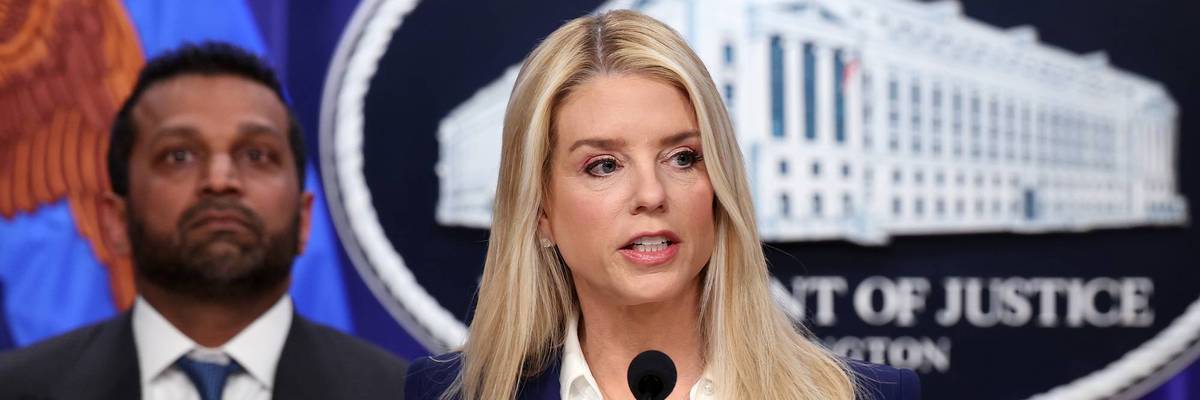
US Attorney General Pam Bondi and FBI Director Kash Patel speak during a press conference at the Department of Justice on February 6, 2026 in Washington, DC.
'Huge Win': Judge Bars Trump DOJ From Searching Devices of Washington Post Journalist
One press freedom group called the raid on Hannah Natanson's home last month a "warning shot to journalists and whistleblowers nationwide."
A federal judge ruled Tuesday that the US Justice Department cannot search the devices it seized from Hannah Natanson, a Washington Post journalist whose home was raided by the FBI earlier this year as part of an investigation into a government contractor.
William Porter, magistrate judge of the US District Court for the Eastern District of Virginia's Arlington Division, wrote in his 22-page decision that the Trump administration's "failure to identify and analyze" the Privacy Protection Act (PPA) in its application for a search warrant in the case "has seriously undermined the court’s confidence in the government’s disclosures in this proceeding."
The PPA shields journalists from being forced to turn over work materials to law enforcement. During the raid on Natanson's home, FBI agents reportedly seized a phone, two laptops, a recorder, and other devices.
"Many government lawyers had multiple opportunities to identify the PPA as controlling authority and to include an analysis of it in the warrant application," Porter wrote. "None of them did."
Porter added that he hopes "this search was conducted—as the government contends—to gather evidence of a crime in a single case, not to collect information about confidential sources from a reporter who has published articles critical of the administration."
Runa Sandvik, founder of a startup that works to protect journalists' digital security, called the ruling a "huge win for Hannah Natanson and the Washington Post."
The Post noted in its reporting on the decision that federal prosecutors "acknowledged that only a small portion of the information on the devices seized from Natanson would be relevant to the case against" Aurelio Perez-Lugones, a government contractor who was indicted last month on charges of illegally obtaining and sharing classified materials.
Federal prosecutors "asked Porter to allow a government filter team to search through the devices for relevant information," and the team "would then hand over the responsive information to prosecutors," the Post reported.
Porter rejected that proposal in his ruling, citing "documented reporting on government leak investigations and the government’s well-chronicled efforts to stop them."
"Allowing the government’s filter team to search a reporter’s work product—most of which consists of unrelated information from confidential sources—is the equivalent of leaving the government’s fox in charge of the Washington Post’s henhouse,” Porter wrote. “The concern that a filter team may err by neglect, by malice, or by honest difference of opinion is heightened where its institutional interests are so directly at odds with the press freedom values at stake.”
Press freedom organizations have condemned the Trump administration's raid on Natanson's home and seizure of her work devices as an alarming escalation in a broader assault on journalism.
Earlier this month, the Freedom of the Press Foundation filed a complaint against Gordon Kromberg, the federal prosecutor who signed the search warrant application targeting Natanson.
“Kromberg and the government omitted a federal law that should have prohibited the raid of Hannah Natanson’s home when applying for a search warrant," Seth Stern, chief of advocacy for FPF, said in a statement, referring to the Privacy Protection Act. "That choice now threatens to expose Natanson’s sources and cripple her ability to report, while also sending a warning shot to journalists and whistleblowers nationwide."
“Disciplinary bodies cannot look the other way and ignore misconduct that threatens the First Amendment, particularly from an administration with a long history of misleading judges and everyone else," Stern added. "When prosecutors abuse their power to facilitate efforts to silence reporting and intimidate news sources, disciplinary authorities must hold them accountable and impose real consequences.”
We are at a crossroads
This country and this world are at a monumental crossroads. In a few short weeks, US voters will have an opportunity to beat back the forces of fascism and confront the billionaires who are rigging the economy, our media system, and our democracy, making it increasingly impossible for ordinary people to get by. We’re not just talking about the election. We’re talking about what must be done once these fascist elements are vanquished from power. We need a bolder set of solutions than what either major party has so far been willing to offer and a working-class movement ready to fight like hell for it. Trump didn't emerge from nowhere. The conditions that fueled MAGA authoritarianism were created by decades of radical neoliberal economic policies and a corrupt political system dominated by corporate interests. They slashed taxes on the super-rich, promising that the benefits would trickle down. They said giveaways to the corporate titans would make life more affordable for the rest of us. It was all bullshit. And when a bitter, betrayed populace searches for someone to blame, right-wing demagogues have little trouble finding scapegoats. People know when they're being lied to, but you won't hear any of this from the corporate media. Only independent journalism—powered and funded by people who believe in building a better world—can deliver truly trustworthy daily news. Our Fall Campaign is underway, and we need your help. To power our newsroom through the rest of the year, we need to raise $125,000 by midnight on October 31. So if you share our vision, please contribute whatever you can to sustain our work. |
A federal judge ruled Tuesday that the US Justice Department cannot search the devices it seized from Hannah Natanson, a Washington Post journalist whose home was raided by the FBI earlier this year as part of an investigation into a government contractor.
William Porter, magistrate judge of the US District Court for the Eastern District of Virginia's Arlington Division, wrote in his 22-page decision that the Trump administration's "failure to identify and analyze" the Privacy Protection Act (PPA) in its application for a search warrant in the case "has seriously undermined the court’s confidence in the government’s disclosures in this proceeding."
The PPA shields journalists from being forced to turn over work materials to law enforcement. During the raid on Natanson's home, FBI agents reportedly seized a phone, two laptops, a recorder, and other devices.
"Many government lawyers had multiple opportunities to identify the PPA as controlling authority and to include an analysis of it in the warrant application," Porter wrote. "None of them did."
Porter added that he hopes "this search was conducted—as the government contends—to gather evidence of a crime in a single case, not to collect information about confidential sources from a reporter who has published articles critical of the administration."
Runa Sandvik, founder of a startup that works to protect journalists' digital security, called the ruling a "huge win for Hannah Natanson and the Washington Post."
The Post noted in its reporting on the decision that federal prosecutors "acknowledged that only a small portion of the information on the devices seized from Natanson would be relevant to the case against" Aurelio Perez-Lugones, a government contractor who was indicted last month on charges of illegally obtaining and sharing classified materials.
Federal prosecutors "asked Porter to allow a government filter team to search through the devices for relevant information," and the team "would then hand over the responsive information to prosecutors," the Post reported.
Porter rejected that proposal in his ruling, citing "documented reporting on government leak investigations and the government’s well-chronicled efforts to stop them."
"Allowing the government’s filter team to search a reporter’s work product—most of which consists of unrelated information from confidential sources—is the equivalent of leaving the government’s fox in charge of the Washington Post’s henhouse,” Porter wrote. “The concern that a filter team may err by neglect, by malice, or by honest difference of opinion is heightened where its institutional interests are so directly at odds with the press freedom values at stake.”
Press freedom organizations have condemned the Trump administration's raid on Natanson's home and seizure of her work devices as an alarming escalation in a broader assault on journalism.
Earlier this month, the Freedom of the Press Foundation filed a complaint against Gordon Kromberg, the federal prosecutor who signed the search warrant application targeting Natanson.
“Kromberg and the government omitted a federal law that should have prohibited the raid of Hannah Natanson’s home when applying for a search warrant," Seth Stern, chief of advocacy for FPF, said in a statement, referring to the Privacy Protection Act. "That choice now threatens to expose Natanson’s sources and cripple her ability to report, while also sending a warning shot to journalists and whistleblowers nationwide."
“Disciplinary bodies cannot look the other way and ignore misconduct that threatens the First Amendment, particularly from an administration with a long history of misleading judges and everyone else," Stern added. "When prosecutors abuse their power to facilitate efforts to silence reporting and intimidate news sources, disciplinary authorities must hold them accountable and impose real consequences.”
A federal judge ruled Tuesday that the US Justice Department cannot search the devices it seized from Hannah Natanson, a Washington Post journalist whose home was raided by the FBI earlier this year as part of an investigation into a government contractor.
William Porter, magistrate judge of the US District Court for the Eastern District of Virginia's Arlington Division, wrote in his 22-page decision that the Trump administration's "failure to identify and analyze" the Privacy Protection Act (PPA) in its application for a search warrant in the case "has seriously undermined the court’s confidence in the government’s disclosures in this proceeding."
The PPA shields journalists from being forced to turn over work materials to law enforcement. During the raid on Natanson's home, FBI agents reportedly seized a phone, two laptops, a recorder, and other devices.
"Many government lawyers had multiple opportunities to identify the PPA as controlling authority and to include an analysis of it in the warrant application," Porter wrote. "None of them did."
Porter added that he hopes "this search was conducted—as the government contends—to gather evidence of a crime in a single case, not to collect information about confidential sources from a reporter who has published articles critical of the administration."
Runa Sandvik, founder of a startup that works to protect journalists' digital security, called the ruling a "huge win for Hannah Natanson and the Washington Post."
The Post noted in its reporting on the decision that federal prosecutors "acknowledged that only a small portion of the information on the devices seized from Natanson would be relevant to the case against" Aurelio Perez-Lugones, a government contractor who was indicted last month on charges of illegally obtaining and sharing classified materials.
Federal prosecutors "asked Porter to allow a government filter team to search through the devices for relevant information," and the team "would then hand over the responsive information to prosecutors," the Post reported.
Porter rejected that proposal in his ruling, citing "documented reporting on government leak investigations and the government’s well-chronicled efforts to stop them."
"Allowing the government’s filter team to search a reporter’s work product—most of which consists of unrelated information from confidential sources—is the equivalent of leaving the government’s fox in charge of the Washington Post’s henhouse,” Porter wrote. “The concern that a filter team may err by neglect, by malice, or by honest difference of opinion is heightened where its institutional interests are so directly at odds with the press freedom values at stake.”
Press freedom organizations have condemned the Trump administration's raid on Natanson's home and seizure of her work devices as an alarming escalation in a broader assault on journalism.
Earlier this month, the Freedom of the Press Foundation filed a complaint against Gordon Kromberg, the federal prosecutor who signed the search warrant application targeting Natanson.
“Kromberg and the government omitted a federal law that should have prohibited the raid of Hannah Natanson’s home when applying for a search warrant," Seth Stern, chief of advocacy for FPF, said in a statement, referring to the Privacy Protection Act. "That choice now threatens to expose Natanson’s sources and cripple her ability to report, while also sending a warning shot to journalists and whistleblowers nationwide."
“Disciplinary bodies cannot look the other way and ignore misconduct that threatens the First Amendment, particularly from an administration with a long history of misleading judges and everyone else," Stern added. "When prosecutors abuse their power to facilitate efforts to silence reporting and intimidate news sources, disciplinary authorities must hold them accountable and impose real consequences.”