
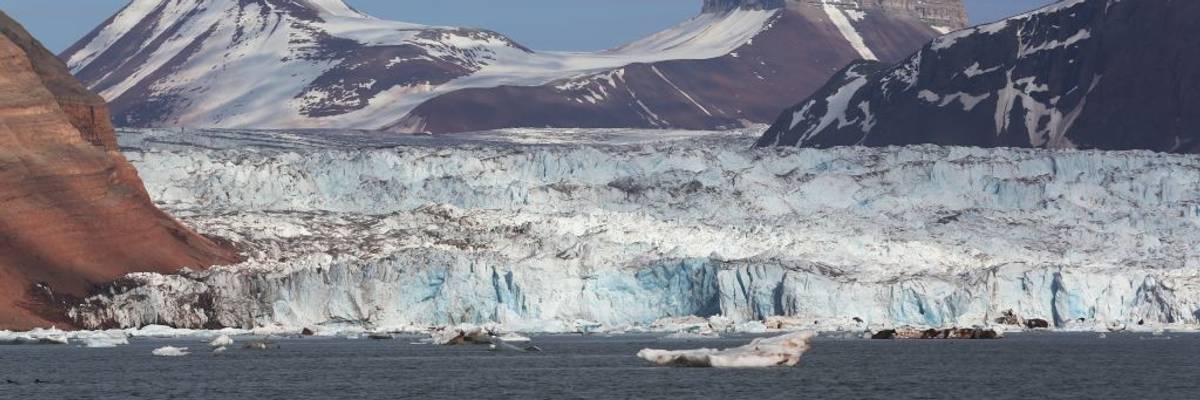
This photo, taken on June 22, 2024, shows a melting glacier in Svalbard, Norway.
Study Shows Glaciers Have Lost '3 Olympic Swimming Pools Per Second' Since 2000
One researcher said the findings support calls "for urgent and concrete actions to reduce greenhouse gas emissions and associated warming."
An international science project on Wednesday published a study in the journal Nature showing that glaciers have lost an average of 273 billion metric tons of ice annually since 2000—depleting freshwater resources, driving sea-level rise, and underscoring the need for sweeping global action to significantly reduce planet-heating pollution.
The Glacier Mass Balance Intercomparison Exercise (GlaMBIE) team compiled major studies to estimate global mass change from 2000, when glaciers—excluding Antarctica and Greenland's ice sheets—held about 121,728 billion metric tons of ice, to 2023.
The researchers found that during that period, the world lost 5% of all glacier ice, with regional losses for the full two decades ranging from 2% on the Antarctic and Subantarctic islands, to 39% in Central Europe.
That's a loss of 6,542 billion metric tons total or 273 billion metric tons per year, "the equivalent of three Olympic swimming pools per second," noted France's National Center for Scientific Research (CNRS).
Glaciologist Michael Zemp, who co-led the study, said in a statement that the annual figure "amounts to what the entire global population consumes in 30 years, assuming three liters per person and day."
"Every tenth of a degree warming that we avoid saves us money, saves us lives, saves us problems."
Although the researchers highlighted the annual average, they also emphasized that the rate of glacier ice loss "increased significantly" from 231 billion metric tons annually during the first half of the study period to 314 billion metric tons per year in the second half. In other words, the amount of ice being lost surged by 36% between the two ranges.
Zemp, a professor at Switzerland's University of Zurich and director of the World Glacier Monitoring Service, told Agence France-Presse that the findings are "shocking" and warned that many smaller glaciers "will not survive the present century."
Stephen Plummer, an Earth observation applications scientist at the European Space Agency, said that "these findings are not only crucial for advancing our scientific understanding of global glacier changes, but also provide a valuable baseline to help regions address the challenges of managing scarce freshwater resources and contribute to developing effective mitigation strategies to combat rising sea level."
The ice loss over the GlaMBIE study's full timeline led to about 18 mm or 0.7 inches of sea-level rise. The researchers projected future losses that lead to 32-67 mm, or 1.26-2.6 inches, of sea-level rise by 2040.
"We are facing higher sea-level rise until the end of this century than expected before," Zemp told AFP, referring to the latest projection from the United Nations Intergovernmental Panel on Climate Change (IPCC).
"You have to reduce the greenhouse gas emissions, it is as simple and as complicated as that," Zemp said. "Every tenth of a degree warming that we avoid saves us money, saves us lives, saves us problems."
The GlaMBIE project manager, Samuel Nussbaumer, similarly told Oceanographic that "our observations and recent modeling studies indicate that glacier mass loss will continue and possibly accelerate until the end of this century," which underpins the IPCC's "call for urgent and concrete actions to reduce greenhouse gas emissions and associated warming to limit the impact of glacier wastage on local geohazards, regional freshwater availability, and global sea-level rise."
The team's findings were released during the U.N.'s International Year of Glaciers' Preservation and the Decade of Action for Cryospheric Sciences—and they "will feed into the next IPCC report, due in 2029," according to CNRS.
Scientists from around the world who were not involved with the study were alarmed by its revelations—which come after the hottest year in human history and amid humanity's failure to curb planet-heating emissions, largely from fossil fuels.
Martin Siegert, a professor at the United Kingdom's University of Exeter, said in a statement that "this research is concerning to us, because it predicts further glacier loss, which can be considered like a 'canary in the coal mine' for ice sheet reaction to global warming and far more sea-level rise this century and beyond. The IPCC indicates 0.5-1 meters this century—but that is with a 66% certainty—hence 1/3 chance it could be higher under 'strong' warming, which unfortunately is the pathway we are on presently."
Andrew Shepherd, a professor at Northumbria University, another U.K. institution, explained that "glacier melting has two main impacts; it causes sea-level rise and it disrupts the water supply in rivers that are fed by meltwater."
"Around 2 billion people depend on meltwater from glaciers and so their retreat is a big problem for society—it's not just that we are losing them from our landscape, they are an important part of our daily lives," he said. "Even small amounts of sea-level rise matter because it leads to more frequent coastal flooding. Every centimeter of sea-level rise exposes another 2 million people to annual flooding somewhere on our planet."
We are at a crossroads
This country and this world are at a monumental crossroads. US voters have an opportunity to beat back the forces of fascism and confront the billionaires who are rigging the economy, our media system, and our democracy, making it increasingly impossible for ordinary people to get by. We’re not just talking about the election. We’re talking about what must be done once these fascist elements are vanquished from power. We need a bolder set of solutions than what either major party has so far been willing to offer and a working-class movement ready to fight like hell for it. Trump didn't emerge from nowhere. The conditions that fueled MAGA authoritarianism were created by decades of radical neoliberal economic policies and a corrupt political system dominated by corporate interests. They slashed taxes on the super-rich, promising that the benefits would trickle down. They said giveaways to the corporate titans would make life more affordable for the rest of us. It was all bullshit. And when a bitter, betrayed populace searches for someone to blame, right-wing demagogues have little trouble finding scapegoats. People know when they're being lied to, but you won't hear any of this from the corporate media. Only independent journalism—powered and funded by people who believe in building a better world—can deliver truly trustworthy daily news. Our Fall Campaign is underway, and we need your help. To power our newsroom through the rest of the year, we need to raise $125,000 by midnight on October 31. So if you share our vision, please contribute whatever you can to sustain our work. |
An international science project on Wednesday published a study in the journal Nature showing that glaciers have lost an average of 273 billion metric tons of ice annually since 2000—depleting freshwater resources, driving sea-level rise, and underscoring the need for sweeping global action to significantly reduce planet-heating pollution.
The Glacier Mass Balance Intercomparison Exercise (GlaMBIE) team compiled major studies to estimate global mass change from 2000, when glaciers—excluding Antarctica and Greenland's ice sheets—held about 121,728 billion metric tons of ice, to 2023.
The researchers found that during that period, the world lost 5% of all glacier ice, with regional losses for the full two decades ranging from 2% on the Antarctic and Subantarctic islands, to 39% in Central Europe.
That's a loss of 6,542 billion metric tons total or 273 billion metric tons per year, "the equivalent of three Olympic swimming pools per second," noted France's National Center for Scientific Research (CNRS).
Glaciologist Michael Zemp, who co-led the study, said in a statement that the annual figure "amounts to what the entire global population consumes in 30 years, assuming three liters per person and day."
"Every tenth of a degree warming that we avoid saves us money, saves us lives, saves us problems."
Although the researchers highlighted the annual average, they also emphasized that the rate of glacier ice loss "increased significantly" from 231 billion metric tons annually during the first half of the study period to 314 billion metric tons per year in the second half. In other words, the amount of ice being lost surged by 36% between the two ranges.
Zemp, a professor at Switzerland's University of Zurich and director of the World Glacier Monitoring Service, told Agence France-Presse that the findings are "shocking" and warned that many smaller glaciers "will not survive the present century."
Stephen Plummer, an Earth observation applications scientist at the European Space Agency, said that "these findings are not only crucial for advancing our scientific understanding of global glacier changes, but also provide a valuable baseline to help regions address the challenges of managing scarce freshwater resources and contribute to developing effective mitigation strategies to combat rising sea level."
The ice loss over the GlaMBIE study's full timeline led to about 18 mm or 0.7 inches of sea-level rise. The researchers projected future losses that lead to 32-67 mm, or 1.26-2.6 inches, of sea-level rise by 2040.
"We are facing higher sea-level rise until the end of this century than expected before," Zemp told AFP, referring to the latest projection from the United Nations Intergovernmental Panel on Climate Change (IPCC).
"You have to reduce the greenhouse gas emissions, it is as simple and as complicated as that," Zemp said. "Every tenth of a degree warming that we avoid saves us money, saves us lives, saves us problems."
The GlaMBIE project manager, Samuel Nussbaumer, similarly told Oceanographic that "our observations and recent modeling studies indicate that glacier mass loss will continue and possibly accelerate until the end of this century," which underpins the IPCC's "call for urgent and concrete actions to reduce greenhouse gas emissions and associated warming to limit the impact of glacier wastage on local geohazards, regional freshwater availability, and global sea-level rise."
The team's findings were released during the U.N.'s International Year of Glaciers' Preservation and the Decade of Action for Cryospheric Sciences—and they "will feed into the next IPCC report, due in 2029," according to CNRS.
Scientists from around the world who were not involved with the study were alarmed by its revelations—which come after the hottest year in human history and amid humanity's failure to curb planet-heating emissions, largely from fossil fuels.
Martin Siegert, a professor at the United Kingdom's University of Exeter, said in a statement that "this research is concerning to us, because it predicts further glacier loss, which can be considered like a 'canary in the coal mine' for ice sheet reaction to global warming and far more sea-level rise this century and beyond. The IPCC indicates 0.5-1 meters this century—but that is with a 66% certainty—hence 1/3 chance it could be higher under 'strong' warming, which unfortunately is the pathway we are on presently."
Andrew Shepherd, a professor at Northumbria University, another U.K. institution, explained that "glacier melting has two main impacts; it causes sea-level rise and it disrupts the water supply in rivers that are fed by meltwater."
"Around 2 billion people depend on meltwater from glaciers and so their retreat is a big problem for society—it's not just that we are losing them from our landscape, they are an important part of our daily lives," he said. "Even small amounts of sea-level rise matter because it leads to more frequent coastal flooding. Every centimeter of sea-level rise exposes another 2 million people to annual flooding somewhere on our planet."
- Glaciologist Says New Melting Study 'Frankly Scary. Even to Me.' ›
- Himalayan Glaciers Could Lose 80% of Their Ice by 2100, Threatening Billions of Lives ›
- Rapidly Melting Glaciers Threaten Collapse of Crucial Ocean Circulation Systems: Study ›
- Researchers Warn of Imminent 'Death Spiral' for Rapidly Melting Alaska Ice Field ›
- 'Unknown Territory': Antarctic Glaciers Melting at Rate Unprecedented in 5,500 Years: Study ›
- Scientists Warn Major Glaciers Won't 'Survive This Century,' With Grave Impacts for Billions | Common Dreams ›
- 'Little to No Measurable Progress' on Climate as World on Track for 2.6°C: Report | Common Dreams ›