SUBSCRIBE TO OUR FREE NEWSLETTER
Daily news & progressive opinion—funded by the people, not the corporations—delivered straight to your inbox.
5
#000000
#FFFFFF
To donate by check, phone, or other method, see our More Ways to Give page.
Daily news & progressive opinion—funded by the people, not the corporations—delivered straight to your inbox.
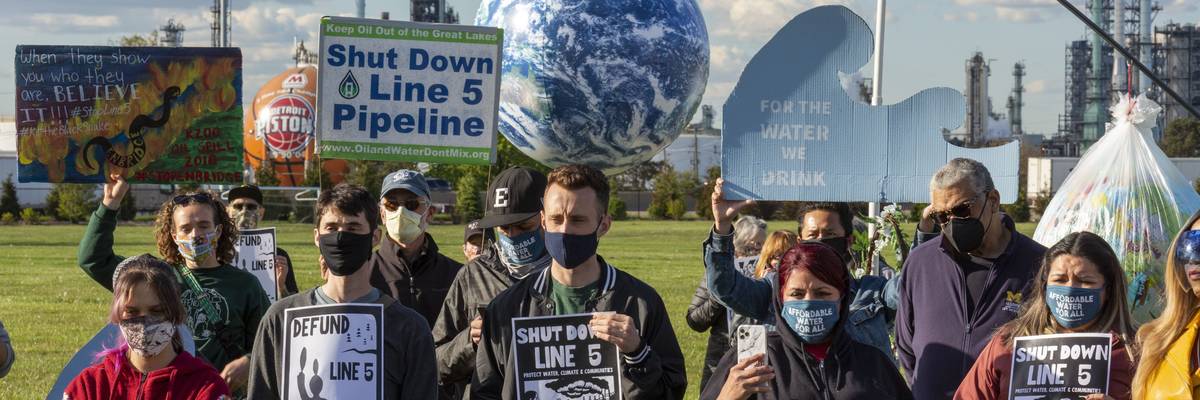
State regulators said the permits for a tunnel under the Straits of Mackinac would have "significant impacts" on wildlife and sacred Indigenous burial grounds, but issued them nonetheless.
Anti-fossil fuel campaigners on Wednesday emphasized that Michigan state regulators had issued key permits for the Enbridge Line 5 tunnel in the Straits of Mackinac on the same day that "wildfire smoke from climate change blotted out the Mackinac Bridge from view" and as the US and other countries faced extreme heatwaves.
Despite the mounting evidence that—as energy and climate experts have long warned—continued fossil fuel extraction is heating the planet and causing dangerous extreme weather, Michigan's Department of Environment, Great Lakes, and Energy handed down a permit Wednesday to allow the Canadian company Enbridge to construct a tunnel that EGLE officials acknowledged will likely have "significant impacts" on threatened or endangered species and Indigenous burial ground in the Straits.
“The magnitude of impacts to recognized historic and cultural values of this proposed project exceeds that of any other that EGLE has reviewed,” said EGLE in its statement on the permits.
Enbridge has sought to build a tunnel around its Line 5 pipeline in the Straits for years, following a massive oil spill from its Line 6B pipeline in the Kalamazoo River. Line 5 has been struck by ships' anchors numerous times, heightening concerns.
EGLE said in its explanation that the oil spill risk was found to be "unacceptable" and that the need for the tunnel outweighed its risks.
But opponents who have argued that Line 5 should be permanently shut down, including the Bay Mills Indian Community, condemned the agency for "rewarding" Enbridge with new permits even after its fossil fuel infrastructure has caused hazardous oil spills.
“Enbridge has spilled oil, committed safety violations, trespassed on lands, shattered ecosystems, pierced aquifers, violated our laws, and repeatedly shown contempt for tribal sovereignty," said Whitney Gravelle, president of the Bay Mills Indian Community. "They have left devastation in their wake, and now they’re being rewarded with responsibility over one of the most precious and sacred resources in our state. The Great Lakes are not safe in their hands. This decision is a deep betrayal of our Great Lake State, and we will confront it immediately, fiercely, and without hesitation.”
The state Department of Natural Resources also issued a permit following EGLE's decision, granting permission for the tunnel despite its potential impact on rare plants and animal habitats.
According to Michigan Bridge, about 1.53 acres of wetlands in Mackinac County would be impacted by the tunnel project, as well as 0.17 acres of Lake Michigan bottomlands in Emmet County, where Enbridge is expected to build a water intake structure.
The environmental legal organization Earthjustice, which has helped represent the Bay Mills Indian Community in its legal challenges against Enbridge, said that with the permits, the company will "transform the Straits of Mackinac into an industrial construction zone for at least six years, destroying views, displacing wildlife, and interrupting tourism dollars."
“Our environmental laws, the looming climate crisis, and simple common sense tells us that an oil pipeline doesn’t belong in the Great Lakes,” said Earthjustice managing attorney Debbie Chizewer. “Today’s decision is a setback, but we’re not giving up. A future without oil in the Great Lakes is still possible.”
EGLE is also expected to rule by September 30 on an Enbridge request to discharge millions of gallons of treated wastewater per day into Lake Michigan while it is constructing the tunnel, and the Michigan Supreme Court is considering a lawsuit brought by four Tribal Nations, including Bay Mills, alleging that the Michigan Public Service Commission improperly issued a key tunnel permit in 2023.
The state is also fighting Enbridge over Democratic Gov. Gretchen Whitmer's 2020 order to shut down Line 5 over oil spill concerns. She had campaigned in 2018 on a promise to shut down the pipeline. A federal judge ruled last year that the state had no authority to terminate the use of the pipeline, and the state appealed that ruling.
Advocates expressed anger on Wednesday at Whitmer as her government issued the permits.
“It’s incredibly disappointing that a governor who ran on a commitment to the climate and protecting the Great Lakes has now decided to instead endorse a Canadian industrial tunnel project that still threatens the Great Lakes and will contribute fossil fuels to the climate,” David Holtz, coalition coordinator for the anti-Line 5 group Oil & Water Don’t Mix, told Bridge Michigan.
David Gover, managing attorney for the Native American Rights Fund, said that "the Straits of Mackinac are not a piece of Enbridge oil infrastructure; they are the heart of creation for Anishinaabe people and a vital source of life for all who depend on the Great Lakes."
“We will pursue every legal avenue," Gover said, "to defend treaty rights, protect drinking water, and preserve tribal lifeways from another Enbridge disaster.”
Dear Common Dreams reader, It’s been nearly 30 years since I co-founded Common Dreams with my late wife, Lina Newhouser. We had the radical notion that journalism should serve the public good, not corporate profits. It was clear to us from the outset what it would take to build such a project. No paid advertisements. No corporate sponsors. No millionaire publisher telling us what to think or do. Many people said we wouldn't last a year, but we proved those doubters wrong. Together with a tremendous team of journalists and dedicated staff, we built an independent media outlet free from the constraints of profits and corporate control. Our mission has always been simple: To inform. To inspire. To ignite change for the common good. Building Common Dreams was not easy. Our survival was never guaranteed. When you take on the most powerful forces—Wall Street greed, fossil fuel industry destruction, Big Tech lobbyists, and uber-rich oligarchs who have spent billions upon billions rigging the economy and democracy in their favor—the only bulwark you have is supporters who believe in your work. But here’s the urgent message from me today. It's never been this bad out there. And it's never been this hard to keep us going. At the very moment Common Dreams is most needed, the threats we face are intensifying. We need your support now more than ever. We don't accept corporate advertising and never will. We don't have a paywall because we don't think people should be blocked from critical news based on their ability to pay. Everything we do is funded by the donations of readers like you. When everyone does the little they can afford, we are strong. But if that support retreats or dries up, so do we. Will you donate now to make sure Common Dreams not only survives but thrives? —Craig Brown, Co-founder |
Anti-fossil fuel campaigners on Wednesday emphasized that Michigan state regulators had issued key permits for the Enbridge Line 5 tunnel in the Straits of Mackinac on the same day that "wildfire smoke from climate change blotted out the Mackinac Bridge from view" and as the US and other countries faced extreme heatwaves.
Despite the mounting evidence that—as energy and climate experts have long warned—continued fossil fuel extraction is heating the planet and causing dangerous extreme weather, Michigan's Department of Environment, Great Lakes, and Energy handed down a permit Wednesday to allow the Canadian company Enbridge to construct a tunnel that EGLE officials acknowledged will likely have "significant impacts" on threatened or endangered species and Indigenous burial ground in the Straits.
“The magnitude of impacts to recognized historic and cultural values of this proposed project exceeds that of any other that EGLE has reviewed,” said EGLE in its statement on the permits.
Enbridge has sought to build a tunnel around its Line 5 pipeline in the Straits for years, following a massive oil spill from its Line 6B pipeline in the Kalamazoo River. Line 5 has been struck by ships' anchors numerous times, heightening concerns.
EGLE said in its explanation that the oil spill risk was found to be "unacceptable" and that the need for the tunnel outweighed its risks.
But opponents who have argued that Line 5 should be permanently shut down, including the Bay Mills Indian Community, condemned the agency for "rewarding" Enbridge with new permits even after its fossil fuel infrastructure has caused hazardous oil spills.
“Enbridge has spilled oil, committed safety violations, trespassed on lands, shattered ecosystems, pierced aquifers, violated our laws, and repeatedly shown contempt for tribal sovereignty," said Whitney Gravelle, president of the Bay Mills Indian Community. "They have left devastation in their wake, and now they’re being rewarded with responsibility over one of the most precious and sacred resources in our state. The Great Lakes are not safe in their hands. This decision is a deep betrayal of our Great Lake State, and we will confront it immediately, fiercely, and without hesitation.”
The state Department of Natural Resources also issued a permit following EGLE's decision, granting permission for the tunnel despite its potential impact on rare plants and animal habitats.
According to Michigan Bridge, about 1.53 acres of wetlands in Mackinac County would be impacted by the tunnel project, as well as 0.17 acres of Lake Michigan bottomlands in Emmet County, where Enbridge is expected to build a water intake structure.
The environmental legal organization Earthjustice, which has helped represent the Bay Mills Indian Community in its legal challenges against Enbridge, said that with the permits, the company will "transform the Straits of Mackinac into an industrial construction zone for at least six years, destroying views, displacing wildlife, and interrupting tourism dollars."
“Our environmental laws, the looming climate crisis, and simple common sense tells us that an oil pipeline doesn’t belong in the Great Lakes,” said Earthjustice managing attorney Debbie Chizewer. “Today’s decision is a setback, but we’re not giving up. A future without oil in the Great Lakes is still possible.”
EGLE is also expected to rule by September 30 on an Enbridge request to discharge millions of gallons of treated wastewater per day into Lake Michigan while it is constructing the tunnel, and the Michigan Supreme Court is considering a lawsuit brought by four Tribal Nations, including Bay Mills, alleging that the Michigan Public Service Commission improperly issued a key tunnel permit in 2023.
The state is also fighting Enbridge over Democratic Gov. Gretchen Whitmer's 2020 order to shut down Line 5 over oil spill concerns. She had campaigned in 2018 on a promise to shut down the pipeline. A federal judge ruled last year that the state had no authority to terminate the use of the pipeline, and the state appealed that ruling.
Advocates expressed anger on Wednesday at Whitmer as her government issued the permits.
“It’s incredibly disappointing that a governor who ran on a commitment to the climate and protecting the Great Lakes has now decided to instead endorse a Canadian industrial tunnel project that still threatens the Great Lakes and will contribute fossil fuels to the climate,” David Holtz, coalition coordinator for the anti-Line 5 group Oil & Water Don’t Mix, told Bridge Michigan.
David Gover, managing attorney for the Native American Rights Fund, said that "the Straits of Mackinac are not a piece of Enbridge oil infrastructure; they are the heart of creation for Anishinaabe people and a vital source of life for all who depend on the Great Lakes."
“We will pursue every legal avenue," Gover said, "to defend treaty rights, protect drinking water, and preserve tribal lifeways from another Enbridge disaster.”
Anti-fossil fuel campaigners on Wednesday emphasized that Michigan state regulators had issued key permits for the Enbridge Line 5 tunnel in the Straits of Mackinac on the same day that "wildfire smoke from climate change blotted out the Mackinac Bridge from view" and as the US and other countries faced extreme heatwaves.
Despite the mounting evidence that—as energy and climate experts have long warned—continued fossil fuel extraction is heating the planet and causing dangerous extreme weather, Michigan's Department of Environment, Great Lakes, and Energy handed down a permit Wednesday to allow the Canadian company Enbridge to construct a tunnel that EGLE officials acknowledged will likely have "significant impacts" on threatened or endangered species and Indigenous burial ground in the Straits.
“The magnitude of impacts to recognized historic and cultural values of this proposed project exceeds that of any other that EGLE has reviewed,” said EGLE in its statement on the permits.
Enbridge has sought to build a tunnel around its Line 5 pipeline in the Straits for years, following a massive oil spill from its Line 6B pipeline in the Kalamazoo River. Line 5 has been struck by ships' anchors numerous times, heightening concerns.
EGLE said in its explanation that the oil spill risk was found to be "unacceptable" and that the need for the tunnel outweighed its risks.
But opponents who have argued that Line 5 should be permanently shut down, including the Bay Mills Indian Community, condemned the agency for "rewarding" Enbridge with new permits even after its fossil fuel infrastructure has caused hazardous oil spills.
“Enbridge has spilled oil, committed safety violations, trespassed on lands, shattered ecosystems, pierced aquifers, violated our laws, and repeatedly shown contempt for tribal sovereignty," said Whitney Gravelle, president of the Bay Mills Indian Community. "They have left devastation in their wake, and now they’re being rewarded with responsibility over one of the most precious and sacred resources in our state. The Great Lakes are not safe in their hands. This decision is a deep betrayal of our Great Lake State, and we will confront it immediately, fiercely, and without hesitation.”
The state Department of Natural Resources also issued a permit following EGLE's decision, granting permission for the tunnel despite its potential impact on rare plants and animal habitats.
According to Michigan Bridge, about 1.53 acres of wetlands in Mackinac County would be impacted by the tunnel project, as well as 0.17 acres of Lake Michigan bottomlands in Emmet County, where Enbridge is expected to build a water intake structure.
The environmental legal organization Earthjustice, which has helped represent the Bay Mills Indian Community in its legal challenges against Enbridge, said that with the permits, the company will "transform the Straits of Mackinac into an industrial construction zone for at least six years, destroying views, displacing wildlife, and interrupting tourism dollars."
“Our environmental laws, the looming climate crisis, and simple common sense tells us that an oil pipeline doesn’t belong in the Great Lakes,” said Earthjustice managing attorney Debbie Chizewer. “Today’s decision is a setback, but we’re not giving up. A future without oil in the Great Lakes is still possible.”
EGLE is also expected to rule by September 30 on an Enbridge request to discharge millions of gallons of treated wastewater per day into Lake Michigan while it is constructing the tunnel, and the Michigan Supreme Court is considering a lawsuit brought by four Tribal Nations, including Bay Mills, alleging that the Michigan Public Service Commission improperly issued a key tunnel permit in 2023.
The state is also fighting Enbridge over Democratic Gov. Gretchen Whitmer's 2020 order to shut down Line 5 over oil spill concerns. She had campaigned in 2018 on a promise to shut down the pipeline. A federal judge ruled last year that the state had no authority to terminate the use of the pipeline, and the state appealed that ruling.
Advocates expressed anger on Wednesday at Whitmer as her government issued the permits.
“It’s incredibly disappointing that a governor who ran on a commitment to the climate and protecting the Great Lakes has now decided to instead endorse a Canadian industrial tunnel project that still threatens the Great Lakes and will contribute fossil fuels to the climate,” David Holtz, coalition coordinator for the anti-Line 5 group Oil & Water Don’t Mix, told Bridge Michigan.
David Gover, managing attorney for the Native American Rights Fund, said that "the Straits of Mackinac are not a piece of Enbridge oil infrastructure; they are the heart of creation for Anishinaabe people and a vital source of life for all who depend on the Great Lakes."
“We will pursue every legal avenue," Gover said, "to defend treaty rights, protect drinking water, and preserve tribal lifeways from another Enbridge disaster.”