SUBSCRIBE TO OUR FREE NEWSLETTER
Daily news & progressive opinion—funded by the people, not the corporations—delivered straight to your inbox.
5
#000000
#FFFFFF
To donate by check, phone, or other method, see our More Ways to Give page.
Daily news & progressive opinion—funded by the people, not the corporations—delivered straight to your inbox.
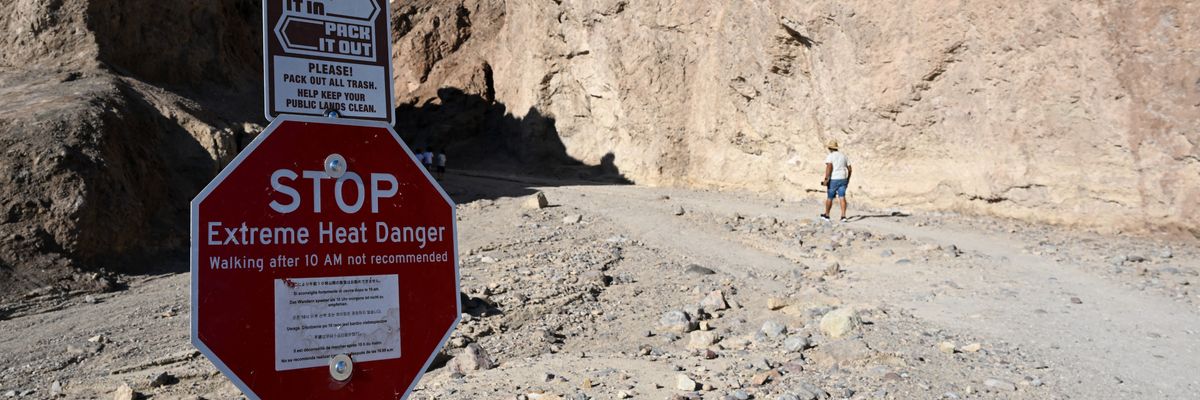
A sign says "Stop: Extreme Heat Danger" at the Golden Canyon Trailhead in Death Valley, California on July 9, 2023.
"To be extremely clear: this is not normal," said the Union of Concerned Scientists as nearly 120 million people in the U.S. faced extreme weather alerts.
The weekend heat forecast in the United States on Friday signaled that new temperature records being set in quick succession is a trend that is here to stay, as meteorologists predicted California's Death Valley could reach 131°F on Sunday.
If the National Weather Service's projection is correct, the desert region will endure the hottest temperature in the planet's recorded history.
The desert set the present global temperature record in 2020, reaching 130°F. Climatologists say an often-cited heat record of 134°F, allegedly observed in Death Valley in 2013, was likely not a credible recording.
The agency warned of the potential new record one day after the National Oceanic and Atmospheric Administration (NOAA) and the National Aeronautics and Space Administration (NASA) said that last month was the hottest June since scientists began keeping heat records in the 1880s.
On Wednesday, the World Meteorological Organization announced that last week was the planet's hottest on record.
"With extreme heat on the rise because of climate change, it is critical that policymakers and regulators take steps to ensure our communities are protected."
In the United States, a heat dome—in which an area of high pressure traps heat underneath it—now stretches from the West Coast to the Southeast. The Union of Concerned Scientists (UCS) included Death Valley in its map of regions currently facing extreme heat on Friday, but people in the area are just some of the more than 118 million in the U.S. who are currently subject to "extreme weather alerts," the group said.
"To be extremely clear: this is not normal," said UCS. "Decades of dependence on fossil fuels, decades of deception and obstruction on the part of the fossil fuel industry, and decades of inaction by policymakers who have been in their thrall have landed us where we are today. This has to stop."
With nearly 120 million people at risk of wildfires, flooding, extreme heat, or tropical storms, the UCS has dubbed the time between roughly May and October as "Danger Season" and warned that "climate change impacts in the United States are at their peak and increasingly likely to collide with one another" in the next several months.
During this danger season, said the group, 43% of extreme heat alerts have been made more likely by the climate crisis and the continued extraction of fossil fuels.
"With extreme heat on the rise because of climate change, it is critical that policymakers and regulators take steps to ensure our communities are protected and our infrastructure is more resilient to extreme weather; that fossil fuels are quickly and sharply phased down while we rapidly transition to clean energy; and fossil fuel companies are held accountable for the damage their products have caused," said UCS.
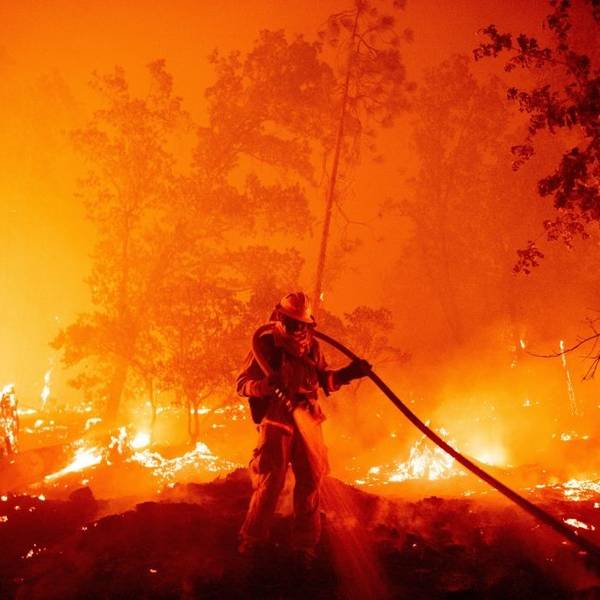
California Natural Resources Secretary Wade Crowfoot added that the climate emergency is "supercharging" heatwaves and making wildfires more frequent and extreme in the state.
"As we get deeper into the summer and vegetation that grew up during the wet spring dries out, we are seeing an uptick in wildfire activity," he said in a statement.
Dear Common Dreams reader, It’s been nearly 30 years since I co-founded Common Dreams with my late wife, Lina Newhouser. We had the radical notion that journalism should serve the public good, not corporate profits. It was clear to us from the outset what it would take to build such a project. No paid advertisements. No corporate sponsors. No millionaire publisher telling us what to think or do. Many people said we wouldn't last a year, but we proved those doubters wrong. Together with a tremendous team of journalists and dedicated staff, we built an independent media outlet free from the constraints of profits and corporate control. Our mission has always been simple: To inform. To inspire. To ignite change for the common good. Building Common Dreams was not easy. Our survival was never guaranteed. When you take on the most powerful forces—Wall Street greed, fossil fuel industry destruction, Big Tech lobbyists, and uber-rich oligarchs who have spent billions upon billions rigging the economy and democracy in their favor—the only bulwark you have is supporters who believe in your work. But here’s the urgent message from me today. It's never been this bad out there. And it's never been this hard to keep us going. At the very moment Common Dreams is most needed, the threats we face are intensifying. We need your support now more than ever. We don't accept corporate advertising and never will. We don't have a paywall because we don't think people should be blocked from critical news based on their ability to pay. Everything we do is funded by the donations of readers like you. When everyone does the little they can afford, we are strong. But if that support retreats or dries up, so do we. Will you donate now to make sure Common Dreams not only survives but thrives? —Craig Brown, Co-founder |
The weekend heat forecast in the United States on Friday signaled that new temperature records being set in quick succession is a trend that is here to stay, as meteorologists predicted California's Death Valley could reach 131°F on Sunday.
If the National Weather Service's projection is correct, the desert region will endure the hottest temperature in the planet's recorded history.
The desert set the present global temperature record in 2020, reaching 130°F. Climatologists say an often-cited heat record of 134°F, allegedly observed in Death Valley in 2013, was likely not a credible recording.
The agency warned of the potential new record one day after the National Oceanic and Atmospheric Administration (NOAA) and the National Aeronautics and Space Administration (NASA) said that last month was the hottest June since scientists began keeping heat records in the 1880s.
On Wednesday, the World Meteorological Organization announced that last week was the planet's hottest on record.
"With extreme heat on the rise because of climate change, it is critical that policymakers and regulators take steps to ensure our communities are protected."
In the United States, a heat dome—in which an area of high pressure traps heat underneath it—now stretches from the West Coast to the Southeast. The Union of Concerned Scientists (UCS) included Death Valley in its map of regions currently facing extreme heat on Friday, but people in the area are just some of the more than 118 million in the U.S. who are currently subject to "extreme weather alerts," the group said.
"To be extremely clear: this is not normal," said UCS. "Decades of dependence on fossil fuels, decades of deception and obstruction on the part of the fossil fuel industry, and decades of inaction by policymakers who have been in their thrall have landed us where we are today. This has to stop."
With nearly 120 million people at risk of wildfires, flooding, extreme heat, or tropical storms, the UCS has dubbed the time between roughly May and October as "Danger Season" and warned that "climate change impacts in the United States are at their peak and increasingly likely to collide with one another" in the next several months.
During this danger season, said the group, 43% of extreme heat alerts have been made more likely by the climate crisis and the continued extraction of fossil fuels.
"With extreme heat on the rise because of climate change, it is critical that policymakers and regulators take steps to ensure our communities are protected and our infrastructure is more resilient to extreme weather; that fossil fuels are quickly and sharply phased down while we rapidly transition to clean energy; and fossil fuel companies are held accountable for the damage their products have caused," said UCS.
California Natural Resources Secretary Wade Crowfoot added that the climate emergency is "supercharging" heatwaves and making wildfires more frequent and extreme in the state.
"As we get deeper into the summer and vegetation that grew up during the wet spring dries out, we are seeing an uptick in wildfire activity," he said in a statement.
The weekend heat forecast in the United States on Friday signaled that new temperature records being set in quick succession is a trend that is here to stay, as meteorologists predicted California's Death Valley could reach 131°F on Sunday.
If the National Weather Service's projection is correct, the desert region will endure the hottest temperature in the planet's recorded history.
The desert set the present global temperature record in 2020, reaching 130°F. Climatologists say an often-cited heat record of 134°F, allegedly observed in Death Valley in 2013, was likely not a credible recording.
The agency warned of the potential new record one day after the National Oceanic and Atmospheric Administration (NOAA) and the National Aeronautics and Space Administration (NASA) said that last month was the hottest June since scientists began keeping heat records in the 1880s.
On Wednesday, the World Meteorological Organization announced that last week was the planet's hottest on record.
"With extreme heat on the rise because of climate change, it is critical that policymakers and regulators take steps to ensure our communities are protected."
In the United States, a heat dome—in which an area of high pressure traps heat underneath it—now stretches from the West Coast to the Southeast. The Union of Concerned Scientists (UCS) included Death Valley in its map of regions currently facing extreme heat on Friday, but people in the area are just some of the more than 118 million in the U.S. who are currently subject to "extreme weather alerts," the group said.
"To be extremely clear: this is not normal," said UCS. "Decades of dependence on fossil fuels, decades of deception and obstruction on the part of the fossil fuel industry, and decades of inaction by policymakers who have been in their thrall have landed us where we are today. This has to stop."
With nearly 120 million people at risk of wildfires, flooding, extreme heat, or tropical storms, the UCS has dubbed the time between roughly May and October as "Danger Season" and warned that "climate change impacts in the United States are at their peak and increasingly likely to collide with one another" in the next several months.
During this danger season, said the group, 43% of extreme heat alerts have been made more likely by the climate crisis and the continued extraction of fossil fuels.
"With extreme heat on the rise because of climate change, it is critical that policymakers and regulators take steps to ensure our communities are protected and our infrastructure is more resilient to extreme weather; that fossil fuels are quickly and sharply phased down while we rapidly transition to clean energy; and fossil fuel companies are held accountable for the damage their products have caused," said UCS.
California Natural Resources Secretary Wade Crowfoot added that the climate emergency is "supercharging" heatwaves and making wildfires more frequent and extreme in the state.
"As we get deeper into the summer and vegetation that grew up during the wet spring dries out, we are seeing an uptick in wildfire activity," he said in a statement.