SUBSCRIBE TO OUR FREE NEWSLETTER
Daily news & progressive opinion—funded by the people, not the corporations—delivered straight to your inbox.
5
#000000
#FFFFFF
To donate by check, phone, or other method, see our More Ways to Give page.
Daily news & progressive opinion—funded by the people, not the corporations—delivered straight to your inbox.
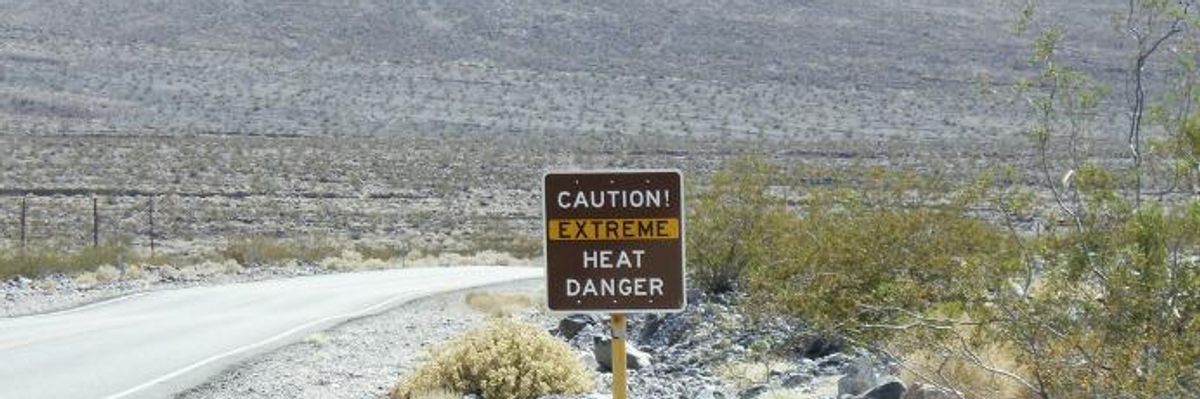
"The heatwaves and extreme heat we are experiencing are consistent with what we expect as a result of climate change caused by greenhouse gas emissions," said WMO deputy secretary-general Elena Manaenkova. (Photo: fosco lucarelli/flickr/cc)
Amid predictions that the year could go down as one of the warmest on the books, Death Valley, California just beat its own record for the hottest month ever measured in the United States.
"The heatwaves and extreme heat we are experiencing are consistent with what we expect as a result of climate change caused by greenhouse gas emissions. This is not a future scenario. It is happening now." --WMO deputy secretary-general Elena Manaenkova
According to data compiled by the Washington Post, the average July temperature there averaged 108.1degF (42.3degC), topping the record the same location "set a year ago by about a half-degree."
The new record temperature, according to weather records expert Maximiliano Herrera, comes in just below the world record for hottest monthly temperature anywhere--108.5degF (42.5degC)--which was recorded in July 2000 at Dehloran, Iran.
"Searing heat in Death Valley in July, is of course, the norm," the Post reports. "So it might be hard to contemplate it being unusually hot in such a place. But this July's temperature has averaged nearly six degrees above the average of 102.2."
The new record comes as the state faces catastrophic and deadly wildfires, with firefighters continuing to battle them on Wednesday. Experts say their link to the climate crisis is clear:
ABC News Senior Meteorologist Rob Marciano said it was an exceedingly long heatwave and that the high temperatures could create more wind in the afternoon and evening that's partly why the Carr fire spread so rapidly.
"Even by July standards, this is an unusually long July heat wave with triple-digit heat in areas for three weeks straight. And the night that the fire went off, temperatures were well above 110 degrees. In cases like this, there's an undeniable link to climate change," Marciano said.
In a statement on Wednesday, the World Meteorological Organization (WMO) noted extreme weather experienced across the globe during the month of July, including heatwaves in the Arctic, deadly fires in Greece, and historic rainfall in Japan.
"2018 is shaping up to be one of the hottest years on record, with new temperature records in many countries. This is no surprise," said WMO deputy secretary-general Elena Manaenkova.
"The heatwaves and extreme heat we are experiencing are consistent with what we expect as a result of climate change caused by greenhouse gas emissions," she added. "This is not a future scenario. It is happening now."
Dear Common Dreams reader, It’s been nearly 30 years since I co-founded Common Dreams with my late wife, Lina Newhouser. We had the radical notion that journalism should serve the public good, not corporate profits. It was clear to us from the outset what it would take to build such a project. No paid advertisements. No corporate sponsors. No millionaire publisher telling us what to think or do. Many people said we wouldn't last a year, but we proved those doubters wrong. Together with a tremendous team of journalists and dedicated staff, we built an independent media outlet free from the constraints of profits and corporate control. Our mission has always been simple: To inform. To inspire. To ignite change for the common good. Building Common Dreams was not easy. Our survival was never guaranteed. When you take on the most powerful forces—Wall Street greed, fossil fuel industry destruction, Big Tech lobbyists, and uber-rich oligarchs who have spent billions upon billions rigging the economy and democracy in their favor—the only bulwark you have is supporters who believe in your work. But here’s the urgent message from me today. It's never been this bad out there. And it's never been this hard to keep us going. At the very moment Common Dreams is most needed, the threats we face are intensifying. We need your support now more than ever. We don't accept corporate advertising and never will. We don't have a paywall because we don't think people should be blocked from critical news based on their ability to pay. Everything we do is funded by the donations of readers like you. When everyone does the little they can afford, we are strong. But if that support retreats or dries up, so do we. Will you donate now to make sure Common Dreams not only survives but thrives? —Craig Brown, Co-founder |
Amid predictions that the year could go down as one of the warmest on the books, Death Valley, California just beat its own record for the hottest month ever measured in the United States.
"The heatwaves and extreme heat we are experiencing are consistent with what we expect as a result of climate change caused by greenhouse gas emissions. This is not a future scenario. It is happening now." --WMO deputy secretary-general Elena Manaenkova
According to data compiled by the Washington Post, the average July temperature there averaged 108.1degF (42.3degC), topping the record the same location "set a year ago by about a half-degree."
The new record temperature, according to weather records expert Maximiliano Herrera, comes in just below the world record for hottest monthly temperature anywhere--108.5degF (42.5degC)--which was recorded in July 2000 at Dehloran, Iran.
"Searing heat in Death Valley in July, is of course, the norm," the Post reports. "So it might be hard to contemplate it being unusually hot in such a place. But this July's temperature has averaged nearly six degrees above the average of 102.2."
The new record comes as the state faces catastrophic and deadly wildfires, with firefighters continuing to battle them on Wednesday. Experts say their link to the climate crisis is clear:
ABC News Senior Meteorologist Rob Marciano said it was an exceedingly long heatwave and that the high temperatures could create more wind in the afternoon and evening that's partly why the Carr fire spread so rapidly.
"Even by July standards, this is an unusually long July heat wave with triple-digit heat in areas for three weeks straight. And the night that the fire went off, temperatures were well above 110 degrees. In cases like this, there's an undeniable link to climate change," Marciano said.
In a statement on Wednesday, the World Meteorological Organization (WMO) noted extreme weather experienced across the globe during the month of July, including heatwaves in the Arctic, deadly fires in Greece, and historic rainfall in Japan.
"2018 is shaping up to be one of the hottest years on record, with new temperature records in many countries. This is no surprise," said WMO deputy secretary-general Elena Manaenkova.
"The heatwaves and extreme heat we are experiencing are consistent with what we expect as a result of climate change caused by greenhouse gas emissions," she added. "This is not a future scenario. It is happening now."
Amid predictions that the year could go down as one of the warmest on the books, Death Valley, California just beat its own record for the hottest month ever measured in the United States.
"The heatwaves and extreme heat we are experiencing are consistent with what we expect as a result of climate change caused by greenhouse gas emissions. This is not a future scenario. It is happening now." --WMO deputy secretary-general Elena Manaenkova
According to data compiled by the Washington Post, the average July temperature there averaged 108.1degF (42.3degC), topping the record the same location "set a year ago by about a half-degree."
The new record temperature, according to weather records expert Maximiliano Herrera, comes in just below the world record for hottest monthly temperature anywhere--108.5degF (42.5degC)--which was recorded in July 2000 at Dehloran, Iran.
"Searing heat in Death Valley in July, is of course, the norm," the Post reports. "So it might be hard to contemplate it being unusually hot in such a place. But this July's temperature has averaged nearly six degrees above the average of 102.2."
The new record comes as the state faces catastrophic and deadly wildfires, with firefighters continuing to battle them on Wednesday. Experts say their link to the climate crisis is clear:
ABC News Senior Meteorologist Rob Marciano said it was an exceedingly long heatwave and that the high temperatures could create more wind in the afternoon and evening that's partly why the Carr fire spread so rapidly.
"Even by July standards, this is an unusually long July heat wave with triple-digit heat in areas for three weeks straight. And the night that the fire went off, temperatures were well above 110 degrees. In cases like this, there's an undeniable link to climate change," Marciano said.
In a statement on Wednesday, the World Meteorological Organization (WMO) noted extreme weather experienced across the globe during the month of July, including heatwaves in the Arctic, deadly fires in Greece, and historic rainfall in Japan.
"2018 is shaping up to be one of the hottest years on record, with new temperature records in many countries. This is no surprise," said WMO deputy secretary-general Elena Manaenkova.
"The heatwaves and extreme heat we are experiencing are consistent with what we expect as a result of climate change caused by greenhouse gas emissions," she added. "This is not a future scenario. It is happening now."