SUBSCRIBE TO OUR FREE NEWSLETTER
Daily news & progressive opinion—funded by the people, not the corporations—delivered straight to your inbox.
5
#000000
#FFFFFF
To donate by check, phone, or other method, see our More Ways to Give page.
Daily news & progressive opinion—funded by the people, not the corporations—delivered straight to your inbox.
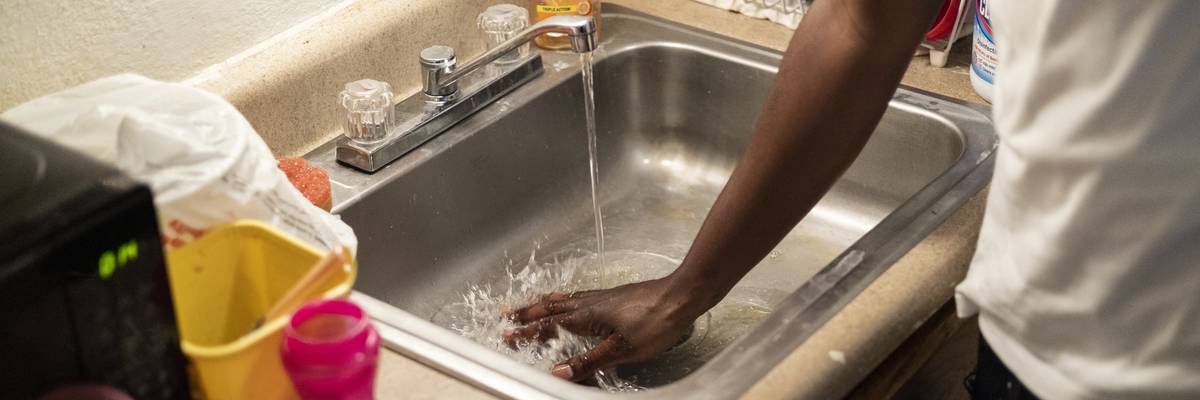
Terrence Carter mixes bleach and soap into the water before washing dishes in response to the water crisis on September 1, 2022 in Jackson, Mississippi, after river flooding caused the main water treatment facility to fail.
The White House has proposed slashing funds for the nation's water systems by 90%.
As the Trump administration and Republicans in Congress push to eliminate hundreds of millions of dollars in federal funding for water infrastructure, they are increasing the flood risk community waters system face across the United States—making it more likely that close to 60 million people could lose access to safe water during or after such emergencies.
The environmental justice group Food and Water Watch (FWW) on Tuesday released a report on a sometimes overlooked impact of flooding: In addition to the devastating damage that floods can do to homes, roads, and community buildings, flooding can contaminate water supplies while overwhelming water utility systems and putting treatment plants out of commission even after the water has receded.
In Washed Out, FWW warns that the flood risk to the 448 largest community water systems in the country is growing as extreme weather events become increasingly common and more severe, with more than one-third of those systems facing "significant" flood risks.
At least 10% of the land served by the systems with the highest risks lie in areas prone to flooding, according to FWW, and 59.4 million people rely on those systems for safe drinking water.
About 15% of water systems evaluated by FWW have "elevated" flood risks, with at least 20% of land in high flood risk areas, where nearly 22 million people live.
Florida, which had at least four billion-dollar flood disasters between 1980-2024 and experienced several "100-year" rainstorms last year, was identified as having the highest flooding risk for large community water systems. The state is home to 10 of the country's 15 large systems that serve areas where at least half the land is in high flood risk zones.
New Jersey and Louisiana each have two large systems at high risk, while at least half the the area served by Boston's water system is also in a flood zone, putting more than 2.5 million people at serious risk of losing water access in the event of a flood.
Other high risk areas identified by FWW include New York City, where the municipal water system serves 8.2 million people and which has more than 12% of its land in high risk flood zones; Corpus Christi, Texas, where 23% of land is at high risk of flooding; and Alameda County, California, where 42% of land is in a flood zone.
"Now more than ever, it is imperative that all members of Congress stand firmly united against any shortsighted attempt to strip support for our critical water and sewer infrastructure."
"As our analysis illuminates, scores of water systems serving highly-populated communities are at significant threat of flooding that could suddenly break safe water delivery and sanitary sewer operation—for days, weeks or even months. Meanwhile, Trump and Republicans in Congress are seeking to decimate the key federal funding that keeps these systems operating safely," said Mary Grant, water program director at FWW.
Republicans in the US House are currently seeking a 25% cut to the Drinking Water and Clean Water State Revolving Funds (SRF)—the primary source of federal funding for the nation's water and wastewater systems.
An appropriations bill released last month by the House Interior Subcommittee would slash the funds from $2.8 billion to $2.1 billion, bringing them to their lowest level since 2008.
The proposal does not go as far as President Donald Trump's push to cut the programs by nearly 90% with a plan to eventually zero them out, but FWW noted last month that the proposed cuts "come at a time when the needs of our nation's water and wastewater systems are substantial and growing."
"According to the latest needs survey of the US EPA, upgrading our water and wastewater infrastructure will cost $1.3 trillion over the next two decades just to comply with existing federal law," said the group.
Slashing funds for water infrastructure, including building more climate-resilient systems, would also put the drinking water of millions of people at risk at a time when flooding and other extreme weather disasters is becoming more common due to the continued extraction of planet-heating fossil fuels.
Scientists last year said Hurricane Helene—which along with smaller storms that happened around the same time dumped 40 trillion gallons of rain on the Southeast—was made about 10% more intense and dangerous by the human-caused climate crisis. The flooding left Asheville, North Carolina without safe drinking water for more than seven weeks.
FWW on Tuesday renewed its call for the US to shift from fossil fuels to renewable energy sources—instead of slashing regulations for oil and gas industries as Trump has—and warned that "local water providers must also improve their systems to withstand today's climate reality."
"This level of investment will require a strong federal commitment," said the group.
FWW called on Congress to pass legislation like the Water Affordability, Transparency, Equity and Reliability (WATER) Act "to guarantee federal support for safe and clean water in every community" and reject efforts to strip crucial funding from the SRF.
"Now more than ever," said Grant, "it is imperative that all members of Congress stand firmly united against any shortsighted attempt to strip support for our critical water and sewer infrastructure."
Dear Common Dreams reader, It’s been nearly 30 years since I co-founded Common Dreams with my late wife, Lina Newhouser. We had the radical notion that journalism should serve the public good, not corporate profits. It was clear to us from the outset what it would take to build such a project. No paid advertisements. No corporate sponsors. No millionaire publisher telling us what to think or do. Many people said we wouldn't last a year, but we proved those doubters wrong. Together with a tremendous team of journalists and dedicated staff, we built an independent media outlet free from the constraints of profits and corporate control. Our mission has always been simple: To inform. To inspire. To ignite change for the common good. Building Common Dreams was not easy. Our survival was never guaranteed. When you take on the most powerful forces—Wall Street greed, fossil fuel industry destruction, Big Tech lobbyists, and uber-rich oligarchs who have spent billions upon billions rigging the economy and democracy in their favor—the only bulwark you have is supporters who believe in your work. But here’s the urgent message from me today. It's never been this bad out there. And it's never been this hard to keep us going. At the very moment Common Dreams is most needed, the threats we face are intensifying. We need your support now more than ever. We don't accept corporate advertising and never will. We don't have a paywall because we don't think people should be blocked from critical news based on their ability to pay. Everything we do is funded by the donations of readers like you. When everyone does the little they can afford, we are strong. But if that support retreats or dries up, so do we. Will you donate now to make sure Common Dreams not only survives but thrives? —Craig Brown, Co-founder |
As the Trump administration and Republicans in Congress push to eliminate hundreds of millions of dollars in federal funding for water infrastructure, they are increasing the flood risk community waters system face across the United States—making it more likely that close to 60 million people could lose access to safe water during or after such emergencies.
The environmental justice group Food and Water Watch (FWW) on Tuesday released a report on a sometimes overlooked impact of flooding: In addition to the devastating damage that floods can do to homes, roads, and community buildings, flooding can contaminate water supplies while overwhelming water utility systems and putting treatment plants out of commission even after the water has receded.
In Washed Out, FWW warns that the flood risk to the 448 largest community water systems in the country is growing as extreme weather events become increasingly common and more severe, with more than one-third of those systems facing "significant" flood risks.
At least 10% of the land served by the systems with the highest risks lie in areas prone to flooding, according to FWW, and 59.4 million people rely on those systems for safe drinking water.
About 15% of water systems evaluated by FWW have "elevated" flood risks, with at least 20% of land in high flood risk areas, where nearly 22 million people live.
Florida, which had at least four billion-dollar flood disasters between 1980-2024 and experienced several "100-year" rainstorms last year, was identified as having the highest flooding risk for large community water systems. The state is home to 10 of the country's 15 large systems that serve areas where at least half the land is in high flood risk zones.
New Jersey and Louisiana each have two large systems at high risk, while at least half the the area served by Boston's water system is also in a flood zone, putting more than 2.5 million people at serious risk of losing water access in the event of a flood.
Other high risk areas identified by FWW include New York City, where the municipal water system serves 8.2 million people and which has more than 12% of its land in high risk flood zones; Corpus Christi, Texas, where 23% of land is at high risk of flooding; and Alameda County, California, where 42% of land is in a flood zone.
"Now more than ever, it is imperative that all members of Congress stand firmly united against any shortsighted attempt to strip support for our critical water and sewer infrastructure."
"As our analysis illuminates, scores of water systems serving highly-populated communities are at significant threat of flooding that could suddenly break safe water delivery and sanitary sewer operation—for days, weeks or even months. Meanwhile, Trump and Republicans in Congress are seeking to decimate the key federal funding that keeps these systems operating safely," said Mary Grant, water program director at FWW.
Republicans in the US House are currently seeking a 25% cut to the Drinking Water and Clean Water State Revolving Funds (SRF)—the primary source of federal funding for the nation's water and wastewater systems.
An appropriations bill released last month by the House Interior Subcommittee would slash the funds from $2.8 billion to $2.1 billion, bringing them to their lowest level since 2008.
The proposal does not go as far as President Donald Trump's push to cut the programs by nearly 90% with a plan to eventually zero them out, but FWW noted last month that the proposed cuts "come at a time when the needs of our nation's water and wastewater systems are substantial and growing."
"According to the latest needs survey of the US EPA, upgrading our water and wastewater infrastructure will cost $1.3 trillion over the next two decades just to comply with existing federal law," said the group.
Slashing funds for water infrastructure, including building more climate-resilient systems, would also put the drinking water of millions of people at risk at a time when flooding and other extreme weather disasters is becoming more common due to the continued extraction of planet-heating fossil fuels.
Scientists last year said Hurricane Helene—which along with smaller storms that happened around the same time dumped 40 trillion gallons of rain on the Southeast—was made about 10% more intense and dangerous by the human-caused climate crisis. The flooding left Asheville, North Carolina without safe drinking water for more than seven weeks.
FWW on Tuesday renewed its call for the US to shift from fossil fuels to renewable energy sources—instead of slashing regulations for oil and gas industries as Trump has—and warned that "local water providers must also improve their systems to withstand today's climate reality."
"This level of investment will require a strong federal commitment," said the group.
FWW called on Congress to pass legislation like the Water Affordability, Transparency, Equity and Reliability (WATER) Act "to guarantee federal support for safe and clean water in every community" and reject efforts to strip crucial funding from the SRF.
"Now more than ever," said Grant, "it is imperative that all members of Congress stand firmly united against any shortsighted attempt to strip support for our critical water and sewer infrastructure."
As the Trump administration and Republicans in Congress push to eliminate hundreds of millions of dollars in federal funding for water infrastructure, they are increasing the flood risk community waters system face across the United States—making it more likely that close to 60 million people could lose access to safe water during or after such emergencies.
The environmental justice group Food and Water Watch (FWW) on Tuesday released a report on a sometimes overlooked impact of flooding: In addition to the devastating damage that floods can do to homes, roads, and community buildings, flooding can contaminate water supplies while overwhelming water utility systems and putting treatment plants out of commission even after the water has receded.
In Washed Out, FWW warns that the flood risk to the 448 largest community water systems in the country is growing as extreme weather events become increasingly common and more severe, with more than one-third of those systems facing "significant" flood risks.
At least 10% of the land served by the systems with the highest risks lie in areas prone to flooding, according to FWW, and 59.4 million people rely on those systems for safe drinking water.
About 15% of water systems evaluated by FWW have "elevated" flood risks, with at least 20% of land in high flood risk areas, where nearly 22 million people live.
Florida, which had at least four billion-dollar flood disasters between 1980-2024 and experienced several "100-year" rainstorms last year, was identified as having the highest flooding risk for large community water systems. The state is home to 10 of the country's 15 large systems that serve areas where at least half the land is in high flood risk zones.
New Jersey and Louisiana each have two large systems at high risk, while at least half the the area served by Boston's water system is also in a flood zone, putting more than 2.5 million people at serious risk of losing water access in the event of a flood.
Other high risk areas identified by FWW include New York City, where the municipal water system serves 8.2 million people and which has more than 12% of its land in high risk flood zones; Corpus Christi, Texas, where 23% of land is at high risk of flooding; and Alameda County, California, where 42% of land is in a flood zone.
"Now more than ever, it is imperative that all members of Congress stand firmly united against any shortsighted attempt to strip support for our critical water and sewer infrastructure."
"As our analysis illuminates, scores of water systems serving highly-populated communities are at significant threat of flooding that could suddenly break safe water delivery and sanitary sewer operation—for days, weeks or even months. Meanwhile, Trump and Republicans in Congress are seeking to decimate the key federal funding that keeps these systems operating safely," said Mary Grant, water program director at FWW.
Republicans in the US House are currently seeking a 25% cut to the Drinking Water and Clean Water State Revolving Funds (SRF)—the primary source of federal funding for the nation's water and wastewater systems.
An appropriations bill released last month by the House Interior Subcommittee would slash the funds from $2.8 billion to $2.1 billion, bringing them to their lowest level since 2008.
The proposal does not go as far as President Donald Trump's push to cut the programs by nearly 90% with a plan to eventually zero them out, but FWW noted last month that the proposed cuts "come at a time when the needs of our nation's water and wastewater systems are substantial and growing."
"According to the latest needs survey of the US EPA, upgrading our water and wastewater infrastructure will cost $1.3 trillion over the next two decades just to comply with existing federal law," said the group.
Slashing funds for water infrastructure, including building more climate-resilient systems, would also put the drinking water of millions of people at risk at a time when flooding and other extreme weather disasters is becoming more common due to the continued extraction of planet-heating fossil fuels.
Scientists last year said Hurricane Helene—which along with smaller storms that happened around the same time dumped 40 trillion gallons of rain on the Southeast—was made about 10% more intense and dangerous by the human-caused climate crisis. The flooding left Asheville, North Carolina without safe drinking water for more than seven weeks.
FWW on Tuesday renewed its call for the US to shift from fossil fuels to renewable energy sources—instead of slashing regulations for oil and gas industries as Trump has—and warned that "local water providers must also improve their systems to withstand today's climate reality."
"This level of investment will require a strong federal commitment," said the group.
FWW called on Congress to pass legislation like the Water Affordability, Transparency, Equity and Reliability (WATER) Act "to guarantee federal support for safe and clean water in every community" and reject efforts to strip crucial funding from the SRF.
"Now more than ever," said Grant, "it is imperative that all members of Congress stand firmly united against any shortsighted attempt to strip support for our critical water and sewer infrastructure."