SUBSCRIBE TO OUR FREE NEWSLETTER
Daily news & progressive opinion—funded by the people, not the corporations—delivered straight to your inbox.
5
#000000
#FFFFFF
To donate by check, phone, or other method, see our More Ways to Give page.
Daily news & progressive opinion—funded by the people, not the corporations—delivered straight to your inbox.
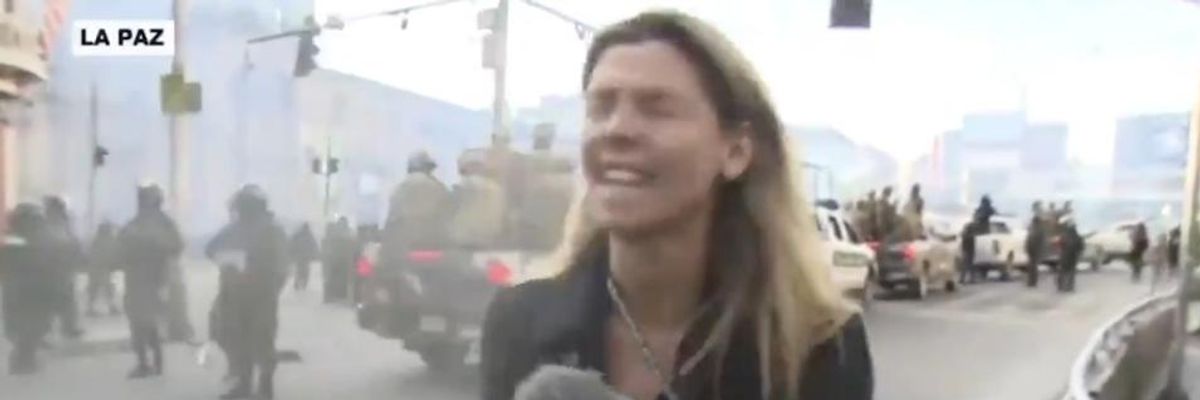
Teresa Bo, a senior correspondent for Al-Jazeera was sprayed directly in the face--clearly "on purpose," she says--while covering anti-coup demonstrators in the city of La Paz, Bolivia on Friday, November 15, 2019. (Photo: Al-Jazeera/Screenshot)
Becoming part of the story she was seeking to cover, international news correspondent Teresa Bo was assaulted by Bolivian state security forces on Friday--shot directly in the face, while on camera, with tear gas or pepper spray.
Perpetrated while she was reporting for Al-Jazeera English in the city of La Paz--where ongoing streets protests erupted this week after a coup forced the resignation of the nation's president Evo Morales--the attack on Bo, which occurred while she was giving an on-camera account of the protests, was caught on film.
"I was just thrown tear gas by the police, on purpose," Bo reports in the segment. "This is what is happening in the middle of a plaza where people have been protesting peacefully. A police officer just threw tear gas in my eyes. It is extremely difficult to speak. Very, very sorry."
Despite the pain, Bo continues to report the scene and explains that the nearby protesters were clashing with security forces--who can be seen firing tear gas canisters in the background--in an effort to reach the nearby presidential palace.
While Bo in the immediate aftermath of the attack calls the substance tear gas, many noted that the substance was more likely pepper spray.
The street protests in Bolivia have grown larger and more violent this week, with massive demonstrations in cities across the country on Friday. As Common Dreams reported, security forces opened fire on a large crowd of mostly indigenous protesters in the city of Cochabamba on Friday afternoon sending many hundreds of people fleeing for their lives. Numerous people were reported killed and scores more injured.
The assault on Bo, said U.S. journalist Ryan Grim of The Intercept, revealed the correspondent's "impressive" grit--as she continued with her reporting despite the volatile chemicals burning her face and eyes--but also helped reveal "what's going on" in Bolivia.
In response to the footage, artist and progressive activist Molly Crabapple--with a sarcastic bite at those who have argued that the overthrow of Morales was not, in fact, a coup--tweeted: "The police of the totally not a coup regime in Bolivia sprayed tear gas into a female journalist's face because she was reporting on their violent suppression of anti-coup protests."
"Thanks so much to those who understand we are only doing our job," Bo tweeted after the video of the attack spread, with many thanking her online for her brave journalism.
"I hate to be the story because we are here to report on what is happening to the people in the amazing country," Bo said. "I hope it helps denounce that such practices cannot be tolerated. Not here not anywhere."
Dear Common Dreams reader, It’s been nearly 30 years since I co-founded Common Dreams with my late wife, Lina Newhouser. We had the radical notion that journalism should serve the public good, not corporate profits. It was clear to us from the outset what it would take to build such a project. No paid advertisements. No corporate sponsors. No millionaire publisher telling us what to think or do. Many people said we wouldn't last a year, but we proved those doubters wrong. Together with a tremendous team of journalists and dedicated staff, we built an independent media outlet free from the constraints of profits and corporate control. Our mission has always been simple: To inform. To inspire. To ignite change for the common good. Building Common Dreams was not easy. Our survival was never guaranteed. When you take on the most powerful forces—Wall Street greed, fossil fuel industry destruction, Big Tech lobbyists, and uber-rich oligarchs who have spent billions upon billions rigging the economy and democracy in their favor—the only bulwark you have is supporters who believe in your work. But here’s the urgent message from me today. It's never been this bad out there. And it's never been this hard to keep us going. At the very moment Common Dreams is most needed, the threats we face are intensifying. We need your support now more than ever. We don't accept corporate advertising and never will. We don't have a paywall because we don't think people should be blocked from critical news based on their ability to pay. Everything we do is funded by the donations of readers like you. When everyone does the little they can afford, we are strong. But if that support retreats or dries up, so do we. Will you donate now to make sure Common Dreams not only survives but thrives? —Craig Brown, Co-founder |
Becoming part of the story she was seeking to cover, international news correspondent Teresa Bo was assaulted by Bolivian state security forces on Friday--shot directly in the face, while on camera, with tear gas or pepper spray.
Perpetrated while she was reporting for Al-Jazeera English in the city of La Paz--where ongoing streets protests erupted this week after a coup forced the resignation of the nation's president Evo Morales--the attack on Bo, which occurred while she was giving an on-camera account of the protests, was caught on film.
"I was just thrown tear gas by the police, on purpose," Bo reports in the segment. "This is what is happening in the middle of a plaza where people have been protesting peacefully. A police officer just threw tear gas in my eyes. It is extremely difficult to speak. Very, very sorry."
Despite the pain, Bo continues to report the scene and explains that the nearby protesters were clashing with security forces--who can be seen firing tear gas canisters in the background--in an effort to reach the nearby presidential palace.
While Bo in the immediate aftermath of the attack calls the substance tear gas, many noted that the substance was more likely pepper spray.
The street protests in Bolivia have grown larger and more violent this week, with massive demonstrations in cities across the country on Friday. As Common Dreams reported, security forces opened fire on a large crowd of mostly indigenous protesters in the city of Cochabamba on Friday afternoon sending many hundreds of people fleeing for their lives. Numerous people were reported killed and scores more injured.
The assault on Bo, said U.S. journalist Ryan Grim of The Intercept, revealed the correspondent's "impressive" grit--as she continued with her reporting despite the volatile chemicals burning her face and eyes--but also helped reveal "what's going on" in Bolivia.
In response to the footage, artist and progressive activist Molly Crabapple--with a sarcastic bite at those who have argued that the overthrow of Morales was not, in fact, a coup--tweeted: "The police of the totally not a coup regime in Bolivia sprayed tear gas into a female journalist's face because she was reporting on their violent suppression of anti-coup protests."
"Thanks so much to those who understand we are only doing our job," Bo tweeted after the video of the attack spread, with many thanking her online for her brave journalism.
"I hate to be the story because we are here to report on what is happening to the people in the amazing country," Bo said. "I hope it helps denounce that such practices cannot be tolerated. Not here not anywhere."
Becoming part of the story she was seeking to cover, international news correspondent Teresa Bo was assaulted by Bolivian state security forces on Friday--shot directly in the face, while on camera, with tear gas or pepper spray.
Perpetrated while she was reporting for Al-Jazeera English in the city of La Paz--where ongoing streets protests erupted this week after a coup forced the resignation of the nation's president Evo Morales--the attack on Bo, which occurred while she was giving an on-camera account of the protests, was caught on film.
"I was just thrown tear gas by the police, on purpose," Bo reports in the segment. "This is what is happening in the middle of a plaza where people have been protesting peacefully. A police officer just threw tear gas in my eyes. It is extremely difficult to speak. Very, very sorry."
Despite the pain, Bo continues to report the scene and explains that the nearby protesters were clashing with security forces--who can be seen firing tear gas canisters in the background--in an effort to reach the nearby presidential palace.
While Bo in the immediate aftermath of the attack calls the substance tear gas, many noted that the substance was more likely pepper spray.
The street protests in Bolivia have grown larger and more violent this week, with massive demonstrations in cities across the country on Friday. As Common Dreams reported, security forces opened fire on a large crowd of mostly indigenous protesters in the city of Cochabamba on Friday afternoon sending many hundreds of people fleeing for their lives. Numerous people were reported killed and scores more injured.
The assault on Bo, said U.S. journalist Ryan Grim of The Intercept, revealed the correspondent's "impressive" grit--as she continued with her reporting despite the volatile chemicals burning her face and eyes--but also helped reveal "what's going on" in Bolivia.
In response to the footage, artist and progressive activist Molly Crabapple--with a sarcastic bite at those who have argued that the overthrow of Morales was not, in fact, a coup--tweeted: "The police of the totally not a coup regime in Bolivia sprayed tear gas into a female journalist's face because she was reporting on their violent suppression of anti-coup protests."
"Thanks so much to those who understand we are only doing our job," Bo tweeted after the video of the attack spread, with many thanking her online for her brave journalism.
"I hate to be the story because we are here to report on what is happening to the people in the amazing country," Bo said. "I hope it helps denounce that such practices cannot be tolerated. Not here not anywhere."