SUBSCRIBE TO OUR FREE NEWSLETTER
Daily news & progressive opinion—funded by the people, not the corporations—delivered straight to your inbox.
5
#000000
#FFFFFF
To donate by check, phone, or other method, see our More Ways to Give page.
Daily news & progressive opinion—funded by the people, not the corporations—delivered straight to your inbox.
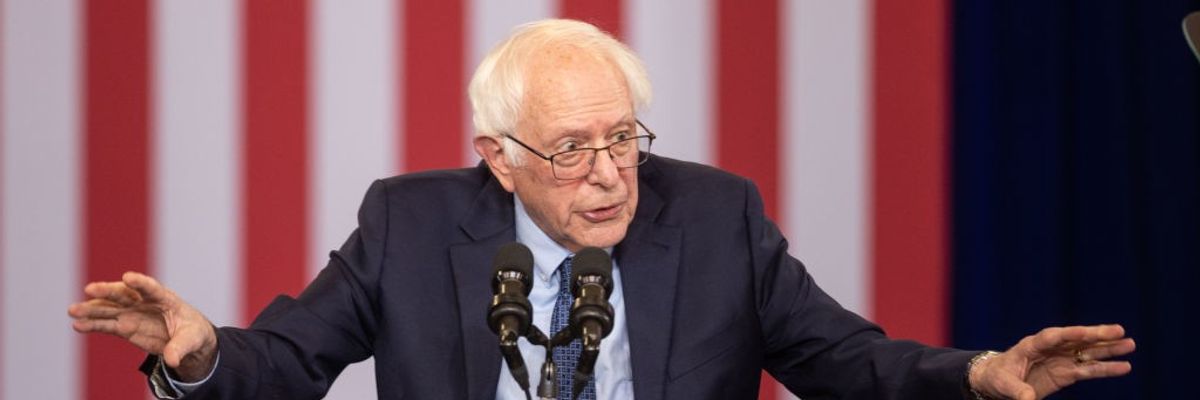
U.S. Sen. Bernie Sanders (I-Vt.) speaks at NHTI Concord's Community College on October 22, 2024 in Concord, New Hampshire.
"Killing people is not the way we're going to reform our healthcare system," he said. "The way we're going to reform our healthcare system is having people come together."
Addressing the assassination of UnitedHealthcare CEO Brian Thompson and conversations it has sparked about the country's for-profit system, longtime Medicare for All advocate Sen. Bernie Sanders on Wednesday condemned the murder and stressed that getting to universal coverage will require a movement challenging corporate money in politics.
"Look, when we talk about the healthcare crisis, in my view, and I think the view of a majority of Americans, the current system is broken, it is dysfunctional, it is cruel, and it is wildly inefficient—far too expensive," said Sanders (I-Vt.), whose position is backed up by various polls.
"The reason we have not joined virtually every other major country on Earth in guaranteeing healthcare to all people as a human right is the political power and financial power of the insurance industry and drug companies," he told Jacobin. "It will take a political revolution in this country to get Congress to say, 'You know what, we're here to represent ordinary people, to provide quality care to ordinary people as a human right,' and not to worry about the profits of insurance and drug companies."
Asked about Thompson's alleged killer—26-year-old Luigi Mangione, whose reported manifesto railed against the nation's expensive healthcare system and low life expectancy—Sanders said: "You don't kill people. It's abhorrent. I condemn it wholeheartedly. It was a terrible act. But what it did show online is that many, many people are furious at the health insurance companies who make huge profits denying them and their families the healthcare that they desperately need."
"What you're seeing, the outpouring of anger at the insurance companies, is a reflection of how people feel about the current healthcare system."
"What you're seeing, the outpouring of anger at the insurance companies, is a reflection of how people feel about the current healthcare system," he continued, noting the tens of thousands of Americans who die each year because they can't get to a doctor.
"Killing people is not the way we're going to reform our healthcare system," Sanders added. "The way we're going to reform our healthcare system is having people come together and understanding that it is the right of every American to be able to walk into a doctor's office when they need to and not have to take out their wallet."
"The way we're going to bring about the kind of fundamental changes we need in healthcare is, in fact, by a political movement which understands the government has got to represent all of us, not just the 1%," the senator told Jacobin.
The 83-year-old Vermonter, who was just reelected to what he says is likely his last six-year term, is an Independent but caucuses with Democrats and sought their presidential nomination in 2016 and 2020. He has urged the Democratic Party to recognize why some working-class voters have abandoned it since Republicans won the White House and both chambers of Congress last month. A refusal to take on insurance and drug companies and overhaul the healthcare system, he argues, is one reason.
Sanders—one of the few members of Congress who regularly talks about Medicare for All—isn't alone in suggesting that unsympathetic responses to Thompson's murder can be explained by a privatized healthcare system that fails so many people.
In addition to highlighting Sanders' interview on social media, Congressman Ro Khanna (D-Calif.) pointed out to Business Insider on Wednesday that "you've got thousands of people that are sharing their stories of frustration" in the wake of Thompson's death.
Khanna—a co-sponsor of the Medicare for All Act, led in the House of Representatives by Congressional Progressive Caucus Chair Pramila Jayapal (D-Wash.)—made the case that you can recognize those stories without accepting the assassination.
"You condemn the murder of an insurance executive who was a father of two kids," he said. "At the same time, you say there's obviously an outpouring behavior of people whose claims are being denied, and we need to reform the system."
Two other Medicare for All advocates, Reps. Maxwell Frost (D-Fla.) and Alexandria Ocasio-Cortez (D-N.Y.), also made clear to Business Insider that they oppose Thompson's murder but understand some of the responses to it.
"Of course, we don't want to see the chaos that vigilantism presents," said Ocasio-Cortez. "We also don't want to see the extreme suffering that millions of Americans confront when your life changes overnight from a horrific diagnosis, and people are led to just some of the worst, not just health events, but the worst financial events of their and their family's lives."
Sen. Elizabeth Warren (D-Mass.)—a co-sponsor of Sanders' Medicare for All Act—similarly told HuffPost in a Tuesday interview, "The visceral response from people across this country who feel cheated, ripped off, and threatened by the vile practices of their insurance companies should be a warning to everyone in the healthcare system."
"Violence is never the answer, but people can be pushed only so far," she continued. "This is a warning that if you push people hard enough, they lose faith in the ability of their government to make change, lose faith in the ability of the people who are providing the healthcare to make change, and start to take matters into their own hands in ways that will ultimately be a threat to everyone."
After facing some criticism for those comments, Warren added Wednesday: "Violence is never the answer. Period... I should have been much clearer that there is never a justification for murder."
Dear Common Dreams reader, It’s been nearly 30 years since I co-founded Common Dreams with my late wife, Lina Newhouser. We had the radical notion that journalism should serve the public good, not corporate profits. It was clear to us from the outset what it would take to build such a project. No paid advertisements. No corporate sponsors. No millionaire publisher telling us what to think or do. Many people said we wouldn't last a year, but we proved those doubters wrong. Together with a tremendous team of journalists and dedicated staff, we built an independent media outlet free from the constraints of profits and corporate control. Our mission has always been simple: To inform. To inspire. To ignite change for the common good. Building Common Dreams was not easy. Our survival was never guaranteed. When you take on the most powerful forces—Wall Street greed, fossil fuel industry destruction, Big Tech lobbyists, and uber-rich oligarchs who have spent billions upon billions rigging the economy and democracy in their favor—the only bulwark you have is supporters who believe in your work. But here’s the urgent message from me today. It's never been this bad out there. And it's never been this hard to keep us going. At the very moment Common Dreams is most needed, the threats we face are intensifying. We need your support now more than ever. We don't accept corporate advertising and never will. We don't have a paywall because we don't think people should be blocked from critical news based on their ability to pay. Everything we do is funded by the donations of readers like you. When everyone does the little they can afford, we are strong. But if that support retreats or dries up, so do we. Will you donate now to make sure Common Dreams not only survives but thrives? —Craig Brown, Co-founder |
Addressing the assassination of UnitedHealthcare CEO Brian Thompson and conversations it has sparked about the country's for-profit system, longtime Medicare for All advocate Sen. Bernie Sanders on Wednesday condemned the murder and stressed that getting to universal coverage will require a movement challenging corporate money in politics.
"Look, when we talk about the healthcare crisis, in my view, and I think the view of a majority of Americans, the current system is broken, it is dysfunctional, it is cruel, and it is wildly inefficient—far too expensive," said Sanders (I-Vt.), whose position is backed up by various polls.
"The reason we have not joined virtually every other major country on Earth in guaranteeing healthcare to all people as a human right is the political power and financial power of the insurance industry and drug companies," he told Jacobin. "It will take a political revolution in this country to get Congress to say, 'You know what, we're here to represent ordinary people, to provide quality care to ordinary people as a human right,' and not to worry about the profits of insurance and drug companies."
Asked about Thompson's alleged killer—26-year-old Luigi Mangione, whose reported manifesto railed against the nation's expensive healthcare system and low life expectancy—Sanders said: "You don't kill people. It's abhorrent. I condemn it wholeheartedly. It was a terrible act. But what it did show online is that many, many people are furious at the health insurance companies who make huge profits denying them and their families the healthcare that they desperately need."
"What you're seeing, the outpouring of anger at the insurance companies, is a reflection of how people feel about the current healthcare system."
"What you're seeing, the outpouring of anger at the insurance companies, is a reflection of how people feel about the current healthcare system," he continued, noting the tens of thousands of Americans who die each year because they can't get to a doctor.
"Killing people is not the way we're going to reform our healthcare system," Sanders added. "The way we're going to reform our healthcare system is having people come together and understanding that it is the right of every American to be able to walk into a doctor's office when they need to and not have to take out their wallet."
"The way we're going to bring about the kind of fundamental changes we need in healthcare is, in fact, by a political movement which understands the government has got to represent all of us, not just the 1%," the senator told Jacobin.
The 83-year-old Vermonter, who was just reelected to what he says is likely his last six-year term, is an Independent but caucuses with Democrats and sought their presidential nomination in 2016 and 2020. He has urged the Democratic Party to recognize why some working-class voters have abandoned it since Republicans won the White House and both chambers of Congress last month. A refusal to take on insurance and drug companies and overhaul the healthcare system, he argues, is one reason.
Sanders—one of the few members of Congress who regularly talks about Medicare for All—isn't alone in suggesting that unsympathetic responses to Thompson's murder can be explained by a privatized healthcare system that fails so many people.
In addition to highlighting Sanders' interview on social media, Congressman Ro Khanna (D-Calif.) pointed out to Business Insider on Wednesday that "you've got thousands of people that are sharing their stories of frustration" in the wake of Thompson's death.
Khanna—a co-sponsor of the Medicare for All Act, led in the House of Representatives by Congressional Progressive Caucus Chair Pramila Jayapal (D-Wash.)—made the case that you can recognize those stories without accepting the assassination.
"You condemn the murder of an insurance executive who was a father of two kids," he said. "At the same time, you say there's obviously an outpouring behavior of people whose claims are being denied, and we need to reform the system."
Two other Medicare for All advocates, Reps. Maxwell Frost (D-Fla.) and Alexandria Ocasio-Cortez (D-N.Y.), also made clear to Business Insider that they oppose Thompson's murder but understand some of the responses to it.
"Of course, we don't want to see the chaos that vigilantism presents," said Ocasio-Cortez. "We also don't want to see the extreme suffering that millions of Americans confront when your life changes overnight from a horrific diagnosis, and people are led to just some of the worst, not just health events, but the worst financial events of their and their family's lives."
Sen. Elizabeth Warren (D-Mass.)—a co-sponsor of Sanders' Medicare for All Act—similarly told HuffPost in a Tuesday interview, "The visceral response from people across this country who feel cheated, ripped off, and threatened by the vile practices of their insurance companies should be a warning to everyone in the healthcare system."
"Violence is never the answer, but people can be pushed only so far," she continued. "This is a warning that if you push people hard enough, they lose faith in the ability of their government to make change, lose faith in the ability of the people who are providing the healthcare to make change, and start to take matters into their own hands in ways that will ultimately be a threat to everyone."
After facing some criticism for those comments, Warren added Wednesday: "Violence is never the answer. Period... I should have been much clearer that there is never a justification for murder."
Addressing the assassination of UnitedHealthcare CEO Brian Thompson and conversations it has sparked about the country's for-profit system, longtime Medicare for All advocate Sen. Bernie Sanders on Wednesday condemned the murder and stressed that getting to universal coverage will require a movement challenging corporate money in politics.
"Look, when we talk about the healthcare crisis, in my view, and I think the view of a majority of Americans, the current system is broken, it is dysfunctional, it is cruel, and it is wildly inefficient—far too expensive," said Sanders (I-Vt.), whose position is backed up by various polls.
"The reason we have not joined virtually every other major country on Earth in guaranteeing healthcare to all people as a human right is the political power and financial power of the insurance industry and drug companies," he told Jacobin. "It will take a political revolution in this country to get Congress to say, 'You know what, we're here to represent ordinary people, to provide quality care to ordinary people as a human right,' and not to worry about the profits of insurance and drug companies."
Asked about Thompson's alleged killer—26-year-old Luigi Mangione, whose reported manifesto railed against the nation's expensive healthcare system and low life expectancy—Sanders said: "You don't kill people. It's abhorrent. I condemn it wholeheartedly. It was a terrible act. But what it did show online is that many, many people are furious at the health insurance companies who make huge profits denying them and their families the healthcare that they desperately need."
"What you're seeing, the outpouring of anger at the insurance companies, is a reflection of how people feel about the current healthcare system."
"What you're seeing, the outpouring of anger at the insurance companies, is a reflection of how people feel about the current healthcare system," he continued, noting the tens of thousands of Americans who die each year because they can't get to a doctor.
"Killing people is not the way we're going to reform our healthcare system," Sanders added. "The way we're going to reform our healthcare system is having people come together and understanding that it is the right of every American to be able to walk into a doctor's office when they need to and not have to take out their wallet."
"The way we're going to bring about the kind of fundamental changes we need in healthcare is, in fact, by a political movement which understands the government has got to represent all of us, not just the 1%," the senator told Jacobin.
The 83-year-old Vermonter, who was just reelected to what he says is likely his last six-year term, is an Independent but caucuses with Democrats and sought their presidential nomination in 2016 and 2020. He has urged the Democratic Party to recognize why some working-class voters have abandoned it since Republicans won the White House and both chambers of Congress last month. A refusal to take on insurance and drug companies and overhaul the healthcare system, he argues, is one reason.
Sanders—one of the few members of Congress who regularly talks about Medicare for All—isn't alone in suggesting that unsympathetic responses to Thompson's murder can be explained by a privatized healthcare system that fails so many people.
In addition to highlighting Sanders' interview on social media, Congressman Ro Khanna (D-Calif.) pointed out to Business Insider on Wednesday that "you've got thousands of people that are sharing their stories of frustration" in the wake of Thompson's death.
Khanna—a co-sponsor of the Medicare for All Act, led in the House of Representatives by Congressional Progressive Caucus Chair Pramila Jayapal (D-Wash.)—made the case that you can recognize those stories without accepting the assassination.
"You condemn the murder of an insurance executive who was a father of two kids," he said. "At the same time, you say there's obviously an outpouring behavior of people whose claims are being denied, and we need to reform the system."
Two other Medicare for All advocates, Reps. Maxwell Frost (D-Fla.) and Alexandria Ocasio-Cortez (D-N.Y.), also made clear to Business Insider that they oppose Thompson's murder but understand some of the responses to it.
"Of course, we don't want to see the chaos that vigilantism presents," said Ocasio-Cortez. "We also don't want to see the extreme suffering that millions of Americans confront when your life changes overnight from a horrific diagnosis, and people are led to just some of the worst, not just health events, but the worst financial events of their and their family's lives."
Sen. Elizabeth Warren (D-Mass.)—a co-sponsor of Sanders' Medicare for All Act—similarly told HuffPost in a Tuesday interview, "The visceral response from people across this country who feel cheated, ripped off, and threatened by the vile practices of their insurance companies should be a warning to everyone in the healthcare system."
"Violence is never the answer, but people can be pushed only so far," she continued. "This is a warning that if you push people hard enough, they lose faith in the ability of their government to make change, lose faith in the ability of the people who are providing the healthcare to make change, and start to take matters into their own hands in ways that will ultimately be a threat to everyone."
After facing some criticism for those comments, Warren added Wednesday: "Violence is never the answer. Period... I should have been much clearer that there is never a justification for murder."