5
#000000
#FFFFFF
To donate by check, phone, or other method, see our More Ways to Give page.
Daily news & progressive opinion—funded by the people, not the corporations—delivered straight to your inbox.
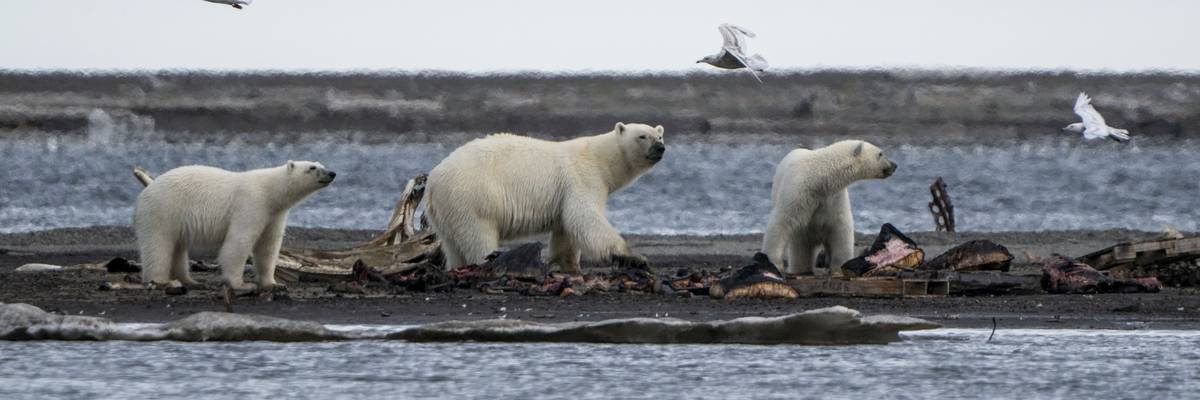
Polar bears feed on whale carcasses in Kaktovik, Alaska on July 1, 2024.
"Even though the interest in today’s sale was tepid, the new leasing still poses significant threats to habitat, iconic wildlife, and Indigenous ways of life," said Earthjustice.
In an embarrassment for President Donald Trump and his "drill, baby, drill" energy policy, Friday's third oil and gas lease sale in Alaska's Arctic National Wildlife Refuge once again drew no bids from Big Oil—but conservationists stressed that fossil fuel expansion still poses a serious threat to the pristine wilderness and its human and animal inhabitants.
The US Department of the Interior’s Bureau of Land Management (BLM) offered 60 tracts on 689,000 acres in the ANWR in northeastern Alaska's Coastal Plain for lease sales. Just two companies—the government-owned Alaska Industrial Development and Export Authority and Hex LLC, an Alaska firm—bought five leases that generated a paltry $3.7 million in total receipts.
“Yet again, no major oil and gas companies showed up to bid, because they know that drilling in the Arctic Refuge is a losing proposition,” said Kristen Moreland, executive director of the Gwich'in Steering Committee, which represents the Gwich'in Indigenous people and opposes drilling.
“We will continue to fight the Trump administration’s leasing program, and work with our friends and allies to protect this sacred and irreplaceable landscape from development of any kind," Moreland added.
The Trump administration had touted fossil fuel lease sales as a way to help pay for tax cuts in the so-called One Big Beautiful Bill Act that mostly benefited corporations and wealthy individuals. The law, which was signed last July by Trump and extends tax cuts the president enacted in 2017, is expected to result in over $5 trillion in lost revenue through 2034, according to an analysis by the Tax Foundation, the world's leading independent tax policy nonprofit.
Despite the underwhelming result, the BLM described Friday's ANWR lease sale as "successful," with agency Director Steve Pearce calling it "another important step toward restoring American Energy Dominance and responsibly developing the vast resources Congress directed us to make available in the Coastal Plain."
Friday's lease sale was the third such auction, the first of which was held in 2021 during Trump's first term and generated just 1% of the administration's projected revenue. The Biden administration—which canceled the leases issued in the 2021 sale—held another lease auction last year because Trump's 2017 tax cut law required two ANWR lease sales within seven years. The 2025 auction drew no bidders.
Green groups and other drilling opponents warned that Friday's flop does not diminish the threat posed by fossil fuel development in ANWR, which is home to the North Slope Iñupiat and the Gwich’in peoples and 270 animal species, including all of the world’s remaining South Beaufort Sea polar bears and the 200,000 porcupine caribou upon which the Gwich'in—who call the area the "sacred place where life begins—rely upon for their survival. The North Slope Iñupiat broadly support drilling and called Friday's lease sale "an important milestone."
"Even though the interest in today’s sale was tepid, the new leasing still poses significant threats to habitat, iconic wildlife, and Indigenous ways of life in one of the nation’s most wild and beautiful landscapes," Earthjustice—one of the groups leading a lawsuit challenging the lease sales—said in a statement. "All of today’s leases are in important polar bear habitat, for example."
Athan Manuel, the Sierra Club's director of lands protection, said that "today's lease sale was another embarrassment and broken promise. The Trump administration has pushed leasing out the Arctic Refuge as the way to finance huge tax cuts, yet today generated $3.7 million for the federal government."
“Let's call that what it is, another scam to trick Americans into giving away our precious natural world," Manuel continued. "It does nothing to change the reality that drilling in the Arctic National Wildlife Refuge remains a risky, controversial, and fundamentally flawed proposition."
"For years, the public was promised that sacrificing the refuge would generate significant economic benefits," Manuel added. "Instead, this leasing program has been plagued by uncertainty while putting one of America's most important public lands at risk."
Autumn Hanna, vice president of the advocacy group Taxpayers for Common Sense, said, "From two previous failed lease sales that delivered less than 1% of promised revenue, taxpayers already know that drilling in the Arctic Refuge is a bad deal."
"Today’s lease sale is yet another reminder that oil and gas development in the refuge is high-risk, low-reward, with zero interest from real industry players," Hanna added. "Americans will not see relief at the pump and, instead, face greater risks from the drilling in a sensitive region.”
Dear Common Dreams reader, It’s been nearly 30 years since I co-founded Common Dreams with my late wife, Lina Newhouser. We had the radical notion that journalism should serve the public good, not corporate profits. It was clear to us from the outset what it would take to build such a project. No paid advertisements. No corporate sponsors. No millionaire publisher telling us what to think or do. Many people said we wouldn't last a year, but we proved those doubters wrong. Together with a tremendous team of journalists and dedicated staff, we built an independent media outlet free from the constraints of profits and corporate control. Our mission has always been simple: To inform. To inspire. To ignite change for the common good. Building Common Dreams was not easy. Our survival was never guaranteed. When you take on the most powerful forces—Wall Street greed, fossil fuel industry destruction, Big Tech lobbyists, and uber-rich oligarchs who have spent billions upon billions rigging the economy and democracy in their favor—the only bulwark you have is supporters who believe in your work. But here’s the urgent message from me today. It's never been this bad out there. And it's never been this hard to keep us going. At the very moment Common Dreams is most needed, the threats we face are intensifying. We need your support now more than ever. We don't accept corporate advertising and never will. We don't have a paywall because we don't think people should be blocked from critical news based on their ability to pay. Everything we do is funded by the donations of readers like you. When everyone does the little they can afford, we are strong. But if that support retreats or dries up, so do we. Will you donate now to make sure Common Dreams not only survives but thrives? —Craig Brown, Co-founder |
In an embarrassment for President Donald Trump and his "drill, baby, drill" energy policy, Friday's third oil and gas lease sale in Alaska's Arctic National Wildlife Refuge once again drew no bids from Big Oil—but conservationists stressed that fossil fuel expansion still poses a serious threat to the pristine wilderness and its human and animal inhabitants.
The US Department of the Interior’s Bureau of Land Management (BLM) offered 60 tracts on 689,000 acres in the ANWR in northeastern Alaska's Coastal Plain for lease sales. Just two companies—the government-owned Alaska Industrial Development and Export Authority and Hex LLC, an Alaska firm—bought five leases that generated a paltry $3.7 million in total receipts.
“Yet again, no major oil and gas companies showed up to bid, because they know that drilling in the Arctic Refuge is a losing proposition,” said Kristen Moreland, executive director of the Gwich'in Steering Committee, which represents the Gwich'in Indigenous people and opposes drilling.
“We will continue to fight the Trump administration’s leasing program, and work with our friends and allies to protect this sacred and irreplaceable landscape from development of any kind," Moreland added.
The Trump administration had touted fossil fuel lease sales as a way to help pay for tax cuts in the so-called One Big Beautiful Bill Act that mostly benefited corporations and wealthy individuals. The law, which was signed last July by Trump and extends tax cuts the president enacted in 2017, is expected to result in over $5 trillion in lost revenue through 2034, according to an analysis by the Tax Foundation, the world's leading independent tax policy nonprofit.
Despite the underwhelming result, the BLM described Friday's ANWR lease sale as "successful," with agency Director Steve Pearce calling it "another important step toward restoring American Energy Dominance and responsibly developing the vast resources Congress directed us to make available in the Coastal Plain."
Friday's lease sale was the third such auction, the first of which was held in 2021 during Trump's first term and generated just 1% of the administration's projected revenue. The Biden administration—which canceled the leases issued in the 2021 sale—held another lease auction last year because Trump's 2017 tax cut law required two ANWR lease sales within seven years. The 2025 auction drew no bidders.
Green groups and other drilling opponents warned that Friday's flop does not diminish the threat posed by fossil fuel development in ANWR, which is home to the North Slope Iñupiat and the Gwich’in peoples and 270 animal species, including all of the world’s remaining South Beaufort Sea polar bears and the 200,000 porcupine caribou upon which the Gwich'in—who call the area the "sacred place where life begins—rely upon for their survival. The North Slope Iñupiat broadly support drilling and called Friday's lease sale "an important milestone."
"Even though the interest in today’s sale was tepid, the new leasing still poses significant threats to habitat, iconic wildlife, and Indigenous ways of life in one of the nation’s most wild and beautiful landscapes," Earthjustice—one of the groups leading a lawsuit challenging the lease sales—said in a statement. "All of today’s leases are in important polar bear habitat, for example."
Athan Manuel, the Sierra Club's director of lands protection, said that "today's lease sale was another embarrassment and broken promise. The Trump administration has pushed leasing out the Arctic Refuge as the way to finance huge tax cuts, yet today generated $3.7 million for the federal government."
“Let's call that what it is, another scam to trick Americans into giving away our precious natural world," Manuel continued. "It does nothing to change the reality that drilling in the Arctic National Wildlife Refuge remains a risky, controversial, and fundamentally flawed proposition."
"For years, the public was promised that sacrificing the refuge would generate significant economic benefits," Manuel added. "Instead, this leasing program has been plagued by uncertainty while putting one of America's most important public lands at risk."
Autumn Hanna, vice president of the advocacy group Taxpayers for Common Sense, said, "From two previous failed lease sales that delivered less than 1% of promised revenue, taxpayers already know that drilling in the Arctic Refuge is a bad deal."
"Today’s lease sale is yet another reminder that oil and gas development in the refuge is high-risk, low-reward, with zero interest from real industry players," Hanna added. "Americans will not see relief at the pump and, instead, face greater risks from the drilling in a sensitive region.”
In an embarrassment for President Donald Trump and his "drill, baby, drill" energy policy, Friday's third oil and gas lease sale in Alaska's Arctic National Wildlife Refuge once again drew no bids from Big Oil—but conservationists stressed that fossil fuel expansion still poses a serious threat to the pristine wilderness and its human and animal inhabitants.
The US Department of the Interior’s Bureau of Land Management (BLM) offered 60 tracts on 689,000 acres in the ANWR in northeastern Alaska's Coastal Plain for lease sales. Just two companies—the government-owned Alaska Industrial Development and Export Authority and Hex LLC, an Alaska firm—bought five leases that generated a paltry $3.7 million in total receipts.
“Yet again, no major oil and gas companies showed up to bid, because they know that drilling in the Arctic Refuge is a losing proposition,” said Kristen Moreland, executive director of the Gwich'in Steering Committee, which represents the Gwich'in Indigenous people and opposes drilling.
“We will continue to fight the Trump administration’s leasing program, and work with our friends and allies to protect this sacred and irreplaceable landscape from development of any kind," Moreland added.
The Trump administration had touted fossil fuel lease sales as a way to help pay for tax cuts in the so-called One Big Beautiful Bill Act that mostly benefited corporations and wealthy individuals. The law, which was signed last July by Trump and extends tax cuts the president enacted in 2017, is expected to result in over $5 trillion in lost revenue through 2034, according to an analysis by the Tax Foundation, the world's leading independent tax policy nonprofit.
Despite the underwhelming result, the BLM described Friday's ANWR lease sale as "successful," with agency Director Steve Pearce calling it "another important step toward restoring American Energy Dominance and responsibly developing the vast resources Congress directed us to make available in the Coastal Plain."
Friday's lease sale was the third such auction, the first of which was held in 2021 during Trump's first term and generated just 1% of the administration's projected revenue. The Biden administration—which canceled the leases issued in the 2021 sale—held another lease auction last year because Trump's 2017 tax cut law required two ANWR lease sales within seven years. The 2025 auction drew no bidders.
Green groups and other drilling opponents warned that Friday's flop does not diminish the threat posed by fossil fuel development in ANWR, which is home to the North Slope Iñupiat and the Gwich’in peoples and 270 animal species, including all of the world’s remaining South Beaufort Sea polar bears and the 200,000 porcupine caribou upon which the Gwich'in—who call the area the "sacred place where life begins—rely upon for their survival. The North Slope Iñupiat broadly support drilling and called Friday's lease sale "an important milestone."
"Even though the interest in today’s sale was tepid, the new leasing still poses significant threats to habitat, iconic wildlife, and Indigenous ways of life in one of the nation’s most wild and beautiful landscapes," Earthjustice—one of the groups leading a lawsuit challenging the lease sales—said in a statement. "All of today’s leases are in important polar bear habitat, for example."
Athan Manuel, the Sierra Club's director of lands protection, said that "today's lease sale was another embarrassment and broken promise. The Trump administration has pushed leasing out the Arctic Refuge as the way to finance huge tax cuts, yet today generated $3.7 million for the federal government."
“Let's call that what it is, another scam to trick Americans into giving away our precious natural world," Manuel continued. "It does nothing to change the reality that drilling in the Arctic National Wildlife Refuge remains a risky, controversial, and fundamentally flawed proposition."
"For years, the public was promised that sacrificing the refuge would generate significant economic benefits," Manuel added. "Instead, this leasing program has been plagued by uncertainty while putting one of America's most important public lands at risk."
Autumn Hanna, vice president of the advocacy group Taxpayers for Common Sense, said, "From two previous failed lease sales that delivered less than 1% of promised revenue, taxpayers already know that drilling in the Arctic Refuge is a bad deal."
"Today’s lease sale is yet another reminder that oil and gas development in the refuge is high-risk, low-reward, with zero interest from real industry players," Hanna added. "Americans will not see relief at the pump and, instead, face greater risks from the drilling in a sensitive region.”