SUBSCRIBE TO OUR FREE NEWSLETTER
Daily news & progressive opinion—funded by the people, not the corporations—delivered straight to your inbox.
5
#000000
#FFFFFF
To donate by check, phone, or other method, see our More Ways to Give page.
Daily news & progressive opinion—funded by the people, not the corporations—delivered straight to your inbox.
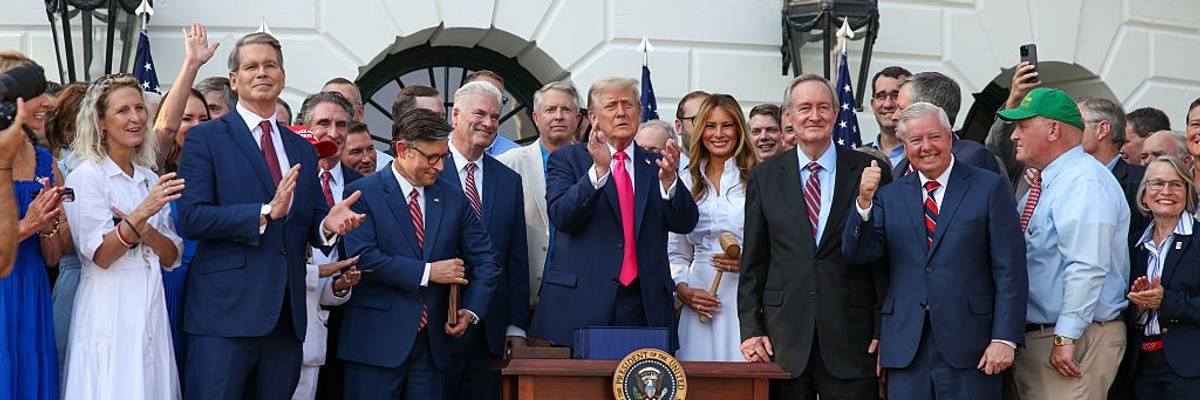
US President Donald Trump, joined by Republican lawmakers, was pictured signing the GOP reconciliation package into law on the South Lawn of the White House on July 4, 2025 in Washington, DC.
"While working Americans struggle to put food on the table, Trump has found another way to cut costs for the ultra-wealthy," said one House Democrat. "Same story, different day."
President Donald Trump's decision last year to withdraw the US from a global effort to rein in corporate tax-dodging has allowed major American companies to avoid at least $40 billion in income taxes, a significant win for profitable business at a time when working class families are struggling with higher costs and stagnant pay.
The New York Times, citing securities filings, reported Friday that American Express, Paypal, Pepsi, and other major US-based corporations "avoided taxes by attributing hundreds of billions of dollars in earnings to low- or no-tax foreign locales like Cyprus, Bermuda, Switzerland, and the Cayman Islands."
The Times noted that the companies often "funneled the profits through subsidiaries in places where they had no employees, offices, or customers."
"Some companies using tax havens to avoid US income tax rely on federal funding for their profits," the newspaper reported. "Thermo Fisher Scientific, the scientific equipment maker, cut its taxes by $3.5 billion last year via Malta. Honeywell, which received over $30 billion in Defense Department contracts over the past decade, used Swiss units to cut its tax rate by more than a quarter—or $301 million—last year."
The tax avoidance was enabled by Trump's decision, on his first day back in the White House, to end US participation in long-running international negotiations to enact a minimum corporate tax and other measures to stop companies from avoiding taxes by offshoring their profits. The Trump administration's top international tax official, Rebecca Burch, formerly worked for Ernst & Young, which has lobbied on behalf of American Express and other companies benefiting from White House tax policy.
"While working Americans struggle to put food on the table, Trump has found another way to cut costs for the ultra-wealthy," US Rep. Debbie Dingell (D-Mich.) wrote in response to the Times reporting. "Same story, different day."
Trump and his Republican allies in Congress have delivered big for corporate America since taking power after the 2024 elections, doubling down on tax cuts first passed in 2017 and quietly pursuing regulatory changes that will deliver windfalls to major companies.
A recent analysis by the Institute on Taxation and Economic Policy found that at least 88 of the largest corporations in the US paid nothing in federal income tax in fiscal year 2025, "at least in part due to two separate packages of corporate tax cuts pushed through by the Trump administration: last year’s 'One Big Beautiful Bill Act' and the 2017 Tax Cuts and Jobs Act (TCJA)."
The Times noted Friday that the TCJA enacted "a few new levies, including one on profits that companies moved into tax havens."
"But the provision contained an escape hatch: it permitted companies to blend the profits and taxes reported in places like Germany, France, or Japan with earnings reported in tax havens like Grand Cayman," the Times explained. "That, in turn, helps many companies avoid the new offshore tax."
The Trump administration also cut a deal earlier this year with the Organization for Economic Cooperation and Development (OECD) that makes it easier for US-headquartered companies to relocate profits in more favorable countries, exempting them from Biden-era efforts to stop such behavior.
The US Chamber of Commerce, the country's largest corporate lobbying organization, celebrated the agreement.
Dear Common Dreams reader, It’s been nearly 30 years since I co-founded Common Dreams with my late wife, Lina Newhouser. We had the radical notion that journalism should serve the public good, not corporate profits. It was clear to us from the outset what it would take to build such a project. No paid advertisements. No corporate sponsors. No millionaire publisher telling us what to think or do. Many people said we wouldn't last a year, but we proved those doubters wrong. Together with a tremendous team of journalists and dedicated staff, we built an independent media outlet free from the constraints of profits and corporate control. Our mission has always been simple: To inform. To inspire. To ignite change for the common good. Building Common Dreams was not easy. Our survival was never guaranteed. When you take on the most powerful forces—Wall Street greed, fossil fuel industry destruction, Big Tech lobbyists, and uber-rich oligarchs who have spent billions upon billions rigging the economy and democracy in their favor—the only bulwark you have is supporters who believe in your work. But here’s the urgent message from me today. It's never been this bad out there. And it's never been this hard to keep us going. At the very moment Common Dreams is most needed, the threats we face are intensifying. We need your support now more than ever. We don't accept corporate advertising and never will. We don't have a paywall because we don't think people should be blocked from critical news based on their ability to pay. Everything we do is funded by the donations of readers like you. When everyone does the little they can afford, we are strong. But if that support retreats or dries up, so do we. Will you donate now to make sure Common Dreams not only survives but thrives? —Craig Brown, Co-founder |
President Donald Trump's decision last year to withdraw the US from a global effort to rein in corporate tax-dodging has allowed major American companies to avoid at least $40 billion in income taxes, a significant win for profitable business at a time when working class families are struggling with higher costs and stagnant pay.
The New York Times, citing securities filings, reported Friday that American Express, Paypal, Pepsi, and other major US-based corporations "avoided taxes by attributing hundreds of billions of dollars in earnings to low- or no-tax foreign locales like Cyprus, Bermuda, Switzerland, and the Cayman Islands."
The Times noted that the companies often "funneled the profits through subsidiaries in places where they had no employees, offices, or customers."
"Some companies using tax havens to avoid US income tax rely on federal funding for their profits," the newspaper reported. "Thermo Fisher Scientific, the scientific equipment maker, cut its taxes by $3.5 billion last year via Malta. Honeywell, which received over $30 billion in Defense Department contracts over the past decade, used Swiss units to cut its tax rate by more than a quarter—or $301 million—last year."
The tax avoidance was enabled by Trump's decision, on his first day back in the White House, to end US participation in long-running international negotiations to enact a minimum corporate tax and other measures to stop companies from avoiding taxes by offshoring their profits. The Trump administration's top international tax official, Rebecca Burch, formerly worked for Ernst & Young, which has lobbied on behalf of American Express and other companies benefiting from White House tax policy.
"While working Americans struggle to put food on the table, Trump has found another way to cut costs for the ultra-wealthy," US Rep. Debbie Dingell (D-Mich.) wrote in response to the Times reporting. "Same story, different day."
Trump and his Republican allies in Congress have delivered big for corporate America since taking power after the 2024 elections, doubling down on tax cuts first passed in 2017 and quietly pursuing regulatory changes that will deliver windfalls to major companies.
A recent analysis by the Institute on Taxation and Economic Policy found that at least 88 of the largest corporations in the US paid nothing in federal income tax in fiscal year 2025, "at least in part due to two separate packages of corporate tax cuts pushed through by the Trump administration: last year’s 'One Big Beautiful Bill Act' and the 2017 Tax Cuts and Jobs Act (TCJA)."
The Times noted Friday that the TCJA enacted "a few new levies, including one on profits that companies moved into tax havens."
"But the provision contained an escape hatch: it permitted companies to blend the profits and taxes reported in places like Germany, France, or Japan with earnings reported in tax havens like Grand Cayman," the Times explained. "That, in turn, helps many companies avoid the new offshore tax."
The Trump administration also cut a deal earlier this year with the Organization for Economic Cooperation and Development (OECD) that makes it easier for US-headquartered companies to relocate profits in more favorable countries, exempting them from Biden-era efforts to stop such behavior.
The US Chamber of Commerce, the country's largest corporate lobbying organization, celebrated the agreement.
President Donald Trump's decision last year to withdraw the US from a global effort to rein in corporate tax-dodging has allowed major American companies to avoid at least $40 billion in income taxes, a significant win for profitable business at a time when working class families are struggling with higher costs and stagnant pay.
The New York Times, citing securities filings, reported Friday that American Express, Paypal, Pepsi, and other major US-based corporations "avoided taxes by attributing hundreds of billions of dollars in earnings to low- or no-tax foreign locales like Cyprus, Bermuda, Switzerland, and the Cayman Islands."
The Times noted that the companies often "funneled the profits through subsidiaries in places where they had no employees, offices, or customers."
"Some companies using tax havens to avoid US income tax rely on federal funding for their profits," the newspaper reported. "Thermo Fisher Scientific, the scientific equipment maker, cut its taxes by $3.5 billion last year via Malta. Honeywell, which received over $30 billion in Defense Department contracts over the past decade, used Swiss units to cut its tax rate by more than a quarter—or $301 million—last year."
The tax avoidance was enabled by Trump's decision, on his first day back in the White House, to end US participation in long-running international negotiations to enact a minimum corporate tax and other measures to stop companies from avoiding taxes by offshoring their profits. The Trump administration's top international tax official, Rebecca Burch, formerly worked for Ernst & Young, which has lobbied on behalf of American Express and other companies benefiting from White House tax policy.
"While working Americans struggle to put food on the table, Trump has found another way to cut costs for the ultra-wealthy," US Rep. Debbie Dingell (D-Mich.) wrote in response to the Times reporting. "Same story, different day."
Trump and his Republican allies in Congress have delivered big for corporate America since taking power after the 2024 elections, doubling down on tax cuts first passed in 2017 and quietly pursuing regulatory changes that will deliver windfalls to major companies.
A recent analysis by the Institute on Taxation and Economic Policy found that at least 88 of the largest corporations in the US paid nothing in federal income tax in fiscal year 2025, "at least in part due to two separate packages of corporate tax cuts pushed through by the Trump administration: last year’s 'One Big Beautiful Bill Act' and the 2017 Tax Cuts and Jobs Act (TCJA)."
The Times noted Friday that the TCJA enacted "a few new levies, including one on profits that companies moved into tax havens."
"But the provision contained an escape hatch: it permitted companies to blend the profits and taxes reported in places like Germany, France, or Japan with earnings reported in tax havens like Grand Cayman," the Times explained. "That, in turn, helps many companies avoid the new offshore tax."
The Trump administration also cut a deal earlier this year with the Organization for Economic Cooperation and Development (OECD) that makes it easier for US-headquartered companies to relocate profits in more favorable countries, exempting them from Biden-era efforts to stop such behavior.
The US Chamber of Commerce, the country's largest corporate lobbying organization, celebrated the agreement.