SUBSCRIBE TO OUR FREE NEWSLETTER
Daily news & progressive opinion—funded by the people, not the corporations—delivered straight to your inbox.
5
#000000
#FFFFFF
To donate by check, phone, or other method, see our More Ways to Give page.
Daily news & progressive opinion—funded by the people, not the corporations—delivered straight to your inbox.
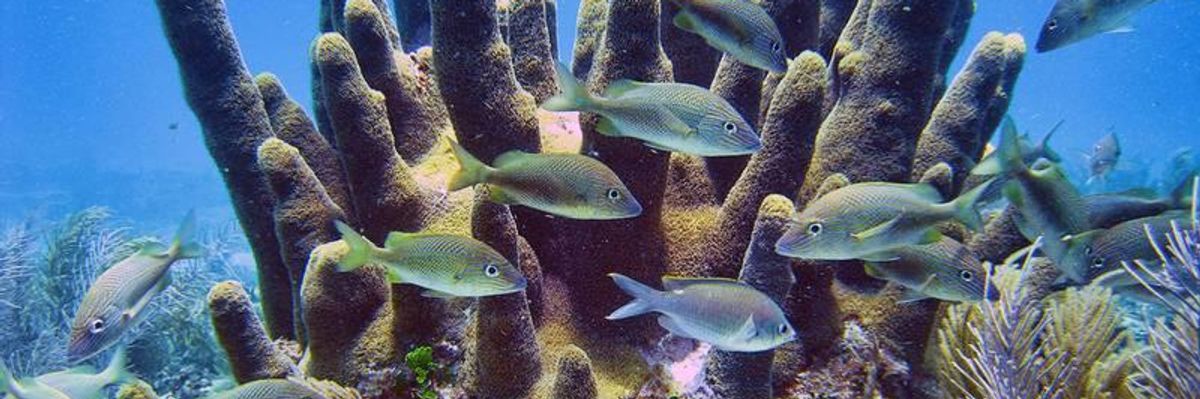
According to the IUCN Red List, pillar coral is one of 26 corals now listed as critically endangered in the Atlantic Ocean. (Photo: NOAA Fisheries)
During the United Nations biodiversity summit in Montreal, an international conversation group on Friday highlighted how humanity is dangerously failing marine life with illegal and unsustainable fishing, pollution from agricultural and industrial runoff, and activities that drive up global temperatures.
"If we are to secure a new future for the world's oceans and the essential biodiversity they harbor, we must act now."
The International Union for Conservation of Nature (IUCN) Red List of Threatened Species now features 150,388 species, 42,108 of which face possible extinction. Of the 17,903 marine animals and plants on the list, more than 1,550 are at risk.
"Today's IUCN Red List update reveals a perfect storm of unsustainable human activity decimating marine life around the globe. As the world looks to the ongoing U.N. Biodiversity Conference to set the course for nature recovery, we simply cannot afford to fail," Bruno Oberle, the group's director general, warned Friday. "We urgently need to address the linked climate and biodiversity crises, with profound changes to our economic systems, or we risk losing the crucial benefits the oceans provide us with."
The primary aim of the 15th Conference of the Parties (COP15) of the Convention on Biological Diversity (CBD)--which is hosted by China but kicked off earlier in Canada this week due to Covid-19 restrictions--is the development of post-2020 global biodiversity framework (GBF).
A top priority for many parties to the treaty--along with the United States, which has failed to ratify the CBD over the past three decades but is still participating in the summit--is to protect 30% of lands and waters by 2030. However, as activists and Indigenous leaders from around the world have noted, there are serious human rights concerns regarding implementation of the 30x30 goal.
COP15 comes after the fifth round of discussions about establishing a U.N. treaty for the high seas, or the two-thirds of oceans outside territorial waters. Those August talks failed to produce an agreement--which, as Laura Meller of Greenpeace's Protect the Oceans campaign warned at the time, "jeopardizes the livelihoods and food security of billions of people around the world."
"While progress has been made, particularly on ocean sanctuaries, members of the High Ambition Coalition and countries like the USA have moved too slowly to find compromises, despite their commitments," Meller continued. "Time has run out. Further delay means ocean destruction. We are sad and disappointed. While countries continue to talk, the oceans and all those who rely on them will suffer."
Similarly urgent warnings came with the update Friday. Ashleigh McGovern, vice president of the Center for Oceans at Conservation International, said that "with this devastating IUCN Red List update on the status of marine species, it is clear that business as usual is no longer an option."
"Human activity has had devastating effects on marine ecosystems and biodiversity, but it can also be harnessed to drive action as a matter of survival, equity, and climate justice," she added. "If we are to secure a new future for the world's oceans and the essential biodiversity they harbor, we must act now."
Jon Paul Rodriguez, chair of the IUCN Species Survival Commission (SSC), pointed out that "most of the Earth's biosphere, 99% of all livable space on our planet, is underwater."
"Humanity acts as if oceans were inexhaustible, capable of sustaining infinite harvest of algae, animals, and plants for food and other products, able to transform vast quantities of sewage and other pollutants that we pour in coastal areas, and absorb the CO2 generated by land-use change and burning fossil fuel," he said. "This Red List update brings to light new evidence of the multiple interacting threats to declining life in the sea."
According to the IUCN Red List, 20 of the 54 abalone species--some of the world's most expensive seafood--are threatened with extinction.
"Abalones reflect humanity's disastrous guardianship of our oceans in microcosm: overfishing, pollution, disease, habitat loss, algal blooms, warming, and acidification, to name but a few threats. They really are the canary in the coal mine," said Howard Peters, a member of the IUCN SSC Mollusc Specialist Group and research associate at the U.K.'s University of York who led the abalone assessment.
"The most immediate action people can take is to eat only farmed or sustainably sourced abalones. Enforcing fishery quotas and anti-poaching measures is also critical," Peters noted. "However, we need to halt the changes to ocean chemistry and temperature to preserve marine life including abalone species over the long term."
The update also raised the alarm about dugongs, particularly in East Africa and New Caledonia. Populations of the large herbivorous marine mammals are threatened by fishing gear, oil and gas exploration and production, chemical pollution, and the destruction of seagrasses they rely on for food.
"Strengthening community-led fisheries governance and expanding work opportunities beyond fishing are key in East Africa, where marine ecosystems are fundamental to people's food security and livelihoods," said Evan Trotzuk, who led the region's assessment.
Another focus of the list is the pillar coral in the Caribbean, given that its population has shrunk by more than 80% across most of its range over the past three decades.
"The awful status of these species should shock us and engage us for urgent action."
Noting that it is just one of 26 corals now listed as critically endangered in the Atlantic Ocean, Arizona State University associate professor Beth Polidoro, Red List coordinator for the IUCN SSC Coral Specialist Group, said that "these alarming results emphasize the urgency of global cooperation and action to address climate change impacts on ocean ecosystems."
Amanda Vincent, chair of the IUCN SSC Marine Conservation Committee, declared that "the awful status of these species should shock us and engage us for urgent action."
"These magical marine species are treasured wildlife, from the wonderful abalone to the charismatic dugong and the glorious pillar coral, and we should safeguard them accordingly," she added. "It is vital that we manage fisheries properly, constrain climate change, and reverse habitat degradation."
Nodding to the conference, Jane Smart, director of IUCN's Science and Data Center, said the update reinforces her group's "urgent call for a post-2020 global biodiversity framework that will be ambitious enough to cease destruction of our life support system and catalyze the necessary action and change to secure life on this planet."
Dear Common Dreams reader, It’s been nearly 30 years since I co-founded Common Dreams with my late wife, Lina Newhouser. We had the radical notion that journalism should serve the public good, not corporate profits. It was clear to us from the outset what it would take to build such a project. No paid advertisements. No corporate sponsors. No millionaire publisher telling us what to think or do. Many people said we wouldn't last a year, but we proved those doubters wrong. Together with a tremendous team of journalists and dedicated staff, we built an independent media outlet free from the constraints of profits and corporate control. Our mission has always been simple: To inform. To inspire. To ignite change for the common good. Building Common Dreams was not easy. Our survival was never guaranteed. When you take on the most powerful forces—Wall Street greed, fossil fuel industry destruction, Big Tech lobbyists, and uber-rich oligarchs who have spent billions upon billions rigging the economy and democracy in their favor—the only bulwark you have is supporters who believe in your work. But here’s the urgent message from me today. It's never been this bad out there. And it's never been this hard to keep us going. At the very moment Common Dreams is most needed, the threats we face are intensifying. We need your support now more than ever. We don't accept corporate advertising and never will. We don't have a paywall because we don't think people should be blocked from critical news based on their ability to pay. Everything we do is funded by the donations of readers like you. When everyone does the little they can afford, we are strong. But if that support retreats or dries up, so do we. Will you donate now to make sure Common Dreams not only survives but thrives? —Craig Brown, Co-founder |
During the United Nations biodiversity summit in Montreal, an international conversation group on Friday highlighted how humanity is dangerously failing marine life with illegal and unsustainable fishing, pollution from agricultural and industrial runoff, and activities that drive up global temperatures.
"If we are to secure a new future for the world's oceans and the essential biodiversity they harbor, we must act now."
The International Union for Conservation of Nature (IUCN) Red List of Threatened Species now features 150,388 species, 42,108 of which face possible extinction. Of the 17,903 marine animals and plants on the list, more than 1,550 are at risk.
"Today's IUCN Red List update reveals a perfect storm of unsustainable human activity decimating marine life around the globe. As the world looks to the ongoing U.N. Biodiversity Conference to set the course for nature recovery, we simply cannot afford to fail," Bruno Oberle, the group's director general, warned Friday. "We urgently need to address the linked climate and biodiversity crises, with profound changes to our economic systems, or we risk losing the crucial benefits the oceans provide us with."
The primary aim of the 15th Conference of the Parties (COP15) of the Convention on Biological Diversity (CBD)--which is hosted by China but kicked off earlier in Canada this week due to Covid-19 restrictions--is the development of post-2020 global biodiversity framework (GBF).
A top priority for many parties to the treaty--along with the United States, which has failed to ratify the CBD over the past three decades but is still participating in the summit--is to protect 30% of lands and waters by 2030. However, as activists and Indigenous leaders from around the world have noted, there are serious human rights concerns regarding implementation of the 30x30 goal.
COP15 comes after the fifth round of discussions about establishing a U.N. treaty for the high seas, or the two-thirds of oceans outside territorial waters. Those August talks failed to produce an agreement--which, as Laura Meller of Greenpeace's Protect the Oceans campaign warned at the time, "jeopardizes the livelihoods and food security of billions of people around the world."
"While progress has been made, particularly on ocean sanctuaries, members of the High Ambition Coalition and countries like the USA have moved too slowly to find compromises, despite their commitments," Meller continued. "Time has run out. Further delay means ocean destruction. We are sad and disappointed. While countries continue to talk, the oceans and all those who rely on them will suffer."
Similarly urgent warnings came with the update Friday. Ashleigh McGovern, vice president of the Center for Oceans at Conservation International, said that "with this devastating IUCN Red List update on the status of marine species, it is clear that business as usual is no longer an option."
"Human activity has had devastating effects on marine ecosystems and biodiversity, but it can also be harnessed to drive action as a matter of survival, equity, and climate justice," she added. "If we are to secure a new future for the world's oceans and the essential biodiversity they harbor, we must act now."
Jon Paul Rodriguez, chair of the IUCN Species Survival Commission (SSC), pointed out that "most of the Earth's biosphere, 99% of all livable space on our planet, is underwater."
"Humanity acts as if oceans were inexhaustible, capable of sustaining infinite harvest of algae, animals, and plants for food and other products, able to transform vast quantities of sewage and other pollutants that we pour in coastal areas, and absorb the CO2 generated by land-use change and burning fossil fuel," he said. "This Red List update brings to light new evidence of the multiple interacting threats to declining life in the sea."
According to the IUCN Red List, 20 of the 54 abalone species--some of the world's most expensive seafood--are threatened with extinction.
"Abalones reflect humanity's disastrous guardianship of our oceans in microcosm: overfishing, pollution, disease, habitat loss, algal blooms, warming, and acidification, to name but a few threats. They really are the canary in the coal mine," said Howard Peters, a member of the IUCN SSC Mollusc Specialist Group and research associate at the U.K.'s University of York who led the abalone assessment.
"The most immediate action people can take is to eat only farmed or sustainably sourced abalones. Enforcing fishery quotas and anti-poaching measures is also critical," Peters noted. "However, we need to halt the changes to ocean chemistry and temperature to preserve marine life including abalone species over the long term."
The update also raised the alarm about dugongs, particularly in East Africa and New Caledonia. Populations of the large herbivorous marine mammals are threatened by fishing gear, oil and gas exploration and production, chemical pollution, and the destruction of seagrasses they rely on for food.
"Strengthening community-led fisheries governance and expanding work opportunities beyond fishing are key in East Africa, where marine ecosystems are fundamental to people's food security and livelihoods," said Evan Trotzuk, who led the region's assessment.
Another focus of the list is the pillar coral in the Caribbean, given that its population has shrunk by more than 80% across most of its range over the past three decades.
"The awful status of these species should shock us and engage us for urgent action."
Noting that it is just one of 26 corals now listed as critically endangered in the Atlantic Ocean, Arizona State University associate professor Beth Polidoro, Red List coordinator for the IUCN SSC Coral Specialist Group, said that "these alarming results emphasize the urgency of global cooperation and action to address climate change impacts on ocean ecosystems."
Amanda Vincent, chair of the IUCN SSC Marine Conservation Committee, declared that "the awful status of these species should shock us and engage us for urgent action."
"These magical marine species are treasured wildlife, from the wonderful abalone to the charismatic dugong and the glorious pillar coral, and we should safeguard them accordingly," she added. "It is vital that we manage fisheries properly, constrain climate change, and reverse habitat degradation."
Nodding to the conference, Jane Smart, director of IUCN's Science and Data Center, said the update reinforces her group's "urgent call for a post-2020 global biodiversity framework that will be ambitious enough to cease destruction of our life support system and catalyze the necessary action and change to secure life on this planet."
During the United Nations biodiversity summit in Montreal, an international conversation group on Friday highlighted how humanity is dangerously failing marine life with illegal and unsustainable fishing, pollution from agricultural and industrial runoff, and activities that drive up global temperatures.
"If we are to secure a new future for the world's oceans and the essential biodiversity they harbor, we must act now."
The International Union for Conservation of Nature (IUCN) Red List of Threatened Species now features 150,388 species, 42,108 of which face possible extinction. Of the 17,903 marine animals and plants on the list, more than 1,550 are at risk.
"Today's IUCN Red List update reveals a perfect storm of unsustainable human activity decimating marine life around the globe. As the world looks to the ongoing U.N. Biodiversity Conference to set the course for nature recovery, we simply cannot afford to fail," Bruno Oberle, the group's director general, warned Friday. "We urgently need to address the linked climate and biodiversity crises, with profound changes to our economic systems, or we risk losing the crucial benefits the oceans provide us with."
The primary aim of the 15th Conference of the Parties (COP15) of the Convention on Biological Diversity (CBD)--which is hosted by China but kicked off earlier in Canada this week due to Covid-19 restrictions--is the development of post-2020 global biodiversity framework (GBF).
A top priority for many parties to the treaty--along with the United States, which has failed to ratify the CBD over the past three decades but is still participating in the summit--is to protect 30% of lands and waters by 2030. However, as activists and Indigenous leaders from around the world have noted, there are serious human rights concerns regarding implementation of the 30x30 goal.
COP15 comes after the fifth round of discussions about establishing a U.N. treaty for the high seas, or the two-thirds of oceans outside territorial waters. Those August talks failed to produce an agreement--which, as Laura Meller of Greenpeace's Protect the Oceans campaign warned at the time, "jeopardizes the livelihoods and food security of billions of people around the world."
"While progress has been made, particularly on ocean sanctuaries, members of the High Ambition Coalition and countries like the USA have moved too slowly to find compromises, despite their commitments," Meller continued. "Time has run out. Further delay means ocean destruction. We are sad and disappointed. While countries continue to talk, the oceans and all those who rely on them will suffer."
Similarly urgent warnings came with the update Friday. Ashleigh McGovern, vice president of the Center for Oceans at Conservation International, said that "with this devastating IUCN Red List update on the status of marine species, it is clear that business as usual is no longer an option."
"Human activity has had devastating effects on marine ecosystems and biodiversity, but it can also be harnessed to drive action as a matter of survival, equity, and climate justice," she added. "If we are to secure a new future for the world's oceans and the essential biodiversity they harbor, we must act now."
Jon Paul Rodriguez, chair of the IUCN Species Survival Commission (SSC), pointed out that "most of the Earth's biosphere, 99% of all livable space on our planet, is underwater."
"Humanity acts as if oceans were inexhaustible, capable of sustaining infinite harvest of algae, animals, and plants for food and other products, able to transform vast quantities of sewage and other pollutants that we pour in coastal areas, and absorb the CO2 generated by land-use change and burning fossil fuel," he said. "This Red List update brings to light new evidence of the multiple interacting threats to declining life in the sea."
According to the IUCN Red List, 20 of the 54 abalone species--some of the world's most expensive seafood--are threatened with extinction.
"Abalones reflect humanity's disastrous guardianship of our oceans in microcosm: overfishing, pollution, disease, habitat loss, algal blooms, warming, and acidification, to name but a few threats. They really are the canary in the coal mine," said Howard Peters, a member of the IUCN SSC Mollusc Specialist Group and research associate at the U.K.'s University of York who led the abalone assessment.
"The most immediate action people can take is to eat only farmed or sustainably sourced abalones. Enforcing fishery quotas and anti-poaching measures is also critical," Peters noted. "However, we need to halt the changes to ocean chemistry and temperature to preserve marine life including abalone species over the long term."
The update also raised the alarm about dugongs, particularly in East Africa and New Caledonia. Populations of the large herbivorous marine mammals are threatened by fishing gear, oil and gas exploration and production, chemical pollution, and the destruction of seagrasses they rely on for food.
"Strengthening community-led fisheries governance and expanding work opportunities beyond fishing are key in East Africa, where marine ecosystems are fundamental to people's food security and livelihoods," said Evan Trotzuk, who led the region's assessment.
Another focus of the list is the pillar coral in the Caribbean, given that its population has shrunk by more than 80% across most of its range over the past three decades.
"The awful status of these species should shock us and engage us for urgent action."
Noting that it is just one of 26 corals now listed as critically endangered in the Atlantic Ocean, Arizona State University associate professor Beth Polidoro, Red List coordinator for the IUCN SSC Coral Specialist Group, said that "these alarming results emphasize the urgency of global cooperation and action to address climate change impacts on ocean ecosystems."
Amanda Vincent, chair of the IUCN SSC Marine Conservation Committee, declared that "the awful status of these species should shock us and engage us for urgent action."
"These magical marine species are treasured wildlife, from the wonderful abalone to the charismatic dugong and the glorious pillar coral, and we should safeguard them accordingly," she added. "It is vital that we manage fisheries properly, constrain climate change, and reverse habitat degradation."
Nodding to the conference, Jane Smart, director of IUCN's Science and Data Center, said the update reinforces her group's "urgent call for a post-2020 global biodiversity framework that will be ambitious enough to cease destruction of our life support system and catalyze the necessary action and change to secure life on this planet."