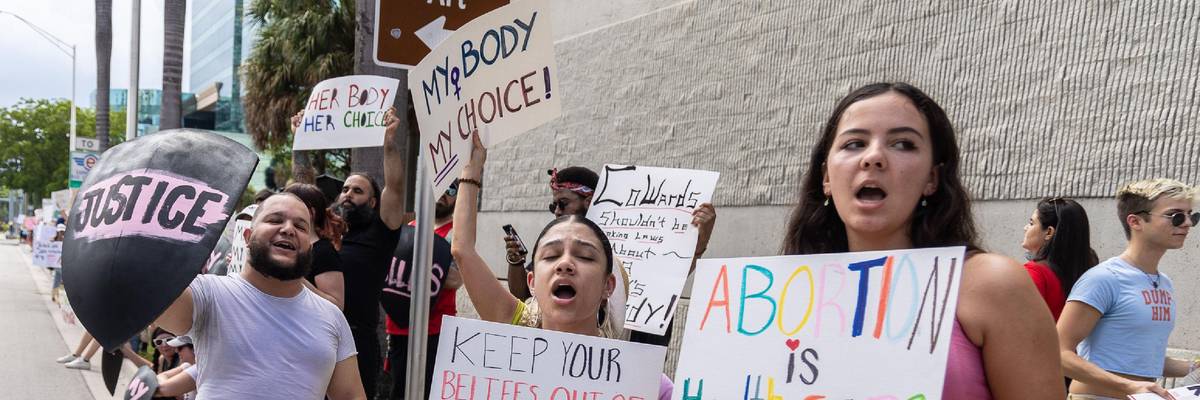
Reproductive rights supporters hold signs at a protest in support of abortion access on July 13, 2022 in Fort Lauderdale, Florida. (Photo: John Parra/Getty Images for MoveOn)
'Hell State America': Florida Appeals Court Won't Let Parentless 16-Year-Old Get an Abortion
"The status of minors in a post-Roe America: Not mature enough to make decisions over your own body, but mature enough to be forced to continue with a pregnancy."
Reproductive rights advocates were outraged by a Florida appellate court's Monday decision upholding a trial judge's move to block a "parentless" 16-year-old from getting an abortion.
Escambia County Circuit Judge Jennifer J. Frydrychowicz recently rejected the unidentified teen's request for permission to bypass the parental notice and consent requirements under Florida law. A three-judge panel from the state's 1st District Court of Appeal upheld that decision, which critics called "barbaric," "flabbergasting," "outrageous," and "unconscionable."
Judges Harvey Jay and Rachel Nordby--joined in part by Judge Scott Makar--affirmed the decision of the trial court, which they said found that the teen "had not established by clear and convincing evidence that she was sufficiently mature to decide whether to terminate her pregnancy."
Florida law, the judges' opinion notes, "allows for a remand to the trial court with instructions for a further ruling, but no such remand is warranted here." On that point, Makar disagreed.
Makak concurred with affirming Frydrychowicz's decision and praised the judge for displaying "concern for the minor's predicament," asking "difficult questions of the minor on sensitive personal matters in a compassionate manner," and producing "a thoughtful written order in a rapid fashion."
However, he also said that "given the open-ended nature of the order reflecting the trial judge's willingness to hear from the minor again--and the time pressures presented--I would remand the case to the trial court."
As Makar detailed:
The minor is almost 17 years old and parentless. She lives with a relative but has an appointed guardian. She is pursuing a GED with involvement in a program designed to assist young women who have experienced trauma in their lives by providing educational support and counseling. The minor experienced renewed trauma (the death of a friend) shortly before she decided to seek termination of her pregnancy.
Her petition--a standard form that she completed by hand--stated two potential bases for a waiver under the statute. First, the minor states that she is sufficiently mature to make the decision, saying she "is not ready to have a baby," she doesn't have a job, she is "still in school," and the father is unable to assist her... Second, the minor states that her "guardian is fine with what [she] wants to do," which would be a sufficient basis for a waiver of notice if other statutory requisites are met.
Civil rights lawyer Sherrilyn Ifill said Makar's opinion "highlights the particular outrage of the majority decision," adding that "it's clear the trial court judge expected that the minor would be able to return to her court to supplement her presentation" and "there is no basis for the appeals [court] to refuse the remand."
"I'm having a hard time with the trial court judge's decision as described in Judge Makar's concurrence/dissent," Ifill continued. "The minor seems to have more than met the standard. A 'close case' [should] err on granting the teen's clearly thought-out request."
Critics highlighted as ridiculous the courts' conclusion that the teen is not mature enough to choose an abortion and thus should be forced to continue a pregnancy that will likely result in the birth of child.
"A Florida court is blocking a 16-year-old from having an abortion because it says she's not 'mature' enough to make that decision. But she's mature enough to raise a child instead?" tweeted Congresswoman Diana DeGette (D-Colo.) "This is outrageous. And it's why we must stop this extreme GOP agenda immediately!"
Writer and Northwestern University professor Keeanga-Yamahtta Taylor similarly said: "Not mature enough to decide to terminate a pregnancy, but mature enough to be forced to carry an unwanted pregnancy. Hell state America."
Florida Senate Minority Leader Lauren Book (D-32) argued that it is "unconscionable" for the state to sentence the girl "to continue an unwanted pregnancy after she stated she was not ready to have a baby, was pursuing her education, didn't have a job, and the father was unable to assist her."
Just "shy of her 18th birthday and from legally being able to make this decision free from radical Republican overreach," Book added, "I truly cannot fathom the court's justification for finding this brave young woman 'not sufficiently mature' to choose what is best for herself, her body, and her future aside from pure political will or inability to separate church and state."
Others also emphasized the importance of empowering pregnant youth to make decisions about their bodies. The group VoteProChoice declared that "young people need access to abortion care free from judgment--not barriers and forced birth."
As Lauren Rankin--author of the 2022 book Bodies on the Line: At the Front Lines of the Fight to Protect Abortion in America--put it: "Young people should be able to legally terminate a pregnancy. They should also be given support and resources, free of judgment and stigma, if they choose to parent. The issue isn't young people parenting. The issue is stigmatizing and eradicating their ability to do either."
Monday's controversial ruling follows GOP Florida Gov. Ron DeSantis signing a 15-week abortion ban in April and the right-wing U.S. Supreme Court majority overturning Roe v. Wade in June. Throughout the summer, stories of pregnant people nationwide struggling to access abortion care have stacked up.
Noting the Florida case in that context, Rewire executive editor Jessica Mason Pieklo said, "The tragedies are compounding and seem never-ending."
We are at a crossroads
This country and this world are at a monumental crossroads. In a few short weeks, US voters will have an opportunity to beat back the forces of fascism and confront the billionaires who are rigging the economy, our media system, and our democracy, making it increasingly impossible for ordinary people to get by. We’re not just talking about the election. We’re talking about what must be done once these fascist elements are vanquished from power. We need a bolder set of solutions than what either major party has so far been willing to offer and a working-class movement ready to fight like hell for it. Trump didn't emerge from nowhere. The conditions that fueled MAGA authoritarianism were created by decades of radical neoliberal economic policies and a corrupt political system dominated by corporate interests. They slashed taxes on the super-rich, promising that the benefits would trickle down. They said giveaways to the corporate titans would make life more affordable for the rest of us. It was all bullshit. And when a bitter, betrayed populace searches for someone to blame, right-wing demagogues have little trouble finding scapegoats. People know when they're being lied to, but you won't hear any of this from the corporate media. Only independent journalism—powered and funded by people who believe in building a better world—can deliver truly trustworthy daily news. Our Fall Campaign is underway, and we need your help. To power our newsroom through the rest of the year, we need to raise $125,000 by midnight on October 31. So if you share our vision, please contribute whatever you can to sustain our work. |
Reproductive rights advocates were outraged by a Florida appellate court's Monday decision upholding a trial judge's move to block a "parentless" 16-year-old from getting an abortion.
Escambia County Circuit Judge Jennifer J. Frydrychowicz recently rejected the unidentified teen's request for permission to bypass the parental notice and consent requirements under Florida law. A three-judge panel from the state's 1st District Court of Appeal upheld that decision, which critics called "barbaric," "flabbergasting," "outrageous," and "unconscionable."
Judges Harvey Jay and Rachel Nordby--joined in part by Judge Scott Makar--affirmed the decision of the trial court, which they said found that the teen "had not established by clear and convincing evidence that she was sufficiently mature to decide whether to terminate her pregnancy."
Florida law, the judges' opinion notes, "allows for a remand to the trial court with instructions for a further ruling, but no such remand is warranted here." On that point, Makar disagreed.
Makak concurred with affirming Frydrychowicz's decision and praised the judge for displaying "concern for the minor's predicament," asking "difficult questions of the minor on sensitive personal matters in a compassionate manner," and producing "a thoughtful written order in a rapid fashion."
However, he also said that "given the open-ended nature of the order reflecting the trial judge's willingness to hear from the minor again--and the time pressures presented--I would remand the case to the trial court."
As Makar detailed:
The minor is almost 17 years old and parentless. She lives with a relative but has an appointed guardian. She is pursuing a GED with involvement in a program designed to assist young women who have experienced trauma in their lives by providing educational support and counseling. The minor experienced renewed trauma (the death of a friend) shortly before she decided to seek termination of her pregnancy.
Her petition--a standard form that she completed by hand--stated two potential bases for a waiver under the statute. First, the minor states that she is sufficiently mature to make the decision, saying she "is not ready to have a baby," she doesn't have a job, she is "still in school," and the father is unable to assist her... Second, the minor states that her "guardian is fine with what [she] wants to do," which would be a sufficient basis for a waiver of notice if other statutory requisites are met.
Civil rights lawyer Sherrilyn Ifill said Makar's opinion "highlights the particular outrage of the majority decision," adding that "it's clear the trial court judge expected that the minor would be able to return to her court to supplement her presentation" and "there is no basis for the appeals [court] to refuse the remand."
"I'm having a hard time with the trial court judge's decision as described in Judge Makar's concurrence/dissent," Ifill continued. "The minor seems to have more than met the standard. A 'close case' [should] err on granting the teen's clearly thought-out request."
Critics highlighted as ridiculous the courts' conclusion that the teen is not mature enough to choose an abortion and thus should be forced to continue a pregnancy that will likely result in the birth of child.
"A Florida court is blocking a 16-year-old from having an abortion because it says she's not 'mature' enough to make that decision. But she's mature enough to raise a child instead?" tweeted Congresswoman Diana DeGette (D-Colo.) "This is outrageous. And it's why we must stop this extreme GOP agenda immediately!"
Writer and Northwestern University professor Keeanga-Yamahtta Taylor similarly said: "Not mature enough to decide to terminate a pregnancy, but mature enough to be forced to carry an unwanted pregnancy. Hell state America."
Florida Senate Minority Leader Lauren Book (D-32) argued that it is "unconscionable" for the state to sentence the girl "to continue an unwanted pregnancy after she stated she was not ready to have a baby, was pursuing her education, didn't have a job, and the father was unable to assist her."
Just "shy of her 18th birthday and from legally being able to make this decision free from radical Republican overreach," Book added, "I truly cannot fathom the court's justification for finding this brave young woman 'not sufficiently mature' to choose what is best for herself, her body, and her future aside from pure political will or inability to separate church and state."
Others also emphasized the importance of empowering pregnant youth to make decisions about their bodies. The group VoteProChoice declared that "young people need access to abortion care free from judgment--not barriers and forced birth."
As Lauren Rankin--author of the 2022 book Bodies on the Line: At the Front Lines of the Fight to Protect Abortion in America--put it: "Young people should be able to legally terminate a pregnancy. They should also be given support and resources, free of judgment and stigma, if they choose to parent. The issue isn't young people parenting. The issue is stigmatizing and eradicating their ability to do either."
Monday's controversial ruling follows GOP Florida Gov. Ron DeSantis signing a 15-week abortion ban in April and the right-wing U.S. Supreme Court majority overturning Roe v. Wade in June. Throughout the summer, stories of pregnant people nationwide struggling to access abortion care have stacked up.
Noting the Florida case in that context, Rewire executive editor Jessica Mason Pieklo said, "The tragedies are compounding and seem never-ending."
Reproductive rights advocates were outraged by a Florida appellate court's Monday decision upholding a trial judge's move to block a "parentless" 16-year-old from getting an abortion.
Escambia County Circuit Judge Jennifer J. Frydrychowicz recently rejected the unidentified teen's request for permission to bypass the parental notice and consent requirements under Florida law. A three-judge panel from the state's 1st District Court of Appeal upheld that decision, which critics called "barbaric," "flabbergasting," "outrageous," and "unconscionable."
Judges Harvey Jay and Rachel Nordby--joined in part by Judge Scott Makar--affirmed the decision of the trial court, which they said found that the teen "had not established by clear and convincing evidence that she was sufficiently mature to decide whether to terminate her pregnancy."
Florida law, the judges' opinion notes, "allows for a remand to the trial court with instructions for a further ruling, but no such remand is warranted here." On that point, Makar disagreed.
Makak concurred with affirming Frydrychowicz's decision and praised the judge for displaying "concern for the minor's predicament," asking "difficult questions of the minor on sensitive personal matters in a compassionate manner," and producing "a thoughtful written order in a rapid fashion."
However, he also said that "given the open-ended nature of the order reflecting the trial judge's willingness to hear from the minor again--and the time pressures presented--I would remand the case to the trial court."
As Makar detailed:
The minor is almost 17 years old and parentless. She lives with a relative but has an appointed guardian. She is pursuing a GED with involvement in a program designed to assist young women who have experienced trauma in their lives by providing educational support and counseling. The minor experienced renewed trauma (the death of a friend) shortly before she decided to seek termination of her pregnancy.
Her petition--a standard form that she completed by hand--stated two potential bases for a waiver under the statute. First, the minor states that she is sufficiently mature to make the decision, saying she "is not ready to have a baby," she doesn't have a job, she is "still in school," and the father is unable to assist her... Second, the minor states that her "guardian is fine with what [she] wants to do," which would be a sufficient basis for a waiver of notice if other statutory requisites are met.
Civil rights lawyer Sherrilyn Ifill said Makar's opinion "highlights the particular outrage of the majority decision," adding that "it's clear the trial court judge expected that the minor would be able to return to her court to supplement her presentation" and "there is no basis for the appeals [court] to refuse the remand."
"I'm having a hard time with the trial court judge's decision as described in Judge Makar's concurrence/dissent," Ifill continued. "The minor seems to have more than met the standard. A 'close case' [should] err on granting the teen's clearly thought-out request."
Critics highlighted as ridiculous the courts' conclusion that the teen is not mature enough to choose an abortion and thus should be forced to continue a pregnancy that will likely result in the birth of child.
"A Florida court is blocking a 16-year-old from having an abortion because it says she's not 'mature' enough to make that decision. But she's mature enough to raise a child instead?" tweeted Congresswoman Diana DeGette (D-Colo.) "This is outrageous. And it's why we must stop this extreme GOP agenda immediately!"
Writer and Northwestern University professor Keeanga-Yamahtta Taylor similarly said: "Not mature enough to decide to terminate a pregnancy, but mature enough to be forced to carry an unwanted pregnancy. Hell state America."
Florida Senate Minority Leader Lauren Book (D-32) argued that it is "unconscionable" for the state to sentence the girl "to continue an unwanted pregnancy after she stated she was not ready to have a baby, was pursuing her education, didn't have a job, and the father was unable to assist her."
Just "shy of her 18th birthday and from legally being able to make this decision free from radical Republican overreach," Book added, "I truly cannot fathom the court's justification for finding this brave young woman 'not sufficiently mature' to choose what is best for herself, her body, and her future aside from pure political will or inability to separate church and state."
Others also emphasized the importance of empowering pregnant youth to make decisions about their bodies. The group VoteProChoice declared that "young people need access to abortion care free from judgment--not barriers and forced birth."
As Lauren Rankin--author of the 2022 book Bodies on the Line: At the Front Lines of the Fight to Protect Abortion in America--put it: "Young people should be able to legally terminate a pregnancy. They should also be given support and resources, free of judgment and stigma, if they choose to parent. The issue isn't young people parenting. The issue is stigmatizing and eradicating their ability to do either."
Monday's controversial ruling follows GOP Florida Gov. Ron DeSantis signing a 15-week abortion ban in April and the right-wing U.S. Supreme Court majority overturning Roe v. Wade in June. Throughout the summer, stories of pregnant people nationwide struggling to access abortion care have stacked up.
Noting the Florida case in that context, Rewire executive editor Jessica Mason Pieklo said, "The tragedies are compounding and seem never-ending."