
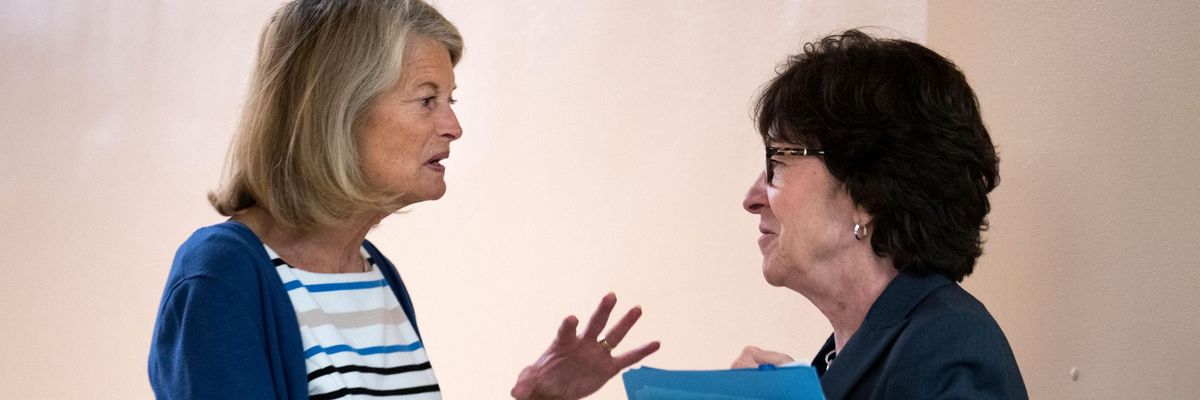
U.S. Sens. Lisa Murkowski (R-Alaska) and Susan Collins (R-Maine) converse at the U.S. Capitol on June 23, 2022. (Photo: Tom Williams/CQ-Roll Call, Inc. via Getty Images)
Collins-Murkowski Abortion Bill Denounced as 'Just Another Political Stunt'
"Unless these senators are willing to end the filibuster to pass this measure, there's no reason to take it seriously," said the head of NARAL Pro-Choice America.
As GOP-led states continue working to further restrict reproductive freedom in the wake of the U.S. Supreme Court's late June ruling, some progressive advocates on Monday responded critically to the introduction of bipartisan abortion rights legislation.
Sens. Susan Collins (R-Maine), Tim Kaine (D-Va.), Lisa Murkowski (R-Alaska), and Kyrsten Sinema (D-Ariz.) introduced the Reproductive Freedom for All Act, which they claim "would undo the damage of Dobbs v. Jackson Women's Health, the Supreme Court decision overturning Roe v. Wade."
NARAL Pro-Choice America president Mini Timmaraju declared that "this bill is just another political stunt that would not actually address the abortion rights and access crisis that has pushed care out of reach for millions of people already."
"Unless these senators are willing to end the filibuster to pass this measure, there's no reason to take it seriously," Timmaraju added.
A coalition of 15 groups including the ACLU, NARAL, Physicians for Reproductive Health (PRH), and Planned Parenthood Federation of America said in a lengthy joint statement Monday that "the crisis today demands legislative solutions that make abortion truly accessible."
"We are looking to the future and the bills that get us there--bills that protect our liberty, and strike down the political interference that denies us access to abortion and treats us as less than," the coalition continued. "Regrettably, the bill introduced does not address the abortion access crisis."
"This bill claims to 'codify' Roe v. Wade but fails to do so. In fact, it does not expressly prohibit pre-viability abortion bans, leaving states able to continue to pass abortion bans that are denying people access to essential healthcare across the country," the groups added. "This bill has been written for a world that does not exist and would provide little solace in the nightmare we are living."
According to the co-sponsors, the Reproductive Freedom for All Act would:
- Prohibit state regulations that impose an undue burden on a woman's access to pre-viability abortions, while allowing states to enact reasonable restrictions on post-viability abortions--provided that states cannot ban abortions that are necessary to protect the life or health of the mother;
- Protect access to contraceptives; and
- Preserve conscience protections.
NARAL noted that in February, then again in May--after a draft of the Dobbs decision leaked--both Collins and Murkowski refused to support the Women's Health Protection Act (WHPA), a Democrat-led bill to codify Roe, the 1973 decision that affirmed the constitutional right to abortion until it was recently overturned by the high court's far-right majority.
At least 10 Republican senators would have to join with the Democratic caucus to pass a bill, due to the filibuster rule that is backed by not only the GOP, but also Sinema and Sen. Joe Manchin (D-W.Va.), who notably opposed WHPA.
"Senate Republicans have been crystal clear about where they stand on abortion," NARAL said, pointing out that ahead of the Dobbs ruling, "47 GOP senators signed onto amicus briefs calling on the court to end" Roe.
Collins and Murkowski also helped shift the U.S. Supreme Court to the right during former President Donald Trump's tenure. Though Murkowski voted present rather than to confirm Justice Brett Kavanaugh and Collins voted against confirming Justice Amy Coney Barrett, Murkowski backed Barrett, Collins supported Kavanaugh, and they both voted for Justice Neil Gorsuch.
As The Washington Post reported Monday:
It's not clear that Senate Majority Leader Charles E. Schumer (D-N.Y.) would bring up the bill for a vote ahead of the midterm elections in November. There has been disagreement in the Democratic caucus on whether a bipartisan bill that has no chance of passage should be brought forward, which would make it more difficult for Democratic candidates to contrast themselves with Republicans. And many Democrats, Kaine said, would prefer the Democratic version of the bill, the Women's Health Protection Act, which includes fewer limitations on abortion.
Kaine calls the bill the bare minimum.
"What the four of us were trying to do was put a statutory minimum in place that replicated what the law was a day before Dobbs," he said.
The newspaper noted that Kaine also admitted their proposal does not have the support of 10 Republican senators.
Last week, Sen. Joni Ernst (R-Iowa) blocked the Right to Contraception Act. Because Sen. Ed Markey (D-Mass.) tried to pass the House-approved bill by unanimous consent, other GOP senators were not required to weigh in.
This post has been updated with the coalition statement.
We are at a crossroads
This country and this world are at a monumental crossroads. In a few short weeks, US voters will have an opportunity to beat back the forces of fascism and confront the billionaires who are rigging the economy, our media system, and our democracy, making it increasingly impossible for ordinary people to get by. We’re not just talking about the election. We’re talking about what must be done once these fascist elements are vanquished from power. We need a bolder set of solutions than what either major party has so far been willing to offer and a working-class movement ready to fight like hell for it. Trump didn't emerge from nowhere. The conditions that fueled MAGA authoritarianism were created by decades of radical neoliberal economic policies and a corrupt political system dominated by corporate interests. They slashed taxes on the super-rich, promising that the benefits would trickle down. They said giveaways to the corporate titans would make life more affordable for the rest of us. It was all bullshit. And when a bitter, betrayed populace searches for someone to blame, right-wing demagogues have little trouble finding scapegoats. People know when they're being lied to, but you won't hear any of this from the corporate media. Only independent journalism—powered and funded by people who believe in building a better world—can deliver truly trustworthy daily news. Our Fall Campaign is underway, and we need your help. To power our newsroom through the rest of the year, we need to raise $125,000 by midnight on October 31. So if you share our vision, please contribute whatever you can to sustain our work. |
As GOP-led states continue working to further restrict reproductive freedom in the wake of the U.S. Supreme Court's late June ruling, some progressive advocates on Monday responded critically to the introduction of bipartisan abortion rights legislation.
Sens. Susan Collins (R-Maine), Tim Kaine (D-Va.), Lisa Murkowski (R-Alaska), and Kyrsten Sinema (D-Ariz.) introduced the Reproductive Freedom for All Act, which they claim "would undo the damage of Dobbs v. Jackson Women's Health, the Supreme Court decision overturning Roe v. Wade."
NARAL Pro-Choice America president Mini Timmaraju declared that "this bill is just another political stunt that would not actually address the abortion rights and access crisis that has pushed care out of reach for millions of people already."
"Unless these senators are willing to end the filibuster to pass this measure, there's no reason to take it seriously," Timmaraju added.
A coalition of 15 groups including the ACLU, NARAL, Physicians for Reproductive Health (PRH), and Planned Parenthood Federation of America said in a lengthy joint statement Monday that "the crisis today demands legislative solutions that make abortion truly accessible."
"We are looking to the future and the bills that get us there--bills that protect our liberty, and strike down the political interference that denies us access to abortion and treats us as less than," the coalition continued. "Regrettably, the bill introduced does not address the abortion access crisis."
"This bill claims to 'codify' Roe v. Wade but fails to do so. In fact, it does not expressly prohibit pre-viability abortion bans, leaving states able to continue to pass abortion bans that are denying people access to essential healthcare across the country," the groups added. "This bill has been written for a world that does not exist and would provide little solace in the nightmare we are living."
According to the co-sponsors, the Reproductive Freedom for All Act would:
- Prohibit state regulations that impose an undue burden on a woman's access to pre-viability abortions, while allowing states to enact reasonable restrictions on post-viability abortions--provided that states cannot ban abortions that are necessary to protect the life or health of the mother;
- Protect access to contraceptives; and
- Preserve conscience protections.
NARAL noted that in February, then again in May--after a draft of the Dobbs decision leaked--both Collins and Murkowski refused to support the Women's Health Protection Act (WHPA), a Democrat-led bill to codify Roe, the 1973 decision that affirmed the constitutional right to abortion until it was recently overturned by the high court's far-right majority.
At least 10 Republican senators would have to join with the Democratic caucus to pass a bill, due to the filibuster rule that is backed by not only the GOP, but also Sinema and Sen. Joe Manchin (D-W.Va.), who notably opposed WHPA.
"Senate Republicans have been crystal clear about where they stand on abortion," NARAL said, pointing out that ahead of the Dobbs ruling, "47 GOP senators signed onto amicus briefs calling on the court to end" Roe.
Collins and Murkowski also helped shift the U.S. Supreme Court to the right during former President Donald Trump's tenure. Though Murkowski voted present rather than to confirm Justice Brett Kavanaugh and Collins voted against confirming Justice Amy Coney Barrett, Murkowski backed Barrett, Collins supported Kavanaugh, and they both voted for Justice Neil Gorsuch.
As The Washington Post reported Monday:
It's not clear that Senate Majority Leader Charles E. Schumer (D-N.Y.) would bring up the bill for a vote ahead of the midterm elections in November. There has been disagreement in the Democratic caucus on whether a bipartisan bill that has no chance of passage should be brought forward, which would make it more difficult for Democratic candidates to contrast themselves with Republicans. And many Democrats, Kaine said, would prefer the Democratic version of the bill, the Women's Health Protection Act, which includes fewer limitations on abortion.
Kaine calls the bill the bare minimum.
"What the four of us were trying to do was put a statutory minimum in place that replicated what the law was a day before Dobbs," he said.
The newspaper noted that Kaine also admitted their proposal does not have the support of 10 Republican senators.
Last week, Sen. Joni Ernst (R-Iowa) blocked the Right to Contraception Act. Because Sen. Ed Markey (D-Mass.) tried to pass the House-approved bill by unanimous consent, other GOP senators were not required to weigh in.
This post has been updated with the coalition statement.
As GOP-led states continue working to further restrict reproductive freedom in the wake of the U.S. Supreme Court's late June ruling, some progressive advocates on Monday responded critically to the introduction of bipartisan abortion rights legislation.
Sens. Susan Collins (R-Maine), Tim Kaine (D-Va.), Lisa Murkowski (R-Alaska), and Kyrsten Sinema (D-Ariz.) introduced the Reproductive Freedom for All Act, which they claim "would undo the damage of Dobbs v. Jackson Women's Health, the Supreme Court decision overturning Roe v. Wade."
NARAL Pro-Choice America president Mini Timmaraju declared that "this bill is just another political stunt that would not actually address the abortion rights and access crisis that has pushed care out of reach for millions of people already."
"Unless these senators are willing to end the filibuster to pass this measure, there's no reason to take it seriously," Timmaraju added.
A coalition of 15 groups including the ACLU, NARAL, Physicians for Reproductive Health (PRH), and Planned Parenthood Federation of America said in a lengthy joint statement Monday that "the crisis today demands legislative solutions that make abortion truly accessible."
"We are looking to the future and the bills that get us there--bills that protect our liberty, and strike down the political interference that denies us access to abortion and treats us as less than," the coalition continued. "Regrettably, the bill introduced does not address the abortion access crisis."
"This bill claims to 'codify' Roe v. Wade but fails to do so. In fact, it does not expressly prohibit pre-viability abortion bans, leaving states able to continue to pass abortion bans that are denying people access to essential healthcare across the country," the groups added. "This bill has been written for a world that does not exist and would provide little solace in the nightmare we are living."
According to the co-sponsors, the Reproductive Freedom for All Act would:
- Prohibit state regulations that impose an undue burden on a woman's access to pre-viability abortions, while allowing states to enact reasonable restrictions on post-viability abortions--provided that states cannot ban abortions that are necessary to protect the life or health of the mother;
- Protect access to contraceptives; and
- Preserve conscience protections.
NARAL noted that in February, then again in May--after a draft of the Dobbs decision leaked--both Collins and Murkowski refused to support the Women's Health Protection Act (WHPA), a Democrat-led bill to codify Roe, the 1973 decision that affirmed the constitutional right to abortion until it was recently overturned by the high court's far-right majority.
At least 10 Republican senators would have to join with the Democratic caucus to pass a bill, due to the filibuster rule that is backed by not only the GOP, but also Sinema and Sen. Joe Manchin (D-W.Va.), who notably opposed WHPA.
"Senate Republicans have been crystal clear about where they stand on abortion," NARAL said, pointing out that ahead of the Dobbs ruling, "47 GOP senators signed onto amicus briefs calling on the court to end" Roe.
Collins and Murkowski also helped shift the U.S. Supreme Court to the right during former President Donald Trump's tenure. Though Murkowski voted present rather than to confirm Justice Brett Kavanaugh and Collins voted against confirming Justice Amy Coney Barrett, Murkowski backed Barrett, Collins supported Kavanaugh, and they both voted for Justice Neil Gorsuch.
As The Washington Post reported Monday:
It's not clear that Senate Majority Leader Charles E. Schumer (D-N.Y.) would bring up the bill for a vote ahead of the midterm elections in November. There has been disagreement in the Democratic caucus on whether a bipartisan bill that has no chance of passage should be brought forward, which would make it more difficult for Democratic candidates to contrast themselves with Republicans. And many Democrats, Kaine said, would prefer the Democratic version of the bill, the Women's Health Protection Act, which includes fewer limitations on abortion.
Kaine calls the bill the bare minimum.
"What the four of us were trying to do was put a statutory minimum in place that replicated what the law was a day before Dobbs," he said.
The newspaper noted that Kaine also admitted their proposal does not have the support of 10 Republican senators.
Last week, Sen. Joni Ernst (R-Iowa) blocked the Right to Contraception Act. Because Sen. Ed Markey (D-Mass.) tried to pass the House-approved bill by unanimous consent, other GOP senators were not required to weigh in.
This post has been updated with the coalition statement.