SUBSCRIBE TO OUR FREE NEWSLETTER
Daily news & progressive opinion—funded by the people, not the corporations—delivered straight to your inbox.
5
#000000
#FFFFFF
To donate by check, phone, or other method, see our More Ways to Give page.
Daily news & progressive opinion—funded by the people, not the corporations—delivered straight to your inbox.
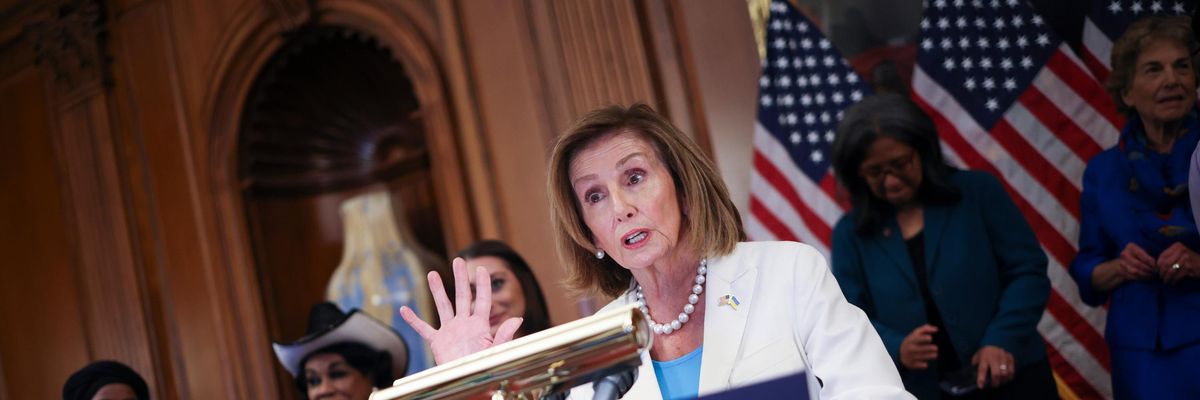
U.S. Speaker of the House Nancy Pelosi (D-Calif.) speaks on Capitol Hill on July 20, 2022 in Washington, D.C. (Photo: Win McNamee/Getty Images)
With many lawmakers expressing disbelief that a law codifying the right to use birth control is needed in the U.S. in 2022, House Democrats passed the Right to Contraception Act on Thursday--joined by just eight Republicans as the party denied access to contraception is under attack.
All 220 Democrats voted in favor of the bill.
"One hundred ninety-five House Republicans just voted against protecting your right to access contraception," said Rep. Bonnie Watson Coleman (D-N.J.).
"Birth control is a basic form of healthcare we ALL deserve to access."
The legislation defines contraception as "any drug, device, or biological product intended for use in the prevention of pregnancy, whether specifically intended to prevent pregnancy or for other health needs, that is legally marketed under the Federal Food, Drug, and Cosmetic Act, such as oral contraceptives, long-acting reversible contraceptives, emergency contraceptives, internal and external condoms, injectables, vaginal barrier methods, transdermal patches, and vaginal rings, or other contraceptives."
Rep. Kathy Manning (D-N.C.) introduced the bill weeks after the U.S. Supreme Court's right-wing majority overturned Roe v. Wade, eliminating the right to abortion care for millions of women and likely reducing access to abortions even in states where the right is still protected.
In an opinion concurring with the ruling, Justice Clarence Thomas wrote that "in future cases, we should reconsider all of the Court's substantive due process precedents, including Griswold, Lawrence, and Obergefell," naming cases that affirmed Americans have the right to contraception, same-sex relationships, and marriage equality.
Thursday's vote showed that opposition to contraceptive rights "is not just an opinion of one man," said Rep. Andy Kim (D-N.J.). "This is their plan."
"If they had the chance they would ban" contraception, Rep. Ilhan Omar (D-Minn.) added.
Earlier this week, the House passed a bill codifying the right of same-sex couples to marry, with the vast majority of Republicans voting against it.
After the ruling overturning Roe was handed down, a health system in Missouri--where abortion is now banned--temporarily stopped providing emergency contraception, better known as Plan B, saying the state needed to "better define" its abortion ban.
Republicans in Missouri have also tried to stop Medicaid funding from being used for contraception.
GOP legislators on Thursday, however, claimed the right to access contraception is not being threatened, with Rep. Cathy McMorris Rodgers (R-Wash.) accusing the Democrats of "spreading fear and misinformation" and calling the bill "a Trojan horse for more abortions."
After the House bill passed, advocates called on the Senate to promptly pass the Right to Contraception Act, which was introduced by Sens. Ed Markey (D-Mass.), Tammy Duckworth (D-Ill.), and Mazie Hirono (D-Hawaii) this week.
Republicans in the Senate have also denied people are at risk of losing their right to use contraception, with Sen. John Cornyn (R-Texas) calling the Democrats' efforts "pure hysteria."
"Birth control is a basic form of healthcare we ALL deserve to access," said the Leadership Conference on Civil and Human Rights after the House bill was passed. "Senate must follow."
Dear Common Dreams reader, It’s been nearly 30 years since I co-founded Common Dreams with my late wife, Lina Newhouser. We had the radical notion that journalism should serve the public good, not corporate profits. It was clear to us from the outset what it would take to build such a project. No paid advertisements. No corporate sponsors. No millionaire publisher telling us what to think or do. Many people said we wouldn't last a year, but we proved those doubters wrong. Together with a tremendous team of journalists and dedicated staff, we built an independent media outlet free from the constraints of profits and corporate control. Our mission has always been simple: To inform. To inspire. To ignite change for the common good. Building Common Dreams was not easy. Our survival was never guaranteed. When you take on the most powerful forces—Wall Street greed, fossil fuel industry destruction, Big Tech lobbyists, and uber-rich oligarchs who have spent billions upon billions rigging the economy and democracy in their favor—the only bulwark you have is supporters who believe in your work. But here’s the urgent message from me today. It's never been this bad out there. And it's never been this hard to keep us going. At the very moment Common Dreams is most needed, the threats we face are intensifying. We need your support now more than ever. We don't accept corporate advertising and never will. We don't have a paywall because we don't think people should be blocked from critical news based on their ability to pay. Everything we do is funded by the donations of readers like you. When everyone does the little they can afford, we are strong. But if that support retreats or dries up, so do we. Will you donate now to make sure Common Dreams not only survives but thrives? —Craig Brown, Co-founder |
With many lawmakers expressing disbelief that a law codifying the right to use birth control is needed in the U.S. in 2022, House Democrats passed the Right to Contraception Act on Thursday--joined by just eight Republicans as the party denied access to contraception is under attack.
All 220 Democrats voted in favor of the bill.
"One hundred ninety-five House Republicans just voted against protecting your right to access contraception," said Rep. Bonnie Watson Coleman (D-N.J.).
"Birth control is a basic form of healthcare we ALL deserve to access."
The legislation defines contraception as "any drug, device, or biological product intended for use in the prevention of pregnancy, whether specifically intended to prevent pregnancy or for other health needs, that is legally marketed under the Federal Food, Drug, and Cosmetic Act, such as oral contraceptives, long-acting reversible contraceptives, emergency contraceptives, internal and external condoms, injectables, vaginal barrier methods, transdermal patches, and vaginal rings, or other contraceptives."
Rep. Kathy Manning (D-N.C.) introduced the bill weeks after the U.S. Supreme Court's right-wing majority overturned Roe v. Wade, eliminating the right to abortion care for millions of women and likely reducing access to abortions even in states where the right is still protected.
In an opinion concurring with the ruling, Justice Clarence Thomas wrote that "in future cases, we should reconsider all of the Court's substantive due process precedents, including Griswold, Lawrence, and Obergefell," naming cases that affirmed Americans have the right to contraception, same-sex relationships, and marriage equality.
Thursday's vote showed that opposition to contraceptive rights "is not just an opinion of one man," said Rep. Andy Kim (D-N.J.). "This is their plan."
"If they had the chance they would ban" contraception, Rep. Ilhan Omar (D-Minn.) added.
Earlier this week, the House passed a bill codifying the right of same-sex couples to marry, with the vast majority of Republicans voting against it.
After the ruling overturning Roe was handed down, a health system in Missouri--where abortion is now banned--temporarily stopped providing emergency contraception, better known as Plan B, saying the state needed to "better define" its abortion ban.
Republicans in Missouri have also tried to stop Medicaid funding from being used for contraception.
GOP legislators on Thursday, however, claimed the right to access contraception is not being threatened, with Rep. Cathy McMorris Rodgers (R-Wash.) accusing the Democrats of "spreading fear and misinformation" and calling the bill "a Trojan horse for more abortions."
After the House bill passed, advocates called on the Senate to promptly pass the Right to Contraception Act, which was introduced by Sens. Ed Markey (D-Mass.), Tammy Duckworth (D-Ill.), and Mazie Hirono (D-Hawaii) this week.
Republicans in the Senate have also denied people are at risk of losing their right to use contraception, with Sen. John Cornyn (R-Texas) calling the Democrats' efforts "pure hysteria."
"Birth control is a basic form of healthcare we ALL deserve to access," said the Leadership Conference on Civil and Human Rights after the House bill was passed. "Senate must follow."
With many lawmakers expressing disbelief that a law codifying the right to use birth control is needed in the U.S. in 2022, House Democrats passed the Right to Contraception Act on Thursday--joined by just eight Republicans as the party denied access to contraception is under attack.
All 220 Democrats voted in favor of the bill.
"One hundred ninety-five House Republicans just voted against protecting your right to access contraception," said Rep. Bonnie Watson Coleman (D-N.J.).
"Birth control is a basic form of healthcare we ALL deserve to access."
The legislation defines contraception as "any drug, device, or biological product intended for use in the prevention of pregnancy, whether specifically intended to prevent pregnancy or for other health needs, that is legally marketed under the Federal Food, Drug, and Cosmetic Act, such as oral contraceptives, long-acting reversible contraceptives, emergency contraceptives, internal and external condoms, injectables, vaginal barrier methods, transdermal patches, and vaginal rings, or other contraceptives."
Rep. Kathy Manning (D-N.C.) introduced the bill weeks after the U.S. Supreme Court's right-wing majority overturned Roe v. Wade, eliminating the right to abortion care for millions of women and likely reducing access to abortions even in states where the right is still protected.
In an opinion concurring with the ruling, Justice Clarence Thomas wrote that "in future cases, we should reconsider all of the Court's substantive due process precedents, including Griswold, Lawrence, and Obergefell," naming cases that affirmed Americans have the right to contraception, same-sex relationships, and marriage equality.
Thursday's vote showed that opposition to contraceptive rights "is not just an opinion of one man," said Rep. Andy Kim (D-N.J.). "This is their plan."
"If they had the chance they would ban" contraception, Rep. Ilhan Omar (D-Minn.) added.
Earlier this week, the House passed a bill codifying the right of same-sex couples to marry, with the vast majority of Republicans voting against it.
After the ruling overturning Roe was handed down, a health system in Missouri--where abortion is now banned--temporarily stopped providing emergency contraception, better known as Plan B, saying the state needed to "better define" its abortion ban.
Republicans in Missouri have also tried to stop Medicaid funding from being used for contraception.
GOP legislators on Thursday, however, claimed the right to access contraception is not being threatened, with Rep. Cathy McMorris Rodgers (R-Wash.) accusing the Democrats of "spreading fear and misinformation" and calling the bill "a Trojan horse for more abortions."
After the House bill passed, advocates called on the Senate to promptly pass the Right to Contraception Act, which was introduced by Sens. Ed Markey (D-Mass.), Tammy Duckworth (D-Ill.), and Mazie Hirono (D-Hawaii) this week.
Republicans in the Senate have also denied people are at risk of losing their right to use contraception, with Sen. John Cornyn (R-Texas) calling the Democrats' efforts "pure hysteria."
"Birth control is a basic form of healthcare we ALL deserve to access," said the Leadership Conference on Civil and Human Rights after the House bill was passed. "Senate must follow."