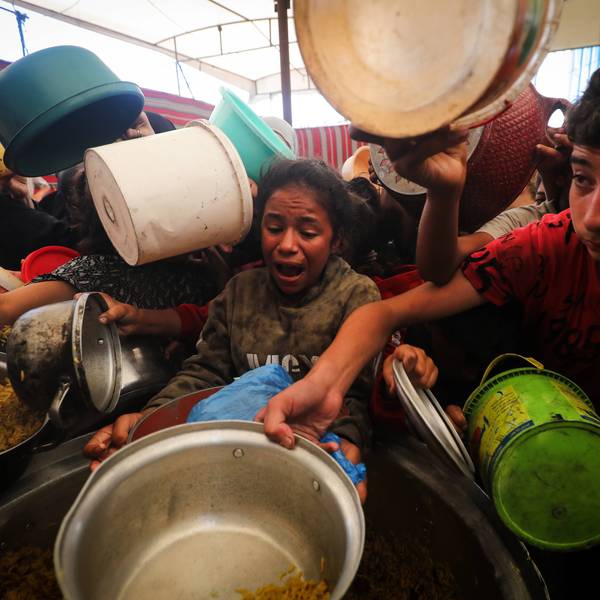


A Palestinian man works in a wheat mill in Rafah, in the southern Gaza Strip, on March 21, 2022. (Photo: Said Khatib/AFP via Getty Images)
Aid Group Warns Palestine Wheat Reserves Could Soon Run Out Amid Ukraine Crisis
"The reliance on imports and the constraints forced upon them by Israel's continuing military occupation, settler violence, and land grabs are compounding the food crisis," said Oxfam International.
The humanitarian group Oxfam International warned Monday that wheat flour reserves in the occupied Palestinian territories could run out within the next three weeks as Russia's assault on Ukraine continues, pushing prices to all-time highs and throwing the global grain market into chaos.
"Palestinian households are being hit hard by rising global food prices, and many are struggling to meet their basic needs."
Prior to the war, Russia and Ukraine together supplied nearly 30% of the world's wheat, with a large portion of its exports going to the Middle East.
The Palestinian Authority, which governs part of the Israeli-occupied West Bank, imports around 95% of its wheat, according to Oxfam. Israel, which often throttles the occupied territories' trading and restricts their agricultural development, imports half of its grain and cereals from Ukraine.
If Russia's war on Ukraine continues, Oxfam noted, experts believe the Palestinian territories' diminishing wheat stocks could be exhausted in two to three weeks.
"Palestinian households are being hit hard by rising global food prices, and many are struggling to meet their basic needs," said Shane Stevenson, Oxfam's country director in the occupied Palestinian territories and Israel. "The reliance on imports and the constraints forced upon them by Israel's continuing military occupation, settler violence, and land grabs are compounding the food crisis."
Oxfam reported that food insecurity across the Palestinian territories has jumped to 31.2%, and roughly 2.1 million people there will require humanitarian assistance this year.
To prevent the hunger crisis in the territories from intensifying, Oxfam called on the international community to "urgently adopt a common and coordinated economic and diplomatic position that challenges Israel's restrictive policies and allows Palestinians to invest in local food production and infrastructure."
"It is difficult to describe the true level of damage that all this is causing on people's lives--it is devastating."
"Every day we meet people who are searching for jobs and money just to feed their children. We feel very stuck at this stage," Najla Shawa, Oxfam's head of food security in Gaza, said in a statement Monday. "How can we draw attention from the international community to the deteriorating socio-economic situation in Gaza?"
"Our work in Gaza is becoming increasingly challenging," Shawa added. "It is difficult to describe the true level of damage that all this is causing on people's lives--it is devastating."
Last week, the U.N. Food and Agriculture Organization (FAO) said that global food prices soared to record levels in March, driven by the rising costs of cereals and vegetable oils. Ukraine is the world's largest exporter of sunflower oil.
Price surges and war-induced supply chain disruptions are endangering the food supply of millions of people in Yemen and other nations ravaged by years of military conflict.
The World Food Programme, which purchases half of its grain from Ukraine, noted in March that "imports from Ukraine account for 31% of the wheat arriving in Yemen in the past three months--prices are suddenly seven times higher than they were in 2015."
We are at a crossroads
This country and this world are at a monumental crossroads. In a few short weeks, US voters will have an opportunity to beat back the forces of fascism and confront the billionaires who are rigging the economy, our media system, and our democracy, making it increasingly impossible for ordinary people to get by. We’re not just talking about the election. We’re talking about what must be done once these fascist elements are vanquished from power. We need a bolder set of solutions than what either major party has so far been willing to offer and a working-class movement ready to fight like hell for it. Trump didn't emerge from nowhere. The conditions that fueled MAGA authoritarianism were created by decades of radical neoliberal economic policies and a corrupt political system dominated by corporate interests. They slashed taxes on the super-rich, promising that the benefits would trickle down. They said giveaways to the corporate titans would make life more affordable for the rest of us. It was all bullshit. And when a bitter, betrayed populace searches for someone to blame, right-wing demagogues have little trouble finding scapegoats. People know when they're being lied to, but you won't hear any of this from the corporate media. Only independent journalism—powered and funded by people who believe in building a better world—can deliver truly trustworthy daily news. Our Fall Campaign is underway, and we need your help. To power our newsroom through the rest of the year, we need to raise $125,000 by midnight on October 31. So if you share our vision, please contribute whatever you can to sustain our work. |
The humanitarian group Oxfam International warned Monday that wheat flour reserves in the occupied Palestinian territories could run out within the next three weeks as Russia's assault on Ukraine continues, pushing prices to all-time highs and throwing the global grain market into chaos.
"Palestinian households are being hit hard by rising global food prices, and many are struggling to meet their basic needs."
Prior to the war, Russia and Ukraine together supplied nearly 30% of the world's wheat, with a large portion of its exports going to the Middle East.
The Palestinian Authority, which governs part of the Israeli-occupied West Bank, imports around 95% of its wheat, according to Oxfam. Israel, which often throttles the occupied territories' trading and restricts their agricultural development, imports half of its grain and cereals from Ukraine.
If Russia's war on Ukraine continues, Oxfam noted, experts believe the Palestinian territories' diminishing wheat stocks could be exhausted in two to three weeks.
"Palestinian households are being hit hard by rising global food prices, and many are struggling to meet their basic needs," said Shane Stevenson, Oxfam's country director in the occupied Palestinian territories and Israel. "The reliance on imports and the constraints forced upon them by Israel's continuing military occupation, settler violence, and land grabs are compounding the food crisis."
Oxfam reported that food insecurity across the Palestinian territories has jumped to 31.2%, and roughly 2.1 million people there will require humanitarian assistance this year.
To prevent the hunger crisis in the territories from intensifying, Oxfam called on the international community to "urgently adopt a common and coordinated economic and diplomatic position that challenges Israel's restrictive policies and allows Palestinians to invest in local food production and infrastructure."
"It is difficult to describe the true level of damage that all this is causing on people's lives--it is devastating."
"Every day we meet people who are searching for jobs and money just to feed their children. We feel very stuck at this stage," Najla Shawa, Oxfam's head of food security in Gaza, said in a statement Monday. "How can we draw attention from the international community to the deteriorating socio-economic situation in Gaza?"
"Our work in Gaza is becoming increasingly challenging," Shawa added. "It is difficult to describe the true level of damage that all this is causing on people's lives--it is devastating."
Last week, the U.N. Food and Agriculture Organization (FAO) said that global food prices soared to record levels in March, driven by the rising costs of cereals and vegetable oils. Ukraine is the world's largest exporter of sunflower oil.
Price surges and war-induced supply chain disruptions are endangering the food supply of millions of people in Yemen and other nations ravaged by years of military conflict.
The World Food Programme, which purchases half of its grain from Ukraine, noted in March that "imports from Ukraine account for 31% of the wheat arriving in Yemen in the past three months--prices are suddenly seven times higher than they were in 2015."
The humanitarian group Oxfam International warned Monday that wheat flour reserves in the occupied Palestinian territories could run out within the next three weeks as Russia's assault on Ukraine continues, pushing prices to all-time highs and throwing the global grain market into chaos.
"Palestinian households are being hit hard by rising global food prices, and many are struggling to meet their basic needs."
Prior to the war, Russia and Ukraine together supplied nearly 30% of the world's wheat, with a large portion of its exports going to the Middle East.
The Palestinian Authority, which governs part of the Israeli-occupied West Bank, imports around 95% of its wheat, according to Oxfam. Israel, which often throttles the occupied territories' trading and restricts their agricultural development, imports half of its grain and cereals from Ukraine.
If Russia's war on Ukraine continues, Oxfam noted, experts believe the Palestinian territories' diminishing wheat stocks could be exhausted in two to three weeks.
"Palestinian households are being hit hard by rising global food prices, and many are struggling to meet their basic needs," said Shane Stevenson, Oxfam's country director in the occupied Palestinian territories and Israel. "The reliance on imports and the constraints forced upon them by Israel's continuing military occupation, settler violence, and land grabs are compounding the food crisis."
Oxfam reported that food insecurity across the Palestinian territories has jumped to 31.2%, and roughly 2.1 million people there will require humanitarian assistance this year.
To prevent the hunger crisis in the territories from intensifying, Oxfam called on the international community to "urgently adopt a common and coordinated economic and diplomatic position that challenges Israel's restrictive policies and allows Palestinians to invest in local food production and infrastructure."
"It is difficult to describe the true level of damage that all this is causing on people's lives--it is devastating."
"Every day we meet people who are searching for jobs and money just to feed their children. We feel very stuck at this stage," Najla Shawa, Oxfam's head of food security in Gaza, said in a statement Monday. "How can we draw attention from the international community to the deteriorating socio-economic situation in Gaza?"
"Our work in Gaza is becoming increasingly challenging," Shawa added. "It is difficult to describe the true level of damage that all this is causing on people's lives--it is devastating."
Last week, the U.N. Food and Agriculture Organization (FAO) said that global food prices soared to record levels in March, driven by the rising costs of cereals and vegetable oils. Ukraine is the world's largest exporter of sunflower oil.
Price surges and war-induced supply chain disruptions are endangering the food supply of millions of people in Yemen and other nations ravaged by years of military conflict.
The World Food Programme, which purchases half of its grain from Ukraine, noted in March that "imports from Ukraine account for 31% of the wheat arriving in Yemen in the past three months--prices are suddenly seven times higher than they were in 2015."