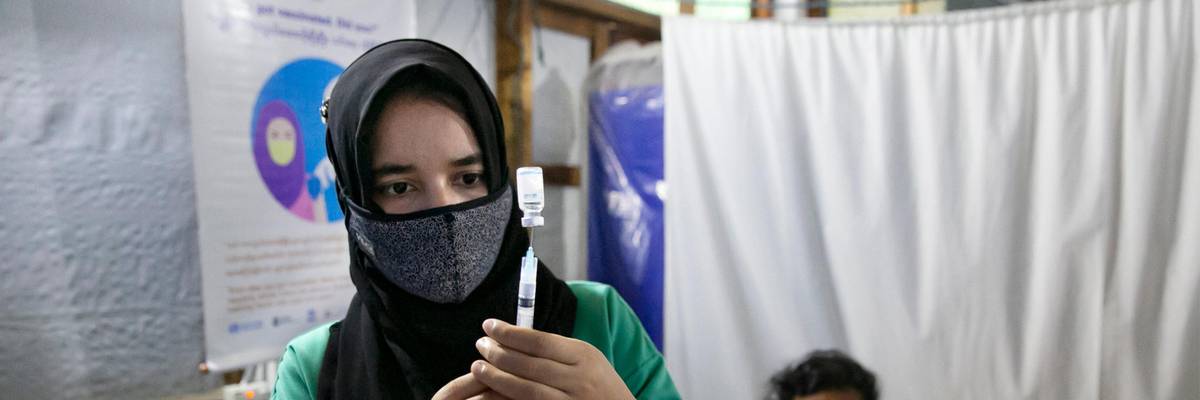
A nurse fills a syringe with a Covid-19 vaccine in a Rohingya refugee camp on August 11, 2021 in Bangladesh. (Photo: Allison Joyce/Getty Images)
UN Experts Denounce 'Truly Shocking' Magnitude of Inequality Revealed by Pandemic
At a panel on Tuesday, officials condemned vaccine apartheid, rising food insecurity, and other markers of inequality that have been exacerbated by the pandemic.
Sep 29, 2021
United Nations human rights officials on Tuesday decried the "truly shocking" levels of inequality that have been exposed and exacerbated by the coronavirus pandemic--from the unequal availability of vaccines to increases in food and housing insecurity across the globe.
With 78% of vaccine doses administered in wealthy and upper-middle-income countries and fewer than 1% distributed in the Global South, one international expert said at a meeting of the U.N. Human Rights Council that "the impact of Covid-19 was determined less by biological factors and determined more by structural and socioeconomic inequality, systemic racism, and discrimination."
"States must act together, in solidarity, to fairly distribute vaccines and help each other combat the impacts of Covid-19."
--Michelle Bachelet, U.N. High Commissioner for Human Rights
"Vaccine nationalism and profiteering around supply and demand approaches to vaccine production and distribution [is] a human rights violation and abuse being committed by states and businesses alike," Dr. Tlaleng Mofokeng, special rapporteur on the right to physical and mental health, told the council, according to a U.N. report on the meeting.
The inequality of the vaccine rollout has been perpetuated by policy choices in the wealthiest countries in the world, including Germany and the United Kingdom, where officials have not expressed support for waiving patent protections for Covid-19 immunizations.
"States must act together, in solidarity, to fairly distribute vaccines and help each other combat the impacts of Covid-19," said Michelle Bachelet, U.N. High Commissioner for Human Rights.
The "crisis of vaccine inequity continues to drive deeper divides into the heart of the international community," she added, with countries including Congo, Haiti, and South Sudan among the least vaccinated.
"Data suggest that most people in the poorest countries will need to wait another two years before they are vaccinated against Covid-19," said Mofokeng.
Bachelet also said the pandemic has exposed people around the world to "economic and social shock," with as many as 124 million people pushed into extreme poverty since the worldwide public health crisis began in 2020.
The meeting came two months after an Oxfam report revealed that more than half a million people in some of the poorest countries in the world are facing famine-like conditions--an increase of 500% since the pandemic started, as Common Dreams reported in July.
Bachelet noted at Tuesday's panel that according to the Food and Agricultural Organization (FAO), "the number of people living with food insecurity had risen by 318 million... amounting to an unprecedented 2.38 billion people."
The level of economic inequality facing countries around the world quickly became apparent when the pandemic began, economist and Nobel Laureate Joseph Stiglitz told the panel, noting that the coronavirus has not been "an equal opportunity virus."
"It has had a devastating effect on the bottom parts of our economy, our society," Stiglitz said. "Most of them have been able to carry on, continuing their jobs on Zoom, continuing their incomes, almost without interruption."
That dynamic has been apparent in the United States, with studies showing since the pandemic began that many of the approximately 50 million frontline essential workers have faced heightened Covid-19 transmission risk at work.
Meanwhile, Stiglitz added, "those at the top, many of them have done very well," in reference to moguls including Amazon founder Jeff Bezos and SpaceX founder Elon Musk, whose fortunes have skyrocketed since the pandemic began. According to a report released last month by the Institute for Policy Studies, U.S. billionaires have seen their wealth collectively grow by $1.8 trillion, or 62%, since March 2020.
Bachelet reiterated a call that's been heard for months from rights advocates for a pandemic recovery that is "built on the bedrock of human rights and in meaningful consultation with civil society."
"There must be steps to uphold universal healthcare, universal social protections, and other fundamental rights to protect societies from harm, and make all communities more resilient," said the high commissioner.
We are at a crossroads
This country and this world are at a monumental crossroads. In a few short weeks, US voters will have an opportunity to beat back the forces of fascism and confront the billionaires who are rigging the economy, our media system, and our democracy, making it increasingly impossible for ordinary people to get by. We’re not just talking about the election. We’re talking about what must be done once these fascist elements are vanquished from power. We need a bolder set of solutions than what either major party has so far been willing to offer and a working-class movement ready to fight like hell for it. Trump didn't emerge from nowhere. The conditions that fueled MAGA authoritarianism were created by decades of radical neoliberal economic policies and a corrupt political system dominated by corporate interests. They slashed taxes on the super-rich, promising that the benefits would trickle down. They said giveaways to the corporate titans would make life more affordable for the rest of us. It was all bullshit. And when a bitter, betrayed populace searches for someone to blame, right-wing demagogues have little trouble finding scapegoats. People know when they're being lied to, but you won't hear any of this from the corporate media. Only independent journalism—powered and funded by people who believe in building a better world—can deliver truly trustworthy daily news. Our Fall Campaign is underway, and we need your help. To power our newsroom through the rest of the year, we need to raise $125,000 by midnight on October 31. So if you share our vision, please contribute whatever you can to sustain our work. |
Our work is licensed under Creative Commons (CC BY-NC-ND 3.0). Feel free to republish and share widely.
United Nations human rights officials on Tuesday decried the "truly shocking" levels of inequality that have been exposed and exacerbated by the coronavirus pandemic--from the unequal availability of vaccines to increases in food and housing insecurity across the globe.
With 78% of vaccine doses administered in wealthy and upper-middle-income countries and fewer than 1% distributed in the Global South, one international expert said at a meeting of the U.N. Human Rights Council that "the impact of Covid-19 was determined less by biological factors and determined more by structural and socioeconomic inequality, systemic racism, and discrimination."
"States must act together, in solidarity, to fairly distribute vaccines and help each other combat the impacts of Covid-19."
--Michelle Bachelet, U.N. High Commissioner for Human Rights
"Vaccine nationalism and profiteering around supply and demand approaches to vaccine production and distribution [is] a human rights violation and abuse being committed by states and businesses alike," Dr. Tlaleng Mofokeng, special rapporteur on the right to physical and mental health, told the council, according to a U.N. report on the meeting.
The inequality of the vaccine rollout has been perpetuated by policy choices in the wealthiest countries in the world, including Germany and the United Kingdom, where officials have not expressed support for waiving patent protections for Covid-19 immunizations.
"States must act together, in solidarity, to fairly distribute vaccines and help each other combat the impacts of Covid-19," said Michelle Bachelet, U.N. High Commissioner for Human Rights.
The "crisis of vaccine inequity continues to drive deeper divides into the heart of the international community," she added, with countries including Congo, Haiti, and South Sudan among the least vaccinated.
"Data suggest that most people in the poorest countries will need to wait another two years before they are vaccinated against Covid-19," said Mofokeng.
Bachelet also said the pandemic has exposed people around the world to "economic and social shock," with as many as 124 million people pushed into extreme poverty since the worldwide public health crisis began in 2020.
The meeting came two months after an Oxfam report revealed that more than half a million people in some of the poorest countries in the world are facing famine-like conditions--an increase of 500% since the pandemic started, as Common Dreams reported in July.
Bachelet noted at Tuesday's panel that according to the Food and Agricultural Organization (FAO), "the number of people living with food insecurity had risen by 318 million... amounting to an unprecedented 2.38 billion people."
The level of economic inequality facing countries around the world quickly became apparent when the pandemic began, economist and Nobel Laureate Joseph Stiglitz told the panel, noting that the coronavirus has not been "an equal opportunity virus."
"It has had a devastating effect on the bottom parts of our economy, our society," Stiglitz said. "Most of them have been able to carry on, continuing their jobs on Zoom, continuing their incomes, almost without interruption."
That dynamic has been apparent in the United States, with studies showing since the pandemic began that many of the approximately 50 million frontline essential workers have faced heightened Covid-19 transmission risk at work.
Meanwhile, Stiglitz added, "those at the top, many of them have done very well," in reference to moguls including Amazon founder Jeff Bezos and SpaceX founder Elon Musk, whose fortunes have skyrocketed since the pandemic began. According to a report released last month by the Institute for Policy Studies, U.S. billionaires have seen their wealth collectively grow by $1.8 trillion, or 62%, since March 2020.
Bachelet reiterated a call that's been heard for months from rights advocates for a pandemic recovery that is "built on the bedrock of human rights and in meaningful consultation with civil society."
"There must be steps to uphold universal healthcare, universal social protections, and other fundamental rights to protect societies from harm, and make all communities more resilient," said the high commissioner.
United Nations human rights officials on Tuesday decried the "truly shocking" levels of inequality that have been exposed and exacerbated by the coronavirus pandemic--from the unequal availability of vaccines to increases in food and housing insecurity across the globe.
With 78% of vaccine doses administered in wealthy and upper-middle-income countries and fewer than 1% distributed in the Global South, one international expert said at a meeting of the U.N. Human Rights Council that "the impact of Covid-19 was determined less by biological factors and determined more by structural and socioeconomic inequality, systemic racism, and discrimination."
"States must act together, in solidarity, to fairly distribute vaccines and help each other combat the impacts of Covid-19."
--Michelle Bachelet, U.N. High Commissioner for Human Rights
"Vaccine nationalism and profiteering around supply and demand approaches to vaccine production and distribution [is] a human rights violation and abuse being committed by states and businesses alike," Dr. Tlaleng Mofokeng, special rapporteur on the right to physical and mental health, told the council, according to a U.N. report on the meeting.
The inequality of the vaccine rollout has been perpetuated by policy choices in the wealthiest countries in the world, including Germany and the United Kingdom, where officials have not expressed support for waiving patent protections for Covid-19 immunizations.
"States must act together, in solidarity, to fairly distribute vaccines and help each other combat the impacts of Covid-19," said Michelle Bachelet, U.N. High Commissioner for Human Rights.
The "crisis of vaccine inequity continues to drive deeper divides into the heart of the international community," she added, with countries including Congo, Haiti, and South Sudan among the least vaccinated.
"Data suggest that most people in the poorest countries will need to wait another two years before they are vaccinated against Covid-19," said Mofokeng.
Bachelet also said the pandemic has exposed people around the world to "economic and social shock," with as many as 124 million people pushed into extreme poverty since the worldwide public health crisis began in 2020.
The meeting came two months after an Oxfam report revealed that more than half a million people in some of the poorest countries in the world are facing famine-like conditions--an increase of 500% since the pandemic started, as Common Dreams reported in July.
Bachelet noted at Tuesday's panel that according to the Food and Agricultural Organization (FAO), "the number of people living with food insecurity had risen by 318 million... amounting to an unprecedented 2.38 billion people."
The level of economic inequality facing countries around the world quickly became apparent when the pandemic began, economist and Nobel Laureate Joseph Stiglitz told the panel, noting that the coronavirus has not been "an equal opportunity virus."
"It has had a devastating effect on the bottom parts of our economy, our society," Stiglitz said. "Most of them have been able to carry on, continuing their jobs on Zoom, continuing their incomes, almost without interruption."
That dynamic has been apparent in the United States, with studies showing since the pandemic began that many of the approximately 50 million frontline essential workers have faced heightened Covid-19 transmission risk at work.
Meanwhile, Stiglitz added, "those at the top, many of them have done very well," in reference to moguls including Amazon founder Jeff Bezos and SpaceX founder Elon Musk, whose fortunes have skyrocketed since the pandemic began. According to a report released last month by the Institute for Policy Studies, U.S. billionaires have seen their wealth collectively grow by $1.8 trillion, or 62%, since March 2020.
Bachelet reiterated a call that's been heard for months from rights advocates for a pandemic recovery that is "built on the bedrock of human rights and in meaningful consultation with civil society."
"There must be steps to uphold universal healthcare, universal social protections, and other fundamental rights to protect societies from harm, and make all communities more resilient," said the high commissioner.
We've had enough. The 1% own and operate the corporate media. They are doing everything they can to defend the status quo, squash dissent and protect the wealthy and the powerful. The Common Dreams media model is different. We cover the news that matters to the 99%. Our mission? To inform. To inspire. To ignite change for the common good. How? Nonprofit. Independent. Reader-supported. Free to read. Free to republish. Free to share. With no advertising. No paywalls. No selling of your data. Thousands of small donations fund our newsroom and allow us to continue publishing. Can you chip in? We can't do it without you. Thank you.
To inform. To inspire. To ignite change for the common good.
News & Opinion
Trending
Common Dreams, Inc. Founded 1997. Registered 501(c3) Non-Profit
Privacy Policy