SUBSCRIBE TO OUR FREE NEWSLETTER
Daily news & progressive opinion—funded by the people, not the corporations—delivered straight to your inbox.
5
#000000
#FFFFFF
To donate by check, phone, or other method, see our More Ways to Give page.
Daily news & progressive opinion—funded by the people, not the corporations—delivered straight to your inbox.
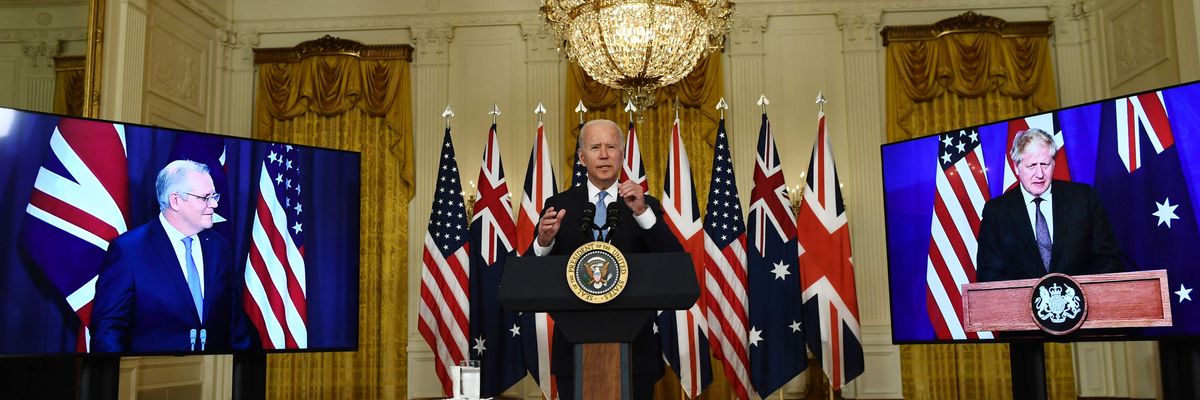
U.S. President Joe Biden participates is a virtual press conference with British Prime Minister Boris Johnson (right) and Australian Prime Minister Scott Morrison (left) in the East Room of the White House in Washington, D.C. on September 15, 2021. (Photo: Brendan Smialowski/AFP via Getty Images)
Echoing concerns raised by international activists over the perils posed by the three-nation AUKUS agreement, delegates at the U.K. Labour Conference on Monday voted to condemn the new military pact between Australia, the United Kingdom, and the United States as a threat to world peace.
"I want to live in a peaceful world. And if we've got differences with people, as we have on human rights, then challenge... then support those in those societies that are demanding their rights."
--Jeremy Corbyn, Labour MP
Labour Party members voted 70.35% to 29.65% on the motion condemning AUKUS during the Brighton conference, according to The Independent. The Labour delegates join global peace advocates and nations including China--whom critics say the pact seeks to contain--in denouncing the agreement.
Countering Conservative British Prime Minister Boris Johnson's claim that AUKUS will "promote stability" in the Indo-Pacific region, the motion stated that "this is a dangerous move which will undermine world peace," and that the conference "resolves to oppose the AUKUS agreement and make appropriate moves to de-escalate the situation."
The Guardian called the motion "an embarrassment" for Labour Leader Keir Starmer, who recently told Parliament that the party "welcomes" the "increased cooperation" with Britain's allies.
In a further embarrassment, the motion's results were announced shortly after John Healey, the shadow secretary of state for defense, declared that "Britain will be democracy's most reliable ally," and that the country "will no longer be half-hearted about essential alliances and treaties."
Jeremy Corbyn, the former Labour leader who represents Islington North in Parliament, called AUKUS "crazy beyond belief" during a peace conference over the weekend.
Speaking Saturday at The World Transformed conference--also in Brighton--Corbyn rejected the notion that Britain, a country of "65 million people, northwest coast of Europe, tiny proportion of the world's population, should have a global arms presence and involve ourselves in an alliance that can only lead to rearmament of the West and of China, and of Russia at the same time."
"I want to live in a peaceful world," Corbyn said. "And if we've got differences with people, as we have on human rights, then challenge, then take it up, then support those in those societies that are demanding their rights, work with them."
"But the idea we're going to sort of bomb our way into these things is simply not very sensible," he added. "Let's learn the lessons of Afghanistan and Iraq, of Libya, of Syria, and talk to the 70 million people who are refugees around the world, many of whom are victims of war. We can do things differently."
Under the AUKUS agreement, Australia will acquire its first nuclear submarine fleet, a development that has alarmed China, enraged and humiliated France--with whom Canberra reneged on a deal to purchase diesel subs--and placed New Zealand, a nuclear-free state, in the position of having to ban some of its closest ally's naval vessels from entering its waters.
However, it is the specter of an accelerated regional nuclear arms race that has raised the most alarm among AUKUS opponents, as well as critics of the Quadrilateral Security Dialog--the so-called "Quad"--a strategic engagement between Australia, India, Japan, and the United States. Beijing warily eyed a meeting of "Quad" leaders last Friday at the White House in Washington, D.C.
Carol Turner of the Labour Campaign for Nuclear Disarmament wrote last week that "far from promoting stability in the Indo-Pacific, AUKUS will generate greater military tension that could contribute to another round of nuclear proliferation."
"AUKUS is the next step in a new cold war with China," she added. "It makes the Indo-Pacific, and the world, a more dangerous, not a more stable, place."
Dear Common Dreams reader, It’s been nearly 30 years since I co-founded Common Dreams with my late wife, Lina Newhouser. We had the radical notion that journalism should serve the public good, not corporate profits. It was clear to us from the outset what it would take to build such a project. No paid advertisements. No corporate sponsors. No millionaire publisher telling us what to think or do. Many people said we wouldn't last a year, but we proved those doubters wrong. Together with a tremendous team of journalists and dedicated staff, we built an independent media outlet free from the constraints of profits and corporate control. Our mission has always been simple: To inform. To inspire. To ignite change for the common good. Building Common Dreams was not easy. Our survival was never guaranteed. When you take on the most powerful forces—Wall Street greed, fossil fuel industry destruction, Big Tech lobbyists, and uber-rich oligarchs who have spent billions upon billions rigging the economy and democracy in their favor—the only bulwark you have is supporters who believe in your work. But here’s the urgent message from me today. It's never been this bad out there. And it's never been this hard to keep us going. At the very moment Common Dreams is most needed, the threats we face are intensifying. We need your support now more than ever. We don't accept corporate advertising and never will. We don't have a paywall because we don't think people should be blocked from critical news based on their ability to pay. Everything we do is funded by the donations of readers like you. When everyone does the little they can afford, we are strong. But if that support retreats or dries up, so do we. Will you donate now to make sure Common Dreams not only survives but thrives? —Craig Brown, Co-founder |
Echoing concerns raised by international activists over the perils posed by the three-nation AUKUS agreement, delegates at the U.K. Labour Conference on Monday voted to condemn the new military pact between Australia, the United Kingdom, and the United States as a threat to world peace.
"I want to live in a peaceful world. And if we've got differences with people, as we have on human rights, then challenge... then support those in those societies that are demanding their rights."
--Jeremy Corbyn, Labour MP
Labour Party members voted 70.35% to 29.65% on the motion condemning AUKUS during the Brighton conference, according to The Independent. The Labour delegates join global peace advocates and nations including China--whom critics say the pact seeks to contain--in denouncing the agreement.
Countering Conservative British Prime Minister Boris Johnson's claim that AUKUS will "promote stability" in the Indo-Pacific region, the motion stated that "this is a dangerous move which will undermine world peace," and that the conference "resolves to oppose the AUKUS agreement and make appropriate moves to de-escalate the situation."
The Guardian called the motion "an embarrassment" for Labour Leader Keir Starmer, who recently told Parliament that the party "welcomes" the "increased cooperation" with Britain's allies.
In a further embarrassment, the motion's results were announced shortly after John Healey, the shadow secretary of state for defense, declared that "Britain will be democracy's most reliable ally," and that the country "will no longer be half-hearted about essential alliances and treaties."
Jeremy Corbyn, the former Labour leader who represents Islington North in Parliament, called AUKUS "crazy beyond belief" during a peace conference over the weekend.
Speaking Saturday at The World Transformed conference--also in Brighton--Corbyn rejected the notion that Britain, a country of "65 million people, northwest coast of Europe, tiny proportion of the world's population, should have a global arms presence and involve ourselves in an alliance that can only lead to rearmament of the West and of China, and of Russia at the same time."
"I want to live in a peaceful world," Corbyn said. "And if we've got differences with people, as we have on human rights, then challenge, then take it up, then support those in those societies that are demanding their rights, work with them."
"But the idea we're going to sort of bomb our way into these things is simply not very sensible," he added. "Let's learn the lessons of Afghanistan and Iraq, of Libya, of Syria, and talk to the 70 million people who are refugees around the world, many of whom are victims of war. We can do things differently."
Under the AUKUS agreement, Australia will acquire its first nuclear submarine fleet, a development that has alarmed China, enraged and humiliated France--with whom Canberra reneged on a deal to purchase diesel subs--and placed New Zealand, a nuclear-free state, in the position of having to ban some of its closest ally's naval vessels from entering its waters.
However, it is the specter of an accelerated regional nuclear arms race that has raised the most alarm among AUKUS opponents, as well as critics of the Quadrilateral Security Dialog--the so-called "Quad"--a strategic engagement between Australia, India, Japan, and the United States. Beijing warily eyed a meeting of "Quad" leaders last Friday at the White House in Washington, D.C.
Carol Turner of the Labour Campaign for Nuclear Disarmament wrote last week that "far from promoting stability in the Indo-Pacific, AUKUS will generate greater military tension that could contribute to another round of nuclear proliferation."
"AUKUS is the next step in a new cold war with China," she added. "It makes the Indo-Pacific, and the world, a more dangerous, not a more stable, place."
Echoing concerns raised by international activists over the perils posed by the three-nation AUKUS agreement, delegates at the U.K. Labour Conference on Monday voted to condemn the new military pact between Australia, the United Kingdom, and the United States as a threat to world peace.
"I want to live in a peaceful world. And if we've got differences with people, as we have on human rights, then challenge... then support those in those societies that are demanding their rights."
--Jeremy Corbyn, Labour MP
Labour Party members voted 70.35% to 29.65% on the motion condemning AUKUS during the Brighton conference, according to The Independent. The Labour delegates join global peace advocates and nations including China--whom critics say the pact seeks to contain--in denouncing the agreement.
Countering Conservative British Prime Minister Boris Johnson's claim that AUKUS will "promote stability" in the Indo-Pacific region, the motion stated that "this is a dangerous move which will undermine world peace," and that the conference "resolves to oppose the AUKUS agreement and make appropriate moves to de-escalate the situation."
The Guardian called the motion "an embarrassment" for Labour Leader Keir Starmer, who recently told Parliament that the party "welcomes" the "increased cooperation" with Britain's allies.
In a further embarrassment, the motion's results were announced shortly after John Healey, the shadow secretary of state for defense, declared that "Britain will be democracy's most reliable ally," and that the country "will no longer be half-hearted about essential alliances and treaties."
Jeremy Corbyn, the former Labour leader who represents Islington North in Parliament, called AUKUS "crazy beyond belief" during a peace conference over the weekend.
Speaking Saturday at The World Transformed conference--also in Brighton--Corbyn rejected the notion that Britain, a country of "65 million people, northwest coast of Europe, tiny proportion of the world's population, should have a global arms presence and involve ourselves in an alliance that can only lead to rearmament of the West and of China, and of Russia at the same time."
"I want to live in a peaceful world," Corbyn said. "And if we've got differences with people, as we have on human rights, then challenge, then take it up, then support those in those societies that are demanding their rights, work with them."
"But the idea we're going to sort of bomb our way into these things is simply not very sensible," he added. "Let's learn the lessons of Afghanistan and Iraq, of Libya, of Syria, and talk to the 70 million people who are refugees around the world, many of whom are victims of war. We can do things differently."
Under the AUKUS agreement, Australia will acquire its first nuclear submarine fleet, a development that has alarmed China, enraged and humiliated France--with whom Canberra reneged on a deal to purchase diesel subs--and placed New Zealand, a nuclear-free state, in the position of having to ban some of its closest ally's naval vessels from entering its waters.
However, it is the specter of an accelerated regional nuclear arms race that has raised the most alarm among AUKUS opponents, as well as critics of the Quadrilateral Security Dialog--the so-called "Quad"--a strategic engagement between Australia, India, Japan, and the United States. Beijing warily eyed a meeting of "Quad" leaders last Friday at the White House in Washington, D.C.
Carol Turner of the Labour Campaign for Nuclear Disarmament wrote last week that "far from promoting stability in the Indo-Pacific, AUKUS will generate greater military tension that could contribute to another round of nuclear proliferation."
"AUKUS is the next step in a new cold war with China," she added. "It makes the Indo-Pacific, and the world, a more dangerous, not a more stable, place."