SUBSCRIBE TO OUR FREE NEWSLETTER
Daily news & progressive opinion—funded by the people, not the corporations—delivered straight to your inbox.
5
#000000
#FFFFFF
To donate by check, phone, or other method, see our More Ways to Give page.
Daily news & progressive opinion—funded by the people, not the corporations—delivered straight to your inbox.
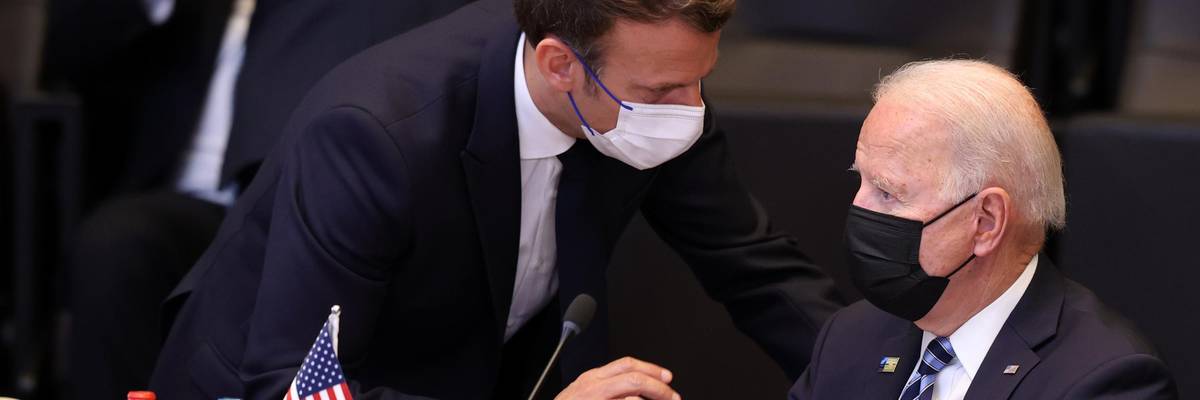
US President Joe Biden (R) and French President Emmanuel Macron (L) have a conversation ahead of the NATO summit at the North Atlantic Treaty Organization (NATO) headquarters in Brussels, on June 14, 2021.
A "brutal lesson in geopolitics," is how the Berlin newspaper Der Tagesspiegel described the announcement of AUKUS, the new security partnership between Australia, the United Kingdom, and the United States. The deal is not just a major financial blow to France, whose contract to deliver 12 submarines to Australia for $A50 billion ($36 billion) was unceremoniously ditched in the process. Perhaps even more important was that US President Joe Biden chose to announce AUKUS in a manner that can only be interpreted as a deliberate humiliation of France and, by association, the rest of the European Union.
When any US president slaps them in the face to remind them who is boss, they have no choice but to turn the other cheek, because it is they who have decided to choose their current privileges at the expense of European independence.
It was not the first brutal lesson the US had taught the EU recently. When Donald Trump reneged on the deal that former President Barack Obama and the EU had jointly struck to end Iran's nuclear program, one of his reasons was to put Germany in its place. Hours after German Chancellor Angela Merkel declared that EU corporations would ignore Trump's sanctions and continue to trade with Iran, German corporations made their own announcement: Unwilling to be cast out of the US market, and to miss out on Trump's corporate tax cuts, they would cease trading in Iran.
The two incidents served the purpose of preserving America's financial and geostrategic hegemony over the West. Both incidents inflamed European leaders enough for them to consider retaliation. Trump's threat of sanctions against EU-based corporations continuing to deal with Iran sparked discussions in the EU of corresponding sanctions on US companies. Last week, French President Emmanuel Macron responded to Biden's AUKUS announcement with a move once reserved as a last resort just before declaring war: recalling France's ambassadors from Washington, DC, and Canberra.
Predictably, once their anger subsides, and their threats fizzle out, Europe's leaders soberly turn to addressing the root causes of their weakness vis-a-vis the US. But it is a charade that should fool no one.
After European companies acquiesced in Trump's sanctions on Iran, EU officials reasonably concluded that, as long as the US controls the payments system, Europe will be at America's mercy in any confrontation involving money. So, they decided that Europe needs a payments system that the US government cannot block. Similarly, after the AUKUS fiasco, the need for a cohesive European military came into sharp focus.
But, in both cases, creating the European institutions needed to challenge American hegemony would require Europe's leaders to make a move that they are loath to contemplate.
Consider the ambition to create a euro-dominated payments system that allows companies and states to trade independently of the US-dominated financial system. For such a system to work, it must be liquid, which means it must be able to attract other people's money--Japanese, Chinese, Indian, and certainly US money.
This in turn requires that non-Europeans holding loads of euros have a euro-dominated safe asset in which to invest their stash for a day or for a decade. In the dollar-denominated, US-dominated financial world, such an asset not only exists but increases daily in proportion to gargantuan US government borrowing. But in the EU, there is no equivalent to US Treasuries. German bunds may be as safe as houses, but there are not enough of them to support a euro-denominated competitor to the dollar-dominated international payment system.
Europe's officials know that creating a European equivalent of US Treasuries, the much discussed but never-realized eurobond, is a bridge too far. After all, creating the necessary volume of eurobonds would imply a large pan-European debt. That, in turn, demands a common treasury, which can be legitimized only by ditching the EU's intergovernmental architecture in favor of European elites' greatest nightmare: a democratic federation.
Indeed, during her 16 years in power, Germany's outgoing chancellor did not block the creation of eurobonds out of petulance or antipathy to a European safe asset. She did so because she had no interest in clashing with European elites' determination to stop the EU integration process well before anything resembling a democratic federation takes shape.
The same is true of military integration. Even the modest project of piecing together a five-thousand-strong European rapid deployment force can never be more than tokenism. Who will send these men and women to spill their blood in some faraway war? The French president? The German chancellor? The president of the European Commission?
And who will have the right, at the drop of a hat, to recall them if necessary? Without a sovereign parliament to back a federal government that makes these decisions, no European military worthy of the name can ever emerge.
European leaders get what they deserve. When any US president slaps them in the face to remind them who is boss, they have no choice but to turn the other cheek, because it is they who have decided to choose their current privileges at the expense of European independence. Every slap angers them enough to issue threats and recall ambassadors. But then they run up against their own hostility to what it would take to liberate Europe from American hegemony.
To prevent the type of humiliation to which Trump subjected Merkel, Europe needs a eurobond. To prevent humiliations like the one Biden has inflicted upon Macron, it needs a common military. But eurobonds and a common military require Europe's national ruling classes (particularly those in creditor countries) to give up their own exorbitant power; and to embrace, instead, the radical idea of transnational voting for a transnational federal government.
Their dilemma is clear: Turn the EU into a democratic federation, and thus lose the exorbitant power over Europe's citizens that they enjoy in today's nondemocratic EU, or submit to ritual flagellation by whoever resides in the White House. Behind the sound and fury of their periodic protests, Europe's leaders seem to have made their choice.
Dear Common Dreams reader, It’s been nearly 30 years since I co-founded Common Dreams with my late wife, Lina Newhouser. We had the radical notion that journalism should serve the public good, not corporate profits. It was clear to us from the outset what it would take to build such a project. No paid advertisements. No corporate sponsors. No millionaire publisher telling us what to think or do. Many people said we wouldn't last a year, but we proved those doubters wrong. Together with a tremendous team of journalists and dedicated staff, we built an independent media outlet free from the constraints of profits and corporate control. Our mission has always been simple: To inform. To inspire. To ignite change for the common good. Building Common Dreams was not easy. Our survival was never guaranteed. When you take on the most powerful forces—Wall Street greed, fossil fuel industry destruction, Big Tech lobbyists, and uber-rich oligarchs who have spent billions upon billions rigging the economy and democracy in their favor—the only bulwark you have is supporters who believe in your work. But here’s the urgent message from me today. It's never been this bad out there. And it's never been this hard to keep us going. At the very moment Common Dreams is most needed, the threats we face are intensifying. We need your support now more than ever. We don't accept corporate advertising and never will. We don't have a paywall because we don't think people should be blocked from critical news based on their ability to pay. Everything we do is funded by the donations of readers like you. When everyone does the little they can afford, we are strong. But if that support retreats or dries up, so do we. Will you donate now to make sure Common Dreams not only survives but thrives? —Craig Brown, Co-founder |
A "brutal lesson in geopolitics," is how the Berlin newspaper Der Tagesspiegel described the announcement of AUKUS, the new security partnership between Australia, the United Kingdom, and the United States. The deal is not just a major financial blow to France, whose contract to deliver 12 submarines to Australia for $A50 billion ($36 billion) was unceremoniously ditched in the process. Perhaps even more important was that US President Joe Biden chose to announce AUKUS in a manner that can only be interpreted as a deliberate humiliation of France and, by association, the rest of the European Union.
When any US president slaps them in the face to remind them who is boss, they have no choice but to turn the other cheek, because it is they who have decided to choose their current privileges at the expense of European independence.
It was not the first brutal lesson the US had taught the EU recently. When Donald Trump reneged on the deal that former President Barack Obama and the EU had jointly struck to end Iran's nuclear program, one of his reasons was to put Germany in its place. Hours after German Chancellor Angela Merkel declared that EU corporations would ignore Trump's sanctions and continue to trade with Iran, German corporations made their own announcement: Unwilling to be cast out of the US market, and to miss out on Trump's corporate tax cuts, they would cease trading in Iran.
The two incidents served the purpose of preserving America's financial and geostrategic hegemony over the West. Both incidents inflamed European leaders enough for them to consider retaliation. Trump's threat of sanctions against EU-based corporations continuing to deal with Iran sparked discussions in the EU of corresponding sanctions on US companies. Last week, French President Emmanuel Macron responded to Biden's AUKUS announcement with a move once reserved as a last resort just before declaring war: recalling France's ambassadors from Washington, DC, and Canberra.
Predictably, once their anger subsides, and their threats fizzle out, Europe's leaders soberly turn to addressing the root causes of their weakness vis-a-vis the US. But it is a charade that should fool no one.
After European companies acquiesced in Trump's sanctions on Iran, EU officials reasonably concluded that, as long as the US controls the payments system, Europe will be at America's mercy in any confrontation involving money. So, they decided that Europe needs a payments system that the US government cannot block. Similarly, after the AUKUS fiasco, the need for a cohesive European military came into sharp focus.
But, in both cases, creating the European institutions needed to challenge American hegemony would require Europe's leaders to make a move that they are loath to contemplate.
Consider the ambition to create a euro-dominated payments system that allows companies and states to trade independently of the US-dominated financial system. For such a system to work, it must be liquid, which means it must be able to attract other people's money--Japanese, Chinese, Indian, and certainly US money.
This in turn requires that non-Europeans holding loads of euros have a euro-dominated safe asset in which to invest their stash for a day or for a decade. In the dollar-denominated, US-dominated financial world, such an asset not only exists but increases daily in proportion to gargantuan US government borrowing. But in the EU, there is no equivalent to US Treasuries. German bunds may be as safe as houses, but there are not enough of them to support a euro-denominated competitor to the dollar-dominated international payment system.
Europe's officials know that creating a European equivalent of US Treasuries, the much discussed but never-realized eurobond, is a bridge too far. After all, creating the necessary volume of eurobonds would imply a large pan-European debt. That, in turn, demands a common treasury, which can be legitimized only by ditching the EU's intergovernmental architecture in favor of European elites' greatest nightmare: a democratic federation.
Indeed, during her 16 years in power, Germany's outgoing chancellor did not block the creation of eurobonds out of petulance or antipathy to a European safe asset. She did so because she had no interest in clashing with European elites' determination to stop the EU integration process well before anything resembling a democratic federation takes shape.
The same is true of military integration. Even the modest project of piecing together a five-thousand-strong European rapid deployment force can never be more than tokenism. Who will send these men and women to spill their blood in some faraway war? The French president? The German chancellor? The president of the European Commission?
And who will have the right, at the drop of a hat, to recall them if necessary? Without a sovereign parliament to back a federal government that makes these decisions, no European military worthy of the name can ever emerge.
European leaders get what they deserve. When any US president slaps them in the face to remind them who is boss, they have no choice but to turn the other cheek, because it is they who have decided to choose their current privileges at the expense of European independence. Every slap angers them enough to issue threats and recall ambassadors. But then they run up against their own hostility to what it would take to liberate Europe from American hegemony.
To prevent the type of humiliation to which Trump subjected Merkel, Europe needs a eurobond. To prevent humiliations like the one Biden has inflicted upon Macron, it needs a common military. But eurobonds and a common military require Europe's national ruling classes (particularly those in creditor countries) to give up their own exorbitant power; and to embrace, instead, the radical idea of transnational voting for a transnational federal government.
Their dilemma is clear: Turn the EU into a democratic federation, and thus lose the exorbitant power over Europe's citizens that they enjoy in today's nondemocratic EU, or submit to ritual flagellation by whoever resides in the White House. Behind the sound and fury of their periodic protests, Europe's leaders seem to have made their choice.
A "brutal lesson in geopolitics," is how the Berlin newspaper Der Tagesspiegel described the announcement of AUKUS, the new security partnership between Australia, the United Kingdom, and the United States. The deal is not just a major financial blow to France, whose contract to deliver 12 submarines to Australia for $A50 billion ($36 billion) was unceremoniously ditched in the process. Perhaps even more important was that US President Joe Biden chose to announce AUKUS in a manner that can only be interpreted as a deliberate humiliation of France and, by association, the rest of the European Union.
When any US president slaps them in the face to remind them who is boss, they have no choice but to turn the other cheek, because it is they who have decided to choose their current privileges at the expense of European independence.
It was not the first brutal lesson the US had taught the EU recently. When Donald Trump reneged on the deal that former President Barack Obama and the EU had jointly struck to end Iran's nuclear program, one of his reasons was to put Germany in its place. Hours after German Chancellor Angela Merkel declared that EU corporations would ignore Trump's sanctions and continue to trade with Iran, German corporations made their own announcement: Unwilling to be cast out of the US market, and to miss out on Trump's corporate tax cuts, they would cease trading in Iran.
The two incidents served the purpose of preserving America's financial and geostrategic hegemony over the West. Both incidents inflamed European leaders enough for them to consider retaliation. Trump's threat of sanctions against EU-based corporations continuing to deal with Iran sparked discussions in the EU of corresponding sanctions on US companies. Last week, French President Emmanuel Macron responded to Biden's AUKUS announcement with a move once reserved as a last resort just before declaring war: recalling France's ambassadors from Washington, DC, and Canberra.
Predictably, once their anger subsides, and their threats fizzle out, Europe's leaders soberly turn to addressing the root causes of their weakness vis-a-vis the US. But it is a charade that should fool no one.
After European companies acquiesced in Trump's sanctions on Iran, EU officials reasonably concluded that, as long as the US controls the payments system, Europe will be at America's mercy in any confrontation involving money. So, they decided that Europe needs a payments system that the US government cannot block. Similarly, after the AUKUS fiasco, the need for a cohesive European military came into sharp focus.
But, in both cases, creating the European institutions needed to challenge American hegemony would require Europe's leaders to make a move that they are loath to contemplate.
Consider the ambition to create a euro-dominated payments system that allows companies and states to trade independently of the US-dominated financial system. For such a system to work, it must be liquid, which means it must be able to attract other people's money--Japanese, Chinese, Indian, and certainly US money.
This in turn requires that non-Europeans holding loads of euros have a euro-dominated safe asset in which to invest their stash for a day or for a decade. In the dollar-denominated, US-dominated financial world, such an asset not only exists but increases daily in proportion to gargantuan US government borrowing. But in the EU, there is no equivalent to US Treasuries. German bunds may be as safe as houses, but there are not enough of them to support a euro-denominated competitor to the dollar-dominated international payment system.
Europe's officials know that creating a European equivalent of US Treasuries, the much discussed but never-realized eurobond, is a bridge too far. After all, creating the necessary volume of eurobonds would imply a large pan-European debt. That, in turn, demands a common treasury, which can be legitimized only by ditching the EU's intergovernmental architecture in favor of European elites' greatest nightmare: a democratic federation.
Indeed, during her 16 years in power, Germany's outgoing chancellor did not block the creation of eurobonds out of petulance or antipathy to a European safe asset. She did so because she had no interest in clashing with European elites' determination to stop the EU integration process well before anything resembling a democratic federation takes shape.
The same is true of military integration. Even the modest project of piecing together a five-thousand-strong European rapid deployment force can never be more than tokenism. Who will send these men and women to spill their blood in some faraway war? The French president? The German chancellor? The president of the European Commission?
And who will have the right, at the drop of a hat, to recall them if necessary? Without a sovereign parliament to back a federal government that makes these decisions, no European military worthy of the name can ever emerge.
European leaders get what they deserve. When any US president slaps them in the face to remind them who is boss, they have no choice but to turn the other cheek, because it is they who have decided to choose their current privileges at the expense of European independence. Every slap angers them enough to issue threats and recall ambassadors. But then they run up against their own hostility to what it would take to liberate Europe from American hegemony.
To prevent the type of humiliation to which Trump subjected Merkel, Europe needs a eurobond. To prevent humiliations like the one Biden has inflicted upon Macron, it needs a common military. But eurobonds and a common military require Europe's national ruling classes (particularly those in creditor countries) to give up their own exorbitant power; and to embrace, instead, the radical idea of transnational voting for a transnational federal government.
Their dilemma is clear: Turn the EU into a democratic federation, and thus lose the exorbitant power over Europe's citizens that they enjoy in today's nondemocratic EU, or submit to ritual flagellation by whoever resides in the White House. Behind the sound and fury of their periodic protests, Europe's leaders seem to have made their choice.