SUBSCRIBE TO OUR FREE NEWSLETTER
Daily news & progressive opinion—funded by the people, not the corporations—delivered straight to your inbox.
5
#000000
#FFFFFF
To donate by check, phone, or other method, see our More Ways to Give page.
Daily news & progressive opinion—funded by the people, not the corporations—delivered straight to your inbox.
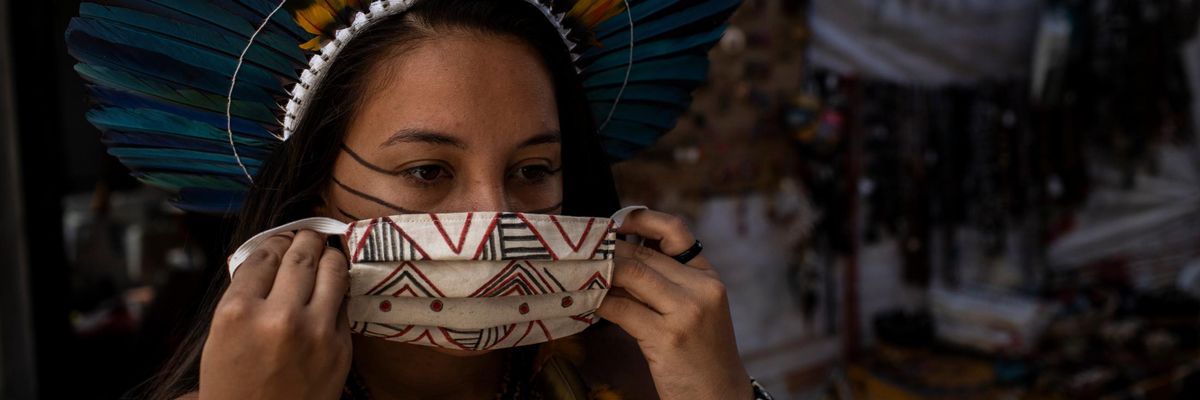
Samela Satere-Mawe, 23, gets ready to start working on making face protection masks at the Association of the Satere-Mawe Indigenous Women (AMISM) in the West Zone of Manaus, the capital of Amazonas state, Brazil, on July 23, 2020. (Photo: International Monetary Fund/Flickr/cc)
Citing the disproportionate impact of the Covid-19 pandemic on native communities and persistent vaccine inequities, a coalition of three leading Indigenous advocacy organizations on Wednesday joined over 1,500 global civil society groups in calling for the postponement of the upcoming United Nations climate summit.
"The United Kingdom's actions have been deeply inadequate to assure just and effective participation of our frontline communities."
--Indigenous groups
"As the world continues to confront the spread of Covid-19, there are serious concerns that many of our Indigenous relatives from the Global South will not be able to adequately participate in the COP due to the disproportionate impact of Covid-19 on their communities," the Indigenous Environmental Network, Indigenous Climate Action, and Native Movement said in a joint statement referring to the United Nations Climate Change Conference in Glasgow, Scotland--also called COP 26.
"It is reprehensible that their voices will not be heard due to [the United Nations Framework Convention on Climate Change] and the United Kingdom's unwillingness to take into account the global inequities of the Covid-19 vaccine distribution," the statement asserted. The U.K. is hosting this year's summit--which is scheduled to start on October 31--in partnership with Italy.
"Indigenous communities are often sacrifice zones bearing the brunt of extractive development and the effects of destructive weather events," the groups said. "Our communities have long been disproportionately impacted not just by climate change, but the forces that are responsible for creating it."
The statement continued:
The representatives of the U.K. as the host of the UNFCCC COP 26 have previously stated they would create mechanisms to ensure the safety and participation of Indigenous peoples, as well as local and civil society from developing countries. However, the United Kingdom's actions have been deeply inadequate to assure just and effective participation of our frontline communities.
With strategic guidance given by our Indigenous Global South partners, should the U.K. and UNFCCC decide against postponing the COP, our organizations will still commit to attending the conference, offer interventions in support and solidarity with those who cannot attend, and elevate our frontline community demands. However, it must be reiterated; this is not a preferred arrangement.
"The exclusion of Indigenous peoples from the Global South would effectively silence them--by failing to enhance accommodations and, those who will be most impacted by the agenda items of the COP, such as Article 6 of the Paris agreement, will be denied their guaranteed right to participation," the groups added. "No equitable or just climate solutions can emerge from such an unjust process."
The Indigenous groups join more than 1,500 other organizations around the world in arguing that COP 26 should be postponed due to continuing disparities in coronavirus vaccine distribution. Less than 2% of people in low-income countries have received at least one dose of vaccine, according to Our World in Data. Many of those nations have been hard-hit by the highly contagious Delta variant.
Tasneem Essop, executive director of Climate Action Network, said earlier this month that "looking at the current timeline for COP 26 and the logistical challenges, it is difficult to imagine fair participation from the Global South under safe conditions and it should therefore be postponed."
"The climate talks are important," Essop added, "but against the current context of 'vaccine apartheid,' they simply cannot proceed by locking out the voices of those who especially need to be heard at this time."
Dear Common Dreams reader, It’s been nearly 30 years since I co-founded Common Dreams with my late wife, Lina Newhouser. We had the radical notion that journalism should serve the public good, not corporate profits. It was clear to us from the outset what it would take to build such a project. No paid advertisements. No corporate sponsors. No millionaire publisher telling us what to think or do. Many people said we wouldn't last a year, but we proved those doubters wrong. Together with a tremendous team of journalists and dedicated staff, we built an independent media outlet free from the constraints of profits and corporate control. Our mission has always been simple: To inform. To inspire. To ignite change for the common good. Building Common Dreams was not easy. Our survival was never guaranteed. When you take on the most powerful forces—Wall Street greed, fossil fuel industry destruction, Big Tech lobbyists, and uber-rich oligarchs who have spent billions upon billions rigging the economy and democracy in their favor—the only bulwark you have is supporters who believe in your work. But here’s the urgent message from me today. It's never been this bad out there. And it's never been this hard to keep us going. At the very moment Common Dreams is most needed, the threats we face are intensifying. We need your support now more than ever. We don't accept corporate advertising and never will. We don't have a paywall because we don't think people should be blocked from critical news based on their ability to pay. Everything we do is funded by the donations of readers like you. When everyone does the little they can afford, we are strong. But if that support retreats or dries up, so do we. Will you donate now to make sure Common Dreams not only survives but thrives? —Craig Brown, Co-founder |
Citing the disproportionate impact of the Covid-19 pandemic on native communities and persistent vaccine inequities, a coalition of three leading Indigenous advocacy organizations on Wednesday joined over 1,500 global civil society groups in calling for the postponement of the upcoming United Nations climate summit.
"The United Kingdom's actions have been deeply inadequate to assure just and effective participation of our frontline communities."
--Indigenous groups
"As the world continues to confront the spread of Covid-19, there are serious concerns that many of our Indigenous relatives from the Global South will not be able to adequately participate in the COP due to the disproportionate impact of Covid-19 on their communities," the Indigenous Environmental Network, Indigenous Climate Action, and Native Movement said in a joint statement referring to the United Nations Climate Change Conference in Glasgow, Scotland--also called COP 26.
"It is reprehensible that their voices will not be heard due to [the United Nations Framework Convention on Climate Change] and the United Kingdom's unwillingness to take into account the global inequities of the Covid-19 vaccine distribution," the statement asserted. The U.K. is hosting this year's summit--which is scheduled to start on October 31--in partnership with Italy.
"Indigenous communities are often sacrifice zones bearing the brunt of extractive development and the effects of destructive weather events," the groups said. "Our communities have long been disproportionately impacted not just by climate change, but the forces that are responsible for creating it."
The statement continued:
The representatives of the U.K. as the host of the UNFCCC COP 26 have previously stated they would create mechanisms to ensure the safety and participation of Indigenous peoples, as well as local and civil society from developing countries. However, the United Kingdom's actions have been deeply inadequate to assure just and effective participation of our frontline communities.
With strategic guidance given by our Indigenous Global South partners, should the U.K. and UNFCCC decide against postponing the COP, our organizations will still commit to attending the conference, offer interventions in support and solidarity with those who cannot attend, and elevate our frontline community demands. However, it must be reiterated; this is not a preferred arrangement.
"The exclusion of Indigenous peoples from the Global South would effectively silence them--by failing to enhance accommodations and, those who will be most impacted by the agenda items of the COP, such as Article 6 of the Paris agreement, will be denied their guaranteed right to participation," the groups added. "No equitable or just climate solutions can emerge from such an unjust process."
The Indigenous groups join more than 1,500 other organizations around the world in arguing that COP 26 should be postponed due to continuing disparities in coronavirus vaccine distribution. Less than 2% of people in low-income countries have received at least one dose of vaccine, according to Our World in Data. Many of those nations have been hard-hit by the highly contagious Delta variant.
Tasneem Essop, executive director of Climate Action Network, said earlier this month that "looking at the current timeline for COP 26 and the logistical challenges, it is difficult to imagine fair participation from the Global South under safe conditions and it should therefore be postponed."
"The climate talks are important," Essop added, "but against the current context of 'vaccine apartheid,' they simply cannot proceed by locking out the voices of those who especially need to be heard at this time."
Citing the disproportionate impact of the Covid-19 pandemic on native communities and persistent vaccine inequities, a coalition of three leading Indigenous advocacy organizations on Wednesday joined over 1,500 global civil society groups in calling for the postponement of the upcoming United Nations climate summit.
"The United Kingdom's actions have been deeply inadequate to assure just and effective participation of our frontline communities."
--Indigenous groups
"As the world continues to confront the spread of Covid-19, there are serious concerns that many of our Indigenous relatives from the Global South will not be able to adequately participate in the COP due to the disproportionate impact of Covid-19 on their communities," the Indigenous Environmental Network, Indigenous Climate Action, and Native Movement said in a joint statement referring to the United Nations Climate Change Conference in Glasgow, Scotland--also called COP 26.
"It is reprehensible that their voices will not be heard due to [the United Nations Framework Convention on Climate Change] and the United Kingdom's unwillingness to take into account the global inequities of the Covid-19 vaccine distribution," the statement asserted. The U.K. is hosting this year's summit--which is scheduled to start on October 31--in partnership with Italy.
"Indigenous communities are often sacrifice zones bearing the brunt of extractive development and the effects of destructive weather events," the groups said. "Our communities have long been disproportionately impacted not just by climate change, but the forces that are responsible for creating it."
The statement continued:
The representatives of the U.K. as the host of the UNFCCC COP 26 have previously stated they would create mechanisms to ensure the safety and participation of Indigenous peoples, as well as local and civil society from developing countries. However, the United Kingdom's actions have been deeply inadequate to assure just and effective participation of our frontline communities.
With strategic guidance given by our Indigenous Global South partners, should the U.K. and UNFCCC decide against postponing the COP, our organizations will still commit to attending the conference, offer interventions in support and solidarity with those who cannot attend, and elevate our frontline community demands. However, it must be reiterated; this is not a preferred arrangement.
"The exclusion of Indigenous peoples from the Global South would effectively silence them--by failing to enhance accommodations and, those who will be most impacted by the agenda items of the COP, such as Article 6 of the Paris agreement, will be denied their guaranteed right to participation," the groups added. "No equitable or just climate solutions can emerge from such an unjust process."
The Indigenous groups join more than 1,500 other organizations around the world in arguing that COP 26 should be postponed due to continuing disparities in coronavirus vaccine distribution. Less than 2% of people in low-income countries have received at least one dose of vaccine, according to Our World in Data. Many of those nations have been hard-hit by the highly contagious Delta variant.
Tasneem Essop, executive director of Climate Action Network, said earlier this month that "looking at the current timeline for COP 26 and the logistical challenges, it is difficult to imagine fair participation from the Global South under safe conditions and it should therefore be postponed."
"The climate talks are important," Essop added, "but against the current context of 'vaccine apartheid,' they simply cannot proceed by locking out the voices of those who especially need to be heard at this time."