SUBSCRIBE TO OUR FREE NEWSLETTER
Daily news & progressive opinion—funded by the people, not the corporations—delivered straight to your inbox.
5
#000000
#FFFFFF
To donate by check, phone, or other method, see our More Ways to Give page.
Daily news & progressive opinion—funded by the people, not the corporations—delivered straight to your inbox.
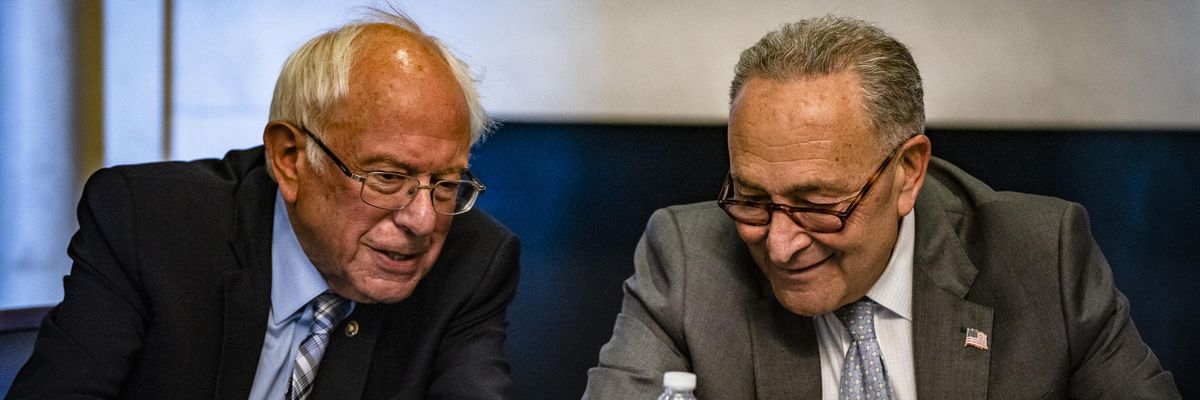
Senate Majority Leader Chuck Schumer (D-N.Y.) and Budget Committee Chairman Bernie Sanders (I-Vt.) hold a meeting in the Mansfield Room at the U.S. Capitol building on June 16, 2021 in Washington, D.C. (Photo: Samuel Corum/Getty Images)
With Senate Budget Committee Chairman Bernie Sanders leading the push for an ambitious package, Democrats in the upper chamber are reportedly considering a $6 trillion infrastructure bill as bipartisan negotiations continue to produce proposals that fall short of what experts say is needed to combat the climate emergency and rebuild the nation's crumbling roads, bridges, and water systems.
"The bottom line is there are a lot of needs facing this country. Now is the time to address those needs, and it has to be paid for in a progressive way, given the fact that we have massive income and wealth inequality in America."
--Sen. Bernie Sanders
Politico reported Thursday morning that "Senate Democrats are weighing spending as much as $6 trillion on their own infrastructure package if the chamber's bipartisan talks fail."
Under the tentative plan, which would be pushed through the arcane and restrictive budget reconciliation process, "half of the proposed Democrats-only alternative would be paid for," according to Politico. As head of the Senate's budget panel, Sanders has significant influence over the size and scope of the emerging reconciliation bill, which would need just a simple-majority vote to pass.
"About $2.5 trillion would go through the Finance Committee, $185 billion through the Energy Committee, and almost $500 billion through the Environment and Public Works Committee," Politico noted, citing anonymous officials familiar with the proposal.
The $6 trillion plan would go well beyond the roughly $4 trillion in spending that President Joe Biden proposed in his two-pronged infrastructure and safety-net package, which consists of the American Jobs Plan and the American Families Plan.
The Washington Post reported Thursday that the $6 trillion plan is expected to include an expansion of Medicare, a top progressive priority that Biden left out of his original American Families Plan. The emerging proposal would lower the Medicare eligibility age from 65 to 60--a move that would open the healthcare program to 23 million people--and expand benefits to include dental, vision, and hearing.
Earlier this week, Sanders (I-Vt.) told reporters he "wouldn't vote for" the infrastructure framework that the bipartisan group of 20 senators is currently hashing out behind closed doors. The group is led by Sens. Kyrsten Sinema (D-Ariz.) and Rob Portman (R-Ohio).
"The bottom line is there are a lot of needs facing this country," said Sanders. "Now is the time to address those needs, and it has to be paid for in a progressive way, given the fact that we have massive income and wealth inequality in America."
The bipartisan package, the details of which began to emerge (pdf) late Wednesday night, calls for just $579 billion in new spending, a figure that a number of Democratic lawmakers in both the House and Senate have rejected as badly inadequate to address the country's dire infrastructure needs and make necessary investments in green energy.
Analysts have also raised alarm over how the bipartisan group is proposing to finance their package as Republican lawmakers refuse to accept any changes to the 2017 GOP tax cuts for the wealthy and large corporations.
A two-page document (pdf) currently circulating in the Senate lists 11 potential pay-fors, including a reduction in the massive IRS tax gap and "asset recycling."
As The American Prospect's David Dayen noted on Twitter, the latter proposal "is a concept from Australia" that entails "funding infrastructure by selling it to private companies."
"You cannot talk about the relative worthiness of this effort without talking about how it would sell the common assets of America to the highest bidder," Dayen wrote.
In a statement, Sunrise Movement advocacy director Lauren Maunus said that "Senate Majority Leader Chuck Schumer cannot let Kyrsten Sinema and Rob Portman hijack this moment, and must proceed with at least" the $6 trillion proposal.
"This is a matter of priorities--and Democrats' priorities must be to support working people, create jobs, and stop the impending climate crisis that's destroying our communities," said Maunus. "If Democrats fail to do so, we not only risk our futures, but will jeopardize any electoral chances in 2022 and beyond."
This story has been updated with comment from the Sunrise Movement.
Dear Common Dreams reader, It’s been nearly 30 years since I co-founded Common Dreams with my late wife, Lina Newhouser. We had the radical notion that journalism should serve the public good, not corporate profits. It was clear to us from the outset what it would take to build such a project. No paid advertisements. No corporate sponsors. No millionaire publisher telling us what to think or do. Many people said we wouldn't last a year, but we proved those doubters wrong. Together with a tremendous team of journalists and dedicated staff, we built an independent media outlet free from the constraints of profits and corporate control. Our mission has always been simple: To inform. To inspire. To ignite change for the common good. Building Common Dreams was not easy. Our survival was never guaranteed. When you take on the most powerful forces—Wall Street greed, fossil fuel industry destruction, Big Tech lobbyists, and uber-rich oligarchs who have spent billions upon billions rigging the economy and democracy in their favor—the only bulwark you have is supporters who believe in your work. But here’s the urgent message from me today. It's never been this bad out there. And it's never been this hard to keep us going. At the very moment Common Dreams is most needed, the threats we face are intensifying. We need your support now more than ever. We don't accept corporate advertising and never will. We don't have a paywall because we don't think people should be blocked from critical news based on their ability to pay. Everything we do is funded by the donations of readers like you. When everyone does the little they can afford, we are strong. But if that support retreats or dries up, so do we. Will you donate now to make sure Common Dreams not only survives but thrives? —Craig Brown, Co-founder |
With Senate Budget Committee Chairman Bernie Sanders leading the push for an ambitious package, Democrats in the upper chamber are reportedly considering a $6 trillion infrastructure bill as bipartisan negotiations continue to produce proposals that fall short of what experts say is needed to combat the climate emergency and rebuild the nation's crumbling roads, bridges, and water systems.
"The bottom line is there are a lot of needs facing this country. Now is the time to address those needs, and it has to be paid for in a progressive way, given the fact that we have massive income and wealth inequality in America."
--Sen. Bernie Sanders
Politico reported Thursday morning that "Senate Democrats are weighing spending as much as $6 trillion on their own infrastructure package if the chamber's bipartisan talks fail."
Under the tentative plan, which would be pushed through the arcane and restrictive budget reconciliation process, "half of the proposed Democrats-only alternative would be paid for," according to Politico. As head of the Senate's budget panel, Sanders has significant influence over the size and scope of the emerging reconciliation bill, which would need just a simple-majority vote to pass.
"About $2.5 trillion would go through the Finance Committee, $185 billion through the Energy Committee, and almost $500 billion through the Environment and Public Works Committee," Politico noted, citing anonymous officials familiar with the proposal.
The $6 trillion plan would go well beyond the roughly $4 trillion in spending that President Joe Biden proposed in his two-pronged infrastructure and safety-net package, which consists of the American Jobs Plan and the American Families Plan.
The Washington Post reported Thursday that the $6 trillion plan is expected to include an expansion of Medicare, a top progressive priority that Biden left out of his original American Families Plan. The emerging proposal would lower the Medicare eligibility age from 65 to 60--a move that would open the healthcare program to 23 million people--and expand benefits to include dental, vision, and hearing.
Earlier this week, Sanders (I-Vt.) told reporters he "wouldn't vote for" the infrastructure framework that the bipartisan group of 20 senators is currently hashing out behind closed doors. The group is led by Sens. Kyrsten Sinema (D-Ariz.) and Rob Portman (R-Ohio).
"The bottom line is there are a lot of needs facing this country," said Sanders. "Now is the time to address those needs, and it has to be paid for in a progressive way, given the fact that we have massive income and wealth inequality in America."
The bipartisan package, the details of which began to emerge (pdf) late Wednesday night, calls for just $579 billion in new spending, a figure that a number of Democratic lawmakers in both the House and Senate have rejected as badly inadequate to address the country's dire infrastructure needs and make necessary investments in green energy.
Analysts have also raised alarm over how the bipartisan group is proposing to finance their package as Republican lawmakers refuse to accept any changes to the 2017 GOP tax cuts for the wealthy and large corporations.
A two-page document (pdf) currently circulating in the Senate lists 11 potential pay-fors, including a reduction in the massive IRS tax gap and "asset recycling."
As The American Prospect's David Dayen noted on Twitter, the latter proposal "is a concept from Australia" that entails "funding infrastructure by selling it to private companies."
"You cannot talk about the relative worthiness of this effort without talking about how it would sell the common assets of America to the highest bidder," Dayen wrote.
In a statement, Sunrise Movement advocacy director Lauren Maunus said that "Senate Majority Leader Chuck Schumer cannot let Kyrsten Sinema and Rob Portman hijack this moment, and must proceed with at least" the $6 trillion proposal.
"This is a matter of priorities--and Democrats' priorities must be to support working people, create jobs, and stop the impending climate crisis that's destroying our communities," said Maunus. "If Democrats fail to do so, we not only risk our futures, but will jeopardize any electoral chances in 2022 and beyond."
This story has been updated with comment from the Sunrise Movement.
With Senate Budget Committee Chairman Bernie Sanders leading the push for an ambitious package, Democrats in the upper chamber are reportedly considering a $6 trillion infrastructure bill as bipartisan negotiations continue to produce proposals that fall short of what experts say is needed to combat the climate emergency and rebuild the nation's crumbling roads, bridges, and water systems.
"The bottom line is there are a lot of needs facing this country. Now is the time to address those needs, and it has to be paid for in a progressive way, given the fact that we have massive income and wealth inequality in America."
--Sen. Bernie Sanders
Politico reported Thursday morning that "Senate Democrats are weighing spending as much as $6 trillion on their own infrastructure package if the chamber's bipartisan talks fail."
Under the tentative plan, which would be pushed through the arcane and restrictive budget reconciliation process, "half of the proposed Democrats-only alternative would be paid for," according to Politico. As head of the Senate's budget panel, Sanders has significant influence over the size and scope of the emerging reconciliation bill, which would need just a simple-majority vote to pass.
"About $2.5 trillion would go through the Finance Committee, $185 billion through the Energy Committee, and almost $500 billion through the Environment and Public Works Committee," Politico noted, citing anonymous officials familiar with the proposal.
The $6 trillion plan would go well beyond the roughly $4 trillion in spending that President Joe Biden proposed in his two-pronged infrastructure and safety-net package, which consists of the American Jobs Plan and the American Families Plan.
The Washington Post reported Thursday that the $6 trillion plan is expected to include an expansion of Medicare, a top progressive priority that Biden left out of his original American Families Plan. The emerging proposal would lower the Medicare eligibility age from 65 to 60--a move that would open the healthcare program to 23 million people--and expand benefits to include dental, vision, and hearing.
Earlier this week, Sanders (I-Vt.) told reporters he "wouldn't vote for" the infrastructure framework that the bipartisan group of 20 senators is currently hashing out behind closed doors. The group is led by Sens. Kyrsten Sinema (D-Ariz.) and Rob Portman (R-Ohio).
"The bottom line is there are a lot of needs facing this country," said Sanders. "Now is the time to address those needs, and it has to be paid for in a progressive way, given the fact that we have massive income and wealth inequality in America."
The bipartisan package, the details of which began to emerge (pdf) late Wednesday night, calls for just $579 billion in new spending, a figure that a number of Democratic lawmakers in both the House and Senate have rejected as badly inadequate to address the country's dire infrastructure needs and make necessary investments in green energy.
Analysts have also raised alarm over how the bipartisan group is proposing to finance their package as Republican lawmakers refuse to accept any changes to the 2017 GOP tax cuts for the wealthy and large corporations.
A two-page document (pdf) currently circulating in the Senate lists 11 potential pay-fors, including a reduction in the massive IRS tax gap and "asset recycling."
As The American Prospect's David Dayen noted on Twitter, the latter proposal "is a concept from Australia" that entails "funding infrastructure by selling it to private companies."
"You cannot talk about the relative worthiness of this effort without talking about how it would sell the common assets of America to the highest bidder," Dayen wrote.
In a statement, Sunrise Movement advocacy director Lauren Maunus said that "Senate Majority Leader Chuck Schumer cannot let Kyrsten Sinema and Rob Portman hijack this moment, and must proceed with at least" the $6 trillion proposal.
"This is a matter of priorities--and Democrats' priorities must be to support working people, create jobs, and stop the impending climate crisis that's destroying our communities," said Maunus. "If Democrats fail to do so, we not only risk our futures, but will jeopardize any electoral chances in 2022 and beyond."
This story has been updated with comment from the Sunrise Movement.