SUBSCRIBE TO OUR FREE NEWSLETTER
Daily news & progressive opinion—funded by the people, not the corporations—delivered straight to your inbox.
5
#000000
#FFFFFF
To donate by check, phone, or other method, see our More Ways to Give page.
Daily news & progressive opinion—funded by the people, not the corporations—delivered straight to your inbox.
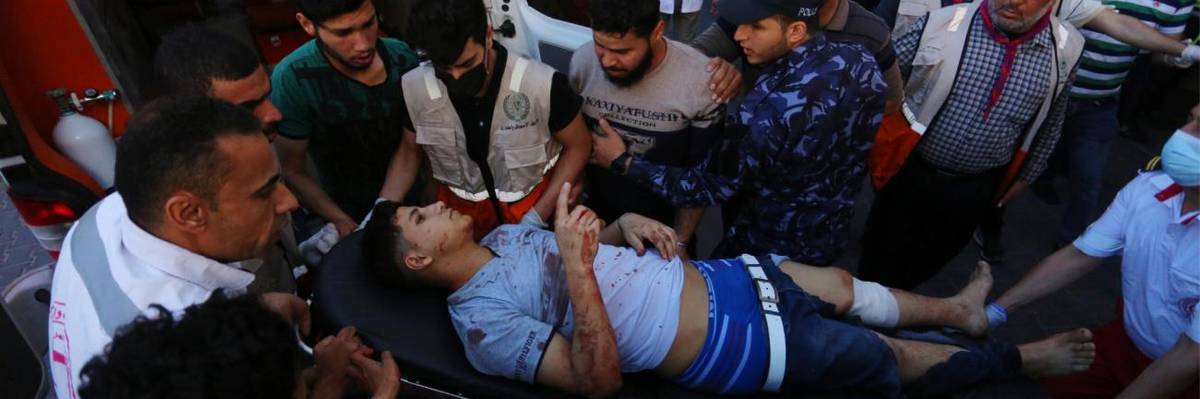
A wounded Palestinian boy is brought to Shifa Hospital after he survived the Israeli attacks on Al-Zaytun neighborhood in Gaza City on May 18, 2021. (Photo by Ashraf Amra/Anadolu Agency via Getty Images)
As healthcare workers in Gaza cope with the aftermath of the Israel Defense Forces' 11-day bombardment campaign, health officials on Saturday expressed fear that the effects of thousands of Palestinians crowding into shelters for safety from the airstrikes was becoming apparent as coronavirus cases appeared to surge in the besieged territory.
More than 1,900 people were injured in the IDF attacks, with people of all ages crowding hospitals and forcing officials to evacuate Covid-19 patients from critical care wards to make room.
"Despite the preparedness of UNRWA staff and UNRWA facilities in providing shelter in conflict, UNRWA now also contends with the unprecedented circumstance of the Covid-19 pandemic which requires additional measures to be taken."
--UNRWA
According to the Washington Post, about 70,000 people in Gaza sought refuge in schools, underground shelters, community centers, and other sites as residential areas were bombed and homes were destroyed. Thousands of people also crowded into relatives' homes.
"People stopped [social] distancing," Dr. Shadi Awad, head of respiratory care at al-Shifa hospital, told the Post. "They had no choice."
As Common Dreams reported last week, Israel bombed Gaza's only coronavirus testing facility and Dr. Ayman Abu al-Ouf, who helped lead the territory's coronavirus response, was one of at least 248 Palestinians killed.
The loss of the testing lab will leave asymptomatic Covid-19 cases undetected, health officials told the Post, in a place where less than 2% of the population has been vaccinated--compared with more than 56% of Israelis.
On Friday, al-Shifa hospital was able to test 50 people and found that 40 tested positive for the coronavirus, leading to critical care beds being filled to capacity.
Palestinian-American writer and political analyst Yousef Munayyer tweeted last week that a public health "nightmare" would likely take hold in Gaza once the bombing stopped, as it did early Friday following a ceasefire.
In addition to the crowding of hospitals and shelters where Covid-19 has apparently been able to spread rapidly, water supplies have been cut by 40% in Gaza, leading to sanitation concerns.
The United Nations Relief and Works Agency for Palestinian Refugees (UNRWA) on Friday called for $38 million in relief funding for food, water, health needs, and sanitation and hygiene.
"Despite the preparedness of UNRWA staff and UNRWA facilities in providing shelter in conflict, UNRWA now also contends with the unprecedented circumstance of the Covid-19 pandemic which requires additional measures to be taken," said the agency.
The International Committee of the Red Cross told the Post it was sending medical supplies including monitors, defibrillators, and a mechanical ventilator to Gaza, while the COVAX vaccine program planned to deliver a shipment of coronavirus vaccine doses to the territory.
The Israeli blockade, however, will make it difficult for the equipment and doses to reach overwhelmed hospitals quickly.
UNRWA said the surge in Covid-19 cases will only worsen Gaza's already limited ability to recover from the latest Israeli bombardment.
"Every time there is a conflict in Gaza, intense air bombardment pulverises basic infrastructure, homes, hospitals, and factories," Tamara al-Rifai, a spokesperson for UNRWA, said in a statement. "It then takes UNRWA and aid agencies several years to rehabilitate their premises and many homes and livelihoods of Gazans are never rebuilt."
Dear Common Dreams reader, It’s been nearly 30 years since I co-founded Common Dreams with my late wife, Lina Newhouser. We had the radical notion that journalism should serve the public good, not corporate profits. It was clear to us from the outset what it would take to build such a project. No paid advertisements. No corporate sponsors. No millionaire publisher telling us what to think or do. Many people said we wouldn't last a year, but we proved those doubters wrong. Together with a tremendous team of journalists and dedicated staff, we built an independent media outlet free from the constraints of profits and corporate control. Our mission has always been simple: To inform. To inspire. To ignite change for the common good. Building Common Dreams was not easy. Our survival was never guaranteed. When you take on the most powerful forces—Wall Street greed, fossil fuel industry destruction, Big Tech lobbyists, and uber-rich oligarchs who have spent billions upon billions rigging the economy and democracy in their favor—the only bulwark you have is supporters who believe in your work. But here’s the urgent message from me today. It's never been this bad out there. And it's never been this hard to keep us going. At the very moment Common Dreams is most needed, the threats we face are intensifying. We need your support now more than ever. We don't accept corporate advertising and never will. We don't have a paywall because we don't think people should be blocked from critical news based on their ability to pay. Everything we do is funded by the donations of readers like you. When everyone does the little they can afford, we are strong. But if that support retreats or dries up, so do we. Will you donate now to make sure Common Dreams not only survives but thrives? —Craig Brown, Co-founder |
As healthcare workers in Gaza cope with the aftermath of the Israel Defense Forces' 11-day bombardment campaign, health officials on Saturday expressed fear that the effects of thousands of Palestinians crowding into shelters for safety from the airstrikes was becoming apparent as coronavirus cases appeared to surge in the besieged territory.
More than 1,900 people were injured in the IDF attacks, with people of all ages crowding hospitals and forcing officials to evacuate Covid-19 patients from critical care wards to make room.
"Despite the preparedness of UNRWA staff and UNRWA facilities in providing shelter in conflict, UNRWA now also contends with the unprecedented circumstance of the Covid-19 pandemic which requires additional measures to be taken."
--UNRWA
According to the Washington Post, about 70,000 people in Gaza sought refuge in schools, underground shelters, community centers, and other sites as residential areas were bombed and homes were destroyed. Thousands of people also crowded into relatives' homes.
"People stopped [social] distancing," Dr. Shadi Awad, head of respiratory care at al-Shifa hospital, told the Post. "They had no choice."
As Common Dreams reported last week, Israel bombed Gaza's only coronavirus testing facility and Dr. Ayman Abu al-Ouf, who helped lead the territory's coronavirus response, was one of at least 248 Palestinians killed.
The loss of the testing lab will leave asymptomatic Covid-19 cases undetected, health officials told the Post, in a place where less than 2% of the population has been vaccinated--compared with more than 56% of Israelis.
On Friday, al-Shifa hospital was able to test 50 people and found that 40 tested positive for the coronavirus, leading to critical care beds being filled to capacity.
Palestinian-American writer and political analyst Yousef Munayyer tweeted last week that a public health "nightmare" would likely take hold in Gaza once the bombing stopped, as it did early Friday following a ceasefire.
In addition to the crowding of hospitals and shelters where Covid-19 has apparently been able to spread rapidly, water supplies have been cut by 40% in Gaza, leading to sanitation concerns.
The United Nations Relief and Works Agency for Palestinian Refugees (UNRWA) on Friday called for $38 million in relief funding for food, water, health needs, and sanitation and hygiene.
"Despite the preparedness of UNRWA staff and UNRWA facilities in providing shelter in conflict, UNRWA now also contends with the unprecedented circumstance of the Covid-19 pandemic which requires additional measures to be taken," said the agency.
The International Committee of the Red Cross told the Post it was sending medical supplies including monitors, defibrillators, and a mechanical ventilator to Gaza, while the COVAX vaccine program planned to deliver a shipment of coronavirus vaccine doses to the territory.
The Israeli blockade, however, will make it difficult for the equipment and doses to reach overwhelmed hospitals quickly.
UNRWA said the surge in Covid-19 cases will only worsen Gaza's already limited ability to recover from the latest Israeli bombardment.
"Every time there is a conflict in Gaza, intense air bombardment pulverises basic infrastructure, homes, hospitals, and factories," Tamara al-Rifai, a spokesperson for UNRWA, said in a statement. "It then takes UNRWA and aid agencies several years to rehabilitate their premises and many homes and livelihoods of Gazans are never rebuilt."
As healthcare workers in Gaza cope with the aftermath of the Israel Defense Forces' 11-day bombardment campaign, health officials on Saturday expressed fear that the effects of thousands of Palestinians crowding into shelters for safety from the airstrikes was becoming apparent as coronavirus cases appeared to surge in the besieged territory.
More than 1,900 people were injured in the IDF attacks, with people of all ages crowding hospitals and forcing officials to evacuate Covid-19 patients from critical care wards to make room.
"Despite the preparedness of UNRWA staff and UNRWA facilities in providing shelter in conflict, UNRWA now also contends with the unprecedented circumstance of the Covid-19 pandemic which requires additional measures to be taken."
--UNRWA
According to the Washington Post, about 70,000 people in Gaza sought refuge in schools, underground shelters, community centers, and other sites as residential areas were bombed and homes were destroyed. Thousands of people also crowded into relatives' homes.
"People stopped [social] distancing," Dr. Shadi Awad, head of respiratory care at al-Shifa hospital, told the Post. "They had no choice."
As Common Dreams reported last week, Israel bombed Gaza's only coronavirus testing facility and Dr. Ayman Abu al-Ouf, who helped lead the territory's coronavirus response, was one of at least 248 Palestinians killed.
The loss of the testing lab will leave asymptomatic Covid-19 cases undetected, health officials told the Post, in a place where less than 2% of the population has been vaccinated--compared with more than 56% of Israelis.
On Friday, al-Shifa hospital was able to test 50 people and found that 40 tested positive for the coronavirus, leading to critical care beds being filled to capacity.
Palestinian-American writer and political analyst Yousef Munayyer tweeted last week that a public health "nightmare" would likely take hold in Gaza once the bombing stopped, as it did early Friday following a ceasefire.
In addition to the crowding of hospitals and shelters where Covid-19 has apparently been able to spread rapidly, water supplies have been cut by 40% in Gaza, leading to sanitation concerns.
The United Nations Relief and Works Agency for Palestinian Refugees (UNRWA) on Friday called for $38 million in relief funding for food, water, health needs, and sanitation and hygiene.
"Despite the preparedness of UNRWA staff and UNRWA facilities in providing shelter in conflict, UNRWA now also contends with the unprecedented circumstance of the Covid-19 pandemic which requires additional measures to be taken," said the agency.
The International Committee of the Red Cross told the Post it was sending medical supplies including monitors, defibrillators, and a mechanical ventilator to Gaza, while the COVAX vaccine program planned to deliver a shipment of coronavirus vaccine doses to the territory.
The Israeli blockade, however, will make it difficult for the equipment and doses to reach overwhelmed hospitals quickly.
UNRWA said the surge in Covid-19 cases will only worsen Gaza's already limited ability to recover from the latest Israeli bombardment.
"Every time there is a conflict in Gaza, intense air bombardment pulverises basic infrastructure, homes, hospitals, and factories," Tamara al-Rifai, a spokesperson for UNRWA, said in a statement. "It then takes UNRWA and aid agencies several years to rehabilitate their premises and many homes and livelihoods of Gazans are never rebuilt."