SUBSCRIBE TO OUR FREE NEWSLETTER
Daily news & progressive opinion—funded by the people, not the corporations—delivered straight to your inbox.
5
#000000
#FFFFFF
To donate by check, phone, or other method, see our More Ways to Give page.
Daily news & progressive opinion—funded by the people, not the corporations—delivered straight to your inbox.
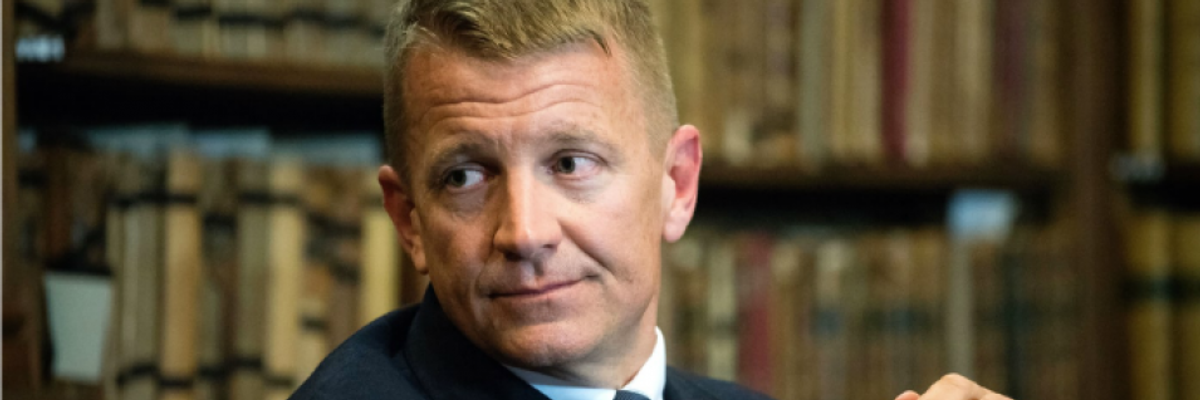
Erik Prince is the brother of former Education Secretary Betsy DeVos and founder of the mercenary firm Blackwater. (Photo: The Oxford Union/REX Shutterstock)
Erik Prince, the founder and former CEO of the mercenary firm Blackwater and a close ally of former President Donald Trump, sent weapons to a Libyan warlord in violation of a United Nations arms embargo, according to a confidential U.N. document reported Friday by the New York Times.
"To what degree did Trump help facilitate this war alongside Erik Prince?"
--Anas el-Gomati,
Sadeq Institute
The U.N. report, which investigators sent to the Security Council on Thursday, reportedly details how Prince sent foreign mercenaries armed with attack aircraft, gunboats, and cyberwarfare capabilities to support renegade military commander Khalifa Haftar during a major 2019 battle in eastern Libya.
According to the U.N. report, the mercenary operation cost $80 million and included a plan to form a hit squad to locate and assassinate commanders opposed to Haftar.
Haftar, a one-time CIA asset considered Libya's most powerful warlord, has fought to overthrow the North African nation's internationally recognized government during the country's second civil war since the overthrow of longtime dictator Muammar Gaddafi in the 2011 Arab Spring revolts. Haftar has enjoyed various degrees of support from Egypt, the United Arab Emirates, and Russia. British, French, U.S., and UAE warplanes have also assisted his forces.
In 2019, Trump reportedly granted permission for Haftar--who stands accused of ordering his troops to commit war crimes--to launch an air campaign against the U.N.-backed Government of National Accord, attacks which killed hundreds of civilians in the Libyan capital of Tripoli.
The U.N. report raises questions about whether Trump was complicit in Prince's violation of the international arms embargo against Haftar's forces.
Anas el-Gomati, director of Libyan think tank Sadeq Institute, told Al Jazeera that using mercenaries allows leaders to "outright refuse that you have any knowledge of what's going on."
"To what degree did Trump help facilitate this war alongside Erik Prince?" asked el-Gomati, who also wondered whether "Erik Prince was coordinating with Russian Wagner Group mercenaries in Libya, and has helped them establish a foothold in the way he helped the United Arab Emirates establish a foothold in Libya."
Another unanswered question is who funded Prince's $80 million operation. Wolfram Lacher, a Libya expert at the German Institute for International and Security Affairs, told the Times that Prince has "been linked to the Trump administration, the Emirati leadership, and the Russians."
"For me, the question is who is tacitly backing him?" asked Lacher.
Prince, a former U.S. Navy SEAL, founded Blackwater--now called Constellis after multiple sales--in 1997. He rose to prominence during the George W. Bush administration and the so-called War on Terror, in which the U.S. relied heavily upon private contractors. On September 16, 2007, Blackwater guards massacred 17 men, women, and children in Nisour Square in Baghdad, Iraq.
Last December, Trump pardoned four of the Nisour Square killers, who had been sentenced to 12 years to life in prison for crimes including first-degree murder.
Trump and Prince have long enjoyed warm relations. Prince was a major Trump donor whose sister, Betsy DeVos, was confirmed as secretary of education in 2017.
This isn't the first time Prince has been accused of breaking domestic and international laws against weapons transfers. In 2012 his anti-piracy security force in Somalia was accused by the U.N. of "the most brazen violation of the arms embargo by a private security company." Prince was also reportedly the target of an FBI investigation last year for weaponizing crop dusters.
Dear Common Dreams reader, It’s been nearly 30 years since I co-founded Common Dreams with my late wife, Lina Newhouser. We had the radical notion that journalism should serve the public good, not corporate profits. It was clear to us from the outset what it would take to build such a project. No paid advertisements. No corporate sponsors. No millionaire publisher telling us what to think or do. Many people said we wouldn't last a year, but we proved those doubters wrong. Together with a tremendous team of journalists and dedicated staff, we built an independent media outlet free from the constraints of profits and corporate control. Our mission has always been simple: To inform. To inspire. To ignite change for the common good. Building Common Dreams was not easy. Our survival was never guaranteed. When you take on the most powerful forces—Wall Street greed, fossil fuel industry destruction, Big Tech lobbyists, and uber-rich oligarchs who have spent billions upon billions rigging the economy and democracy in their favor—the only bulwark you have is supporters who believe in your work. But here’s the urgent message from me today. It's never been this bad out there. And it's never been this hard to keep us going. At the very moment Common Dreams is most needed, the threats we face are intensifying. We need your support now more than ever. We don't accept corporate advertising and never will. We don't have a paywall because we don't think people should be blocked from critical news based on their ability to pay. Everything we do is funded by the donations of readers like you. When everyone does the little they can afford, we are strong. But if that support retreats or dries up, so do we. Will you donate now to make sure Common Dreams not only survives but thrives? —Craig Brown, Co-founder |
Erik Prince, the founder and former CEO of the mercenary firm Blackwater and a close ally of former President Donald Trump, sent weapons to a Libyan warlord in violation of a United Nations arms embargo, according to a confidential U.N. document reported Friday by the New York Times.
"To what degree did Trump help facilitate this war alongside Erik Prince?"
--Anas el-Gomati,
Sadeq Institute
The U.N. report, which investigators sent to the Security Council on Thursday, reportedly details how Prince sent foreign mercenaries armed with attack aircraft, gunboats, and cyberwarfare capabilities to support renegade military commander Khalifa Haftar during a major 2019 battle in eastern Libya.
According to the U.N. report, the mercenary operation cost $80 million and included a plan to form a hit squad to locate and assassinate commanders opposed to Haftar.
Haftar, a one-time CIA asset considered Libya's most powerful warlord, has fought to overthrow the North African nation's internationally recognized government during the country's second civil war since the overthrow of longtime dictator Muammar Gaddafi in the 2011 Arab Spring revolts. Haftar has enjoyed various degrees of support from Egypt, the United Arab Emirates, and Russia. British, French, U.S., and UAE warplanes have also assisted his forces.
In 2019, Trump reportedly granted permission for Haftar--who stands accused of ordering his troops to commit war crimes--to launch an air campaign against the U.N.-backed Government of National Accord, attacks which killed hundreds of civilians in the Libyan capital of Tripoli.
The U.N. report raises questions about whether Trump was complicit in Prince's violation of the international arms embargo against Haftar's forces.
Anas el-Gomati, director of Libyan think tank Sadeq Institute, told Al Jazeera that using mercenaries allows leaders to "outright refuse that you have any knowledge of what's going on."
"To what degree did Trump help facilitate this war alongside Erik Prince?" asked el-Gomati, who also wondered whether "Erik Prince was coordinating with Russian Wagner Group mercenaries in Libya, and has helped them establish a foothold in the way he helped the United Arab Emirates establish a foothold in Libya."
Another unanswered question is who funded Prince's $80 million operation. Wolfram Lacher, a Libya expert at the German Institute for International and Security Affairs, told the Times that Prince has "been linked to the Trump administration, the Emirati leadership, and the Russians."
"For me, the question is who is tacitly backing him?" asked Lacher.
Prince, a former U.S. Navy SEAL, founded Blackwater--now called Constellis after multiple sales--in 1997. He rose to prominence during the George W. Bush administration and the so-called War on Terror, in which the U.S. relied heavily upon private contractors. On September 16, 2007, Blackwater guards massacred 17 men, women, and children in Nisour Square in Baghdad, Iraq.
Last December, Trump pardoned four of the Nisour Square killers, who had been sentenced to 12 years to life in prison for crimes including first-degree murder.
Trump and Prince have long enjoyed warm relations. Prince was a major Trump donor whose sister, Betsy DeVos, was confirmed as secretary of education in 2017.
This isn't the first time Prince has been accused of breaking domestic and international laws against weapons transfers. In 2012 his anti-piracy security force in Somalia was accused by the U.N. of "the most brazen violation of the arms embargo by a private security company." Prince was also reportedly the target of an FBI investigation last year for weaponizing crop dusters.
Erik Prince, the founder and former CEO of the mercenary firm Blackwater and a close ally of former President Donald Trump, sent weapons to a Libyan warlord in violation of a United Nations arms embargo, according to a confidential U.N. document reported Friday by the New York Times.
"To what degree did Trump help facilitate this war alongside Erik Prince?"
--Anas el-Gomati,
Sadeq Institute
The U.N. report, which investigators sent to the Security Council on Thursday, reportedly details how Prince sent foreign mercenaries armed with attack aircraft, gunboats, and cyberwarfare capabilities to support renegade military commander Khalifa Haftar during a major 2019 battle in eastern Libya.
According to the U.N. report, the mercenary operation cost $80 million and included a plan to form a hit squad to locate and assassinate commanders opposed to Haftar.
Haftar, a one-time CIA asset considered Libya's most powerful warlord, has fought to overthrow the North African nation's internationally recognized government during the country's second civil war since the overthrow of longtime dictator Muammar Gaddafi in the 2011 Arab Spring revolts. Haftar has enjoyed various degrees of support from Egypt, the United Arab Emirates, and Russia. British, French, U.S., and UAE warplanes have also assisted his forces.
In 2019, Trump reportedly granted permission for Haftar--who stands accused of ordering his troops to commit war crimes--to launch an air campaign against the U.N.-backed Government of National Accord, attacks which killed hundreds of civilians in the Libyan capital of Tripoli.
The U.N. report raises questions about whether Trump was complicit in Prince's violation of the international arms embargo against Haftar's forces.
Anas el-Gomati, director of Libyan think tank Sadeq Institute, told Al Jazeera that using mercenaries allows leaders to "outright refuse that you have any knowledge of what's going on."
"To what degree did Trump help facilitate this war alongside Erik Prince?" asked el-Gomati, who also wondered whether "Erik Prince was coordinating with Russian Wagner Group mercenaries in Libya, and has helped them establish a foothold in the way he helped the United Arab Emirates establish a foothold in Libya."
Another unanswered question is who funded Prince's $80 million operation. Wolfram Lacher, a Libya expert at the German Institute for International and Security Affairs, told the Times that Prince has "been linked to the Trump administration, the Emirati leadership, and the Russians."
"For me, the question is who is tacitly backing him?" asked Lacher.
Prince, a former U.S. Navy SEAL, founded Blackwater--now called Constellis after multiple sales--in 1997. He rose to prominence during the George W. Bush administration and the so-called War on Terror, in which the U.S. relied heavily upon private contractors. On September 16, 2007, Blackwater guards massacred 17 men, women, and children in Nisour Square in Baghdad, Iraq.
Last December, Trump pardoned four of the Nisour Square killers, who had been sentenced to 12 years to life in prison for crimes including first-degree murder.
Trump and Prince have long enjoyed warm relations. Prince was a major Trump donor whose sister, Betsy DeVos, was confirmed as secretary of education in 2017.
This isn't the first time Prince has been accused of breaking domestic and international laws against weapons transfers. In 2012 his anti-piracy security force in Somalia was accused by the U.N. of "the most brazen violation of the arms embargo by a private security company." Prince was also reportedly the target of an FBI investigation last year for weaponizing crop dusters.