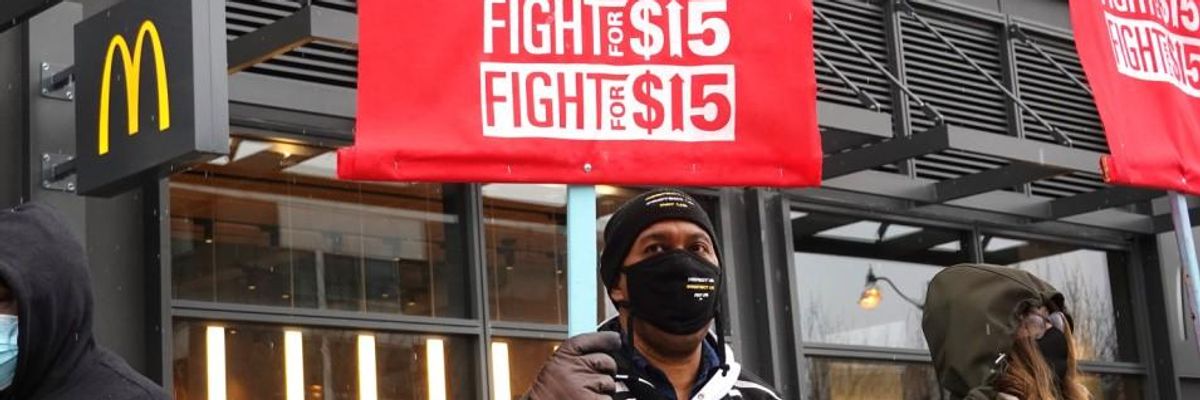
Demonstrators participate in a protest outside of McDonald's corporate headquarters on January 15, 2021 in Chicago. (Photo: Scott Olson/Getty Images)
'Biggest Risk' for Democrats on Minimum Wage, Says Top Sanders Aide, Is Not Raising It to $15
With the White House and legislative branch under their control, says Warren Gunnels, Democrats "must win" fight on behalf of working people.
Amid ongoing wrangling over the inclusion of a $15 federal minimum wage provision in the proposed coronavirus rescue package, a top aide to Sen. Bernie Sanders--chair of the powerful Senate Budget Committee--suggested Sunday that Democrats would be shooting themselves in the foot politically not to boost the wage floor.
"The biggest risk the Democratic Party faces with respect to the minimum wage is failing to raise it to $15 an hour when they control the House, the Senate, and the White House," tweeted Warren Gunnels, majority staff director for Sanders.
"A $15 minimum wage is not a radical idea. What's radical is the fact that millions of Americans are forced to work for starvation wages, while 650 billionaires became over $1 trillion richer during a global pandemic."
--Sen. Bernie Sanders"I've been pretty silent on this sight for awhile. This has been our focus and our mission. We must win," he wrote.
The federal minimum wage currently sits $7.25 an hour--a level unchanged in a dozen years, even though many individual states have a higher wage set.
Incrementally increasing the federal wage to $15 an hour by 2025, as the House-passed bill calls for is not only appropriate procedurally for the reconciliation bill, say progressive lawmakers, it's nothing "radical."
"A $15 minimum wage is not a radical idea," Sanders tweeted Sunday. "What's radical is the fact that millions of Americans are forced to work for starvation wages, while 650 billionaires became over $1 trillion richer during a global pandemic. Yes. We must raise the minimum wage to a living wage."
While the Senate parliamentarian has yet to formally weigh in on the question of using reconciliation in this instance, the wage hike proposal--which would affect at least 27 million workers--is facing resistance not only from Republicans but some Democrats as well. Conservative Democratic Sens. Kyrsten Sinema of Arizona and Joe Manchin of West Virginia announced their opposition, and the Democrats' narrow control of the Senate means they can't afford any opposition to the measure, even with reconciliation requiring just a simple majority.
Sinema, for her part, asserted last week that the "minimum wage provision is not appropriate for the reconciliation process" because it's "not a budget item." That runs counter to the Congressional Budget Office's analysis showing that it does in fact have a budgetary impact.
Among other the "key players" in the minimum wage hike effort, according to The Hill, is the powerful U.S. Chamber of Commerce.
"The CBO report confirms that a $15 minimum wage would result in significant job losses," Glenn Spencer, senior vice president of the Chamber's Employment Policy Division, told the outlet. That job loss estimate, however, was firmly rejected by numerous economists, including those at the Economic Policy Institute (EPI).
"We believe that the CBO's assumptions on the scale of job loss are just wrong and inappropriately inflated relative to what cutting-edge economics literature would indicate," EPI said in an analysis. "The median employment effect of the minimum wage across studies of low-wage workers is essentially zero, according to a 2019 review of the evidence." he Economic Policy Institute (EPI).
Further undercutting arguments against the wage hike are its estimated impacts on safety net programs. Economist Ken Jacobs, chair of the UC Berkeley Labor Center, explained this week:
Beyond the working families who will get a raise, every single American taxpayer has a stake in raising the minimum wage. When corporations like McDonald's pay poverty wages, workers often turn to public safety net programs to make ends meet. Our recent study finds that families of half of the workers who would receive a pay increase under the proposed $15 minimum wage bill in Congress are enrolled in one or more public safety net programs, at a cost of $107 billion a year. [...]
Our study on the public cost of low wages supports Sanders' contention that raising the minimum wage to $15 an hour could have a measurable savings to the federal budget--a key consideration in determining whether the legislation meets the criteria for moving through the reconciliation process. This is backed up by new research finding that a $15 minimum wage could save the federal budget of at least $65 billion per year.
Demands for an increased wage floor are set to play out on the streets this week as well, with fast food workers expected to stage walkouts Tuesday.
"$15/hr should be the absolute floor at our jobs and everywhere," the Fight for 15 movement tweeted Sunday.
That assessment is shared by the Rev. Dr. William Barber II, president and senior lecturer of Repairers of the Breach and co-chair of the Poor People's Campaign.
"We say to President Biden, to Democrats, to Republicans, to senators, to all of them: don't turn your back on the $15 an hour minimum wage," he wrote last week.
"Listen: 55% of poor, low-wealth people voted for this current ticket. That's the mandate. The mandate is in the people who voted, not in the back slapping of senators and congresspeople," he continued. "And if we turn our backs now, it will hurt 62 million poor, low-wealth people who have literally kept this economy alive, who were the first to have to go to jobs, first to get infected, first to get sick, first to die. We cannot be the last to get relief and the last to get treated and paid properly. Protect us, respect us, and pay us."
We are at a crossroads
This country and this world are at a monumental crossroads. In a few short weeks, US voters will have an opportunity to beat back the forces of fascism and confront the billionaires who are rigging the economy, our media system, and our democracy, making it increasingly impossible for ordinary people to get by. We’re not just talking about the election. We’re talking about what must be done once these fascist elements are vanquished from power. We need a bolder set of solutions than what either major party has so far been willing to offer and a working-class movement ready to fight like hell for it. Trump didn't emerge from nowhere. The conditions that fueled MAGA authoritarianism were created by decades of radical neoliberal economic policies and a corrupt political system dominated by corporate interests. They slashed taxes on the super-rich, promising that the benefits would trickle down. They said giveaways to the corporate titans would make life more affordable for the rest of us. It was all bullshit. And when a bitter, betrayed populace searches for someone to blame, right-wing demagogues have little trouble finding scapegoats. People know when they're being lied to, but you won't hear any of this from the corporate media. Only independent journalism—powered and funded by people who believe in building a better world—can deliver truly trustworthy daily news. Our Fall Campaign is underway, and we need your help. To power our newsroom through the rest of the year, we need to raise $125,000 by midnight on October 31. So if you share our vision, please contribute whatever you can to sustain our work. |
Amid ongoing wrangling over the inclusion of a $15 federal minimum wage provision in the proposed coronavirus rescue package, a top aide to Sen. Bernie Sanders--chair of the powerful Senate Budget Committee--suggested Sunday that Democrats would be shooting themselves in the foot politically not to boost the wage floor.
"The biggest risk the Democratic Party faces with respect to the minimum wage is failing to raise it to $15 an hour when they control the House, the Senate, and the White House," tweeted Warren Gunnels, majority staff director for Sanders.
"A $15 minimum wage is not a radical idea. What's radical is the fact that millions of Americans are forced to work for starvation wages, while 650 billionaires became over $1 trillion richer during a global pandemic."
--Sen. Bernie Sanders"I've been pretty silent on this sight for awhile. This has been our focus and our mission. We must win," he wrote.
The federal minimum wage currently sits $7.25 an hour--a level unchanged in a dozen years, even though many individual states have a higher wage set.
Incrementally increasing the federal wage to $15 an hour by 2025, as the House-passed bill calls for is not only appropriate procedurally for the reconciliation bill, say progressive lawmakers, it's nothing "radical."
"A $15 minimum wage is not a radical idea," Sanders tweeted Sunday. "What's radical is the fact that millions of Americans are forced to work for starvation wages, while 650 billionaires became over $1 trillion richer during a global pandemic. Yes. We must raise the minimum wage to a living wage."
While the Senate parliamentarian has yet to formally weigh in on the question of using reconciliation in this instance, the wage hike proposal--which would affect at least 27 million workers--is facing resistance not only from Republicans but some Democrats as well. Conservative Democratic Sens. Kyrsten Sinema of Arizona and Joe Manchin of West Virginia announced their opposition, and the Democrats' narrow control of the Senate means they can't afford any opposition to the measure, even with reconciliation requiring just a simple majority.
Sinema, for her part, asserted last week that the "minimum wage provision is not appropriate for the reconciliation process" because it's "not a budget item." That runs counter to the Congressional Budget Office's analysis showing that it does in fact have a budgetary impact.
Among other the "key players" in the minimum wage hike effort, according to The Hill, is the powerful U.S. Chamber of Commerce.
"The CBO report confirms that a $15 minimum wage would result in significant job losses," Glenn Spencer, senior vice president of the Chamber's Employment Policy Division, told the outlet. That job loss estimate, however, was firmly rejected by numerous economists, including those at the Economic Policy Institute (EPI).
"We believe that the CBO's assumptions on the scale of job loss are just wrong and inappropriately inflated relative to what cutting-edge economics literature would indicate," EPI said in an analysis. "The median employment effect of the minimum wage across studies of low-wage workers is essentially zero, according to a 2019 review of the evidence." he Economic Policy Institute (EPI).
Further undercutting arguments against the wage hike are its estimated impacts on safety net programs. Economist Ken Jacobs, chair of the UC Berkeley Labor Center, explained this week:
Beyond the working families who will get a raise, every single American taxpayer has a stake in raising the minimum wage. When corporations like McDonald's pay poverty wages, workers often turn to public safety net programs to make ends meet. Our recent study finds that families of half of the workers who would receive a pay increase under the proposed $15 minimum wage bill in Congress are enrolled in one or more public safety net programs, at a cost of $107 billion a year. [...]
Our study on the public cost of low wages supports Sanders' contention that raising the minimum wage to $15 an hour could have a measurable savings to the federal budget--a key consideration in determining whether the legislation meets the criteria for moving through the reconciliation process. This is backed up by new research finding that a $15 minimum wage could save the federal budget of at least $65 billion per year.
Demands for an increased wage floor are set to play out on the streets this week as well, with fast food workers expected to stage walkouts Tuesday.
"$15/hr should be the absolute floor at our jobs and everywhere," the Fight for 15 movement tweeted Sunday.
That assessment is shared by the Rev. Dr. William Barber II, president and senior lecturer of Repairers of the Breach and co-chair of the Poor People's Campaign.
"We say to President Biden, to Democrats, to Republicans, to senators, to all of them: don't turn your back on the $15 an hour minimum wage," he wrote last week.
"Listen: 55% of poor, low-wealth people voted for this current ticket. That's the mandate. The mandate is in the people who voted, not in the back slapping of senators and congresspeople," he continued. "And if we turn our backs now, it will hurt 62 million poor, low-wealth people who have literally kept this economy alive, who were the first to have to go to jobs, first to get infected, first to get sick, first to die. We cannot be the last to get relief and the last to get treated and paid properly. Protect us, respect us, and pay us."
Amid ongoing wrangling over the inclusion of a $15 federal minimum wage provision in the proposed coronavirus rescue package, a top aide to Sen. Bernie Sanders--chair of the powerful Senate Budget Committee--suggested Sunday that Democrats would be shooting themselves in the foot politically not to boost the wage floor.
"The biggest risk the Democratic Party faces with respect to the minimum wage is failing to raise it to $15 an hour when they control the House, the Senate, and the White House," tweeted Warren Gunnels, majority staff director for Sanders.
"A $15 minimum wage is not a radical idea. What's radical is the fact that millions of Americans are forced to work for starvation wages, while 650 billionaires became over $1 trillion richer during a global pandemic."
--Sen. Bernie Sanders"I've been pretty silent on this sight for awhile. This has been our focus and our mission. We must win," he wrote.
The federal minimum wage currently sits $7.25 an hour--a level unchanged in a dozen years, even though many individual states have a higher wage set.
Incrementally increasing the federal wage to $15 an hour by 2025, as the House-passed bill calls for is not only appropriate procedurally for the reconciliation bill, say progressive lawmakers, it's nothing "radical."
"A $15 minimum wage is not a radical idea," Sanders tweeted Sunday. "What's radical is the fact that millions of Americans are forced to work for starvation wages, while 650 billionaires became over $1 trillion richer during a global pandemic. Yes. We must raise the minimum wage to a living wage."
While the Senate parliamentarian has yet to formally weigh in on the question of using reconciliation in this instance, the wage hike proposal--which would affect at least 27 million workers--is facing resistance not only from Republicans but some Democrats as well. Conservative Democratic Sens. Kyrsten Sinema of Arizona and Joe Manchin of West Virginia announced their opposition, and the Democrats' narrow control of the Senate means they can't afford any opposition to the measure, even with reconciliation requiring just a simple majority.
Sinema, for her part, asserted last week that the "minimum wage provision is not appropriate for the reconciliation process" because it's "not a budget item." That runs counter to the Congressional Budget Office's analysis showing that it does in fact have a budgetary impact.
Among other the "key players" in the minimum wage hike effort, according to The Hill, is the powerful U.S. Chamber of Commerce.
"The CBO report confirms that a $15 minimum wage would result in significant job losses," Glenn Spencer, senior vice president of the Chamber's Employment Policy Division, told the outlet. That job loss estimate, however, was firmly rejected by numerous economists, including those at the Economic Policy Institute (EPI).
"We believe that the CBO's assumptions on the scale of job loss are just wrong and inappropriately inflated relative to what cutting-edge economics literature would indicate," EPI said in an analysis. "The median employment effect of the minimum wage across studies of low-wage workers is essentially zero, according to a 2019 review of the evidence." he Economic Policy Institute (EPI).
Further undercutting arguments against the wage hike are its estimated impacts on safety net programs. Economist Ken Jacobs, chair of the UC Berkeley Labor Center, explained this week:
Beyond the working families who will get a raise, every single American taxpayer has a stake in raising the minimum wage. When corporations like McDonald's pay poverty wages, workers often turn to public safety net programs to make ends meet. Our recent study finds that families of half of the workers who would receive a pay increase under the proposed $15 minimum wage bill in Congress are enrolled in one or more public safety net programs, at a cost of $107 billion a year. [...]
Our study on the public cost of low wages supports Sanders' contention that raising the minimum wage to $15 an hour could have a measurable savings to the federal budget--a key consideration in determining whether the legislation meets the criteria for moving through the reconciliation process. This is backed up by new research finding that a $15 minimum wage could save the federal budget of at least $65 billion per year.
Demands for an increased wage floor are set to play out on the streets this week as well, with fast food workers expected to stage walkouts Tuesday.
"$15/hr should be the absolute floor at our jobs and everywhere," the Fight for 15 movement tweeted Sunday.
That assessment is shared by the Rev. Dr. William Barber II, president and senior lecturer of Repairers of the Breach and co-chair of the Poor People's Campaign.
"We say to President Biden, to Democrats, to Republicans, to senators, to all of them: don't turn your back on the $15 an hour minimum wage," he wrote last week.
"Listen: 55% of poor, low-wealth people voted for this current ticket. That's the mandate. The mandate is in the people who voted, not in the back slapping of senators and congresspeople," he continued. "And if we turn our backs now, it will hurt 62 million poor, low-wealth people who have literally kept this economy alive, who were the first to have to go to jobs, first to get infected, first to get sick, first to die. We cannot be the last to get relief and the last to get treated and paid properly. Protect us, respect us, and pay us."