SUBSCRIBE TO OUR FREE NEWSLETTER
Daily news & progressive opinion—funded by the people, not the corporations—delivered straight to your inbox.
5
#000000
#FFFFFF
To donate by check, phone, or other method, see our More Ways to Give page.
Daily news & progressive opinion—funded by the people, not the corporations—delivered straight to your inbox.
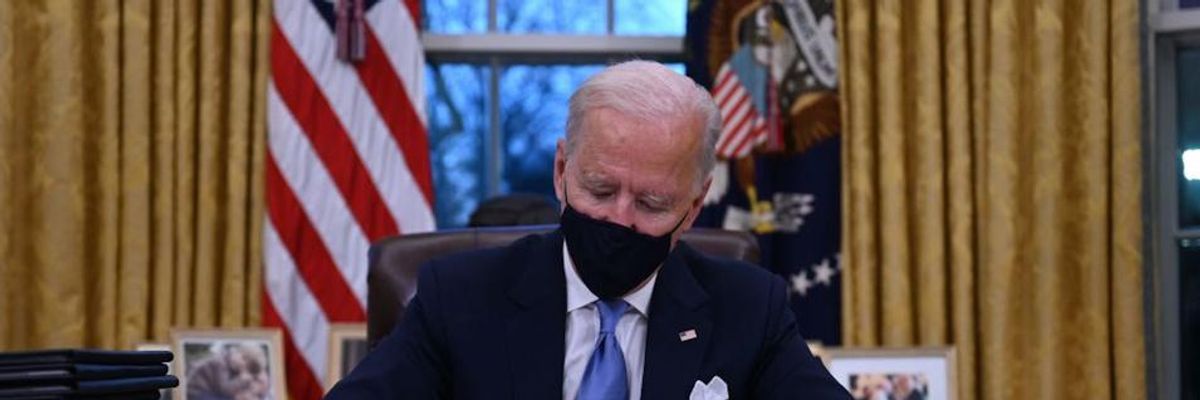
President Joe Biden signs one of a slate of executive orders during his first few hours in the White House on January 20, 2021. (Photo: Jim Watson/AFP via Getty Images)
Muslim, African, and Arab Americans, and people around the world Wednesday celebrated President Joe Biden's rescinding of the racist Trump-era travel ban that mostly targeted immigrants and visitors from Muslim countries.
"The Muslim and African ban was never about national security, it was always rooted in bigotry and called into question what values America stands for."
--NO BAN Act Coalition
The lifting of the so-called Muslim ban was one of numerous executive actions taken by Biden shortly after his inauguration and fufills a campaign promise he made to end the prohibition on "day one" of his administration.
During the course of Trump's presidency, more than 41,000 visa requests were denied (pdf) under the ban, which ripped families apart, prevented people from the proscribed countries from getting healthcare and education in the U.S., and deprived the United States of doctors, nurses, and other medical workers during the coronavirus pandemic.
There was a great sense of joy and relief at the ban's demise. The NO BAN Act Coalition, a broad alliance of 81 national and local civil rights, faith, and community groups fighting for anti-discrimination legislation that is now included in Biden's U.S. Citizenship Act, issued a statement bidding "goodbye to the Muslim and African ban."
The statement continued:
Almost four years ago, one of President [Donald] Trump's first acts in office was to ban Muslims from the United States. Three years later, he expanded the ban to include several African countries. Today, it's fitting that one of Biden's first acts is to rescind the Muslim and African Ban. This is a momentous occasion for the millions of Americans who were separated by the ban and those who stood up against this injustice at airports nationwide.
Thank you, President Biden for staying true to your promise to repeal this bigoted policy immediately. The Muslim and African Ban was never about national security, it was always rooted in bigotry and called into question what values America stands for. However, just ending the ban through an executive order won't stop this from happening again. That's why we applaud the historic inclusion of the NO BAN Act in the U.S. Citizenship Act of 2021.
Zahra Billoo, executive director of the Council on American-Islamic Relations-San Francisco Bay Area, told Religion News Service that Biden's order would "correct the course" of the lives disrupted by Trump.
"Tens of thousands of impacted individuals will now have the chance to be with their families during cherished and challenging times," said Billoo. "While we know our work is far from over, today we celebrate the heroic efforts undertaken by so many over the last several years in our effort to repeal the Muslim and African bans."
Some of the most poignant reaction to the end of the ban came from people directly affected by it. Ramez Alghazzouli, a Syrian immigrant who had been separated from his wife for a year due to the policy, told Religion News Service it felt like a boulder had been removed from his chest. But he also said the travel prohibition irreparably damaged his family.
"The ban itself will be reversed but no one can reverse our feelings and emotions and the time we lost while being separated from each other," said Alghazzouli. "It'll still be part of our life and history. The Muslim ban is the nuke that we survived but we are still suffering from its collateral damage."
There was no shortage of suggestions on what Biden could do help heal the harm caused by travel ban, from ending Trump-era "extreme vetting" of Muslims and others entering the U.S., to increasing the number of refugees allowed into the country, to ending U.S. wars that have killed at least hundreds of thousands of Muslim men, women, and children since 2001.
This country and this world are at a monumental crossroads. US voters have an opportunity to beat back the forces of fascism and confront the billionaires who are rigging the economy, our media system, and our democracy, making it increasingly impossible for ordinary people to get by. We’re not just talking about the election. We’re talking about what must be done once these fascist elements are vanquished from power. We need a bolder set of solutions than what either major party has so far been willing to offer and a working-class movement ready to fight like hell for it. Trump didn't emerge from nowhere. The conditions that fueled MAGA authoritarianism were created by decades of radical neoliberal economic policies and a corrupt political system dominated by corporate interests. They slashed taxes on the super-rich, promising that the benefits would trickle down. They said giveaways to the corporate titans would make life more affordable for the rest of us. It was all bullshit. And when a bitter, betrayed populace searches for someone to blame, right-wing demagogues have little trouble finding scapegoats. People know when they're being lied to, but you won't hear any of this from the corporate media. Only independent journalism—powered and funded by people who believe in building a better world—can deliver truly trustworthy daily news. If you share our vision, please contribute whatever you can to sustain our work. |
Muslim, African, and Arab Americans, and people around the world Wednesday celebrated President Joe Biden's rescinding of the racist Trump-era travel ban that mostly targeted immigrants and visitors from Muslim countries.
"The Muslim and African ban was never about national security, it was always rooted in bigotry and called into question what values America stands for."
--NO BAN Act Coalition
The lifting of the so-called Muslim ban was one of numerous executive actions taken by Biden shortly after his inauguration and fufills a campaign promise he made to end the prohibition on "day one" of his administration.
During the course of Trump's presidency, more than 41,000 visa requests were denied (pdf) under the ban, which ripped families apart, prevented people from the proscribed countries from getting healthcare and education in the U.S., and deprived the United States of doctors, nurses, and other medical workers during the coronavirus pandemic.
There was a great sense of joy and relief at the ban's demise. The NO BAN Act Coalition, a broad alliance of 81 national and local civil rights, faith, and community groups fighting for anti-discrimination legislation that is now included in Biden's U.S. Citizenship Act, issued a statement bidding "goodbye to the Muslim and African ban."
The statement continued:
Almost four years ago, one of President [Donald] Trump's first acts in office was to ban Muslims from the United States. Three years later, he expanded the ban to include several African countries. Today, it's fitting that one of Biden's first acts is to rescind the Muslim and African Ban. This is a momentous occasion for the millions of Americans who were separated by the ban and those who stood up against this injustice at airports nationwide.
Thank you, President Biden for staying true to your promise to repeal this bigoted policy immediately. The Muslim and African Ban was never about national security, it was always rooted in bigotry and called into question what values America stands for. However, just ending the ban through an executive order won't stop this from happening again. That's why we applaud the historic inclusion of the NO BAN Act in the U.S. Citizenship Act of 2021.
Zahra Billoo, executive director of the Council on American-Islamic Relations-San Francisco Bay Area, told Religion News Service that Biden's order would "correct the course" of the lives disrupted by Trump.
"Tens of thousands of impacted individuals will now have the chance to be with their families during cherished and challenging times," said Billoo. "While we know our work is far from over, today we celebrate the heroic efforts undertaken by so many over the last several years in our effort to repeal the Muslim and African bans."
Some of the most poignant reaction to the end of the ban came from people directly affected by it. Ramez Alghazzouli, a Syrian immigrant who had been separated from his wife for a year due to the policy, told Religion News Service it felt like a boulder had been removed from his chest. But he also said the travel prohibition irreparably damaged his family.
"The ban itself will be reversed but no one can reverse our feelings and emotions and the time we lost while being separated from each other," said Alghazzouli. "It'll still be part of our life and history. The Muslim ban is the nuke that we survived but we are still suffering from its collateral damage."
There was no shortage of suggestions on what Biden could do help heal the harm caused by travel ban, from ending Trump-era "extreme vetting" of Muslims and others entering the U.S., to increasing the number of refugees allowed into the country, to ending U.S. wars that have killed at least hundreds of thousands of Muslim men, women, and children since 2001.