SUBSCRIBE TO OUR FREE NEWSLETTER
Daily news & progressive opinion—funded by the people, not the corporations—delivered straight to your inbox.
5
#000000
#FFFFFF
To donate by check, phone, or other method, see our More Ways to Give page.
Daily news & progressive opinion—funded by the people, not the corporations—delivered straight to your inbox.
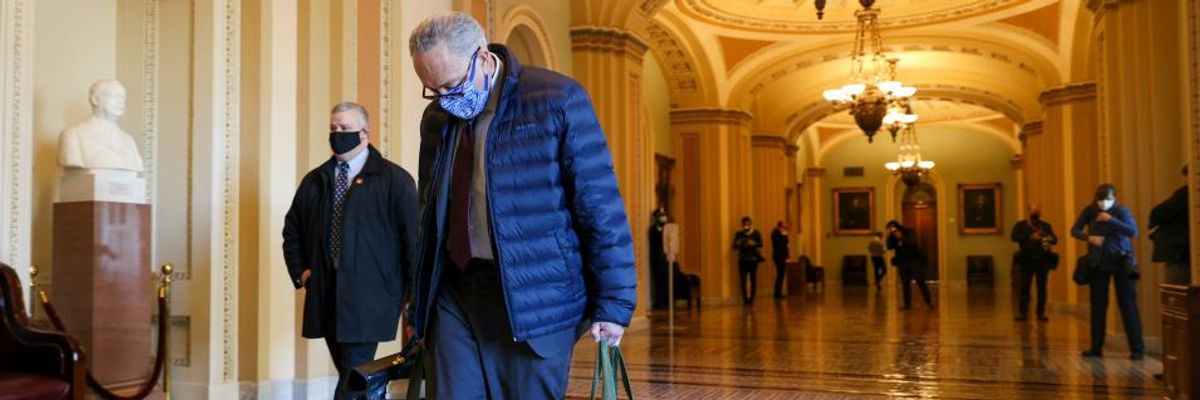
Senate Minority Leader Chuck Schumer (D-N.Y.) arrives on Capitol Hill on December 29, 2020 in Washington, D.C. (Photo: Tasos Katopodis/Getty Images)
After Senate Republicans repeatedly stymied a Sen. Bernie Sanders-led effort to force a clean up-or-down vote on $2,000 direct payments, dozens of Democrats late Wednesday joined Majority Leader Mitch McConnell in allowing the chamber to move ahead with the process of overriding President Donald Trump's veto of the $740 billion National Defense Authorization Act.
The vote on the motion to proceed to the NDAA veto override came after Sanders, Senate Minority Leader Chuck Schumer (D-N.Y.), and others denied McConnell unanimous consent this week to speedily advance the behemoth military spending bill, a tactic aimed at securing a clean vote on House-passed legislation that would deliver $2,000 payments to most Americans.
"Maybe my colleague, the Majority Leader, might want to get on the phone and start talking to working families in Kentucky and find out how they feel about the need for immediate help in terms of a $2,000 check per adult."
--Sen. Bernie Sanders
But McConnell, joined by Sens. Pat Toomey (R-Pa.) and John Cornyn (R-Texas), rejected demands for a vote on the direct payments once again on Wednesday, declaring that the checks would benefit "millionaires and billionaires"--a complaint that was both false and shamelessly hypocritical, given that the same Republicans had no issue with passing President Donald Trump's $1.5 trillion in tax cuts for the wealthy in 2017.
Thanks to the delay tactics that Sanders spearheaded, McConnell was forced to hold a vote Wednesday on a formal motion to proceed to the NDAA. But ultimately, Sanders was one of just six members of the Senate Democratic caucus to vote against the motion, which succeeded by an overwhelming margin of 80-12.
Sens. Ed Markey (D-Mass.), Jeff Merkley (D-Ore.), Chris Van Hollen (D-Md.), Elizabeth Warren (D-Mass.), and Ron Wyden (D-Ore.) joined the Vermont senator in opposing the motion. Six Republicans also voted no.
In total, 41 Democrats--including Schumer and Vice President-elect Kamala Harris--voted for the motion, paving the way for an override of Trump's NDAA veto and effectively killing the prospect of a vote on $2,000 direct payments before the next Congress. View the full roll call here.
A final vote on the NDAA veto override is expected by January 2. Sanders made clear following the motion's passage Wednesday that he plans to continue pushing for a vote on the direct payments.
"The sheer scale of Wednesday's Democratic surrender was truly a sight to behold," wrote The Daily Poster's David Sirota and Andrew Perez. "And it probably ended the chance for more immediate aid to millions of Americans facing eviction, starvation, and bankruptcy... Democratic senators in fact provided the majority of the votes for the measure that lets the defense bill proceed without a vote on the $2,000 checks."
Ahead of Wednesday's vote, Sanders took Republican senators to task for standing in the way of robust direct relief for their constituents amid widespread hunger, surging poverty, and a looming eviction crisis. McConnell, a Kentucky Republican, said during his floor remarks that the Senate is "not going to be bullied into rushing out more borrowed money into the hands of the Democrats' rich friends who don't need the help."
"Let me just make it clear for the Majority Leader that 10 out of the poorest 25 counties in the United States of America are located in Kentucky," Sanders said in response. "So maybe my colleague, the Majority Leader, might want to get on the phone and start talking to working families in Kentucky and find out how they feel about the need for immediate help in terms of a $2,000 check per adult. And I have the strong feeling that the people of Kentucky will respond no differently than the people of Vermont or New York."
Sen. Ed Markey joined Sanders in demanding a vote on the $2,000 checks, declaring, "He is right. The Republicans are wrong on this issue, on every single part of this debate. Senator Sanders is right. The Republicans are wrong."
"We're in the middle of an unprecedented crisis in our country," Markey said. "We have a healthcare crisis. We have an unemployment crisis. We have a hunger crisis. We have a housing crisis. We have an addiction crisis. We have a moral crisis in this country. The United States government should be responding to the needs, to the desperation, of families in our country at this time."
Dear Common Dreams reader, It’s been nearly 30 years since I co-founded Common Dreams with my late wife, Lina Newhouser. We had the radical notion that journalism should serve the public good, not corporate profits. It was clear to us from the outset what it would take to build such a project. No paid advertisements. No corporate sponsors. No millionaire publisher telling us what to think or do. Many people said we wouldn't last a year, but we proved those doubters wrong. Together with a tremendous team of journalists and dedicated staff, we built an independent media outlet free from the constraints of profits and corporate control. Our mission has always been simple: To inform. To inspire. To ignite change for the common good. Building Common Dreams was not easy. Our survival was never guaranteed. When you take on the most powerful forces—Wall Street greed, fossil fuel industry destruction, Big Tech lobbyists, and uber-rich oligarchs who have spent billions upon billions rigging the economy and democracy in their favor—the only bulwark you have is supporters who believe in your work. But here’s the urgent message from me today. It's never been this bad out there. And it's never been this hard to keep us going. At the very moment Common Dreams is most needed, the threats we face are intensifying. We need your support now more than ever. We don't accept corporate advertising and never will. We don't have a paywall because we don't think people should be blocked from critical news based on their ability to pay. Everything we do is funded by the donations of readers like you. When everyone does the little they can afford, we are strong. But if that support retreats or dries up, so do we. Will you donate now to make sure Common Dreams not only survives but thrives? —Craig Brown, Co-founder |
After Senate Republicans repeatedly stymied a Sen. Bernie Sanders-led effort to force a clean up-or-down vote on $2,000 direct payments, dozens of Democrats late Wednesday joined Majority Leader Mitch McConnell in allowing the chamber to move ahead with the process of overriding President Donald Trump's veto of the $740 billion National Defense Authorization Act.
The vote on the motion to proceed to the NDAA veto override came after Sanders, Senate Minority Leader Chuck Schumer (D-N.Y.), and others denied McConnell unanimous consent this week to speedily advance the behemoth military spending bill, a tactic aimed at securing a clean vote on House-passed legislation that would deliver $2,000 payments to most Americans.
"Maybe my colleague, the Majority Leader, might want to get on the phone and start talking to working families in Kentucky and find out how they feel about the need for immediate help in terms of a $2,000 check per adult."
--Sen. Bernie Sanders
But McConnell, joined by Sens. Pat Toomey (R-Pa.) and John Cornyn (R-Texas), rejected demands for a vote on the direct payments once again on Wednesday, declaring that the checks would benefit "millionaires and billionaires"--a complaint that was both false and shamelessly hypocritical, given that the same Republicans had no issue with passing President Donald Trump's $1.5 trillion in tax cuts for the wealthy in 2017.
Thanks to the delay tactics that Sanders spearheaded, McConnell was forced to hold a vote Wednesday on a formal motion to proceed to the NDAA. But ultimately, Sanders was one of just six members of the Senate Democratic caucus to vote against the motion, which succeeded by an overwhelming margin of 80-12.
Sens. Ed Markey (D-Mass.), Jeff Merkley (D-Ore.), Chris Van Hollen (D-Md.), Elizabeth Warren (D-Mass.), and Ron Wyden (D-Ore.) joined the Vermont senator in opposing the motion. Six Republicans also voted no.
In total, 41 Democrats--including Schumer and Vice President-elect Kamala Harris--voted for the motion, paving the way for an override of Trump's NDAA veto and effectively killing the prospect of a vote on $2,000 direct payments before the next Congress. View the full roll call here.
A final vote on the NDAA veto override is expected by January 2. Sanders made clear following the motion's passage Wednesday that he plans to continue pushing for a vote on the direct payments.
"The sheer scale of Wednesday's Democratic surrender was truly a sight to behold," wrote The Daily Poster's David Sirota and Andrew Perez. "And it probably ended the chance for more immediate aid to millions of Americans facing eviction, starvation, and bankruptcy... Democratic senators in fact provided the majority of the votes for the measure that lets the defense bill proceed without a vote on the $2,000 checks."
Ahead of Wednesday's vote, Sanders took Republican senators to task for standing in the way of robust direct relief for their constituents amid widespread hunger, surging poverty, and a looming eviction crisis. McConnell, a Kentucky Republican, said during his floor remarks that the Senate is "not going to be bullied into rushing out more borrowed money into the hands of the Democrats' rich friends who don't need the help."
"Let me just make it clear for the Majority Leader that 10 out of the poorest 25 counties in the United States of America are located in Kentucky," Sanders said in response. "So maybe my colleague, the Majority Leader, might want to get on the phone and start talking to working families in Kentucky and find out how they feel about the need for immediate help in terms of a $2,000 check per adult. And I have the strong feeling that the people of Kentucky will respond no differently than the people of Vermont or New York."
Sen. Ed Markey joined Sanders in demanding a vote on the $2,000 checks, declaring, "He is right. The Republicans are wrong on this issue, on every single part of this debate. Senator Sanders is right. The Republicans are wrong."
"We're in the middle of an unprecedented crisis in our country," Markey said. "We have a healthcare crisis. We have an unemployment crisis. We have a hunger crisis. We have a housing crisis. We have an addiction crisis. We have a moral crisis in this country. The United States government should be responding to the needs, to the desperation, of families in our country at this time."
After Senate Republicans repeatedly stymied a Sen. Bernie Sanders-led effort to force a clean up-or-down vote on $2,000 direct payments, dozens of Democrats late Wednesday joined Majority Leader Mitch McConnell in allowing the chamber to move ahead with the process of overriding President Donald Trump's veto of the $740 billion National Defense Authorization Act.
The vote on the motion to proceed to the NDAA veto override came after Sanders, Senate Minority Leader Chuck Schumer (D-N.Y.), and others denied McConnell unanimous consent this week to speedily advance the behemoth military spending bill, a tactic aimed at securing a clean vote on House-passed legislation that would deliver $2,000 payments to most Americans.
"Maybe my colleague, the Majority Leader, might want to get on the phone and start talking to working families in Kentucky and find out how they feel about the need for immediate help in terms of a $2,000 check per adult."
--Sen. Bernie Sanders
But McConnell, joined by Sens. Pat Toomey (R-Pa.) and John Cornyn (R-Texas), rejected demands for a vote on the direct payments once again on Wednesday, declaring that the checks would benefit "millionaires and billionaires"--a complaint that was both false and shamelessly hypocritical, given that the same Republicans had no issue with passing President Donald Trump's $1.5 trillion in tax cuts for the wealthy in 2017.
Thanks to the delay tactics that Sanders spearheaded, McConnell was forced to hold a vote Wednesday on a formal motion to proceed to the NDAA. But ultimately, Sanders was one of just six members of the Senate Democratic caucus to vote against the motion, which succeeded by an overwhelming margin of 80-12.
Sens. Ed Markey (D-Mass.), Jeff Merkley (D-Ore.), Chris Van Hollen (D-Md.), Elizabeth Warren (D-Mass.), and Ron Wyden (D-Ore.) joined the Vermont senator in opposing the motion. Six Republicans also voted no.
In total, 41 Democrats--including Schumer and Vice President-elect Kamala Harris--voted for the motion, paving the way for an override of Trump's NDAA veto and effectively killing the prospect of a vote on $2,000 direct payments before the next Congress. View the full roll call here.
A final vote on the NDAA veto override is expected by January 2. Sanders made clear following the motion's passage Wednesday that he plans to continue pushing for a vote on the direct payments.
"The sheer scale of Wednesday's Democratic surrender was truly a sight to behold," wrote The Daily Poster's David Sirota and Andrew Perez. "And it probably ended the chance for more immediate aid to millions of Americans facing eviction, starvation, and bankruptcy... Democratic senators in fact provided the majority of the votes for the measure that lets the defense bill proceed without a vote on the $2,000 checks."
Ahead of Wednesday's vote, Sanders took Republican senators to task for standing in the way of robust direct relief for their constituents amid widespread hunger, surging poverty, and a looming eviction crisis. McConnell, a Kentucky Republican, said during his floor remarks that the Senate is "not going to be bullied into rushing out more borrowed money into the hands of the Democrats' rich friends who don't need the help."
"Let me just make it clear for the Majority Leader that 10 out of the poorest 25 counties in the United States of America are located in Kentucky," Sanders said in response. "So maybe my colleague, the Majority Leader, might want to get on the phone and start talking to working families in Kentucky and find out how they feel about the need for immediate help in terms of a $2,000 check per adult. And I have the strong feeling that the people of Kentucky will respond no differently than the people of Vermont or New York."
Sen. Ed Markey joined Sanders in demanding a vote on the $2,000 checks, declaring, "He is right. The Republicans are wrong on this issue, on every single part of this debate. Senator Sanders is right. The Republicans are wrong."
"We're in the middle of an unprecedented crisis in our country," Markey said. "We have a healthcare crisis. We have an unemployment crisis. We have a hunger crisis. We have a housing crisis. We have an addiction crisis. We have a moral crisis in this country. The United States government should be responding to the needs, to the desperation, of families in our country at this time."