SUBSCRIBE TO OUR FREE NEWSLETTER
Daily news & progressive opinion—funded by the people, not the corporations—delivered straight to your inbox.
5
#000000
#FFFFFF
To donate by check, phone, or other method, see our More Ways to Give page.
Daily news & progressive opinion—funded by the people, not the corporations—delivered straight to your inbox.
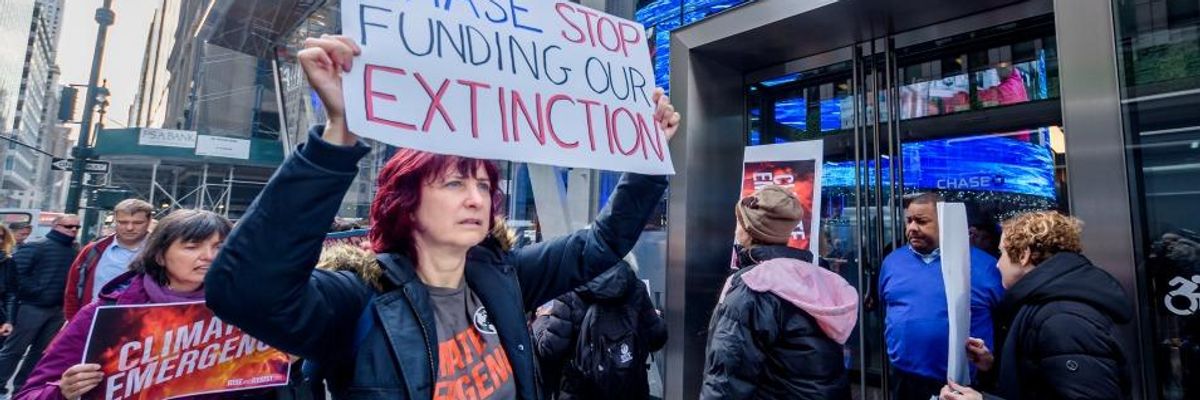
Protesters picket outside a Chase Bank branch in November 2019. (Photo: Erik McGregor/LightRocket via Getty Images)
Five years after the world adopted the Paris climate agreement, global financial institutions have provided over $1.6 trillion in loans and underwriting to multinational fossil fuel firms planning and developing destructive oil and gas projects, a joint report from 18 environmental groups revealed Thursday.
"Instead of adopting a rigorous approach that would prevent the expansion of fossil fuels and facilitate their phase-out, global banks are refusing to break with the fatal growth trend of fossil extraction."
--Lucie Pinson,
Reclaim Finance
Entitled Five Years Lost: How Finance Is Blowing the Paris Carbon Budget (pdf), the report was coordinated by Germany-based environmental and human rights group Urgewald, with the participation of organizations including Rainforest Action Network, Friends of the Earth USA, Oil Change International, Re:Common, and Reclaim Finance.
The new paper details a dozen of the most devastating fossil fuel projects around the world, which together would use up fully three-quarters of the total remaining carbon budget, based on the Paris accord's goal of limiting global warming to 1.5degC.
Furthermore, the report exposes the banks and investors that are financing leading fossil fuel companies, as well as the environmental and social costs associated with their projects. These include violation of Indigenous rights, negative health impacts, human rights violations, and expected CO2 emissions caused by each of the projects.
Projects covered in the report are located in countries including Argentina, Australia, Bangladesh, China, India, Mozambique, Norway, Suriname, the United Kingdom, and the United States.
Banks including CitiGroup, Bank of America, and JPMorgan Chase in the U.S.; Barclays, HSBC, BNP Paribas, Deutsche Bank, Credit Suisse, and Santander in Europe; Mitsubishi, Mizuho, and SMBC in Japan; Bank of China and the Industrial and Commercial Bank of China; and the Royal Bank of Canada together provided more than half of the total funding to the fossil fuel companies involved in the 12 projects.
Leading financial firms including BlackRock, Vanguard, State Street, and Capital Group in the U.S.; UBS in Switzerland; Legal & General in the U.K.; and the Norwegian Government Pension Fund also provided nearly half of the projects' funding.
Fossil fuel companies receiving loans and other financial support include BP, Chevron, ExxonMobil, Total, Royal Dutch Shell, Repsol, Eni, and Equinor.
"These 12 case studies illustrate the lamentable failure of banks to respond to the urgency of the climate crisis," said Lucie Pinson, executive director of Reclaim Finance. "Instead of adopting a rigorous approach that would prevent the expansion of fossil fuels and facilitate their phase-out, global banks are refusing to break with the fatal growth trend of fossil extraction."
"BNP Paribas, JPMorgan Chase, and Mitsubishi all have very different coal, oil, and gas exclusion policies," Pinson added. "However, this report shows that there is something that clearly unites them: They all keep supporting some of the worst projects worldwide through their loyal financing to the oil and gas majors."
Katrin Ganswindt, Urgewald's finance campaigner, added that "developing new coal, oil, and gas reserves while the world is already experiencing the devastating effects of climate change is insane."
"This is the opposite of reducing CO2 emissions as agreed five years ago in Paris," said Ganswindt. "If carbon bomb mega-projects such as the ones showcased in this report move forward, we will overshoot 1.5deg of global warming."
"These institutions are gambling away our future," she added. "The only reasonable decision for investors in this situation is to green their portfolio and to quit companies planning new fossil investments now."
The report comes amid growing pressure from grassroots activists and governments alike for banks and finance firms to stop bankrolling carbon polluters.
In the U.S., Sen. Jeff Merkley (D-Ore.) in October introduced a pair of bills aimed squarely at these entities: the Protecting America's Economy from the Carbon Bubble Act of 2020, which his office says "would help safeguard the economy by prohibiting financial companies from making new investments in fossil fuels," and the Sustainable International Financial Institutions Act of 2020, which "would elevate that priority to the international stage by ensuring that the United States uses its voice and vote in international financial institutions to divest from fossil fuel investments."
The measures, however, have little chance of passage in the current Republican-controlled Senate.
In Britain, there are mounting calls to link banking executive pay with fulfillment of the Paris agreement's goals.
On the other hand, the administration of U.S. President Donald Trump is accused of pressuring banks into backing Arctic fossil fuel extraction, even as the six largest U.S. financial firms have decided they want no part of bankrolling drilling in Alaska's pristine Arctic National Wildlife Refuge.
A new United Nations report released this week details how, despite a pandemic-related drop, planet-heating emissions are on track to surpass the Paris agreement's target temperate threshold.
Dear Common Dreams reader, It’s been nearly 30 years since I co-founded Common Dreams with my late wife, Lina Newhouser. We had the radical notion that journalism should serve the public good, not corporate profits. It was clear to us from the outset what it would take to build such a project. No paid advertisements. No corporate sponsors. No millionaire publisher telling us what to think or do. Many people said we wouldn't last a year, but we proved those doubters wrong. Together with a tremendous team of journalists and dedicated staff, we built an independent media outlet free from the constraints of profits and corporate control. Our mission has always been simple: To inform. To inspire. To ignite change for the common good. Building Common Dreams was not easy. Our survival was never guaranteed. When you take on the most powerful forces—Wall Street greed, fossil fuel industry destruction, Big Tech lobbyists, and uber-rich oligarchs who have spent billions upon billions rigging the economy and democracy in their favor—the only bulwark you have is supporters who believe in your work. But here’s the urgent message from me today. It's never been this bad out there. And it's never been this hard to keep us going. At the very moment Common Dreams is most needed, the threats we face are intensifying. We need your support now more than ever. We don't accept corporate advertising and never will. We don't have a paywall because we don't think people should be blocked from critical news based on their ability to pay. Everything we do is funded by the donations of readers like you. When everyone does the little they can afford, we are strong. But if that support retreats or dries up, so do we. Will you donate now to make sure Common Dreams not only survives but thrives? —Craig Brown, Co-founder |
Five years after the world adopted the Paris climate agreement, global financial institutions have provided over $1.6 trillion in loans and underwriting to multinational fossil fuel firms planning and developing destructive oil and gas projects, a joint report from 18 environmental groups revealed Thursday.
"Instead of adopting a rigorous approach that would prevent the expansion of fossil fuels and facilitate their phase-out, global banks are refusing to break with the fatal growth trend of fossil extraction."
--Lucie Pinson,
Reclaim Finance
Entitled Five Years Lost: How Finance Is Blowing the Paris Carbon Budget (pdf), the report was coordinated by Germany-based environmental and human rights group Urgewald, with the participation of organizations including Rainforest Action Network, Friends of the Earth USA, Oil Change International, Re:Common, and Reclaim Finance.
The new paper details a dozen of the most devastating fossil fuel projects around the world, which together would use up fully three-quarters of the total remaining carbon budget, based on the Paris accord's goal of limiting global warming to 1.5degC.
Furthermore, the report exposes the banks and investors that are financing leading fossil fuel companies, as well as the environmental and social costs associated with their projects. These include violation of Indigenous rights, negative health impacts, human rights violations, and expected CO2 emissions caused by each of the projects.
Projects covered in the report are located in countries including Argentina, Australia, Bangladesh, China, India, Mozambique, Norway, Suriname, the United Kingdom, and the United States.
Banks including CitiGroup, Bank of America, and JPMorgan Chase in the U.S.; Barclays, HSBC, BNP Paribas, Deutsche Bank, Credit Suisse, and Santander in Europe; Mitsubishi, Mizuho, and SMBC in Japan; Bank of China and the Industrial and Commercial Bank of China; and the Royal Bank of Canada together provided more than half of the total funding to the fossil fuel companies involved in the 12 projects.
Leading financial firms including BlackRock, Vanguard, State Street, and Capital Group in the U.S.; UBS in Switzerland; Legal & General in the U.K.; and the Norwegian Government Pension Fund also provided nearly half of the projects' funding.
Fossil fuel companies receiving loans and other financial support include BP, Chevron, ExxonMobil, Total, Royal Dutch Shell, Repsol, Eni, and Equinor.
"These 12 case studies illustrate the lamentable failure of banks to respond to the urgency of the climate crisis," said Lucie Pinson, executive director of Reclaim Finance. "Instead of adopting a rigorous approach that would prevent the expansion of fossil fuels and facilitate their phase-out, global banks are refusing to break with the fatal growth trend of fossil extraction."
"BNP Paribas, JPMorgan Chase, and Mitsubishi all have very different coal, oil, and gas exclusion policies," Pinson added. "However, this report shows that there is something that clearly unites them: They all keep supporting some of the worst projects worldwide through their loyal financing to the oil and gas majors."
Katrin Ganswindt, Urgewald's finance campaigner, added that "developing new coal, oil, and gas reserves while the world is already experiencing the devastating effects of climate change is insane."
"This is the opposite of reducing CO2 emissions as agreed five years ago in Paris," said Ganswindt. "If carbon bomb mega-projects such as the ones showcased in this report move forward, we will overshoot 1.5deg of global warming."
"These institutions are gambling away our future," she added. "The only reasonable decision for investors in this situation is to green their portfolio and to quit companies planning new fossil investments now."
The report comes amid growing pressure from grassroots activists and governments alike for banks and finance firms to stop bankrolling carbon polluters.
In the U.S., Sen. Jeff Merkley (D-Ore.) in October introduced a pair of bills aimed squarely at these entities: the Protecting America's Economy from the Carbon Bubble Act of 2020, which his office says "would help safeguard the economy by prohibiting financial companies from making new investments in fossil fuels," and the Sustainable International Financial Institutions Act of 2020, which "would elevate that priority to the international stage by ensuring that the United States uses its voice and vote in international financial institutions to divest from fossil fuel investments."
The measures, however, have little chance of passage in the current Republican-controlled Senate.
In Britain, there are mounting calls to link banking executive pay with fulfillment of the Paris agreement's goals.
On the other hand, the administration of U.S. President Donald Trump is accused of pressuring banks into backing Arctic fossil fuel extraction, even as the six largest U.S. financial firms have decided they want no part of bankrolling drilling in Alaska's pristine Arctic National Wildlife Refuge.
A new United Nations report released this week details how, despite a pandemic-related drop, planet-heating emissions are on track to surpass the Paris agreement's target temperate threshold.
Five years after the world adopted the Paris climate agreement, global financial institutions have provided over $1.6 trillion in loans and underwriting to multinational fossil fuel firms planning and developing destructive oil and gas projects, a joint report from 18 environmental groups revealed Thursday.
"Instead of adopting a rigorous approach that would prevent the expansion of fossil fuels and facilitate their phase-out, global banks are refusing to break with the fatal growth trend of fossil extraction."
--Lucie Pinson,
Reclaim Finance
Entitled Five Years Lost: How Finance Is Blowing the Paris Carbon Budget (pdf), the report was coordinated by Germany-based environmental and human rights group Urgewald, with the participation of organizations including Rainforest Action Network, Friends of the Earth USA, Oil Change International, Re:Common, and Reclaim Finance.
The new paper details a dozen of the most devastating fossil fuel projects around the world, which together would use up fully three-quarters of the total remaining carbon budget, based on the Paris accord's goal of limiting global warming to 1.5degC.
Furthermore, the report exposes the banks and investors that are financing leading fossil fuel companies, as well as the environmental and social costs associated with their projects. These include violation of Indigenous rights, negative health impacts, human rights violations, and expected CO2 emissions caused by each of the projects.
Projects covered in the report are located in countries including Argentina, Australia, Bangladesh, China, India, Mozambique, Norway, Suriname, the United Kingdom, and the United States.
Banks including CitiGroup, Bank of America, and JPMorgan Chase in the U.S.; Barclays, HSBC, BNP Paribas, Deutsche Bank, Credit Suisse, and Santander in Europe; Mitsubishi, Mizuho, and SMBC in Japan; Bank of China and the Industrial and Commercial Bank of China; and the Royal Bank of Canada together provided more than half of the total funding to the fossil fuel companies involved in the 12 projects.
Leading financial firms including BlackRock, Vanguard, State Street, and Capital Group in the U.S.; UBS in Switzerland; Legal & General in the U.K.; and the Norwegian Government Pension Fund also provided nearly half of the projects' funding.
Fossil fuel companies receiving loans and other financial support include BP, Chevron, ExxonMobil, Total, Royal Dutch Shell, Repsol, Eni, and Equinor.
"These 12 case studies illustrate the lamentable failure of banks to respond to the urgency of the climate crisis," said Lucie Pinson, executive director of Reclaim Finance. "Instead of adopting a rigorous approach that would prevent the expansion of fossil fuels and facilitate their phase-out, global banks are refusing to break with the fatal growth trend of fossil extraction."
"BNP Paribas, JPMorgan Chase, and Mitsubishi all have very different coal, oil, and gas exclusion policies," Pinson added. "However, this report shows that there is something that clearly unites them: They all keep supporting some of the worst projects worldwide through their loyal financing to the oil and gas majors."
Katrin Ganswindt, Urgewald's finance campaigner, added that "developing new coal, oil, and gas reserves while the world is already experiencing the devastating effects of climate change is insane."
"This is the opposite of reducing CO2 emissions as agreed five years ago in Paris," said Ganswindt. "If carbon bomb mega-projects such as the ones showcased in this report move forward, we will overshoot 1.5deg of global warming."
"These institutions are gambling away our future," she added. "The only reasonable decision for investors in this situation is to green their portfolio and to quit companies planning new fossil investments now."
The report comes amid growing pressure from grassroots activists and governments alike for banks and finance firms to stop bankrolling carbon polluters.
In the U.S., Sen. Jeff Merkley (D-Ore.) in October introduced a pair of bills aimed squarely at these entities: the Protecting America's Economy from the Carbon Bubble Act of 2020, which his office says "would help safeguard the economy by prohibiting financial companies from making new investments in fossil fuels," and the Sustainable International Financial Institutions Act of 2020, which "would elevate that priority to the international stage by ensuring that the United States uses its voice and vote in international financial institutions to divest from fossil fuel investments."
The measures, however, have little chance of passage in the current Republican-controlled Senate.
In Britain, there are mounting calls to link banking executive pay with fulfillment of the Paris agreement's goals.
On the other hand, the administration of U.S. President Donald Trump is accused of pressuring banks into backing Arctic fossil fuel extraction, even as the six largest U.S. financial firms have decided they want no part of bankrolling drilling in Alaska's pristine Arctic National Wildlife Refuge.
A new United Nations report released this week details how, despite a pandemic-related drop, planet-heating emissions are on track to surpass the Paris agreement's target temperate threshold.