SUBSCRIBE TO OUR FREE NEWSLETTER
Daily news & progressive opinion—funded by the people, not the corporations—delivered straight to your inbox.
5
#000000
#FFFFFF
To donate by check, phone, or other method, see our More Ways to Give page.
Daily news & progressive opinion—funded by the people, not the corporations—delivered straight to your inbox.
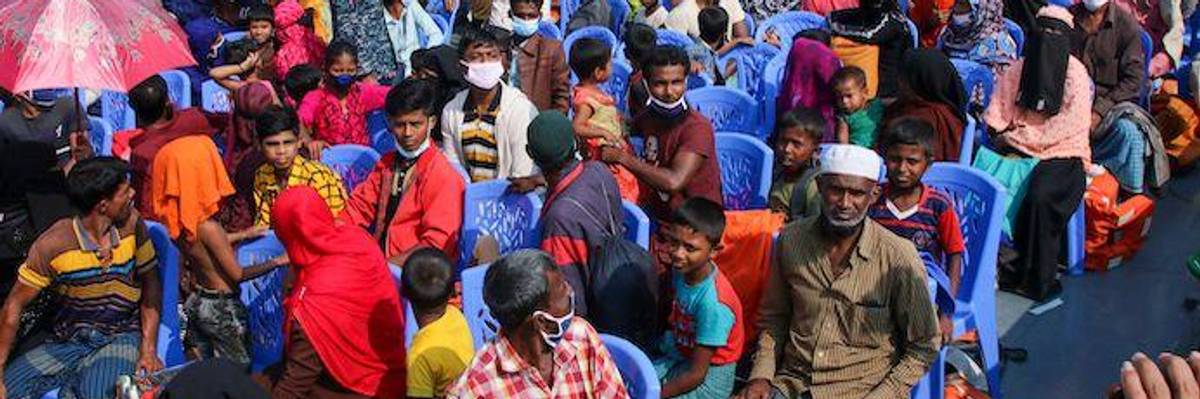
Rohingya refugees board a Bangladesh Navy ship to be transported to the island of Bhashan Char in Chittagong on December 4, 2020. Bangladesh began transferring hundreds of Rohingya refugees on Thursday to a low-lying island in an area prone to cyclones and floods, with rights groups alleging people were being coerced into leaving.
Human rights defenders this week urged Bangladesh to stop its relocation of Rohingya refugees to a flood-prone island in the Bay of Bengal, warning of "grave concerns about independent human rights monitoring."
Bhashan Char, as BBC News previously reported, "emerged less than 20 years ago from the sea. Situated less than 2m (6ft) above sea level, the island is made entirely of silt, Himalayan sediment washed down river and into the sea."
With Bangladesh's main refugee camp, Cox's Bazar, overflowing, Bangladesh has controversially planned to move 100,000 Rohingya refugees there. Human rights groups say it will be akin to a "floating prison," where Rohingya will be forced to move involuntarily, despite humanitarian watchdogs having been blocked from assessing the safety of the conditions.
According to Reuters, Bangladesh--which asserts the relocations are happening with consent--brought roughly 1,600 Rohingya refugees to the island Friday. From Reuters:
On the mainland on Thursday, before the departure, two Rohingya told Reuters their names had appeared on lists compiled by government-appointed local leaders without their consent.
"They have taken us here forcefully," a 31-year-old man told Reuters tearfully by phone as he boarded a bus that he said was taking him from the camps near Cox's Bazar to Chittagong.
"Three days ago, when I heard that my family is on the list, I ran away from the block, but yesterday I was caught and taken here," he said.
Apart from concerns about the refugees' lack of consent to relocate and lack of verification from United Nations authorities that the island has adequate healthcare, housing, and safety measures in place, the island's high risk of flooding has prompted further warnings
"Bangladesh's announced plan to begin relocating Rohingya refugees this week to Bhasan Char--an isolated island in the Bay of Bengal--is short-sighted and inhumane," Refugees International senior advocate for human rights Daniel Sullivan said in a statement Wednesday.
The "cyclone season in the Bay of Bengal is still ongoing," added Sullivan. "As the devastation wrought by Cyclone Amphan demonstrated this summer, super cyclones are the way of the future, and conditions on the isolated island may be too dangerous for the Rohingya."
Amnesty International's South Asia campaigner, Saad Hammadi, sounded similar alarms in a statement Thursday.
"The relocation of so many Rohingya refugees to a remote island, " said Hammadi, "which is still off limits to everyone including rights groups and journalists without prior permission, poses grave concerns about independent human rights monitoring."
"No relocation plan, either to Bhashan Char or to another location, can be undertaken without the full and informed consent of the individuals involved," Hammadi added.
Human Rights Watch also has criticized the relocations, and in a Thursday statement shared ominous accounts from refugees.
"I have no idea how my name appeared there, but I never voluntarily put my name on that list," one refugee said, according to the rights group.
"I only learned I was on the list after the camp-in-charge [camp authority or CiC] called me to his office and told me. After that, I fled from my shelter. I am hearing now that the CiC volunteers and majhis (community leaders) are looking for me and my family. I am afraid that if they find me, they will force me to go," said the refugee.
Brad Adams, HRW's Asia director, accused the Bangladesh government of "actively reneging on its promise to the U.N. not to relocate any refugees to Bhasan Char island until humanitarian experts give a green light."
"If the government were genuinely confident in the habitability of the island," said Adams, "they would be transparent and not hastily circumvent U.N. technical assessments."
Dear Common Dreams reader, It’s been nearly 30 years since I co-founded Common Dreams with my late wife, Lina Newhouser. We had the radical notion that journalism should serve the public good, not corporate profits. It was clear to us from the outset what it would take to build such a project. No paid advertisements. No corporate sponsors. No millionaire publisher telling us what to think or do. Many people said we wouldn't last a year, but we proved those doubters wrong. Together with a tremendous team of journalists and dedicated staff, we built an independent media outlet free from the constraints of profits and corporate control. Our mission has always been simple: To inform. To inspire. To ignite change for the common good. Building Common Dreams was not easy. Our survival was never guaranteed. When you take on the most powerful forces—Wall Street greed, fossil fuel industry destruction, Big Tech lobbyists, and uber-rich oligarchs who have spent billions upon billions rigging the economy and democracy in their favor—the only bulwark you have is supporters who believe in your work. But here’s the urgent message from me today. It's never been this bad out there. And it's never been this hard to keep us going. At the very moment Common Dreams is most needed, the threats we face are intensifying. We need your support now more than ever. We don't accept corporate advertising and never will. We don't have a paywall because we don't think people should be blocked from critical news based on their ability to pay. Everything we do is funded by the donations of readers like you. When everyone does the little they can afford, we are strong. But if that support retreats or dries up, so do we. Will you donate now to make sure Common Dreams not only survives but thrives? —Craig Brown, Co-founder |
Human rights defenders this week urged Bangladesh to stop its relocation of Rohingya refugees to a flood-prone island in the Bay of Bengal, warning of "grave concerns about independent human rights monitoring."
Bhashan Char, as BBC News previously reported, "emerged less than 20 years ago from the sea. Situated less than 2m (6ft) above sea level, the island is made entirely of silt, Himalayan sediment washed down river and into the sea."
With Bangladesh's main refugee camp, Cox's Bazar, overflowing, Bangladesh has controversially planned to move 100,000 Rohingya refugees there. Human rights groups say it will be akin to a "floating prison," where Rohingya will be forced to move involuntarily, despite humanitarian watchdogs having been blocked from assessing the safety of the conditions.
According to Reuters, Bangladesh--which asserts the relocations are happening with consent--brought roughly 1,600 Rohingya refugees to the island Friday. From Reuters:
On the mainland on Thursday, before the departure, two Rohingya told Reuters their names had appeared on lists compiled by government-appointed local leaders without their consent.
"They have taken us here forcefully," a 31-year-old man told Reuters tearfully by phone as he boarded a bus that he said was taking him from the camps near Cox's Bazar to Chittagong.
"Three days ago, when I heard that my family is on the list, I ran away from the block, but yesterday I was caught and taken here," he said.
Apart from concerns about the refugees' lack of consent to relocate and lack of verification from United Nations authorities that the island has adequate healthcare, housing, and safety measures in place, the island's high risk of flooding has prompted further warnings
"Bangladesh's announced plan to begin relocating Rohingya refugees this week to Bhasan Char--an isolated island in the Bay of Bengal--is short-sighted and inhumane," Refugees International senior advocate for human rights Daniel Sullivan said in a statement Wednesday.
The "cyclone season in the Bay of Bengal is still ongoing," added Sullivan. "As the devastation wrought by Cyclone Amphan demonstrated this summer, super cyclones are the way of the future, and conditions on the isolated island may be too dangerous for the Rohingya."
Amnesty International's South Asia campaigner, Saad Hammadi, sounded similar alarms in a statement Thursday.
"The relocation of so many Rohingya refugees to a remote island, " said Hammadi, "which is still off limits to everyone including rights groups and journalists without prior permission, poses grave concerns about independent human rights monitoring."
"No relocation plan, either to Bhashan Char or to another location, can be undertaken without the full and informed consent of the individuals involved," Hammadi added.
Human Rights Watch also has criticized the relocations, and in a Thursday statement shared ominous accounts from refugees.
"I have no idea how my name appeared there, but I never voluntarily put my name on that list," one refugee said, according to the rights group.
"I only learned I was on the list after the camp-in-charge [camp authority or CiC] called me to his office and told me. After that, I fled from my shelter. I am hearing now that the CiC volunteers and majhis (community leaders) are looking for me and my family. I am afraid that if they find me, they will force me to go," said the refugee.
Brad Adams, HRW's Asia director, accused the Bangladesh government of "actively reneging on its promise to the U.N. not to relocate any refugees to Bhasan Char island until humanitarian experts give a green light."
"If the government were genuinely confident in the habitability of the island," said Adams, "they would be transparent and not hastily circumvent U.N. technical assessments."
Human rights defenders this week urged Bangladesh to stop its relocation of Rohingya refugees to a flood-prone island in the Bay of Bengal, warning of "grave concerns about independent human rights monitoring."
Bhashan Char, as BBC News previously reported, "emerged less than 20 years ago from the sea. Situated less than 2m (6ft) above sea level, the island is made entirely of silt, Himalayan sediment washed down river and into the sea."
With Bangladesh's main refugee camp, Cox's Bazar, overflowing, Bangladesh has controversially planned to move 100,000 Rohingya refugees there. Human rights groups say it will be akin to a "floating prison," where Rohingya will be forced to move involuntarily, despite humanitarian watchdogs having been blocked from assessing the safety of the conditions.
According to Reuters, Bangladesh--which asserts the relocations are happening with consent--brought roughly 1,600 Rohingya refugees to the island Friday. From Reuters:
On the mainland on Thursday, before the departure, two Rohingya told Reuters their names had appeared on lists compiled by government-appointed local leaders without their consent.
"They have taken us here forcefully," a 31-year-old man told Reuters tearfully by phone as he boarded a bus that he said was taking him from the camps near Cox's Bazar to Chittagong.
"Three days ago, when I heard that my family is on the list, I ran away from the block, but yesterday I was caught and taken here," he said.
Apart from concerns about the refugees' lack of consent to relocate and lack of verification from United Nations authorities that the island has adequate healthcare, housing, and safety measures in place, the island's high risk of flooding has prompted further warnings
"Bangladesh's announced plan to begin relocating Rohingya refugees this week to Bhasan Char--an isolated island in the Bay of Bengal--is short-sighted and inhumane," Refugees International senior advocate for human rights Daniel Sullivan said in a statement Wednesday.
The "cyclone season in the Bay of Bengal is still ongoing," added Sullivan. "As the devastation wrought by Cyclone Amphan demonstrated this summer, super cyclones are the way of the future, and conditions on the isolated island may be too dangerous for the Rohingya."
Amnesty International's South Asia campaigner, Saad Hammadi, sounded similar alarms in a statement Thursday.
"The relocation of so many Rohingya refugees to a remote island, " said Hammadi, "which is still off limits to everyone including rights groups and journalists without prior permission, poses grave concerns about independent human rights monitoring."
"No relocation plan, either to Bhashan Char or to another location, can be undertaken without the full and informed consent of the individuals involved," Hammadi added.
Human Rights Watch also has criticized the relocations, and in a Thursday statement shared ominous accounts from refugees.
"I have no idea how my name appeared there, but I never voluntarily put my name on that list," one refugee said, according to the rights group.
"I only learned I was on the list after the camp-in-charge [camp authority or CiC] called me to his office and told me. After that, I fled from my shelter. I am hearing now that the CiC volunteers and majhis (community leaders) are looking for me and my family. I am afraid that if they find me, they will force me to go," said the refugee.
Brad Adams, HRW's Asia director, accused the Bangladesh government of "actively reneging on its promise to the U.N. not to relocate any refugees to Bhasan Char island until humanitarian experts give a green light."
"If the government were genuinely confident in the habitability of the island," said Adams, "they would be transparent and not hastily circumvent U.N. technical assessments."