SUBSCRIBE TO OUR FREE NEWSLETTER
Daily news & progressive opinion—funded by the people, not the corporations—delivered straight to your inbox.
5
#000000
#FFFFFF
To donate by check, phone, or other method, see our More Ways to Give page.
Daily news & progressive opinion—funded by the people, not the corporations—delivered straight to your inbox.
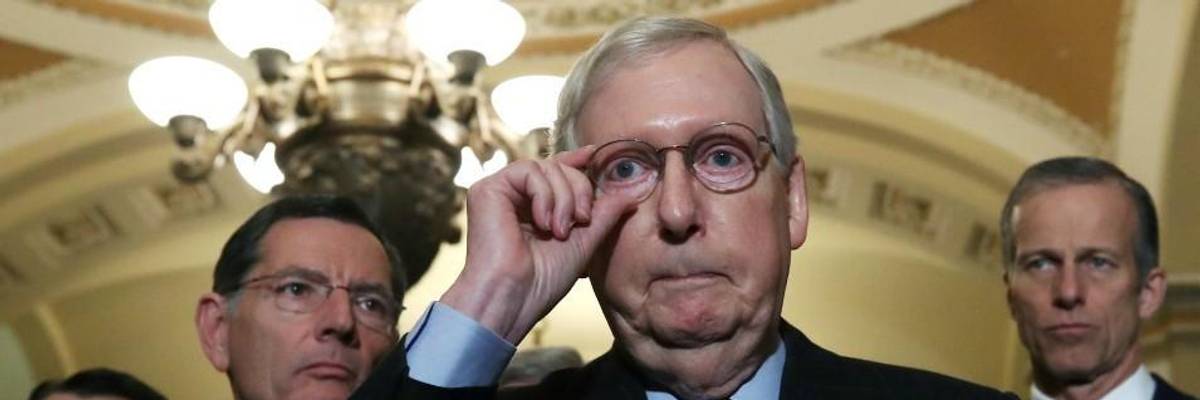
Senate Majority Leader Mitch McConnell (R-Ky.) talks to reporters after attending the weekly Senate Republicans policy luncheon at the U.S. Capitol January 7, 2020 in Washington, D.C. (Photo: Mark Wilson/Getty Images)
While excluding any funding for direct cash payments to Americans struggling to afford basic necessities amid the Covid-19 pandemic and resulting economic crisis, the purportedly "targeted" relief legislation put forth by Senate Republicans Tuesday calls for a $161 million handout to the coal industry--a proposal Sen. Bernie Sanders condemned as "pathetic."
"Senate Republicans tell us we can't afford to give $2,000 a month to the working class during the economic crisis," tweeted the Vermont senator, but "the Covid-19 'relief' bill they just released provides $161 million in corporate welfare to the coal industry during a climate emergency."
Sanders pointed to a provision buried in the 285-page GOP bill (pdf)--titled the Delivering Immediate Relief to America's Families, Schools, and Small Businesses Act--directing the Department of Energy to "carry out a program under which the secretary shall develop advanced separation technologies for the extraction and recovery of rare earth elements and minerals from coal and coal byproducts."
The massive coal industry handout was just one of many provisions crammed in the so-called "skinny" relief bill that progressive advocacy groups and Democratic lawmakers denounced as unacceptable.
Lisa Gilbert, executive vice president of Public Citizen, said in a statement that the new legislation spotlights the extent to which "Senate Republicans' priorities are completely upside down," pointing to the measure's proposal of a sweeping liability shield for corporations that expose workers and customers to Covid-19.
"They're against providing state and local governments with critical aid to fund public services and schools but in favor of granting businesses immunity from lawsuits related to the coronavirus," said Gilbert. "The pandemic is already widening social and economic divisions. Shielding corporations from accountability will endanger workers, consumers, and patients, and make the pandemic even worse."
The price tag of the Republican proposal was pegged at around $300 billion, making the bill dramatically smaller than the $1 trillion plan the Senate GOP rolled out in July--a proposal that was also deemed woefully inadequate to meet the needs of tens of millions of hungry, jobless, and eviction-prone Americans.
The new bill calls for a $300-per-week federal boost to unemployment benefits, just half of the $600 weekly supplement Republicans allowed to expire at the end of July; $105 billion for education and tax credits for "private-school scholarships"; $250 billion for the Paycheck Protection Program; and forgiveness of a $10 billion loan to the U.S. Postal Service approved under a previous relief package.
In a speech on the Senate floor late Tuesday, Senate Majority Leader Mitch McConnell (R-Ky.) said the Senate will vote on the bill this week even though it is widely expected to fail due to lack of Democratic support and divisions within the Republican caucus.
"Every senator who has said they want a bipartisan outcome for the country will have the chance to vote, for everyone to see," said McConnell. "Senators will vote this week. And the American people will be watching."
Senate Minority Leader Chuck Schumer (D-N.Y.) said McConnell's push for a rapid vote on a Republican bill that's "certain to fail" is "one of the cynical things I have ever seen in politics."
"This new emaciated Republican Covid proposal fails to meet the needs of the American people," Schumer tweeted.
Kyle Herrig, president of watchdog group Accountable.US, said in a statement late Tuesday that the Senate GOP's latest plan is "a slap in the face to the millions of Americans struggling to provide for their families during this crisis."
"Without adequate support for people who have lost their jobs or sufficient funds to help small businesses stay afloat," added Herrig, "it's clear that lawmakers are more interested in helping the president and his allies with this bill than the workers who need support most."
Dear Common Dreams reader, It’s been nearly 30 years since I co-founded Common Dreams with my late wife, Lina Newhouser. We had the radical notion that journalism should serve the public good, not corporate profits. It was clear to us from the outset what it would take to build such a project. No paid advertisements. No corporate sponsors. No millionaire publisher telling us what to think or do. Many people said we wouldn't last a year, but we proved those doubters wrong. Together with a tremendous team of journalists and dedicated staff, we built an independent media outlet free from the constraints of profits and corporate control. Our mission has always been simple: To inform. To inspire. To ignite change for the common good. Building Common Dreams was not easy. Our survival was never guaranteed. When you take on the most powerful forces—Wall Street greed, fossil fuel industry destruction, Big Tech lobbyists, and uber-rich oligarchs who have spent billions upon billions rigging the economy and democracy in their favor—the only bulwark you have is supporters who believe in your work. But here’s the urgent message from me today. It's never been this bad out there. And it's never been this hard to keep us going. At the very moment Common Dreams is most needed, the threats we face are intensifying. We need your support now more than ever. We don't accept corporate advertising and never will. We don't have a paywall because we don't think people should be blocked from critical news based on their ability to pay. Everything we do is funded by the donations of readers like you. When everyone does the little they can afford, we are strong. But if that support retreats or dries up, so do we. Will you donate now to make sure Common Dreams not only survives but thrives? —Craig Brown, Co-founder |
While excluding any funding for direct cash payments to Americans struggling to afford basic necessities amid the Covid-19 pandemic and resulting economic crisis, the purportedly "targeted" relief legislation put forth by Senate Republicans Tuesday calls for a $161 million handout to the coal industry--a proposal Sen. Bernie Sanders condemned as "pathetic."
"Senate Republicans tell us we can't afford to give $2,000 a month to the working class during the economic crisis," tweeted the Vermont senator, but "the Covid-19 'relief' bill they just released provides $161 million in corporate welfare to the coal industry during a climate emergency."
Sanders pointed to a provision buried in the 285-page GOP bill (pdf)--titled the Delivering Immediate Relief to America's Families, Schools, and Small Businesses Act--directing the Department of Energy to "carry out a program under which the secretary shall develop advanced separation technologies for the extraction and recovery of rare earth elements and minerals from coal and coal byproducts."
The massive coal industry handout was just one of many provisions crammed in the so-called "skinny" relief bill that progressive advocacy groups and Democratic lawmakers denounced as unacceptable.
Lisa Gilbert, executive vice president of Public Citizen, said in a statement that the new legislation spotlights the extent to which "Senate Republicans' priorities are completely upside down," pointing to the measure's proposal of a sweeping liability shield for corporations that expose workers and customers to Covid-19.
"They're against providing state and local governments with critical aid to fund public services and schools but in favor of granting businesses immunity from lawsuits related to the coronavirus," said Gilbert. "The pandemic is already widening social and economic divisions. Shielding corporations from accountability will endanger workers, consumers, and patients, and make the pandemic even worse."
The price tag of the Republican proposal was pegged at around $300 billion, making the bill dramatically smaller than the $1 trillion plan the Senate GOP rolled out in July--a proposal that was also deemed woefully inadequate to meet the needs of tens of millions of hungry, jobless, and eviction-prone Americans.
The new bill calls for a $300-per-week federal boost to unemployment benefits, just half of the $600 weekly supplement Republicans allowed to expire at the end of July; $105 billion for education and tax credits for "private-school scholarships"; $250 billion for the Paycheck Protection Program; and forgiveness of a $10 billion loan to the U.S. Postal Service approved under a previous relief package.
In a speech on the Senate floor late Tuesday, Senate Majority Leader Mitch McConnell (R-Ky.) said the Senate will vote on the bill this week even though it is widely expected to fail due to lack of Democratic support and divisions within the Republican caucus.
"Every senator who has said they want a bipartisan outcome for the country will have the chance to vote, for everyone to see," said McConnell. "Senators will vote this week. And the American people will be watching."
Senate Minority Leader Chuck Schumer (D-N.Y.) said McConnell's push for a rapid vote on a Republican bill that's "certain to fail" is "one of the cynical things I have ever seen in politics."
"This new emaciated Republican Covid proposal fails to meet the needs of the American people," Schumer tweeted.
Kyle Herrig, president of watchdog group Accountable.US, said in a statement late Tuesday that the Senate GOP's latest plan is "a slap in the face to the millions of Americans struggling to provide for their families during this crisis."
"Without adequate support for people who have lost their jobs or sufficient funds to help small businesses stay afloat," added Herrig, "it's clear that lawmakers are more interested in helping the president and his allies with this bill than the workers who need support most."
While excluding any funding for direct cash payments to Americans struggling to afford basic necessities amid the Covid-19 pandemic and resulting economic crisis, the purportedly "targeted" relief legislation put forth by Senate Republicans Tuesday calls for a $161 million handout to the coal industry--a proposal Sen. Bernie Sanders condemned as "pathetic."
"Senate Republicans tell us we can't afford to give $2,000 a month to the working class during the economic crisis," tweeted the Vermont senator, but "the Covid-19 'relief' bill they just released provides $161 million in corporate welfare to the coal industry during a climate emergency."
Sanders pointed to a provision buried in the 285-page GOP bill (pdf)--titled the Delivering Immediate Relief to America's Families, Schools, and Small Businesses Act--directing the Department of Energy to "carry out a program under which the secretary shall develop advanced separation technologies for the extraction and recovery of rare earth elements and minerals from coal and coal byproducts."
The massive coal industry handout was just one of many provisions crammed in the so-called "skinny" relief bill that progressive advocacy groups and Democratic lawmakers denounced as unacceptable.
Lisa Gilbert, executive vice president of Public Citizen, said in a statement that the new legislation spotlights the extent to which "Senate Republicans' priorities are completely upside down," pointing to the measure's proposal of a sweeping liability shield for corporations that expose workers and customers to Covid-19.
"They're against providing state and local governments with critical aid to fund public services and schools but in favor of granting businesses immunity from lawsuits related to the coronavirus," said Gilbert. "The pandemic is already widening social and economic divisions. Shielding corporations from accountability will endanger workers, consumers, and patients, and make the pandemic even worse."
The price tag of the Republican proposal was pegged at around $300 billion, making the bill dramatically smaller than the $1 trillion plan the Senate GOP rolled out in July--a proposal that was also deemed woefully inadequate to meet the needs of tens of millions of hungry, jobless, and eviction-prone Americans.
The new bill calls for a $300-per-week federal boost to unemployment benefits, just half of the $600 weekly supplement Republicans allowed to expire at the end of July; $105 billion for education and tax credits for "private-school scholarships"; $250 billion for the Paycheck Protection Program; and forgiveness of a $10 billion loan to the U.S. Postal Service approved under a previous relief package.
In a speech on the Senate floor late Tuesday, Senate Majority Leader Mitch McConnell (R-Ky.) said the Senate will vote on the bill this week even though it is widely expected to fail due to lack of Democratic support and divisions within the Republican caucus.
"Every senator who has said they want a bipartisan outcome for the country will have the chance to vote, for everyone to see," said McConnell. "Senators will vote this week. And the American people will be watching."
Senate Minority Leader Chuck Schumer (D-N.Y.) said McConnell's push for a rapid vote on a Republican bill that's "certain to fail" is "one of the cynical things I have ever seen in politics."
"This new emaciated Republican Covid proposal fails to meet the needs of the American people," Schumer tweeted.
Kyle Herrig, president of watchdog group Accountable.US, said in a statement late Tuesday that the Senate GOP's latest plan is "a slap in the face to the millions of Americans struggling to provide for their families during this crisis."
"Without adequate support for people who have lost their jobs or sufficient funds to help small businesses stay afloat," added Herrig, "it's clear that lawmakers are more interested in helping the president and his allies with this bill than the workers who need support most."