

SUBSCRIBE TO OUR FREE NEWSLETTER
Daily news & progressive opinion—funded by the people, not the corporations—delivered straight to your inbox.
5
#000000
#FFFFFF
To donate by check, phone, or other method, see our More Ways to Give page.
Daily news & progressive opinion—funded by the people, not the corporations—delivered straight to your inbox.
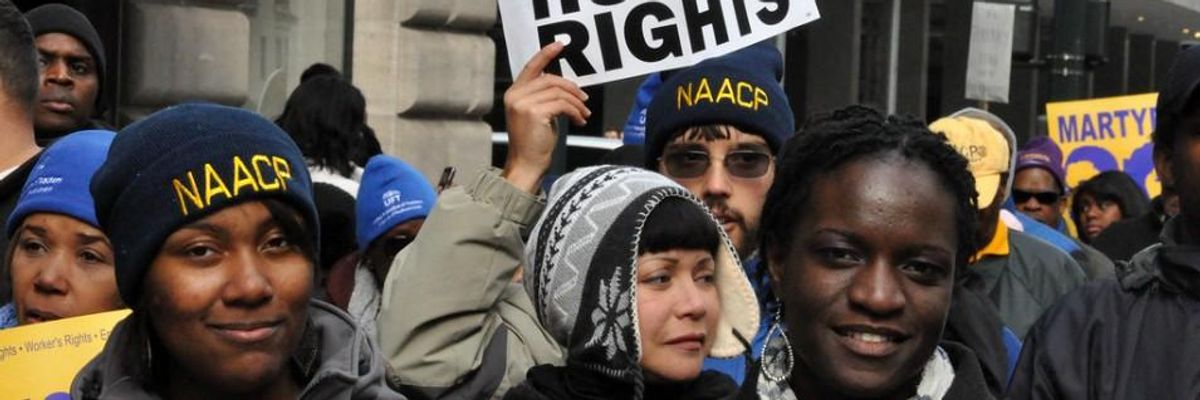
Voting rights advocates march in Manhattan, New York. (Photo: Michael Fleshman/Flickr/cc)
Bolstering a proposal which was denounced by centrists and conservatives as going "too far" in the fight for voting rights when Sen. Bernie Sanders backed it during the Democratic presidential primary, the American Bar Association won applause from rights advocates on Thursday regarding its support for full enfranchisement for current and former prison inmates.
At its annual meeting earlier this month, the ABA adopted a resolution stating the organization would urge all levels of government to "repeal laws that disenfranchise persons based upon criminal conviction [and] restore voting rights to those currently and formerly incarcerated, including those on probation, parole, or any other community-based correctional program."
The national lawyers' association further said (pdf) that "no person convicted of crime" should be disenfranchised in the U.S. because of failure to pay fines, court fees, or other payments as a result of their conviction.
Parisa Dehghani-Tafti, who was elected last year to be commonwealth's attorney, the top prosecutor for Arlington and Falls Church, Virginia was among the reform-minded attorneys who applauded the resolution--and wondered why she was criticized during her campaign for expressing support for prisoner's voting rights.
"Glad to see that 'radical' organization, the ABA, joined the fight," tweeted Dehghani-Tafti.
The proposal was introduced at the organization's annual meeting, which was held between August 3 and 4.
"This Resolution follows a long American Bar Association tradition affirming and supporting the expansion of Americans' right to vote," the proposal presented at the conference reads. "This Resolution supports that progression by urging removal of restrictions on voting by incarcerated citizens and citizens under an order of imprisonment. In other words, beyond the many state laws that currently regulate re-enfranchisement after incarceration, this resolution calls for a guarantee of the right to vote for prisoners while incarcerated."
Wendy K. Mariner, chair of the ABA's Section of Civil Rights and Social Justice, asked the ABA to consider that prisoner disenfranchisement laws "have been used to circumvent the right of African Americans to vote" and has disproportionately impacted Black and Latino people; that because Americans do not have their citizenship revoked when convicted of a crime, nor should they lose the rights that come with citizenship; and that incarcerated people in Maine, Vermont, and Puerto Rico already retain their right to vote.
Several countries including Canada, Denmark, Ireland, Spain, and South Africa also allow people convicted of felonies to vote.
"The right to vote is fundamental to United States citizenship and traditional notions of human dignity," wrote Mariner. "Moreover, the right to vote recognizes and affirms each individual's stake in our system of governance and encourages each one to participate productively in civic life."
Disenfranchisement leaves inmates at the mercy of voters outside of prison, the proposal noted, as prisoners are unable to express their views about who should oversee the facilities in which they're held.
"The Mississippi Constitution provides that people convicted of 10 enumerated crimes permanently lose their right to vote," wrote Mariner. "The state's Attorney General has expanded the list to include another 12 offenses, such as carjacking and timber larceny. The funding and management of prisons are issues that directly affect incarcerated people and upon which they should have a vote."
"Kudos to the ABA," tweeted Eli Savit, a progressive Democratic nominee for prosecutor of Washtenaw County, Michigan, after the resolution was adopted.
The ABA's action came weeks after the U.S. Supreme Court upheld a lower court ruling, which permitted Florida to bar former inmates from voting if they owe court fees or fines.
The ruling sparked outrage among civil rights advocates last month and went against the will of Florida voters, 65% of whom approved Amendment 4 in November 2018. The amendment allowed former prisoners to vote if they had completed "all terms of [their] sentence," but after assuming office in 2019, Republican Gov. Ron DeSantis and state GOP legislators retroactively changed the measure to include the payment of fees in addition to the completion of probation and prison time.
"This ABA resolution seems like a pretty pointed critique" of such disenfranchisement efforts, said Joshua B. Hoe, host of the podcast Decarceration Nation.
Dear Common Dreams reader, It’s been nearly 30 years since I co-founded Common Dreams with my late wife, Lina Newhouser. We had the radical notion that journalism should serve the public good, not corporate profits. It was clear to us from the outset what it would take to build such a project. No paid advertisements. No corporate sponsors. No millionaire publisher telling us what to think or do. Many people said we wouldn't last a year, but we proved those doubters wrong. Together with a tremendous team of journalists and dedicated staff, we built an independent media outlet free from the constraints of profits and corporate control. Our mission has always been simple: To inform. To inspire. To ignite change for the common good. Building Common Dreams was not easy. Our survival was never guaranteed. When you take on the most powerful forces—Wall Street greed, fossil fuel industry destruction, Big Tech lobbyists, and uber-rich oligarchs who have spent billions upon billions rigging the economy and democracy in their favor—the only bulwark you have is supporters who believe in your work. But here’s the urgent message from me today. It's never been this bad out there. And it's never been this hard to keep us going. At the very moment Common Dreams is most needed, the threats we face are intensifying. We need your support now more than ever. We don't accept corporate advertising and never will. We don't have a paywall because we don't think people should be blocked from critical news based on their ability to pay. Everything we do is funded by the donations of readers like you. When everyone does the little they can afford, we are strong. But if that support retreats or dries up, so do we. Will you donate now to make sure Common Dreams not only survives but thrives? —Craig Brown, Co-founder |
Bolstering a proposal which was denounced by centrists and conservatives as going "too far" in the fight for voting rights when Sen. Bernie Sanders backed it during the Democratic presidential primary, the American Bar Association won applause from rights advocates on Thursday regarding its support for full enfranchisement for current and former prison inmates.
At its annual meeting earlier this month, the ABA adopted a resolution stating the organization would urge all levels of government to "repeal laws that disenfranchise persons based upon criminal conviction [and] restore voting rights to those currently and formerly incarcerated, including those on probation, parole, or any other community-based correctional program."
The national lawyers' association further said (pdf) that "no person convicted of crime" should be disenfranchised in the U.S. because of failure to pay fines, court fees, or other payments as a result of their conviction.
Parisa Dehghani-Tafti, who was elected last year to be commonwealth's attorney, the top prosecutor for Arlington and Falls Church, Virginia was among the reform-minded attorneys who applauded the resolution--and wondered why she was criticized during her campaign for expressing support for prisoner's voting rights.
"Glad to see that 'radical' organization, the ABA, joined the fight," tweeted Dehghani-Tafti.
The proposal was introduced at the organization's annual meeting, which was held between August 3 and 4.
"This Resolution follows a long American Bar Association tradition affirming and supporting the expansion of Americans' right to vote," the proposal presented at the conference reads. "This Resolution supports that progression by urging removal of restrictions on voting by incarcerated citizens and citizens under an order of imprisonment. In other words, beyond the many state laws that currently regulate re-enfranchisement after incarceration, this resolution calls for a guarantee of the right to vote for prisoners while incarcerated."
Wendy K. Mariner, chair of the ABA's Section of Civil Rights and Social Justice, asked the ABA to consider that prisoner disenfranchisement laws "have been used to circumvent the right of African Americans to vote" and has disproportionately impacted Black and Latino people; that because Americans do not have their citizenship revoked when convicted of a crime, nor should they lose the rights that come with citizenship; and that incarcerated people in Maine, Vermont, and Puerto Rico already retain their right to vote.
Several countries including Canada, Denmark, Ireland, Spain, and South Africa also allow people convicted of felonies to vote.
"The right to vote is fundamental to United States citizenship and traditional notions of human dignity," wrote Mariner. "Moreover, the right to vote recognizes and affirms each individual's stake in our system of governance and encourages each one to participate productively in civic life."
Disenfranchisement leaves inmates at the mercy of voters outside of prison, the proposal noted, as prisoners are unable to express their views about who should oversee the facilities in which they're held.
"The Mississippi Constitution provides that people convicted of 10 enumerated crimes permanently lose their right to vote," wrote Mariner. "The state's Attorney General has expanded the list to include another 12 offenses, such as carjacking and timber larceny. The funding and management of prisons are issues that directly affect incarcerated people and upon which they should have a vote."
"Kudos to the ABA," tweeted Eli Savit, a progressive Democratic nominee for prosecutor of Washtenaw County, Michigan, after the resolution was adopted.
The ABA's action came weeks after the U.S. Supreme Court upheld a lower court ruling, which permitted Florida to bar former inmates from voting if they owe court fees or fines.
The ruling sparked outrage among civil rights advocates last month and went against the will of Florida voters, 65% of whom approved Amendment 4 in November 2018. The amendment allowed former prisoners to vote if they had completed "all terms of [their] sentence," but after assuming office in 2019, Republican Gov. Ron DeSantis and state GOP legislators retroactively changed the measure to include the payment of fees in addition to the completion of probation and prison time.
"This ABA resolution seems like a pretty pointed critique" of such disenfranchisement efforts, said Joshua B. Hoe, host of the podcast Decarceration Nation.
Bolstering a proposal which was denounced by centrists and conservatives as going "too far" in the fight for voting rights when Sen. Bernie Sanders backed it during the Democratic presidential primary, the American Bar Association won applause from rights advocates on Thursday regarding its support for full enfranchisement for current and former prison inmates.
At its annual meeting earlier this month, the ABA adopted a resolution stating the organization would urge all levels of government to "repeal laws that disenfranchise persons based upon criminal conviction [and] restore voting rights to those currently and formerly incarcerated, including those on probation, parole, or any other community-based correctional program."
The national lawyers' association further said (pdf) that "no person convicted of crime" should be disenfranchised in the U.S. because of failure to pay fines, court fees, or other payments as a result of their conviction.
Parisa Dehghani-Tafti, who was elected last year to be commonwealth's attorney, the top prosecutor for Arlington and Falls Church, Virginia was among the reform-minded attorneys who applauded the resolution--and wondered why she was criticized during her campaign for expressing support for prisoner's voting rights.
"Glad to see that 'radical' organization, the ABA, joined the fight," tweeted Dehghani-Tafti.
The proposal was introduced at the organization's annual meeting, which was held between August 3 and 4.
"This Resolution follows a long American Bar Association tradition affirming and supporting the expansion of Americans' right to vote," the proposal presented at the conference reads. "This Resolution supports that progression by urging removal of restrictions on voting by incarcerated citizens and citizens under an order of imprisonment. In other words, beyond the many state laws that currently regulate re-enfranchisement after incarceration, this resolution calls for a guarantee of the right to vote for prisoners while incarcerated."
Wendy K. Mariner, chair of the ABA's Section of Civil Rights and Social Justice, asked the ABA to consider that prisoner disenfranchisement laws "have been used to circumvent the right of African Americans to vote" and has disproportionately impacted Black and Latino people; that because Americans do not have their citizenship revoked when convicted of a crime, nor should they lose the rights that come with citizenship; and that incarcerated people in Maine, Vermont, and Puerto Rico already retain their right to vote.
Several countries including Canada, Denmark, Ireland, Spain, and South Africa also allow people convicted of felonies to vote.
"The right to vote is fundamental to United States citizenship and traditional notions of human dignity," wrote Mariner. "Moreover, the right to vote recognizes and affirms each individual's stake in our system of governance and encourages each one to participate productively in civic life."
Disenfranchisement leaves inmates at the mercy of voters outside of prison, the proposal noted, as prisoners are unable to express their views about who should oversee the facilities in which they're held.
"The Mississippi Constitution provides that people convicted of 10 enumerated crimes permanently lose their right to vote," wrote Mariner. "The state's Attorney General has expanded the list to include another 12 offenses, such as carjacking and timber larceny. The funding and management of prisons are issues that directly affect incarcerated people and upon which they should have a vote."
"Kudos to the ABA," tweeted Eli Savit, a progressive Democratic nominee for prosecutor of Washtenaw County, Michigan, after the resolution was adopted.
The ABA's action came weeks after the U.S. Supreme Court upheld a lower court ruling, which permitted Florida to bar former inmates from voting if they owe court fees or fines.
The ruling sparked outrage among civil rights advocates last month and went against the will of Florida voters, 65% of whom approved Amendment 4 in November 2018. The amendment allowed former prisoners to vote if they had completed "all terms of [their] sentence," but after assuming office in 2019, Republican Gov. Ron DeSantis and state GOP legislators retroactively changed the measure to include the payment of fees in addition to the completion of probation and prison time.
"This ABA resolution seems like a pretty pointed critique" of such disenfranchisement efforts, said Joshua B. Hoe, host of the podcast Decarceration Nation.

