SUBSCRIBE TO OUR FREE NEWSLETTER
Daily news & progressive opinion—funded by the people, not the corporations—delivered straight to your inbox.
5
#000000
#FFFFFF
To donate by check, phone, or other method, see our More Ways to Give page.
Daily news & progressive opinion—funded by the people, not the corporations—delivered straight to your inbox.
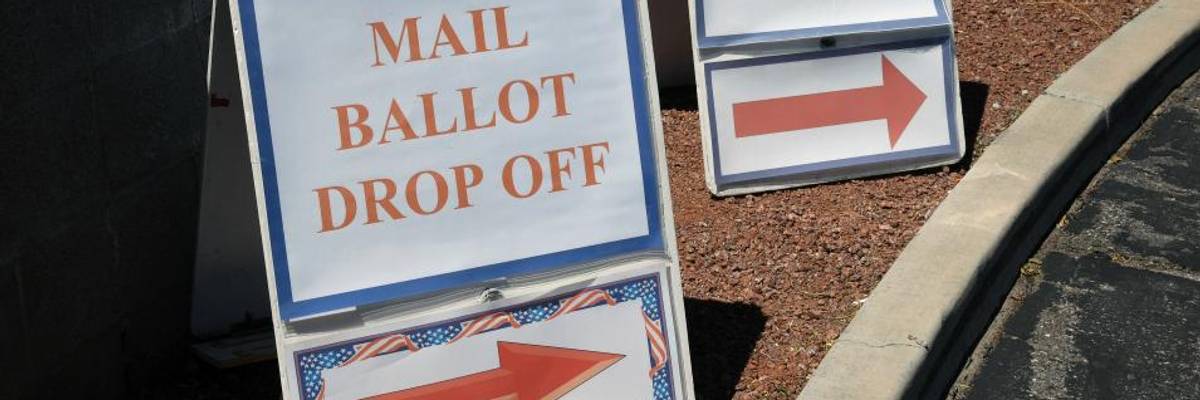
Signs direct people to the entrance of the Clark County Election Department on June 9, 2020 in Las Vegas, Nevada. (Photo: Ethan Miller/Getty Images)
In a decision one journalist hailed as "the first good news on voting rights from SCOTUS in ages," the U.S. Supreme Court on Thursday blocked an effort by the Rhode Island GOP and the Republican National Committee to restore onerous mail-in ballot witness requirements that were suspended by the state's Democratic governor due to the Covid-19 pandemic.
"You can once again vote securely from the safety and privacy of your home."
--ACLU of Rhode Island
Jane Koster, president of the League of Women Voters of Rhode Island, applauded the high court's decision as an affirmation of "our assertion that voters should never have to choose between their health and their right to vote."
The 6-3 ruling (pdf)--with Justices Clarence Thomas, Samuel Alito, and Neil Gorsuch dissenting--leaves intact a consent decree allowing Rhode Island voters to mail their ballots without having to sign them in front of two witnesses or a notary. Gov. Gina Raimondo first suspended the requirement for the state's June primary out of fear that forcing people to comply with the rules would expose voters and witnesses to Covid-19.
As the Washington Post reported, the Rhode Island legislature "could not reach agreement on a bill that would extend that accommodation to elections in September and November. Groups including Common Cause sued, and state officials agreed in a consent decree not to enforce the witness requirement."
The state GOP and the Republican National Committee sued over the consent decree and appealed to the Supreme Court after a lower court rejected the Republicans' initial legal challenge.
John Marion, executive director of Common Cause Rhode Island, said in a statement that thanks to the Supreme Court's decision Thursday, "hundreds of thousands of Rhode Island voters will be able to safely cast their ballots without risking their health."
"We are thrilled that the Supreme Court agreed not to stay the consent decree," said Marion.
The ACLU of Rhode Island celebrated the high court's decision as a "victory for democracy" and welcomed the failure of "the Republican Party's merciless effort to turn the right to vote into a 'Survivor' episode."
"You can once again vote securely from the safety and privacy of your home," the group tweeted.
Dear Common Dreams reader, It’s been nearly 30 years since I co-founded Common Dreams with my late wife, Lina Newhouser. We had the radical notion that journalism should serve the public good, not corporate profits. It was clear to us from the outset what it would take to build such a project. No paid advertisements. No corporate sponsors. No millionaire publisher telling us what to think or do. Many people said we wouldn't last a year, but we proved those doubters wrong. Together with a tremendous team of journalists and dedicated staff, we built an independent media outlet free from the constraints of profits and corporate control. Our mission has always been simple: To inform. To inspire. To ignite change for the common good. Building Common Dreams was not easy. Our survival was never guaranteed. When you take on the most powerful forces—Wall Street greed, fossil fuel industry destruction, Big Tech lobbyists, and uber-rich oligarchs who have spent billions upon billions rigging the economy and democracy in their favor—the only bulwark you have is supporters who believe in your work. But here’s the urgent message from me today. It's never been this bad out there. And it's never been this hard to keep us going. At the very moment Common Dreams is most needed, the threats we face are intensifying. We need your support now more than ever. We don't accept corporate advertising and never will. We don't have a paywall because we don't think people should be blocked from critical news based on their ability to pay. Everything we do is funded by the donations of readers like you. When everyone does the little they can afford, we are strong. But if that support retreats or dries up, so do we. Will you donate now to make sure Common Dreams not only survives but thrives? —Craig Brown, Co-founder |
In a decision one journalist hailed as "the first good news on voting rights from SCOTUS in ages," the U.S. Supreme Court on Thursday blocked an effort by the Rhode Island GOP and the Republican National Committee to restore onerous mail-in ballot witness requirements that were suspended by the state's Democratic governor due to the Covid-19 pandemic.
"You can once again vote securely from the safety and privacy of your home."
--ACLU of Rhode Island
Jane Koster, president of the League of Women Voters of Rhode Island, applauded the high court's decision as an affirmation of "our assertion that voters should never have to choose between their health and their right to vote."
The 6-3 ruling (pdf)--with Justices Clarence Thomas, Samuel Alito, and Neil Gorsuch dissenting--leaves intact a consent decree allowing Rhode Island voters to mail their ballots without having to sign them in front of two witnesses or a notary. Gov. Gina Raimondo first suspended the requirement for the state's June primary out of fear that forcing people to comply with the rules would expose voters and witnesses to Covid-19.
As the Washington Post reported, the Rhode Island legislature "could not reach agreement on a bill that would extend that accommodation to elections in September and November. Groups including Common Cause sued, and state officials agreed in a consent decree not to enforce the witness requirement."
The state GOP and the Republican National Committee sued over the consent decree and appealed to the Supreme Court after a lower court rejected the Republicans' initial legal challenge.
John Marion, executive director of Common Cause Rhode Island, said in a statement that thanks to the Supreme Court's decision Thursday, "hundreds of thousands of Rhode Island voters will be able to safely cast their ballots without risking their health."
"We are thrilled that the Supreme Court agreed not to stay the consent decree," said Marion.
The ACLU of Rhode Island celebrated the high court's decision as a "victory for democracy" and welcomed the failure of "the Republican Party's merciless effort to turn the right to vote into a 'Survivor' episode."
"You can once again vote securely from the safety and privacy of your home," the group tweeted.
In a decision one journalist hailed as "the first good news on voting rights from SCOTUS in ages," the U.S. Supreme Court on Thursday blocked an effort by the Rhode Island GOP and the Republican National Committee to restore onerous mail-in ballot witness requirements that were suspended by the state's Democratic governor due to the Covid-19 pandemic.
"You can once again vote securely from the safety and privacy of your home."
--ACLU of Rhode Island
Jane Koster, president of the League of Women Voters of Rhode Island, applauded the high court's decision as an affirmation of "our assertion that voters should never have to choose between their health and their right to vote."
The 6-3 ruling (pdf)--with Justices Clarence Thomas, Samuel Alito, and Neil Gorsuch dissenting--leaves intact a consent decree allowing Rhode Island voters to mail their ballots without having to sign them in front of two witnesses or a notary. Gov. Gina Raimondo first suspended the requirement for the state's June primary out of fear that forcing people to comply with the rules would expose voters and witnesses to Covid-19.
As the Washington Post reported, the Rhode Island legislature "could not reach agreement on a bill that would extend that accommodation to elections in September and November. Groups including Common Cause sued, and state officials agreed in a consent decree not to enforce the witness requirement."
The state GOP and the Republican National Committee sued over the consent decree and appealed to the Supreme Court after a lower court rejected the Republicans' initial legal challenge.
John Marion, executive director of Common Cause Rhode Island, said in a statement that thanks to the Supreme Court's decision Thursday, "hundreds of thousands of Rhode Island voters will be able to safely cast their ballots without risking their health."
"We are thrilled that the Supreme Court agreed not to stay the consent decree," said Marion.
The ACLU of Rhode Island celebrated the high court's decision as a "victory for democracy" and welcomed the failure of "the Republican Party's merciless effort to turn the right to vote into a 'Survivor' episode."
"You can once again vote securely from the safety and privacy of your home," the group tweeted.