SUBSCRIBE TO OUR FREE NEWSLETTER
Daily news & progressive opinion—funded by the people, not the corporations—delivered straight to your inbox.
5
#000000
#FFFFFF
To donate by check, phone, or other method, see our More Ways to Give page.
Daily news & progressive opinion—funded by the people, not the corporations—delivered straight to your inbox.
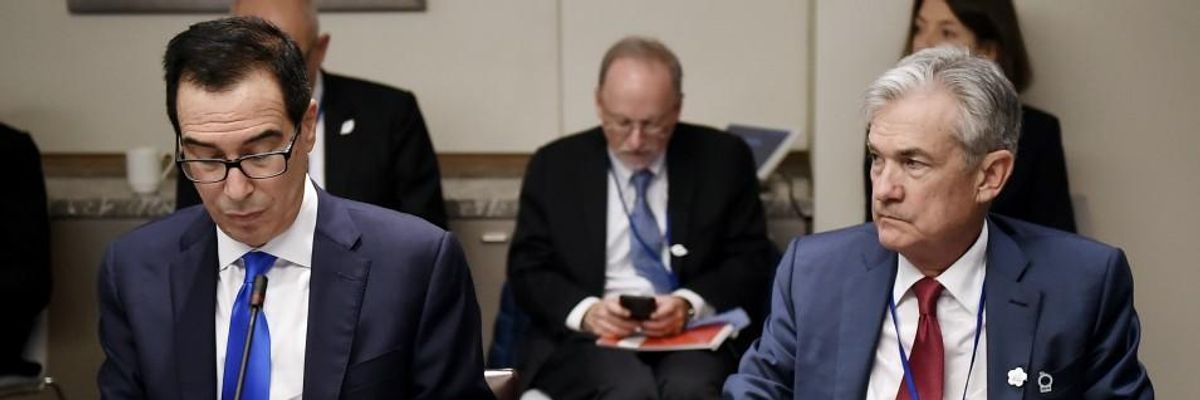
Treasury Secretary Steven Mnuchin and Federal Reserve Board Chairman Jerome Powell attend a meeting on October 17, 2019 in Washington, D.C. (Photo: Olivier Douliery/AFP via Getty Images)
A group of more than 50 House Democrats on Thursday slammed the Federal Reserve for allowing mass public-sector layoffs by refusing to offer state and local governments the same favorable lending terms it has granted private corporations.
"It's time for the Federal Reserve to stop treating corporations better than state and local governments."
--Rep. Mark Pocan
In a letter (pdf) to Fed Chairman Jerome Powell, the lawmakers said the "harsh terms and penalty rates" the central bank set for its Municipal Liquidity Facility (MLF)--a $500 billion state and local aid initiative launched in April--has made the program "functionally unusable for the vast majority of the state and local governments that are technically eligible."
"There have been 1.5 million public-sector layoffs since March, and unless the Fed aligns its assistance to states and cities with its emergency lending to the private sector, mass unemployment, and emergency conditions will persist for years," the lawmakers wrote. "To that end, it must be noted that many of the Federal Reserve's corporate lending programs contain terms that are far more favorable than those included in the MLF."
"This includes, for example, far cheaper pricing, far longer terms, and even payment deferrals for corporations borrowing from the Main Street Lending Program, the Secondary Corporate Credit Facility, and the Term Asset-Backed Securities Loan Facility," the group of Democrats added, urging the Fed to establish more flexible and inexpensive lending terms for state and local governments.
The lawmakers also demanded that the Fed to extend MLF eligibility to smaller counties and territories.
"The Federal Reserve should make these fixes to the MLF before the damage to our economy and our communities becomes irreparable," the coalition of Democrats wrote.
Economists have warned that failing to rescue state and local governments as they face crushing budget shortfalls could send shockwaves through the entire U.S. economy and possibly lead to a "prolonged depression."
"The projected shortfall for 2021 fiscal year, which began on July 1 for most states, is much deeper than the shortfalls faced in any year of the Great Recession," the Center on Budget and Policy Priorities noted last month. "Without additional, substantial federal help, they likely will deeply cut critical program areas such as education and healthcare, lay off teachers and other workers in even greater numbers, and cancel contracts with many businesses."
Rep. Mark Pocan (D-Wis.), co-chair of the Congressional Progressive Caucus and one of the letter's signatories, tweeted Thursday that "it's time for the Federal Reserve to stop treating corporations better than state and local governments."
The letter was also signed by Reps. Rashida Tlaib (D-Mich.), Ayanna Pressley (D-Mass.), Joe Neguse (D-Colo.), CPC co-chair Pramila Jayapal (D-Wash.), and Alexandria Ocasio-Cortez (D-N.Y.).
Bharat Ramamurti, a member of the Congressional Oversight Committee tasked with monitoring Covid-19 bailout funds, said he hopes the Fed heeds the Democratic lawmakers' demands.
"There's no justification for them to offer worse rates and terms to states and cities than to risky companies with a far higher risk of default," Ramamurti tweeted. "And we know that sharp cuts in state and local spending will cause serious economic harm."
Dear Common Dreams reader, It’s been nearly 30 years since I co-founded Common Dreams with my late wife, Lina Newhouser. We had the radical notion that journalism should serve the public good, not corporate profits. It was clear to us from the outset what it would take to build such a project. No paid advertisements. No corporate sponsors. No millionaire publisher telling us what to think or do. Many people said we wouldn't last a year, but we proved those doubters wrong. Together with a tremendous team of journalists and dedicated staff, we built an independent media outlet free from the constraints of profits and corporate control. Our mission has always been simple: To inform. To inspire. To ignite change for the common good. Building Common Dreams was not easy. Our survival was never guaranteed. When you take on the most powerful forces—Wall Street greed, fossil fuel industry destruction, Big Tech lobbyists, and uber-rich oligarchs who have spent billions upon billions rigging the economy and democracy in their favor—the only bulwark you have is supporters who believe in your work. But here’s the urgent message from me today. It's never been this bad out there. And it's never been this hard to keep us going. At the very moment Common Dreams is most needed, the threats we face are intensifying. We need your support now more than ever. We don't accept corporate advertising and never will. We don't have a paywall because we don't think people should be blocked from critical news based on their ability to pay. Everything we do is funded by the donations of readers like you. When everyone does the little they can afford, we are strong. But if that support retreats or dries up, so do we. Will you donate now to make sure Common Dreams not only survives but thrives? —Craig Brown, Co-founder |
A group of more than 50 House Democrats on Thursday slammed the Federal Reserve for allowing mass public-sector layoffs by refusing to offer state and local governments the same favorable lending terms it has granted private corporations.
"It's time for the Federal Reserve to stop treating corporations better than state and local governments."
--Rep. Mark Pocan
In a letter (pdf) to Fed Chairman Jerome Powell, the lawmakers said the "harsh terms and penalty rates" the central bank set for its Municipal Liquidity Facility (MLF)--a $500 billion state and local aid initiative launched in April--has made the program "functionally unusable for the vast majority of the state and local governments that are technically eligible."
"There have been 1.5 million public-sector layoffs since March, and unless the Fed aligns its assistance to states and cities with its emergency lending to the private sector, mass unemployment, and emergency conditions will persist for years," the lawmakers wrote. "To that end, it must be noted that many of the Federal Reserve's corporate lending programs contain terms that are far more favorable than those included in the MLF."
"This includes, for example, far cheaper pricing, far longer terms, and even payment deferrals for corporations borrowing from the Main Street Lending Program, the Secondary Corporate Credit Facility, and the Term Asset-Backed Securities Loan Facility," the group of Democrats added, urging the Fed to establish more flexible and inexpensive lending terms for state and local governments.
The lawmakers also demanded that the Fed to extend MLF eligibility to smaller counties and territories.
"The Federal Reserve should make these fixes to the MLF before the damage to our economy and our communities becomes irreparable," the coalition of Democrats wrote.
Economists have warned that failing to rescue state and local governments as they face crushing budget shortfalls could send shockwaves through the entire U.S. economy and possibly lead to a "prolonged depression."
"The projected shortfall for 2021 fiscal year, which began on July 1 for most states, is much deeper than the shortfalls faced in any year of the Great Recession," the Center on Budget and Policy Priorities noted last month. "Without additional, substantial federal help, they likely will deeply cut critical program areas such as education and healthcare, lay off teachers and other workers in even greater numbers, and cancel contracts with many businesses."
Rep. Mark Pocan (D-Wis.), co-chair of the Congressional Progressive Caucus and one of the letter's signatories, tweeted Thursday that "it's time for the Federal Reserve to stop treating corporations better than state and local governments."
The letter was also signed by Reps. Rashida Tlaib (D-Mich.), Ayanna Pressley (D-Mass.), Joe Neguse (D-Colo.), CPC co-chair Pramila Jayapal (D-Wash.), and Alexandria Ocasio-Cortez (D-N.Y.).
Bharat Ramamurti, a member of the Congressional Oversight Committee tasked with monitoring Covid-19 bailout funds, said he hopes the Fed heeds the Democratic lawmakers' demands.
"There's no justification for them to offer worse rates and terms to states and cities than to risky companies with a far higher risk of default," Ramamurti tweeted. "And we know that sharp cuts in state and local spending will cause serious economic harm."
A group of more than 50 House Democrats on Thursday slammed the Federal Reserve for allowing mass public-sector layoffs by refusing to offer state and local governments the same favorable lending terms it has granted private corporations.
"It's time for the Federal Reserve to stop treating corporations better than state and local governments."
--Rep. Mark Pocan
In a letter (pdf) to Fed Chairman Jerome Powell, the lawmakers said the "harsh terms and penalty rates" the central bank set for its Municipal Liquidity Facility (MLF)--a $500 billion state and local aid initiative launched in April--has made the program "functionally unusable for the vast majority of the state and local governments that are technically eligible."
"There have been 1.5 million public-sector layoffs since March, and unless the Fed aligns its assistance to states and cities with its emergency lending to the private sector, mass unemployment, and emergency conditions will persist for years," the lawmakers wrote. "To that end, it must be noted that many of the Federal Reserve's corporate lending programs contain terms that are far more favorable than those included in the MLF."
"This includes, for example, far cheaper pricing, far longer terms, and even payment deferrals for corporations borrowing from the Main Street Lending Program, the Secondary Corporate Credit Facility, and the Term Asset-Backed Securities Loan Facility," the group of Democrats added, urging the Fed to establish more flexible and inexpensive lending terms for state and local governments.
The lawmakers also demanded that the Fed to extend MLF eligibility to smaller counties and territories.
"The Federal Reserve should make these fixes to the MLF before the damage to our economy and our communities becomes irreparable," the coalition of Democrats wrote.
Economists have warned that failing to rescue state and local governments as they face crushing budget shortfalls could send shockwaves through the entire U.S. economy and possibly lead to a "prolonged depression."
"The projected shortfall for 2021 fiscal year, which began on July 1 for most states, is much deeper than the shortfalls faced in any year of the Great Recession," the Center on Budget and Policy Priorities noted last month. "Without additional, substantial federal help, they likely will deeply cut critical program areas such as education and healthcare, lay off teachers and other workers in even greater numbers, and cancel contracts with many businesses."
Rep. Mark Pocan (D-Wis.), co-chair of the Congressional Progressive Caucus and one of the letter's signatories, tweeted Thursday that "it's time for the Federal Reserve to stop treating corporations better than state and local governments."
The letter was also signed by Reps. Rashida Tlaib (D-Mich.), Ayanna Pressley (D-Mass.), Joe Neguse (D-Colo.), CPC co-chair Pramila Jayapal (D-Wash.), and Alexandria Ocasio-Cortez (D-N.Y.).
Bharat Ramamurti, a member of the Congressional Oversight Committee tasked with monitoring Covid-19 bailout funds, said he hopes the Fed heeds the Democratic lawmakers' demands.
"There's no justification for them to offer worse rates and terms to states and cities than to risky companies with a far higher risk of default," Ramamurti tweeted. "And we know that sharp cuts in state and local spending will cause serious economic harm."