SUBSCRIBE TO OUR FREE NEWSLETTER
Daily news & progressive opinion—funded by the people, not the corporations—delivered straight to your inbox.
5
#000000
#FFFFFF
To donate by check, phone, or other method, see our More Ways to Give page.
Daily news & progressive opinion—funded by the people, not the corporations—delivered straight to your inbox.
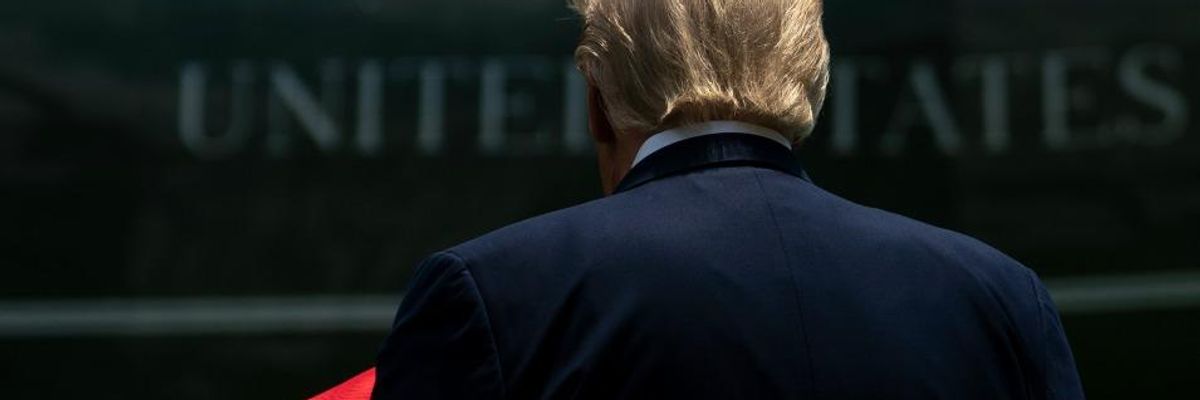
The Western Environmental Law Center announced its intention to sue the Trump administration over its gutting of NEPA, the nation's bedrock environmental law. (Photo: Drew Angerer/Getty Images)
A number of environmental protection groups on Wednesday announced their intention to bring the Trump administration to court directly after President Donald Trump announced his finalized plan to roll back the National Environmental Policy Act.
By weakening the 50-year-old law known as NEPA, the president will end the system of thorough environmental impact reviews, which are meant to keep infrastructure projects from damaging biodiversity, polluting waterways and residential areas, and threatening the climate.
"Gutting NEPA silences voices and puts vulnerable communities, health, and our environment--including our air and water--at risk."
--Kristen Boyles, Earthjustice
Trump announced the sweeping changes to the law at a campaign stop in Atlanta Wednesday afternoon, touting the plan as one that will "modernize" and "streamline" infrastructure projects as environmental reviews will need to be completed within two years.
The Western Environmental Law Center rejected the administration's euphemisms for what it called Trump's attempt to "eviscerate...the single most important safeguard for environmental justice, public health, and environmental protection in the U.S."
"This does not represent 'streamlining,' a 'revision,' a 'modernization,' or any such minimization of the very real effects this will have for Americans and the clean air and water we require to exercise our right to life, liberty, and the pursuit of happiness," said Brian Sweeney, communications director for the group. "This overreach will also deliberately and massively curtail public input on major federal decision-making. Dramatic? Yes. This is a rewrite of a law written by Congress, without Congressional action. We will sue over this."
Environmental law group Earthjustice also announced soon after the president's remarks that it will file a lawsuit against the administration.
Kristen Boyles, an attorney with the organization, expressed exasperation with Trump's insistence that achieving quick approval for oil and gas pipeline projects is the key to an "unprecedented economic boom"--despite evidence that the climate crisis, fueled by fossil fuel emissions, costs the U.S. hundreds of billions of dollars per year.
"When is this administration going to learn that the economy is the people?" said Boyles. "Gutting NEPA silences voices and puts vulnerable communities, health, and our environment--including our air and water--at risk. We're not going to sit back and allow a decision that could harm public health during a public health crisis go unscathed. We'll be seeing them in court."
Environment America slammed the administration for ending a decades-long effort to include frontline communities in the decision-making process behind infrastructure projects by establishing public comment periods prior to projects' approval.
"NEPA has quietly protected some of our most precious, environmentally sensitive places," said Katie Murtha, vice president of federal government relations at Environment America. "It has helped federal agencies minimize the environmental impact of the projects they oversee; it has allowed for public input into all planning efforts."
"Without these safeguards, our environment is at greater risk because our government will no longer have to look before it leaps," she continued. "These regulations have served as a key tool for assuring the federal government acts as a responsible trustee for future generations."
Dear Common Dreams reader, It’s been nearly 30 years since I co-founded Common Dreams with my late wife, Lina Newhouser. We had the radical notion that journalism should serve the public good, not corporate profits. It was clear to us from the outset what it would take to build such a project. No paid advertisements. No corporate sponsors. No millionaire publisher telling us what to think or do. Many people said we wouldn't last a year, but we proved those doubters wrong. Together with a tremendous team of journalists and dedicated staff, we built an independent media outlet free from the constraints of profits and corporate control. Our mission has always been simple: To inform. To inspire. To ignite change for the common good. Building Common Dreams was not easy. Our survival was never guaranteed. When you take on the most powerful forces—Wall Street greed, fossil fuel industry destruction, Big Tech lobbyists, and uber-rich oligarchs who have spent billions upon billions rigging the economy and democracy in their favor—the only bulwark you have is supporters who believe in your work. But here’s the urgent message from me today. It's never been this bad out there. And it's never been this hard to keep us going. At the very moment Common Dreams is most needed, the threats we face are intensifying. We need your support now more than ever. We don't accept corporate advertising and never will. We don't have a paywall because we don't think people should be blocked from critical news based on their ability to pay. Everything we do is funded by the donations of readers like you. When everyone does the little they can afford, we are strong. But if that support retreats or dries up, so do we. Will you donate now to make sure Common Dreams not only survives but thrives? —Craig Brown, Co-founder |
A number of environmental protection groups on Wednesday announced their intention to bring the Trump administration to court directly after President Donald Trump announced his finalized plan to roll back the National Environmental Policy Act.
By weakening the 50-year-old law known as NEPA, the president will end the system of thorough environmental impact reviews, which are meant to keep infrastructure projects from damaging biodiversity, polluting waterways and residential areas, and threatening the climate.
"Gutting NEPA silences voices and puts vulnerable communities, health, and our environment--including our air and water--at risk."
--Kristen Boyles, Earthjustice
Trump announced the sweeping changes to the law at a campaign stop in Atlanta Wednesday afternoon, touting the plan as one that will "modernize" and "streamline" infrastructure projects as environmental reviews will need to be completed within two years.
The Western Environmental Law Center rejected the administration's euphemisms for what it called Trump's attempt to "eviscerate...the single most important safeguard for environmental justice, public health, and environmental protection in the U.S."
"This does not represent 'streamlining,' a 'revision,' a 'modernization,' or any such minimization of the very real effects this will have for Americans and the clean air and water we require to exercise our right to life, liberty, and the pursuit of happiness," said Brian Sweeney, communications director for the group. "This overreach will also deliberately and massively curtail public input on major federal decision-making. Dramatic? Yes. This is a rewrite of a law written by Congress, without Congressional action. We will sue over this."
Environmental law group Earthjustice also announced soon after the president's remarks that it will file a lawsuit against the administration.
Kristen Boyles, an attorney with the organization, expressed exasperation with Trump's insistence that achieving quick approval for oil and gas pipeline projects is the key to an "unprecedented economic boom"--despite evidence that the climate crisis, fueled by fossil fuel emissions, costs the U.S. hundreds of billions of dollars per year.
"When is this administration going to learn that the economy is the people?" said Boyles. "Gutting NEPA silences voices and puts vulnerable communities, health, and our environment--including our air and water--at risk. We're not going to sit back and allow a decision that could harm public health during a public health crisis go unscathed. We'll be seeing them in court."
Environment America slammed the administration for ending a decades-long effort to include frontline communities in the decision-making process behind infrastructure projects by establishing public comment periods prior to projects' approval.
"NEPA has quietly protected some of our most precious, environmentally sensitive places," said Katie Murtha, vice president of federal government relations at Environment America. "It has helped federal agencies minimize the environmental impact of the projects they oversee; it has allowed for public input into all planning efforts."
"Without these safeguards, our environment is at greater risk because our government will no longer have to look before it leaps," she continued. "These regulations have served as a key tool for assuring the federal government acts as a responsible trustee for future generations."
A number of environmental protection groups on Wednesday announced their intention to bring the Trump administration to court directly after President Donald Trump announced his finalized plan to roll back the National Environmental Policy Act.
By weakening the 50-year-old law known as NEPA, the president will end the system of thorough environmental impact reviews, which are meant to keep infrastructure projects from damaging biodiversity, polluting waterways and residential areas, and threatening the climate.
"Gutting NEPA silences voices and puts vulnerable communities, health, and our environment--including our air and water--at risk."
--Kristen Boyles, Earthjustice
Trump announced the sweeping changes to the law at a campaign stop in Atlanta Wednesday afternoon, touting the plan as one that will "modernize" and "streamline" infrastructure projects as environmental reviews will need to be completed within two years.
The Western Environmental Law Center rejected the administration's euphemisms for what it called Trump's attempt to "eviscerate...the single most important safeguard for environmental justice, public health, and environmental protection in the U.S."
"This does not represent 'streamlining,' a 'revision,' a 'modernization,' or any such minimization of the very real effects this will have for Americans and the clean air and water we require to exercise our right to life, liberty, and the pursuit of happiness," said Brian Sweeney, communications director for the group. "This overreach will also deliberately and massively curtail public input on major federal decision-making. Dramatic? Yes. This is a rewrite of a law written by Congress, without Congressional action. We will sue over this."
Environmental law group Earthjustice also announced soon after the president's remarks that it will file a lawsuit against the administration.
Kristen Boyles, an attorney with the organization, expressed exasperation with Trump's insistence that achieving quick approval for oil and gas pipeline projects is the key to an "unprecedented economic boom"--despite evidence that the climate crisis, fueled by fossil fuel emissions, costs the U.S. hundreds of billions of dollars per year.
"When is this administration going to learn that the economy is the people?" said Boyles. "Gutting NEPA silences voices and puts vulnerable communities, health, and our environment--including our air and water--at risk. We're not going to sit back and allow a decision that could harm public health during a public health crisis go unscathed. We'll be seeing them in court."
Environment America slammed the administration for ending a decades-long effort to include frontline communities in the decision-making process behind infrastructure projects by establishing public comment periods prior to projects' approval.
"NEPA has quietly protected some of our most precious, environmentally sensitive places," said Katie Murtha, vice president of federal government relations at Environment America. "It has helped federal agencies minimize the environmental impact of the projects they oversee; it has allowed for public input into all planning efforts."
"Without these safeguards, our environment is at greater risk because our government will no longer have to look before it leaps," she continued. "These regulations have served as a key tool for assuring the federal government acts as a responsible trustee for future generations."