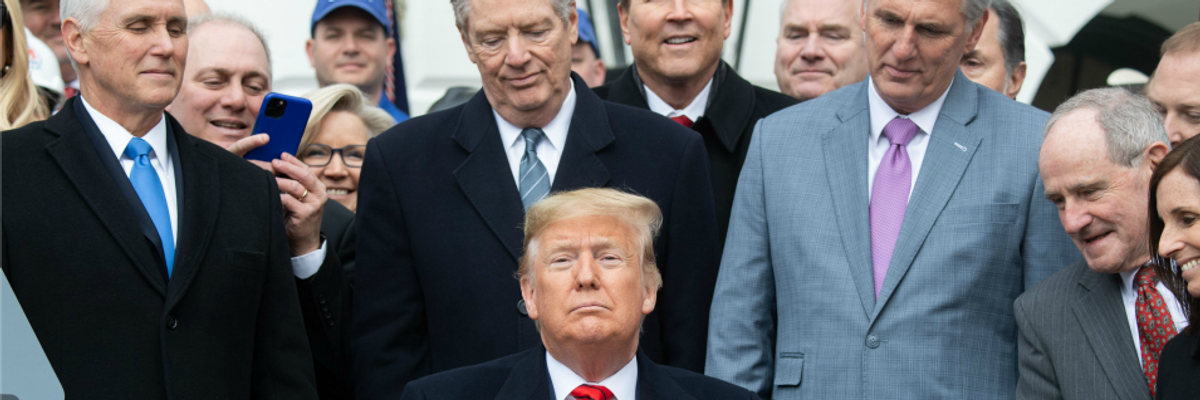
President Donald Trump signs the United States-Mexico-Canada Trade Agreement, known as USMCA, during a ceremony on the South Lawn of the White House in Washington, D.C. on January 29, 2020. (Photo: Saul Loeb/AFP via Getty Images)
Trump Quietly Slashed Pay Raise for Federal Workers a Day Before Claiming US Economy Is Best 'In History'
"This is just the latest action in Donald Trump's war on civil servants."
In a move that drew outrage from labor unions and progressives, President Donald Trump this week quietly took steps to slash a scheduled pay raise for millions of federal workers from 2.5% to 1% due to supposed concerns about "keeping the nation on a fiscally sustainable course."
"I have determined that for 2021 the across-the-board base pay increase will be limited to 1.0%," Trump said in a message to Congress on Monday. "This alternative pay plan decision will not materially affect our ability to attract and retain a well-qualified federal workforce."
"For an administration that has added $3 trillion to the federal debt, gouging federal employee pay and benefits in the name of deficit reduction is ridiculous."
--Tony Reardon, National Treasury Employees Union
The president's proposed "adjustment" to the scheduled pay raise will take effect in January 2021 unless Congress passes legislation to override the change.
Just a day after his message to Congress, Trump tweeted, "BEST USA ECONOMY IN HISTORY!"
Critics highlighted the disconnect between the president's justification for cutting the planned raise for federal workers and his boasts about the state of the U.S. economy.
"Trump claimed we had the 'BEST USA ECONOMY IN HISTORY' and cited 'serious economic conditions affecting the general welfare' to justify limiting pay increases for federal workers," tweeted Rep. Steve Cohen (D-Tenn.). "These are contradicting claims. They can't both be true."
Slate's Elliot Hannon wrote Wednesday that "cutting the 2.5% raise set for 2021 to 1% for millions of federal workers seems a bit austere in the face of such self-proclaimed boom times."
"Even more absurdly, Trump is justifying ordering the cut on the grounds that the country is in the midst of a 'national emergency or serious economic conditions affecting the general welfare,' which the White House says authorizes the president to 'implement alternative plans for pay adjustments,'" Hannon added. "So which is it? The best economy in the history of economies or a national economic emergency? Either way, somebody's lying."
Pat Garofalo, managing editor at Talk Poverty, tweeted that warnings about fiscal sustainability are not credible coming from the president who signed into law $1.5 trillion in tax cuts for the rich in 2017.
Trump's move came on the same day he proposed his budget for fiscal year 2021, which proposes cutting federal workers' retirement benefits as well as Medicare, Medicaid, and Social Security.
Tony Reardon, president of the National Treasury Employees Union (NTEU), the largest independent union of federal workers in the U.S., said a 1% pay raise would "do nothing to close the gap between federal employee salaries and their higher-paid private sector counterparts, it won't keep up with inflation, it won't keep up with private sector wage increases."
"For an administration that has added $3 trillion to the federal debt, gouging federal employee pay and benefits in the name of deficit reduction is ridiculous," Reardon said in a statement. "NTEU will fight these regressive proposals on retirement while supporting existing legislation calling for a 3.5% pay increase in 2021."
We are at a crossroads
This country and this world are at a monumental crossroads. In a few short weeks, US voters will have an opportunity to beat back the forces of fascism and confront the billionaires who are rigging the economy, our media system, and our democracy, making it increasingly impossible for ordinary people to get by. We’re not just talking about the election. We’re talking about what must be done once these fascist elements are vanquished from power. We need a bolder set of solutions than what either major party has so far been willing to offer and a working-class movement ready to fight like hell for it. Trump didn't emerge from nowhere. The conditions that fueled MAGA authoritarianism were created by decades of radical neoliberal economic policies and a corrupt political system dominated by corporate interests. They slashed taxes on the super-rich, promising that the benefits would trickle down. They said giveaways to the corporate titans would make life more affordable for the rest of us. It was all bullshit. And when a bitter, betrayed populace searches for someone to blame, right-wing demagogues have little trouble finding scapegoats. People know when they're being lied to, but you won't hear any of this from the corporate media. Only independent journalism—powered and funded by people who believe in building a better world—can deliver truly trustworthy daily news. Our Fall Campaign is underway, and we need your help. To power our newsroom through the rest of the year, we need to raise $125,000 by midnight on October 31. So if you share our vision, please contribute whatever you can to sustain our work. |
In a move that drew outrage from labor unions and progressives, President Donald Trump this week quietly took steps to slash a scheduled pay raise for millions of federal workers from 2.5% to 1% due to supposed concerns about "keeping the nation on a fiscally sustainable course."
"I have determined that for 2021 the across-the-board base pay increase will be limited to 1.0%," Trump said in a message to Congress on Monday. "This alternative pay plan decision will not materially affect our ability to attract and retain a well-qualified federal workforce."
"For an administration that has added $3 trillion to the federal debt, gouging federal employee pay and benefits in the name of deficit reduction is ridiculous."
--Tony Reardon, National Treasury Employees Union
The president's proposed "adjustment" to the scheduled pay raise will take effect in January 2021 unless Congress passes legislation to override the change.
Just a day after his message to Congress, Trump tweeted, "BEST USA ECONOMY IN HISTORY!"
Critics highlighted the disconnect between the president's justification for cutting the planned raise for federal workers and his boasts about the state of the U.S. economy.
"Trump claimed we had the 'BEST USA ECONOMY IN HISTORY' and cited 'serious economic conditions affecting the general welfare' to justify limiting pay increases for federal workers," tweeted Rep. Steve Cohen (D-Tenn.). "These are contradicting claims. They can't both be true."
Slate's Elliot Hannon wrote Wednesday that "cutting the 2.5% raise set for 2021 to 1% for millions of federal workers seems a bit austere in the face of such self-proclaimed boom times."
"Even more absurdly, Trump is justifying ordering the cut on the grounds that the country is in the midst of a 'national emergency or serious economic conditions affecting the general welfare,' which the White House says authorizes the president to 'implement alternative plans for pay adjustments,'" Hannon added. "So which is it? The best economy in the history of economies or a national economic emergency? Either way, somebody's lying."
Pat Garofalo, managing editor at Talk Poverty, tweeted that warnings about fiscal sustainability are not credible coming from the president who signed into law $1.5 trillion in tax cuts for the rich in 2017.
Trump's move came on the same day he proposed his budget for fiscal year 2021, which proposes cutting federal workers' retirement benefits as well as Medicare, Medicaid, and Social Security.
Tony Reardon, president of the National Treasury Employees Union (NTEU), the largest independent union of federal workers in the U.S., said a 1% pay raise would "do nothing to close the gap between federal employee salaries and their higher-paid private sector counterparts, it won't keep up with inflation, it won't keep up with private sector wage increases."
"For an administration that has added $3 trillion to the federal debt, gouging federal employee pay and benefits in the name of deficit reduction is ridiculous," Reardon said in a statement. "NTEU will fight these regressive proposals on retirement while supporting existing legislation calling for a 3.5% pay increase in 2021."
In a move that drew outrage from labor unions and progressives, President Donald Trump this week quietly took steps to slash a scheduled pay raise for millions of federal workers from 2.5% to 1% due to supposed concerns about "keeping the nation on a fiscally sustainable course."
"I have determined that for 2021 the across-the-board base pay increase will be limited to 1.0%," Trump said in a message to Congress on Monday. "This alternative pay plan decision will not materially affect our ability to attract and retain a well-qualified federal workforce."
"For an administration that has added $3 trillion to the federal debt, gouging federal employee pay and benefits in the name of deficit reduction is ridiculous."
--Tony Reardon, National Treasury Employees Union
The president's proposed "adjustment" to the scheduled pay raise will take effect in January 2021 unless Congress passes legislation to override the change.
Just a day after his message to Congress, Trump tweeted, "BEST USA ECONOMY IN HISTORY!"
Critics highlighted the disconnect between the president's justification for cutting the planned raise for federal workers and his boasts about the state of the U.S. economy.
"Trump claimed we had the 'BEST USA ECONOMY IN HISTORY' and cited 'serious economic conditions affecting the general welfare' to justify limiting pay increases for federal workers," tweeted Rep. Steve Cohen (D-Tenn.). "These are contradicting claims. They can't both be true."
Slate's Elliot Hannon wrote Wednesday that "cutting the 2.5% raise set for 2021 to 1% for millions of federal workers seems a bit austere in the face of such self-proclaimed boom times."
"Even more absurdly, Trump is justifying ordering the cut on the grounds that the country is in the midst of a 'national emergency or serious economic conditions affecting the general welfare,' which the White House says authorizes the president to 'implement alternative plans for pay adjustments,'" Hannon added. "So which is it? The best economy in the history of economies or a national economic emergency? Either way, somebody's lying."
Pat Garofalo, managing editor at Talk Poverty, tweeted that warnings about fiscal sustainability are not credible coming from the president who signed into law $1.5 trillion in tax cuts for the rich in 2017.
Trump's move came on the same day he proposed his budget for fiscal year 2021, which proposes cutting federal workers' retirement benefits as well as Medicare, Medicaid, and Social Security.
Tony Reardon, president of the National Treasury Employees Union (NTEU), the largest independent union of federal workers in the U.S., said a 1% pay raise would "do nothing to close the gap between federal employee salaries and their higher-paid private sector counterparts, it won't keep up with inflation, it won't keep up with private sector wage increases."
"For an administration that has added $3 trillion to the federal debt, gouging federal employee pay and benefits in the name of deficit reduction is ridiculous," Reardon said in a statement. "NTEU will fight these regressive proposals on retirement while supporting existing legislation calling for a 3.5% pay increase in 2021."