

SUBSCRIBE TO OUR FREE NEWSLETTER
Daily news & progressive opinion—funded by the people, not the corporations—delivered straight to your inbox.
5
#000000
#FFFFFF
To donate by check, phone, or other method, see our More Ways to Give page.
Daily news & progressive opinion—funded by the people, not the corporations—delivered straight to your inbox.
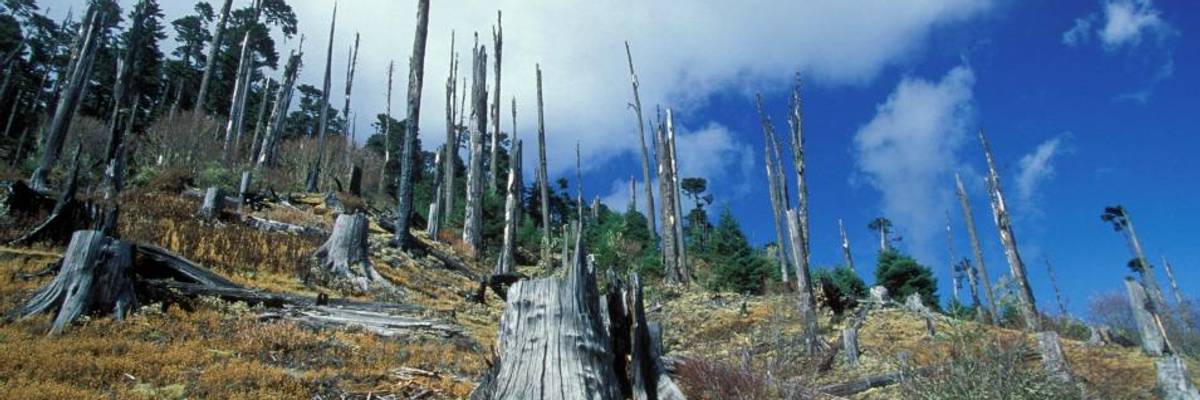
Deforestation is one factor contributing to unprecedented consumption of materials in recent years. (Photo: World Bank Photo Collection/Flickr/cc)
A new report released Tuesday at the World Economic Forum's annual summit in Davos reveals humanity's annual material consumption has now passed 100 billion tons per year, leading the study's authors to urge world governments and communities to drastically reduce waste.
The global think tank Circle Economy showed in its study (pdf) that global consumption just in the last two years has risen by 8% while the reuse and recycling of materials has gone down by half a percentage point--the exact opposite of what needs to happen to build a sustainable global economy.
The group detailed the "circularity gap" on social media.
"The negative trend overall can be explained by three related, underlying trends: high rates of extraction; ongoing stock build-up; plus, low levels of end-of-use processing, and cycling," Circle Economy says. "These trends are embedded deep within the 'take-make-waste' tradition of the linear economy--the problems are hardwired. As such, the outlook to close the circularity gap looks bleak under the dead hand of business as usual. We desperately need transformative and correctional solutions; change is a must."
Circle Economy advocates for economies wherein the use of renewable energy allows materials that go to waste and pollution to be reduced to zero.
"Business as usual is dead. We must commit to taking action at scale to make the circular economy reality."
--Peter Bakker, World Business Council for Sustainable Development
"A circular economy is...about retaining value and complexity of products as highly as possible, for as long as possible--ideally, without any degradation, or fallout," reads the report. "At the same time, they also reduce the requirement for new inputs to produce new products for replacement."
In 2017, the last year the group has data for, humans used 100.6 billion tons of materials.
While the global population has doubled since 1970, Circle Economy found consumption has quadrupled since then.
Half of the materials used each year are clay, gravel, sand, and other materials used for construction, and about 40% of the materials used are turned into housing--yet according to the Homeless World Cup Foundation, an estimated 100 million people worldwide are homeless and as many as 1.6 billion people have inadequate housing.
Along with the extraction of fossil fuels, the overuse of metals, building materials, and deforestation are driving the ecological and climate emergencies, the group warned.
"We risk global disaster if we continue to treat the world's resources as if they are limitless," said Harald Friedl, CEO of Circle Economy, told The Guardian. "Governments must urgently adopt circular economy solutions if we want to achieve a high quality of life for close to 10 billion people by mid-century without destabilizing critical planetary processes."
Beyond helping to mitigate the climate and ecological crises, adopting circular economies would help to make countries more competitive, the report notes.
"Business as usual is dead," Peter Bakker, CEO of the World Business Council for Sustainable Development, said in the report. "We must commit to taking action at scale to make the circular economy reality. Measuring our individual and collective performance in the circular economy is fundamental in knowing whether we're decoupling resource consumption and financial performance at the rate which our planet is demanding of us."
In addition to building materials, plants and trees used for food and fuel make up 25% of the materials consumed each year. Extracted coal, oil, and gas make up 15% of the materials used while metals account for 10%.
A third of the materials used each year end up as waste in landfills or deposits near mining sites, reads the report, which also notes that in recent years the amount of material that was recycled or reused went from 9.1% to 8.6%.
The study points out some countries that have improved their rates of recycling and recovery of waste, including Sweden, Luxembourg, and Austria.
"Against this backdrop of bad news and slow progress," the report reads, "we are seeing a global groundswell of positive action emerging bottom-up... So, sensing both the urgency and the opportunity, an increasing number of countries and national governments are now beginning to shape their strategies in order to support investment towards sustainable and specific circular economy agendas."
Dear Common Dreams reader, It’s been nearly 30 years since I co-founded Common Dreams with my late wife, Lina Newhouser. We had the radical notion that journalism should serve the public good, not corporate profits. It was clear to us from the outset what it would take to build such a project. No paid advertisements. No corporate sponsors. No millionaire publisher telling us what to think or do. Many people said we wouldn't last a year, but we proved those doubters wrong. Together with a tremendous team of journalists and dedicated staff, we built an independent media outlet free from the constraints of profits and corporate control. Our mission has always been simple: To inform. To inspire. To ignite change for the common good. Building Common Dreams was not easy. Our survival was never guaranteed. When you take on the most powerful forces—Wall Street greed, fossil fuel industry destruction, Big Tech lobbyists, and uber-rich oligarchs who have spent billions upon billions rigging the economy and democracy in their favor—the only bulwark you have is supporters who believe in your work. But here’s the urgent message from me today. It's never been this bad out there. And it's never been this hard to keep us going. At the very moment Common Dreams is most needed, the threats we face are intensifying. We need your support now more than ever. We don't accept corporate advertising and never will. We don't have a paywall because we don't think people should be blocked from critical news based on their ability to pay. Everything we do is funded by the donations of readers like you. When everyone does the little they can afford, we are strong. But if that support retreats or dries up, so do we. Will you donate now to make sure Common Dreams not only survives but thrives? —Craig Brown, Co-founder |
A new report released Tuesday at the World Economic Forum's annual summit in Davos reveals humanity's annual material consumption has now passed 100 billion tons per year, leading the study's authors to urge world governments and communities to drastically reduce waste.
The global think tank Circle Economy showed in its study (pdf) that global consumption just in the last two years has risen by 8% while the reuse and recycling of materials has gone down by half a percentage point--the exact opposite of what needs to happen to build a sustainable global economy.
The group detailed the "circularity gap" on social media.
"The negative trend overall can be explained by three related, underlying trends: high rates of extraction; ongoing stock build-up; plus, low levels of end-of-use processing, and cycling," Circle Economy says. "These trends are embedded deep within the 'take-make-waste' tradition of the linear economy--the problems are hardwired. As such, the outlook to close the circularity gap looks bleak under the dead hand of business as usual. We desperately need transformative and correctional solutions; change is a must."
Circle Economy advocates for economies wherein the use of renewable energy allows materials that go to waste and pollution to be reduced to zero.
"Business as usual is dead. We must commit to taking action at scale to make the circular economy reality."
--Peter Bakker, World Business Council for Sustainable Development
"A circular economy is...about retaining value and complexity of products as highly as possible, for as long as possible--ideally, without any degradation, or fallout," reads the report. "At the same time, they also reduce the requirement for new inputs to produce new products for replacement."
In 2017, the last year the group has data for, humans used 100.6 billion tons of materials.
While the global population has doubled since 1970, Circle Economy found consumption has quadrupled since then.
Half of the materials used each year are clay, gravel, sand, and other materials used for construction, and about 40% of the materials used are turned into housing--yet according to the Homeless World Cup Foundation, an estimated 100 million people worldwide are homeless and as many as 1.6 billion people have inadequate housing.
Along with the extraction of fossil fuels, the overuse of metals, building materials, and deforestation are driving the ecological and climate emergencies, the group warned.
"We risk global disaster if we continue to treat the world's resources as if they are limitless," said Harald Friedl, CEO of Circle Economy, told The Guardian. "Governments must urgently adopt circular economy solutions if we want to achieve a high quality of life for close to 10 billion people by mid-century without destabilizing critical planetary processes."
Beyond helping to mitigate the climate and ecological crises, adopting circular economies would help to make countries more competitive, the report notes.
"Business as usual is dead," Peter Bakker, CEO of the World Business Council for Sustainable Development, said in the report. "We must commit to taking action at scale to make the circular economy reality. Measuring our individual and collective performance in the circular economy is fundamental in knowing whether we're decoupling resource consumption and financial performance at the rate which our planet is demanding of us."
In addition to building materials, plants and trees used for food and fuel make up 25% of the materials consumed each year. Extracted coal, oil, and gas make up 15% of the materials used while metals account for 10%.
A third of the materials used each year end up as waste in landfills or deposits near mining sites, reads the report, which also notes that in recent years the amount of material that was recycled or reused went from 9.1% to 8.6%.
The study points out some countries that have improved their rates of recycling and recovery of waste, including Sweden, Luxembourg, and Austria.
"Against this backdrop of bad news and slow progress," the report reads, "we are seeing a global groundswell of positive action emerging bottom-up... So, sensing both the urgency and the opportunity, an increasing number of countries and national governments are now beginning to shape their strategies in order to support investment towards sustainable and specific circular economy agendas."
A new report released Tuesday at the World Economic Forum's annual summit in Davos reveals humanity's annual material consumption has now passed 100 billion tons per year, leading the study's authors to urge world governments and communities to drastically reduce waste.
The global think tank Circle Economy showed in its study (pdf) that global consumption just in the last two years has risen by 8% while the reuse and recycling of materials has gone down by half a percentage point--the exact opposite of what needs to happen to build a sustainable global economy.
The group detailed the "circularity gap" on social media.
"The negative trend overall can be explained by three related, underlying trends: high rates of extraction; ongoing stock build-up; plus, low levels of end-of-use processing, and cycling," Circle Economy says. "These trends are embedded deep within the 'take-make-waste' tradition of the linear economy--the problems are hardwired. As such, the outlook to close the circularity gap looks bleak under the dead hand of business as usual. We desperately need transformative and correctional solutions; change is a must."
Circle Economy advocates for economies wherein the use of renewable energy allows materials that go to waste and pollution to be reduced to zero.
"Business as usual is dead. We must commit to taking action at scale to make the circular economy reality."
--Peter Bakker, World Business Council for Sustainable Development
"A circular economy is...about retaining value and complexity of products as highly as possible, for as long as possible--ideally, without any degradation, or fallout," reads the report. "At the same time, they also reduce the requirement for new inputs to produce new products for replacement."
In 2017, the last year the group has data for, humans used 100.6 billion tons of materials.
While the global population has doubled since 1970, Circle Economy found consumption has quadrupled since then.
Half of the materials used each year are clay, gravel, sand, and other materials used for construction, and about 40% of the materials used are turned into housing--yet according to the Homeless World Cup Foundation, an estimated 100 million people worldwide are homeless and as many as 1.6 billion people have inadequate housing.
Along with the extraction of fossil fuels, the overuse of metals, building materials, and deforestation are driving the ecological and climate emergencies, the group warned.
"We risk global disaster if we continue to treat the world's resources as if they are limitless," said Harald Friedl, CEO of Circle Economy, told The Guardian. "Governments must urgently adopt circular economy solutions if we want to achieve a high quality of life for close to 10 billion people by mid-century without destabilizing critical planetary processes."
Beyond helping to mitigate the climate and ecological crises, adopting circular economies would help to make countries more competitive, the report notes.
"Business as usual is dead," Peter Bakker, CEO of the World Business Council for Sustainable Development, said in the report. "We must commit to taking action at scale to make the circular economy reality. Measuring our individual and collective performance in the circular economy is fundamental in knowing whether we're decoupling resource consumption and financial performance at the rate which our planet is demanding of us."
In addition to building materials, plants and trees used for food and fuel make up 25% of the materials consumed each year. Extracted coal, oil, and gas make up 15% of the materials used while metals account for 10%.
A third of the materials used each year end up as waste in landfills or deposits near mining sites, reads the report, which also notes that in recent years the amount of material that was recycled or reused went from 9.1% to 8.6%.
The study points out some countries that have improved their rates of recycling and recovery of waste, including Sweden, Luxembourg, and Austria.
"Against this backdrop of bad news and slow progress," the report reads, "we are seeing a global groundswell of positive action emerging bottom-up... So, sensing both the urgency and the opportunity, an increasing number of countries and national governments are now beginning to shape their strategies in order to support investment towards sustainable and specific circular economy agendas."

