SUBSCRIBE TO OUR FREE NEWSLETTER
Daily news & progressive opinion—funded by the people, not the corporations—delivered straight to your inbox.
5
#000000
#FFFFFF
To donate by check, phone, or other method, see our More Ways to Give page.
Daily news & progressive opinion—funded by the people, not the corporations—delivered straight to your inbox.
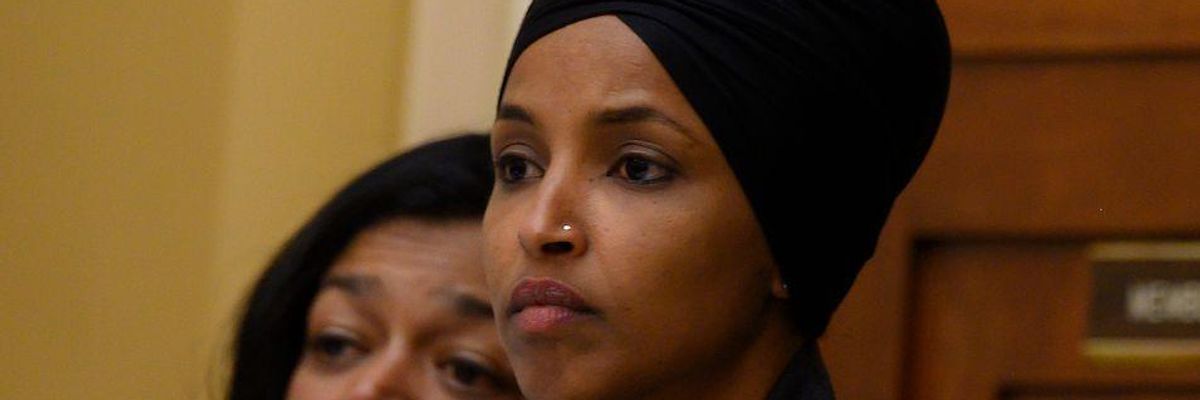
House Progressive Caucus members Reps. Pramila Jayapal (D-Wash.) and Ilhan Omar (D-Minn.) listen during a House hearing on October 22. (Photo: Andrew Caballero-Reynolds/AFP/Getty Images)
Members of the Congressional Progressive Caucus on Wednesday held a news conference at the Capitol calling for a new War Powers resolution to curtail President Donald Trump's ability to unilaterally launch the U.S. into a war with Iran.
The threat of war became imminent after Trump ordered a drone strike assassinating Iranian military commander Qasem Soleimani and Iran retaliated, striking al-Asad airbase in Iraq.
"This is a man who is both an arsonist and a fireman," said caucus whip Rep. Ilhan Omar (D-Minn.), referring to Trump taking credit for solving a crisis that he created.
Congressional Progressive Caucus co-chair Rep. Pramila Jayapal (D-Wash.) said that the caucus had in an intelligence briefing seen "no raw evidence that an attack was imminent" from Iran or its proxies, a contrast with the claims from the White House that Soleimani needed to be assassinated.
"We are not convinced the president acted correctly," said Jayapal's co-chair Rep. Mark Pocan (D-Wis.).
The killing could have been avoided, said Rep. Ro Khanna (D-Calif.), if Congress had taken action earlier.
"If Congress had listened to the Progressive Caucus, this killing would never have happened," said Khanna.
Khanna added that the caucus would continue to fight to repeal the 2001 and 2002 Authorizations for Military Force (AUMF), aimed at the perpetrators of the 9/11 attacks and Iraq, respectively, and to defund any effort by the administration to launch an attack on Iran without first going to Congress. The White House has cited both AUMFs as justification for the strike on Soleimani.
The House will reportedly vote on legislation to curb the president's ability to unilaterally wage war on Iran Thursday.
Pocan and Jayapal on Wednesday urged Congress to pass the resolution.
"To protect American lives and global stability, Congress must reassert our Constitutional authority by passing a strong War Powers Resolution to ensure Congressional authorization for any military action; repealing the 2002 Authorization of Use of Military Force; and ensuring that Congress provides no funds for war with Iran without authorization," the caucus co-chairs said in a statement. "We must not continue down this destructive military path--we must choose de-escalation and diplomacy."
Rep. Barbara Lee (D-Calif.), the lone "no" vote on the 2001 AUMF, said that the 2002 bill was the product of the Bush administration's relentless effort to wage war on Iraq, ostensibly on a fear of "weapons of mass distruction," and that the right choice would have been to vote to empower United Nations weapons inspectors in the country.
In a press conference late Wednesday morning, the president appeared to back away from continuing to escalate military action with Iran.
That, argued The Nation's Jeet Heer, was an "uncharacteristic" moment of good judgement by Trump, but one the president would need to continue to be committed to:
If Trump wants to take the off-ramp from war, he'll have to contend with these influential hawkish voices within his own party and, indeed, within his own administration. It was these hawks who started this new cycle of hostility by convincing Trump to leave the Iran nuclear deal. One of those hawks, Secretary of State Mike Pompeo, played a crucial role in convincing Trump to assassinate Soleimani.
Though disaster is, for now, averted, the push to stop escalating conflict continues. As Common Dreams reported, activists around the country plan to march and demonstrate against war with Iran on Thursday.
A strategy call on preventing war with Iran featuring Khanna, Lee, and Sens. Elizabeth Warren (D-Mass.) and Bernie Sanders (I-Vt.) is scheduled for 8pm this evening. You can join it here.
Dear Common Dreams reader, It’s been nearly 30 years since I co-founded Common Dreams with my late wife, Lina Newhouser. We had the radical notion that journalism should serve the public good, not corporate profits. It was clear to us from the outset what it would take to build such a project. No paid advertisements. No corporate sponsors. No millionaire publisher telling us what to think or do. Many people said we wouldn't last a year, but we proved those doubters wrong. Together with a tremendous team of journalists and dedicated staff, we built an independent media outlet free from the constraints of profits and corporate control. Our mission has always been simple: To inform. To inspire. To ignite change for the common good. Building Common Dreams was not easy. Our survival was never guaranteed. When you take on the most powerful forces—Wall Street greed, fossil fuel industry destruction, Big Tech lobbyists, and uber-rich oligarchs who have spent billions upon billions rigging the economy and democracy in their favor—the only bulwark you have is supporters who believe in your work. But here’s the urgent message from me today. It's never been this bad out there. And it's never been this hard to keep us going. At the very moment Common Dreams is most needed, the threats we face are intensifying. We need your support now more than ever. We don't accept corporate advertising and never will. We don't have a paywall because we don't think people should be blocked from critical news based on their ability to pay. Everything we do is funded by the donations of readers like you. When everyone does the little they can afford, we are strong. But if that support retreats or dries up, so do we. Will you donate now to make sure Common Dreams not only survives but thrives? —Craig Brown, Co-founder |
Members of the Congressional Progressive Caucus on Wednesday held a news conference at the Capitol calling for a new War Powers resolution to curtail President Donald Trump's ability to unilaterally launch the U.S. into a war with Iran.
The threat of war became imminent after Trump ordered a drone strike assassinating Iranian military commander Qasem Soleimani and Iran retaliated, striking al-Asad airbase in Iraq.
"This is a man who is both an arsonist and a fireman," said caucus whip Rep. Ilhan Omar (D-Minn.), referring to Trump taking credit for solving a crisis that he created.
Congressional Progressive Caucus co-chair Rep. Pramila Jayapal (D-Wash.) said that the caucus had in an intelligence briefing seen "no raw evidence that an attack was imminent" from Iran or its proxies, a contrast with the claims from the White House that Soleimani needed to be assassinated.
"We are not convinced the president acted correctly," said Jayapal's co-chair Rep. Mark Pocan (D-Wis.).
The killing could have been avoided, said Rep. Ro Khanna (D-Calif.), if Congress had taken action earlier.
"If Congress had listened to the Progressive Caucus, this killing would never have happened," said Khanna.
Khanna added that the caucus would continue to fight to repeal the 2001 and 2002 Authorizations for Military Force (AUMF), aimed at the perpetrators of the 9/11 attacks and Iraq, respectively, and to defund any effort by the administration to launch an attack on Iran without first going to Congress. The White House has cited both AUMFs as justification for the strike on Soleimani.
The House will reportedly vote on legislation to curb the president's ability to unilaterally wage war on Iran Thursday.
Pocan and Jayapal on Wednesday urged Congress to pass the resolution.
"To protect American lives and global stability, Congress must reassert our Constitutional authority by passing a strong War Powers Resolution to ensure Congressional authorization for any military action; repealing the 2002 Authorization of Use of Military Force; and ensuring that Congress provides no funds for war with Iran without authorization," the caucus co-chairs said in a statement. "We must not continue down this destructive military path--we must choose de-escalation and diplomacy."
Rep. Barbara Lee (D-Calif.), the lone "no" vote on the 2001 AUMF, said that the 2002 bill was the product of the Bush administration's relentless effort to wage war on Iraq, ostensibly on a fear of "weapons of mass distruction," and that the right choice would have been to vote to empower United Nations weapons inspectors in the country.
In a press conference late Wednesday morning, the president appeared to back away from continuing to escalate military action with Iran.
That, argued The Nation's Jeet Heer, was an "uncharacteristic" moment of good judgement by Trump, but one the president would need to continue to be committed to:
If Trump wants to take the off-ramp from war, he'll have to contend with these influential hawkish voices within his own party and, indeed, within his own administration. It was these hawks who started this new cycle of hostility by convincing Trump to leave the Iran nuclear deal. One of those hawks, Secretary of State Mike Pompeo, played a crucial role in convincing Trump to assassinate Soleimani.
Though disaster is, for now, averted, the push to stop escalating conflict continues. As Common Dreams reported, activists around the country plan to march and demonstrate against war with Iran on Thursday.
A strategy call on preventing war with Iran featuring Khanna, Lee, and Sens. Elizabeth Warren (D-Mass.) and Bernie Sanders (I-Vt.) is scheduled for 8pm this evening. You can join it here.
Members of the Congressional Progressive Caucus on Wednesday held a news conference at the Capitol calling for a new War Powers resolution to curtail President Donald Trump's ability to unilaterally launch the U.S. into a war with Iran.
The threat of war became imminent after Trump ordered a drone strike assassinating Iranian military commander Qasem Soleimani and Iran retaliated, striking al-Asad airbase in Iraq.
"This is a man who is both an arsonist and a fireman," said caucus whip Rep. Ilhan Omar (D-Minn.), referring to Trump taking credit for solving a crisis that he created.
Congressional Progressive Caucus co-chair Rep. Pramila Jayapal (D-Wash.) said that the caucus had in an intelligence briefing seen "no raw evidence that an attack was imminent" from Iran or its proxies, a contrast with the claims from the White House that Soleimani needed to be assassinated.
"We are not convinced the president acted correctly," said Jayapal's co-chair Rep. Mark Pocan (D-Wis.).
The killing could have been avoided, said Rep. Ro Khanna (D-Calif.), if Congress had taken action earlier.
"If Congress had listened to the Progressive Caucus, this killing would never have happened," said Khanna.
Khanna added that the caucus would continue to fight to repeal the 2001 and 2002 Authorizations for Military Force (AUMF), aimed at the perpetrators of the 9/11 attacks and Iraq, respectively, and to defund any effort by the administration to launch an attack on Iran without first going to Congress. The White House has cited both AUMFs as justification for the strike on Soleimani.
The House will reportedly vote on legislation to curb the president's ability to unilaterally wage war on Iran Thursday.
Pocan and Jayapal on Wednesday urged Congress to pass the resolution.
"To protect American lives and global stability, Congress must reassert our Constitutional authority by passing a strong War Powers Resolution to ensure Congressional authorization for any military action; repealing the 2002 Authorization of Use of Military Force; and ensuring that Congress provides no funds for war with Iran without authorization," the caucus co-chairs said in a statement. "We must not continue down this destructive military path--we must choose de-escalation and diplomacy."
Rep. Barbara Lee (D-Calif.), the lone "no" vote on the 2001 AUMF, said that the 2002 bill was the product of the Bush administration's relentless effort to wage war on Iraq, ostensibly on a fear of "weapons of mass distruction," and that the right choice would have been to vote to empower United Nations weapons inspectors in the country.
In a press conference late Wednesday morning, the president appeared to back away from continuing to escalate military action with Iran.
That, argued The Nation's Jeet Heer, was an "uncharacteristic" moment of good judgement by Trump, but one the president would need to continue to be committed to:
If Trump wants to take the off-ramp from war, he'll have to contend with these influential hawkish voices within his own party and, indeed, within his own administration. It was these hawks who started this new cycle of hostility by convincing Trump to leave the Iran nuclear deal. One of those hawks, Secretary of State Mike Pompeo, played a crucial role in convincing Trump to assassinate Soleimani.
Though disaster is, for now, averted, the push to stop escalating conflict continues. As Common Dreams reported, activists around the country plan to march and demonstrate against war with Iran on Thursday.
A strategy call on preventing war with Iran featuring Khanna, Lee, and Sens. Elizabeth Warren (D-Mass.) and Bernie Sanders (I-Vt.) is scheduled for 8pm this evening. You can join it here.