

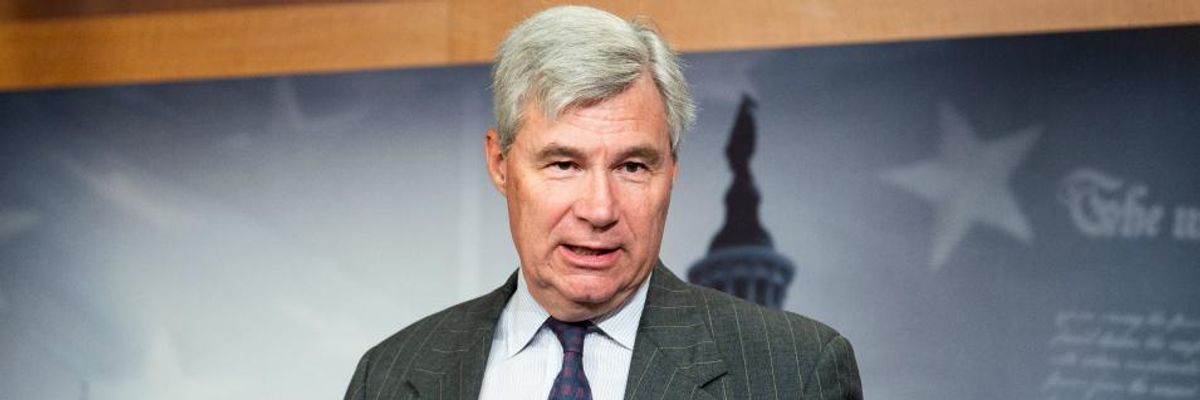
Senator Sheldon Whitehouse (D-R.I.) speaks during a press conference at the U.S. Capitol in Washington, DC. (Photo: Michael Brochstein/SOPA Images/LightRocket via Getty Images)
Senate Democrats Join GOP to Back 'Automatic Austerity' Bill That Would Gut Social Programs, Hamstring Bold Policies
"One priority of a Sanders or Warren White House absolutely must be politically crushing the deficit scolds within the Democratic Party."
A handful of Senate Democrats joined forces with Republicans last week to advance sweeping budget legislation that would establish an "automatic deficit-reduction process" that could trigger trillions of dollars in cuts to Medicare, Medicaid, food stamps, and other social programs--and potentially hobble the agenda of the next president.
The Bipartisan Congressional Budget Reform Act (S.2765), authored by Sens. Sheldon Whitehouse (D-R.I.) and Mike Enzi (R-Wyo.), passed out of the Senate Budget Committee on November 6. The legislation is co-sponsored by five members of the Senate Democratic caucus: Whitehouse, Mark Warner (Va.), Tim Kaine (Va.), Chris Coons (Del.), and Angus King (I-Maine).
"If a Democrat wants to extend free public college to all Americans, or move toward a universal health care system, or amass resources to fight the climate crisis, they're going to run into the deficit scolds."
--David Dayen, The American Prospect
Sen. Bernie Sanders (I-Vt.), the ranking member of the Senate Budget Committee and a 2020 Democratic presidential candidate, issued a statement last week opposing the legislation and warning it "could be used by Republicans to unilaterally cut programs like Medicare, Medicaid, and nutrition assistance--all supposedly to reduce the deficit."
"This new proposed process comes less than two years after Republicans on this Committee showed no hesitation in adding $2 trillion to the deficit in order to pass the Trump tax cuts for the wealthiest families and the most profitable corporations in America," said Sanders.
As The American Prospect's David Dayen noted Thursday, passage of S.2765 would severely hamstring Sanders' ability to implement his agenda should he win the White House in 2020.
"If a Democrat wants to extend free public college to all Americans, or move toward a universal healthcare system, or amass resources to fight the climate crisis," Dayen wrote, "they're going to run into the deficit scolds, the 'No, We Can't' brigade. Republicans like Enzi want to build that 'No, We Can't' presumption into the budget process itself. It makes no sense for Democrats to help them."
Title IV of S.2765, Dayen explained, "would create an automatic process to slash potentially trillions of dollars from programs like Medicare, Medicaid, food stamps, and Obamacare subsidies."
A budget resolution would pass in the first year of a new Congress. The next year, on February 15, the Congressional Budget Office would compare the debt/GDP ratio projected in the budget resolution to a new projection that incorporates the evidence of the past year. If the new projection exceeds the budget resolution's, that would trigger a special, automatic 'reconciliation' process to effectively wipe out that gap.
For the most part, cuts would have to come out of mandatory programs, like health spending and nutrition assistance for the poor. (Social Security is protected from reconciliation and could not be cut.)...
[T]he past three budget resolutions passed by Congress would have, under this bill, forced automatic reconciliation deficit cuts with a staggering total of $9.5 trillion.
In an analysis of S.2765 last week, Richard Kogan and Joel Friedman of the Center on Budget and Policy Priorities wrote that the bill amounts to "automatic austerity" that could "drive harmful budget cuts" and severely hamper the nation's ability to respond to an economic downturn.
"The question of what's sound budget policy should not be driven by a presumption that austerity is always the right answer," Kogan and Friedman wrote.
The vote to advance S.2765 out of the Senate Budget Committee came after House Speaker Nancy Pelosi (D-Calif.) said Democrats must commit to so-called "pay-go" rules, which require all new spending to be offset with budget cuts or tax increases.
"We cannot just keep increasing the debt," Pelosi told Bloomberg earlier this month.
Progressives have warned that adherence to conservative pay-go rules would completely undermine any possibility of Medicare for All, a Green New Deal, and other ambitious policy goals.
"Any left-wing president will have to deal with the Pelosi problem: the existence of powerful Democrats who are too wedded to big money to accept an ambitious program," The Nation's Jeet Heer wrote last week. "Defeating the Republicans will be the easy part. The real challenge will be overriding Pelosi's veto."
We are at a crossroads
This country and this world are at a monumental crossroads. In a few short weeks, US voters will have an opportunity to beat back the forces of fascism and confront the billionaires who are rigging the economy, our media system, and our democracy, making it increasingly impossible for ordinary people to get by. We’re not just talking about the election. We’re talking about what must be done once these fascist elements are vanquished from power. We need a bolder set of solutions than what either major party has so far been willing to offer and a working-class movement ready to fight like hell for it. Trump didn't emerge from nowhere. The conditions that fueled MAGA authoritarianism were created by decades of radical neoliberal economic policies and a corrupt political system dominated by corporate interests. They slashed taxes on the super-rich, promising that the benefits would trickle down. They said giveaways to the corporate titans would make life more affordable for the rest of us. It was all bullshit. And when a bitter, betrayed populace searches for someone to blame, right-wing demagogues have little trouble finding scapegoats. People know when they're being lied to, but you won't hear any of this from the corporate media. Only independent journalism—powered and funded by people who believe in building a better world—can deliver truly trustworthy daily news. Our Fall Campaign is underway, and we need your help. To power our newsroom through the rest of the year, we need to raise $125,000 by midnight on October 31. So if you share our vision, please contribute whatever you can to sustain our work. |
A handful of Senate Democrats joined forces with Republicans last week to advance sweeping budget legislation that would establish an "automatic deficit-reduction process" that could trigger trillions of dollars in cuts to Medicare, Medicaid, food stamps, and other social programs--and potentially hobble the agenda of the next president.
The Bipartisan Congressional Budget Reform Act (S.2765), authored by Sens. Sheldon Whitehouse (D-R.I.) and Mike Enzi (R-Wyo.), passed out of the Senate Budget Committee on November 6. The legislation is co-sponsored by five members of the Senate Democratic caucus: Whitehouse, Mark Warner (Va.), Tim Kaine (Va.), Chris Coons (Del.), and Angus King (I-Maine).
"If a Democrat wants to extend free public college to all Americans, or move toward a universal health care system, or amass resources to fight the climate crisis, they're going to run into the deficit scolds."
--David Dayen, The American Prospect
Sen. Bernie Sanders (I-Vt.), the ranking member of the Senate Budget Committee and a 2020 Democratic presidential candidate, issued a statement last week opposing the legislation and warning it "could be used by Republicans to unilaterally cut programs like Medicare, Medicaid, and nutrition assistance--all supposedly to reduce the deficit."
"This new proposed process comes less than two years after Republicans on this Committee showed no hesitation in adding $2 trillion to the deficit in order to pass the Trump tax cuts for the wealthiest families and the most profitable corporations in America," said Sanders.
As The American Prospect's David Dayen noted Thursday, passage of S.2765 would severely hamstring Sanders' ability to implement his agenda should he win the White House in 2020.
"If a Democrat wants to extend free public college to all Americans, or move toward a universal healthcare system, or amass resources to fight the climate crisis," Dayen wrote, "they're going to run into the deficit scolds, the 'No, We Can't' brigade. Republicans like Enzi want to build that 'No, We Can't' presumption into the budget process itself. It makes no sense for Democrats to help them."
Title IV of S.2765, Dayen explained, "would create an automatic process to slash potentially trillions of dollars from programs like Medicare, Medicaid, food stamps, and Obamacare subsidies."
A budget resolution would pass in the first year of a new Congress. The next year, on February 15, the Congressional Budget Office would compare the debt/GDP ratio projected in the budget resolution to a new projection that incorporates the evidence of the past year. If the new projection exceeds the budget resolution's, that would trigger a special, automatic 'reconciliation' process to effectively wipe out that gap.
For the most part, cuts would have to come out of mandatory programs, like health spending and nutrition assistance for the poor. (Social Security is protected from reconciliation and could not be cut.)...
[T]he past three budget resolutions passed by Congress would have, under this bill, forced automatic reconciliation deficit cuts with a staggering total of $9.5 trillion.
In an analysis of S.2765 last week, Richard Kogan and Joel Friedman of the Center on Budget and Policy Priorities wrote that the bill amounts to "automatic austerity" that could "drive harmful budget cuts" and severely hamper the nation's ability to respond to an economic downturn.
"The question of what's sound budget policy should not be driven by a presumption that austerity is always the right answer," Kogan and Friedman wrote.
The vote to advance S.2765 out of the Senate Budget Committee came after House Speaker Nancy Pelosi (D-Calif.) said Democrats must commit to so-called "pay-go" rules, which require all new spending to be offset with budget cuts or tax increases.
"We cannot just keep increasing the debt," Pelosi told Bloomberg earlier this month.
Progressives have warned that adherence to conservative pay-go rules would completely undermine any possibility of Medicare for All, a Green New Deal, and other ambitious policy goals.
"Any left-wing president will have to deal with the Pelosi problem: the existence of powerful Democrats who are too wedded to big money to accept an ambitious program," The Nation's Jeet Heer wrote last week. "Defeating the Republicans will be the easy part. The real challenge will be overriding Pelosi's veto."
A handful of Senate Democrats joined forces with Republicans last week to advance sweeping budget legislation that would establish an "automatic deficit-reduction process" that could trigger trillions of dollars in cuts to Medicare, Medicaid, food stamps, and other social programs--and potentially hobble the agenda of the next president.
The Bipartisan Congressional Budget Reform Act (S.2765), authored by Sens. Sheldon Whitehouse (D-R.I.) and Mike Enzi (R-Wyo.), passed out of the Senate Budget Committee on November 6. The legislation is co-sponsored by five members of the Senate Democratic caucus: Whitehouse, Mark Warner (Va.), Tim Kaine (Va.), Chris Coons (Del.), and Angus King (I-Maine).
"If a Democrat wants to extend free public college to all Americans, or move toward a universal health care system, or amass resources to fight the climate crisis, they're going to run into the deficit scolds."
--David Dayen, The American Prospect
Sen. Bernie Sanders (I-Vt.), the ranking member of the Senate Budget Committee and a 2020 Democratic presidential candidate, issued a statement last week opposing the legislation and warning it "could be used by Republicans to unilaterally cut programs like Medicare, Medicaid, and nutrition assistance--all supposedly to reduce the deficit."
"This new proposed process comes less than two years after Republicans on this Committee showed no hesitation in adding $2 trillion to the deficit in order to pass the Trump tax cuts for the wealthiest families and the most profitable corporations in America," said Sanders.
As The American Prospect's David Dayen noted Thursday, passage of S.2765 would severely hamstring Sanders' ability to implement his agenda should he win the White House in 2020.
"If a Democrat wants to extend free public college to all Americans, or move toward a universal healthcare system, or amass resources to fight the climate crisis," Dayen wrote, "they're going to run into the deficit scolds, the 'No, We Can't' brigade. Republicans like Enzi want to build that 'No, We Can't' presumption into the budget process itself. It makes no sense for Democrats to help them."
Title IV of S.2765, Dayen explained, "would create an automatic process to slash potentially trillions of dollars from programs like Medicare, Medicaid, food stamps, and Obamacare subsidies."
A budget resolution would pass in the first year of a new Congress. The next year, on February 15, the Congressional Budget Office would compare the debt/GDP ratio projected in the budget resolution to a new projection that incorporates the evidence of the past year. If the new projection exceeds the budget resolution's, that would trigger a special, automatic 'reconciliation' process to effectively wipe out that gap.
For the most part, cuts would have to come out of mandatory programs, like health spending and nutrition assistance for the poor. (Social Security is protected from reconciliation and could not be cut.)...
[T]he past three budget resolutions passed by Congress would have, under this bill, forced automatic reconciliation deficit cuts with a staggering total of $9.5 trillion.
In an analysis of S.2765 last week, Richard Kogan and Joel Friedman of the Center on Budget and Policy Priorities wrote that the bill amounts to "automatic austerity" that could "drive harmful budget cuts" and severely hamper the nation's ability to respond to an economic downturn.
"The question of what's sound budget policy should not be driven by a presumption that austerity is always the right answer," Kogan and Friedman wrote.
The vote to advance S.2765 out of the Senate Budget Committee came after House Speaker Nancy Pelosi (D-Calif.) said Democrats must commit to so-called "pay-go" rules, which require all new spending to be offset with budget cuts or tax increases.
"We cannot just keep increasing the debt," Pelosi told Bloomberg earlier this month.
Progressives have warned that adherence to conservative pay-go rules would completely undermine any possibility of Medicare for All, a Green New Deal, and other ambitious policy goals.
"Any left-wing president will have to deal with the Pelosi problem: the existence of powerful Democrats who are too wedded to big money to accept an ambitious program," The Nation's Jeet Heer wrote last week. "Defeating the Republicans will be the easy part. The real challenge will be overriding Pelosi's veto."