SUBSCRIBE TO OUR FREE NEWSLETTER
Daily news & progressive opinion—funded by the people, not the corporations—delivered straight to your inbox.
5
#000000
#FFFFFF
To donate by check, phone, or other method, see our More Ways to Give page.
Daily news & progressive opinion—funded by the people, not the corporations—delivered straight to your inbox.
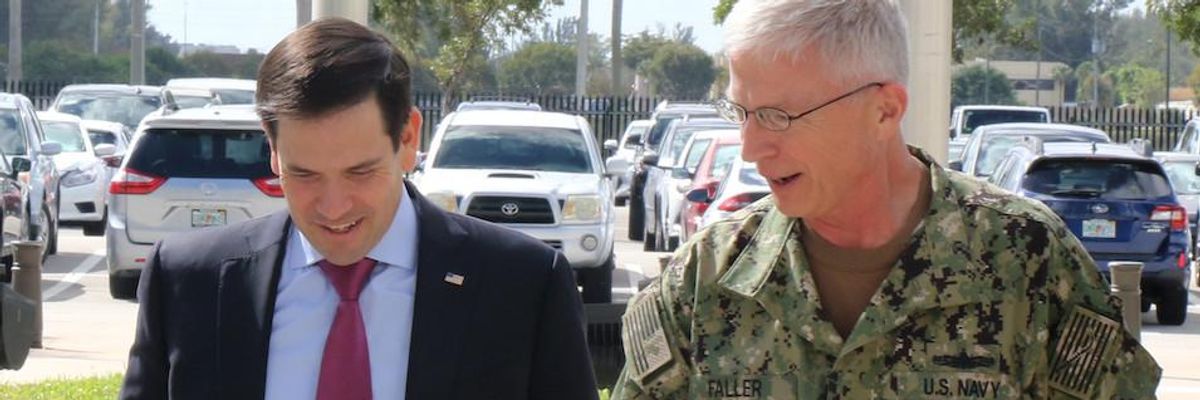
Sen. Marco Rubio speaks with Navy Adm. Craig Faller, commander of U.S. Southern Command, about Venezuela. (Photo: Michael Dougherty, SOUTHCOM Public Affairs)
A U.S. Senator's claim about Venezuela Sunday made him the subject of ridicule, but the underlying message of destabilizing the Latin American country remains official American policy--even as the role of sanctions is ignored.
On Sunday morning, Sen. Marco Rubio (R-Fla.) tweeted that a power failure and subsequent blackout in Venezuela was due to an accident at a location known as "German Dam."
"Today another transformer explosion at the German Dam in Bolivar State caused another massive blackout," Rubio wrote.
There was just one problem: German Dam is the name of a reporter covering the blackout story who tweeted about the transformer exploding, not the location of the accident. In fact, no such location exists in Venezuela.
Rubio's tweet led to endless rounds of mockery, not least from Dam himself.
As amusing as Rubio's mistake was, it hints at another, more important issue: the American foreign policy establishment is using the blackout to take aim at Venezuela, no matter how they have to spin or obfuscate the facts around the power outage.
That was the message from foreign policy analyst Mark Weisbrot, co-director of the Center for Economic and Policy Research, remarking on reporting about Venezuela from The New York Times over the weekend.
"This is amazing," tweeted Weisbrot, "buried deep in this NYT article is a sentence indicating the Trump economic sanctions are a major cause of the deadly blackout in Venezuela, contradicting the rest of the article."
That's a meaningful thing to leave out, Weisbrot explained, because it is part of a continuing push from U.S. media to downplay the role of American sanctions in Venezuela's current instability--when they mention it at all.
U.S. officials, meanwhile, have targeted Venezuelan President Nicolas Maduro with rhetoric tying the blackout to government policies.
The crisis in Venezuela was exacerbated by U.S. sanctions, as Weisbrot pointed out in a recent article for The Nation.
"Make no mistake about it," Weisbrot wrote, "U.S. sanctions on Venezuela are killing people, and have been killing people for some time."
Sanctions are only part of the battle. As part of a coordinated effort in January, the Trump administration unilaterally recognized opposition leader Juan Guaido as Venezuela's "interim president" on the very same day Guaido publicly declared the title for himself. And members of the U.S. government--including Rubio--have advocated for ramped up hostilities and covert actions against Maduro.
Still, it appears that those efforts have yet to be successful. Maduro is still entrenched in Caracas and Guaido, while freely roaming the country, is lacking the kind of support needed to overthrow the government. The situation, in the words of Washington Post reporter Ishaan Tharoor, is starting to "look like a stalemate."
"As tenuous as his grip on power may seem, Maduro shows no sign of relinquishing command," wrote Tharoor.
The deepening reality that 2019's attempt to overthrow Venezuela's government may be as doomed as the attempt in 2002 was on display Sunday when National Security Advisor John Bolton gave a somewhat deflated interview to ABC "This Week" host Martha Raddatz.
"I'm not certain of anything, but I do think momentum is on the side of Guaido," said Bolton. "We'll see what happens."
Dear Common Dreams reader, It’s been nearly 30 years since I co-founded Common Dreams with my late wife, Lina Newhouser. We had the radical notion that journalism should serve the public good, not corporate profits. It was clear to us from the outset what it would take to build such a project. No paid advertisements. No corporate sponsors. No millionaire publisher telling us what to think or do. Many people said we wouldn't last a year, but we proved those doubters wrong. Together with a tremendous team of journalists and dedicated staff, we built an independent media outlet free from the constraints of profits and corporate control. Our mission has always been simple: To inform. To inspire. To ignite change for the common good. Building Common Dreams was not easy. Our survival was never guaranteed. When you take on the most powerful forces—Wall Street greed, fossil fuel industry destruction, Big Tech lobbyists, and uber-rich oligarchs who have spent billions upon billions rigging the economy and democracy in their favor—the only bulwark you have is supporters who believe in your work. But here’s the urgent message from me today. It's never been this bad out there. And it's never been this hard to keep us going. At the very moment Common Dreams is most needed, the threats we face are intensifying. We need your support now more than ever. We don't accept corporate advertising and never will. We don't have a paywall because we don't think people should be blocked from critical news based on their ability to pay. Everything we do is funded by the donations of readers like you. When everyone does the little they can afford, we are strong. But if that support retreats or dries up, so do we. Will you donate now to make sure Common Dreams not only survives but thrives? —Craig Brown, Co-founder |
A U.S. Senator's claim about Venezuela Sunday made him the subject of ridicule, but the underlying message of destabilizing the Latin American country remains official American policy--even as the role of sanctions is ignored.
On Sunday morning, Sen. Marco Rubio (R-Fla.) tweeted that a power failure and subsequent blackout in Venezuela was due to an accident at a location known as "German Dam."
"Today another transformer explosion at the German Dam in Bolivar State caused another massive blackout," Rubio wrote.
There was just one problem: German Dam is the name of a reporter covering the blackout story who tweeted about the transformer exploding, not the location of the accident. In fact, no such location exists in Venezuela.
Rubio's tweet led to endless rounds of mockery, not least from Dam himself.
As amusing as Rubio's mistake was, it hints at another, more important issue: the American foreign policy establishment is using the blackout to take aim at Venezuela, no matter how they have to spin or obfuscate the facts around the power outage.
That was the message from foreign policy analyst Mark Weisbrot, co-director of the Center for Economic and Policy Research, remarking on reporting about Venezuela from The New York Times over the weekend.
"This is amazing," tweeted Weisbrot, "buried deep in this NYT article is a sentence indicating the Trump economic sanctions are a major cause of the deadly blackout in Venezuela, contradicting the rest of the article."
That's a meaningful thing to leave out, Weisbrot explained, because it is part of a continuing push from U.S. media to downplay the role of American sanctions in Venezuela's current instability--when they mention it at all.
U.S. officials, meanwhile, have targeted Venezuelan President Nicolas Maduro with rhetoric tying the blackout to government policies.
The crisis in Venezuela was exacerbated by U.S. sanctions, as Weisbrot pointed out in a recent article for The Nation.
"Make no mistake about it," Weisbrot wrote, "U.S. sanctions on Venezuela are killing people, and have been killing people for some time."
Sanctions are only part of the battle. As part of a coordinated effort in January, the Trump administration unilaterally recognized opposition leader Juan Guaido as Venezuela's "interim president" on the very same day Guaido publicly declared the title for himself. And members of the U.S. government--including Rubio--have advocated for ramped up hostilities and covert actions against Maduro.
Still, it appears that those efforts have yet to be successful. Maduro is still entrenched in Caracas and Guaido, while freely roaming the country, is lacking the kind of support needed to overthrow the government. The situation, in the words of Washington Post reporter Ishaan Tharoor, is starting to "look like a stalemate."
"As tenuous as his grip on power may seem, Maduro shows no sign of relinquishing command," wrote Tharoor.
The deepening reality that 2019's attempt to overthrow Venezuela's government may be as doomed as the attempt in 2002 was on display Sunday when National Security Advisor John Bolton gave a somewhat deflated interview to ABC "This Week" host Martha Raddatz.
"I'm not certain of anything, but I do think momentum is on the side of Guaido," said Bolton. "We'll see what happens."
A U.S. Senator's claim about Venezuela Sunday made him the subject of ridicule, but the underlying message of destabilizing the Latin American country remains official American policy--even as the role of sanctions is ignored.
On Sunday morning, Sen. Marco Rubio (R-Fla.) tweeted that a power failure and subsequent blackout in Venezuela was due to an accident at a location known as "German Dam."
"Today another transformer explosion at the German Dam in Bolivar State caused another massive blackout," Rubio wrote.
There was just one problem: German Dam is the name of a reporter covering the blackout story who tweeted about the transformer exploding, not the location of the accident. In fact, no such location exists in Venezuela.
Rubio's tweet led to endless rounds of mockery, not least from Dam himself.
As amusing as Rubio's mistake was, it hints at another, more important issue: the American foreign policy establishment is using the blackout to take aim at Venezuela, no matter how they have to spin or obfuscate the facts around the power outage.
That was the message from foreign policy analyst Mark Weisbrot, co-director of the Center for Economic and Policy Research, remarking on reporting about Venezuela from The New York Times over the weekend.
"This is amazing," tweeted Weisbrot, "buried deep in this NYT article is a sentence indicating the Trump economic sanctions are a major cause of the deadly blackout in Venezuela, contradicting the rest of the article."
That's a meaningful thing to leave out, Weisbrot explained, because it is part of a continuing push from U.S. media to downplay the role of American sanctions in Venezuela's current instability--when they mention it at all.
U.S. officials, meanwhile, have targeted Venezuelan President Nicolas Maduro with rhetoric tying the blackout to government policies.
The crisis in Venezuela was exacerbated by U.S. sanctions, as Weisbrot pointed out in a recent article for The Nation.
"Make no mistake about it," Weisbrot wrote, "U.S. sanctions on Venezuela are killing people, and have been killing people for some time."
Sanctions are only part of the battle. As part of a coordinated effort in January, the Trump administration unilaterally recognized opposition leader Juan Guaido as Venezuela's "interim president" on the very same day Guaido publicly declared the title for himself. And members of the U.S. government--including Rubio--have advocated for ramped up hostilities and covert actions against Maduro.
Still, it appears that those efforts have yet to be successful. Maduro is still entrenched in Caracas and Guaido, while freely roaming the country, is lacking the kind of support needed to overthrow the government. The situation, in the words of Washington Post reporter Ishaan Tharoor, is starting to "look like a stalemate."
"As tenuous as his grip on power may seem, Maduro shows no sign of relinquishing command," wrote Tharoor.
The deepening reality that 2019's attempt to overthrow Venezuela's government may be as doomed as the attempt in 2002 was on display Sunday when National Security Advisor John Bolton gave a somewhat deflated interview to ABC "This Week" host Martha Raddatz.
"I'm not certain of anything, but I do think momentum is on the side of Guaido," said Bolton. "We'll see what happens."