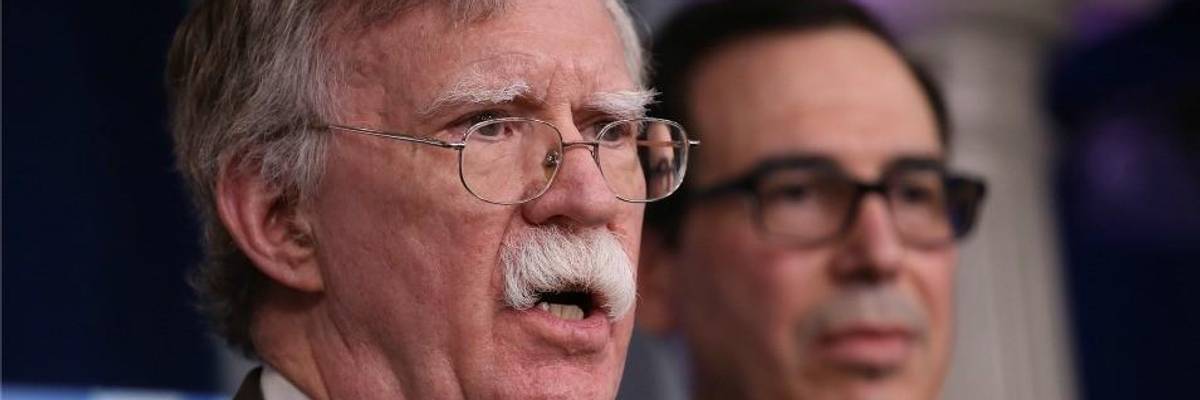
National Security Advisor John Bolton (L) and Treasury Secretary Steve Mnuchin (R) answer questions from reporters during a press briefing at the White House Jan. 28, 2019 in Washington, D.C. (Photo: Win McNamee/Getty Images)
'This Is Very Dangerous': Trump Administration Seizes Venezuela Oil Assets, Renews Threat of Military Action If Maduro Stays
"The problem here is that these efforts by the United States to change other countries' governments often lead to catastrophe."
The Trump administration intensified its interference in politically-fractured Venezuela on Monday by announcing the seizure of billions of dollars in assets connected to the nation's state-owned oil company, a move critics decried as part of a "dangerous" U.S. policy to help opposition forces overthrow elected president Nicolas Maduro.
National Security Adviser John Bolton and Treasury Secretary Steven Mnuchin announced the sanctions imposed via executive order against Petroleos de Venezuela, S.A. (PdVSA)--a primary source of income and foreign currency for the country--at a White House press briefing on Monday afternoon. They were joined by Larry Kudlow, director of the National Economic Council.
Mnuchin vowed the United States "will continue to use all of our diplomatic and economic tools" to back Juan Guaido, who has declared himself Venezuela's "interim president." The secretary made clear that "the path to sanctions relief for PdVSA is through the expeditious transfer of control to the interim president or a subsequent, democratically elected government."
As CNBC reported:
Mnuchin said PDVSA has long been a vehicle for embezzlement and corruption by officials and businessmen. The sanctions will prevent the nation's oil wealth from being diverted to Maduro and will only be lifted when his regime hands control of PDVSA to a successor government, he added.
[...]
Under the sanctions, U.S. companies can continue to purchase Venezuelan oil, but the payments must be held in an account that cannot be accessed by the Maduro regime.
"If the people in Venezuela want to continue to sell us oil, as long as that money goes into blocked accounts, we'll continue to take it," Mnuchin said. "Otherwise we will not be buying it."
In addition to tightening economic restrictions on the Maduro government as a way to bolster the position of Guaido, Bolton also issued a fresh threat of military action by telling reporters in the White House briefing room that Trump "has made it clear that all options are on the table" when it comes to next possible steps.
"This is very dangerous," world-renowned economics professor and senior U.N. advisor Jeffrey D. Sachs warned on CNN Monday afternoon. He expressed concern that the administration's actions could cause immense suffering among the Venezuelan people, similar to the consequences endured by citizens of other countries subjected to U.S. interventions.
"The problem here is that these efforts by the United States to change other countries' governments often lead to catastrophe," Sachs noted, "as has happened all through the Middle East in recent years."
"Very often Washington says, 'Somebody must go,'" he continued. "And this is how our foreign policy often works--it's very arrogant [to say] who should rule in another country. By the way, Maduro is not a decent, pleasant man--but on the other hand, for Washington to just announce that a self-declared politician is the president, is kind of an American regime change tradition."
Keeping with that tradition, a Wall Street Journal report published last week revealed that Guaido's coup attempt has been highly coordinated with Trump administration officials and Republican lawmakers. A handful of other nations including Israel and Brazil are also backing Guaido, and in a speech before the U.N. Security Council on Saturday, U.S. Secretary of State Mike Pompeo urged others to follow suit.
Experts and a few progressive members of Congress, meanwhile, have acknowledged the economic and political crises in Venezuela but also demanded that the Trump administration refrain from intervening through military action or sanctions.
"Instead of a U.S.-led regime change, the two sides need to share power temporarily, until new elections, perhaps in 2021. It seems inconceivable, yet history shows this can be done," Sachs charged in a column for CNN on Sunday, citing Poland's transition to democracy in 1989 as an example. As he outlined:
Such a compromise would have Maduro remain as president, the military in effect hold the Ministries of Defense and Interior, and the opposition forces take over the civilian ministries, and the Central Bank of Venezuela. Guaido, or some other leader in the opposition camp, would serve in effect as a prime minister, leading the civilian cabinet, and guiding Venezuela's economic policies. Elections would be agreed upon for 2021 or 2022, perhaps under a semi-parliamentary system by that time.
"The U.S. instead appears to be aiming for regime change and tightening sanctions to bring Maduro to his knees," Sachs concluded. "Such an outcome is perhaps feasible, though it would leave a very bitter legacy. More likely, though, it would occasion further violence and an escalation of the economic crisis, possibly leading to war."
An Urgent Message From Our Co-Founder
Dear Common Dreams reader, It’s been nearly 30 years since I co-founded Common Dreams with my late wife, Lina Newhouser. We had the radical notion that journalism should serve the public good, not corporate profits. It was clear to us from the outset what it would take to build such a project. No paid advertisements. No corporate sponsors. No millionaire publisher telling us what to think or do. Many people said we wouldn't last a year, but we proved those doubters wrong. Together with a tremendous team of journalists and dedicated staff, we built an independent media outlet free from the constraints of profits and corporate control. Our mission has always been simple: To inform. To inspire. To ignite change for the common good. Building Common Dreams was not easy. Our survival was never guaranteed. When you take on the most powerful forces—Wall Street greed, fossil fuel industry destruction, Big Tech lobbyists, and uber-rich oligarchs who have spent billions upon billions rigging the economy and democracy in their favor—the only bulwark you have is supporters who believe in your work. But here’s the urgent message from me today. It's never been this bad out there. And it's never been this hard to keep us going. At the very moment Common Dreams is most needed, the threats we face are intensifying. We need your support now more than ever. We don't accept corporate advertising and never will. We don't have a paywall because we don't think people should be blocked from critical news based on their ability to pay. Everything we do is funded by the donations of readers like you. When everyone does the little they can afford, we are strong. But if that support retreats or dries up, so do we. Will you donate now to make sure Common Dreams not only survives but thrives? —Craig Brown, Co-founder |
The Trump administration intensified its interference in politically-fractured Venezuela on Monday by announcing the seizure of billions of dollars in assets connected to the nation's state-owned oil company, a move critics decried as part of a "dangerous" U.S. policy to help opposition forces overthrow elected president Nicolas Maduro.
National Security Adviser John Bolton and Treasury Secretary Steven Mnuchin announced the sanctions imposed via executive order against Petroleos de Venezuela, S.A. (PdVSA)--a primary source of income and foreign currency for the country--at a White House press briefing on Monday afternoon. They were joined by Larry Kudlow, director of the National Economic Council.
Mnuchin vowed the United States "will continue to use all of our diplomatic and economic tools" to back Juan Guaido, who has declared himself Venezuela's "interim president." The secretary made clear that "the path to sanctions relief for PdVSA is through the expeditious transfer of control to the interim president or a subsequent, democratically elected government."
As CNBC reported:
Mnuchin said PDVSA has long been a vehicle for embezzlement and corruption by officials and businessmen. The sanctions will prevent the nation's oil wealth from being diverted to Maduro and will only be lifted when his regime hands control of PDVSA to a successor government, he added.
[...]
Under the sanctions, U.S. companies can continue to purchase Venezuelan oil, but the payments must be held in an account that cannot be accessed by the Maduro regime.
"If the people in Venezuela want to continue to sell us oil, as long as that money goes into blocked accounts, we'll continue to take it," Mnuchin said. "Otherwise we will not be buying it."
In addition to tightening economic restrictions on the Maduro government as a way to bolster the position of Guaido, Bolton also issued a fresh threat of military action by telling reporters in the White House briefing room that Trump "has made it clear that all options are on the table" when it comes to next possible steps.
"This is very dangerous," world-renowned economics professor and senior U.N. advisor Jeffrey D. Sachs warned on CNN Monday afternoon. He expressed concern that the administration's actions could cause immense suffering among the Venezuelan people, similar to the consequences endured by citizens of other countries subjected to U.S. interventions.
"The problem here is that these efforts by the United States to change other countries' governments often lead to catastrophe," Sachs noted, "as has happened all through the Middle East in recent years."
"Very often Washington says, 'Somebody must go,'" he continued. "And this is how our foreign policy often works--it's very arrogant [to say] who should rule in another country. By the way, Maduro is not a decent, pleasant man--but on the other hand, for Washington to just announce that a self-declared politician is the president, is kind of an American regime change tradition."
Keeping with that tradition, a Wall Street Journal report published last week revealed that Guaido's coup attempt has been highly coordinated with Trump administration officials and Republican lawmakers. A handful of other nations including Israel and Brazil are also backing Guaido, and in a speech before the U.N. Security Council on Saturday, U.S. Secretary of State Mike Pompeo urged others to follow suit.
Experts and a few progressive members of Congress, meanwhile, have acknowledged the economic and political crises in Venezuela but also demanded that the Trump administration refrain from intervening through military action or sanctions.
"Instead of a U.S.-led regime change, the two sides need to share power temporarily, until new elections, perhaps in 2021. It seems inconceivable, yet history shows this can be done," Sachs charged in a column for CNN on Sunday, citing Poland's transition to democracy in 1989 as an example. As he outlined:
Such a compromise would have Maduro remain as president, the military in effect hold the Ministries of Defense and Interior, and the opposition forces take over the civilian ministries, and the Central Bank of Venezuela. Guaido, or some other leader in the opposition camp, would serve in effect as a prime minister, leading the civilian cabinet, and guiding Venezuela's economic policies. Elections would be agreed upon for 2021 or 2022, perhaps under a semi-parliamentary system by that time.
"The U.S. instead appears to be aiming for regime change and tightening sanctions to bring Maduro to his knees," Sachs concluded. "Such an outcome is perhaps feasible, though it would leave a very bitter legacy. More likely, though, it would occasion further violence and an escalation of the economic crisis, possibly leading to war."
The Trump administration intensified its interference in politically-fractured Venezuela on Monday by announcing the seizure of billions of dollars in assets connected to the nation's state-owned oil company, a move critics decried as part of a "dangerous" U.S. policy to help opposition forces overthrow elected president Nicolas Maduro.
National Security Adviser John Bolton and Treasury Secretary Steven Mnuchin announced the sanctions imposed via executive order against Petroleos de Venezuela, S.A. (PdVSA)--a primary source of income and foreign currency for the country--at a White House press briefing on Monday afternoon. They were joined by Larry Kudlow, director of the National Economic Council.
Mnuchin vowed the United States "will continue to use all of our diplomatic and economic tools" to back Juan Guaido, who has declared himself Venezuela's "interim president." The secretary made clear that "the path to sanctions relief for PdVSA is through the expeditious transfer of control to the interim president or a subsequent, democratically elected government."
As CNBC reported:
Mnuchin said PDVSA has long been a vehicle for embezzlement and corruption by officials and businessmen. The sanctions will prevent the nation's oil wealth from being diverted to Maduro and will only be lifted when his regime hands control of PDVSA to a successor government, he added.
[...]
Under the sanctions, U.S. companies can continue to purchase Venezuelan oil, but the payments must be held in an account that cannot be accessed by the Maduro regime.
"If the people in Venezuela want to continue to sell us oil, as long as that money goes into blocked accounts, we'll continue to take it," Mnuchin said. "Otherwise we will not be buying it."
In addition to tightening economic restrictions on the Maduro government as a way to bolster the position of Guaido, Bolton also issued a fresh threat of military action by telling reporters in the White House briefing room that Trump "has made it clear that all options are on the table" when it comes to next possible steps.
"This is very dangerous," world-renowned economics professor and senior U.N. advisor Jeffrey D. Sachs warned on CNN Monday afternoon. He expressed concern that the administration's actions could cause immense suffering among the Venezuelan people, similar to the consequences endured by citizens of other countries subjected to U.S. interventions.
"The problem here is that these efforts by the United States to change other countries' governments often lead to catastrophe," Sachs noted, "as has happened all through the Middle East in recent years."
"Very often Washington says, 'Somebody must go,'" he continued. "And this is how our foreign policy often works--it's very arrogant [to say] who should rule in another country. By the way, Maduro is not a decent, pleasant man--but on the other hand, for Washington to just announce that a self-declared politician is the president, is kind of an American regime change tradition."
Keeping with that tradition, a Wall Street Journal report published last week revealed that Guaido's coup attempt has been highly coordinated with Trump administration officials and Republican lawmakers. A handful of other nations including Israel and Brazil are also backing Guaido, and in a speech before the U.N. Security Council on Saturday, U.S. Secretary of State Mike Pompeo urged others to follow suit.
Experts and a few progressive members of Congress, meanwhile, have acknowledged the economic and political crises in Venezuela but also demanded that the Trump administration refrain from intervening through military action or sanctions.
"Instead of a U.S.-led regime change, the two sides need to share power temporarily, until new elections, perhaps in 2021. It seems inconceivable, yet history shows this can be done," Sachs charged in a column for CNN on Sunday, citing Poland's transition to democracy in 1989 as an example. As he outlined:
Such a compromise would have Maduro remain as president, the military in effect hold the Ministries of Defense and Interior, and the opposition forces take over the civilian ministries, and the Central Bank of Venezuela. Guaido, or some other leader in the opposition camp, would serve in effect as a prime minister, leading the civilian cabinet, and guiding Venezuela's economic policies. Elections would be agreed upon for 2021 or 2022, perhaps under a semi-parliamentary system by that time.
"The U.S. instead appears to be aiming for regime change and tightening sanctions to bring Maduro to his knees," Sachs concluded. "Such an outcome is perhaps feasible, though it would leave a very bitter legacy. More likely, though, it would occasion further violence and an escalation of the economic crisis, possibly leading to war."