

SUBSCRIBE TO OUR FREE NEWSLETTER
Daily news & progressive opinion—funded by the people, not the corporations—delivered straight to your inbox.
5
#000000
#FFFFFF
To donate by check, phone, or other method, see our More Ways to Give page.
Daily news & progressive opinion—funded by the people, not the corporations—delivered straight to your inbox.
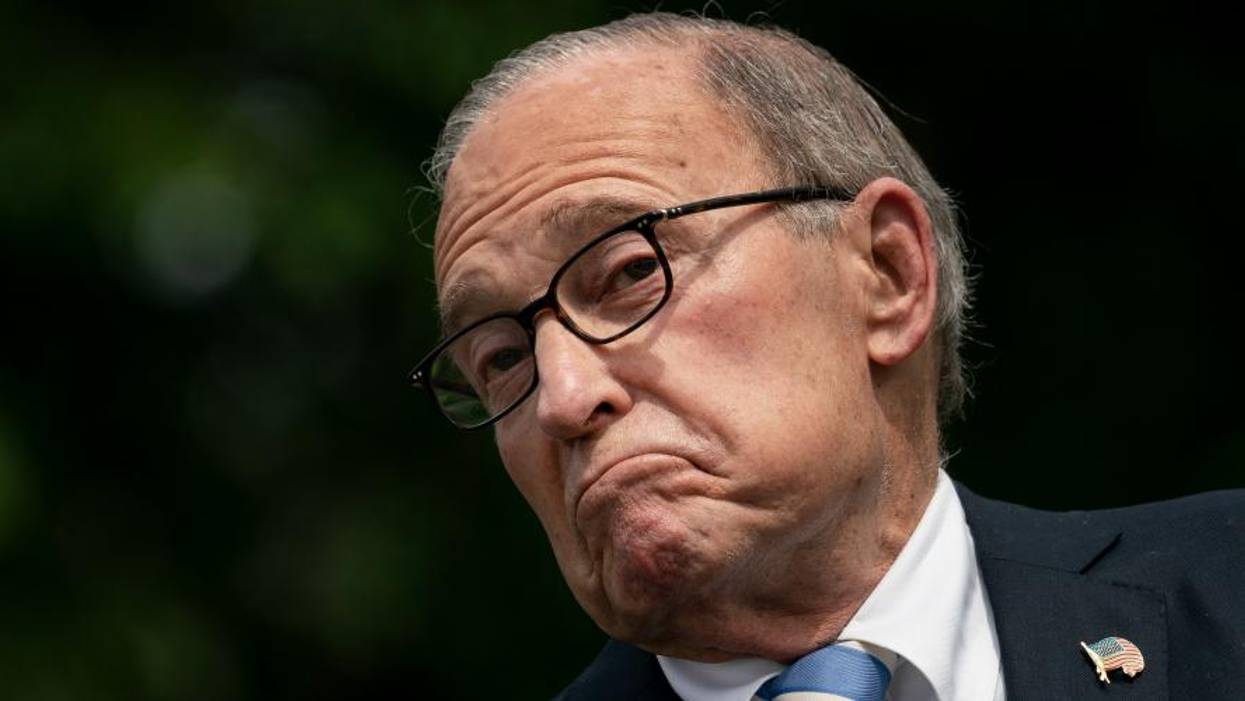
With millions of Americans out of work, struggling to afford food for themselves and their children, and facing the possibility of losing their homes, President Donald Trump's top economic adviser on Friday celebrated what he described as the "gales of creative destruction" supposedly unleashed by the U.S. economic system in the midst of the pandemic-induced recession.
"The talk is that a lot of folks who became unemployed, alright, most regrettably--but, they're sticking with it and they're going out and starting new businesses," Larry Kudlow, director of the National Economic Council, said in an appearance on Fox Business. "They're going to be small businesses."
"But that's the great part of American capitalism, gales of creative destruction," Kudlow continued, deploying a phrase popularized in the 1940s by economist Joseph Schumpeter. "I just love that new business start-up story."
Watch:
Critics immediately noted that the millions of people across the U.S. who are teetering on the brink of complete financial ruin are likely not impressed by the so-called "creative destruction" praised by Kudlow, who in June complained that the $600-per-week federal unemployment insurance boost many jobless workers were receiving at the time was excessive.
"Wonder how the 14% of households with kids who reported that they didn't get enough food to eat in the last seven days or the 32% of adults who are having trouble paying for usual household expenses feel about the 'gales of creative destruction,'" tweeted Washington Post reporter Jacqueline Alemany, pointing to data from the Center on Budget and Policy Priorities.
Kudlow's comments came a day after the Labor Department reported that an additional 1.3 million Americans filed for unemployment benefits, yet another indication that the strong economic recovery Kudlow has repeatedly predicted in recent weeks is not materializing.
"As American capitalism becomes even crueler, the rhetoric of its apologists will only grow more explicit," Jacobin's Luke Savage tweeted in response to Kudlow's remarks.
On top of being cold comfort for Americans struggling to get by as the prospect of another federal relief package before the November election remains uncertain, Kudlow's rosy insistence that the economic turmoil caused by the Covid-19 pandemic spurred a major new wave of entrepreneurship was also likely factually dubious.
"Self-employment is absolutely helping us to adapt to the pandemic," Adam Ozimek, chief economist at freelancing platform Upwork, told the Post's Jeff Stein. "But it's really nowhere near enough to make up for the massive shortfall in overall employment that we still have. Not even close."
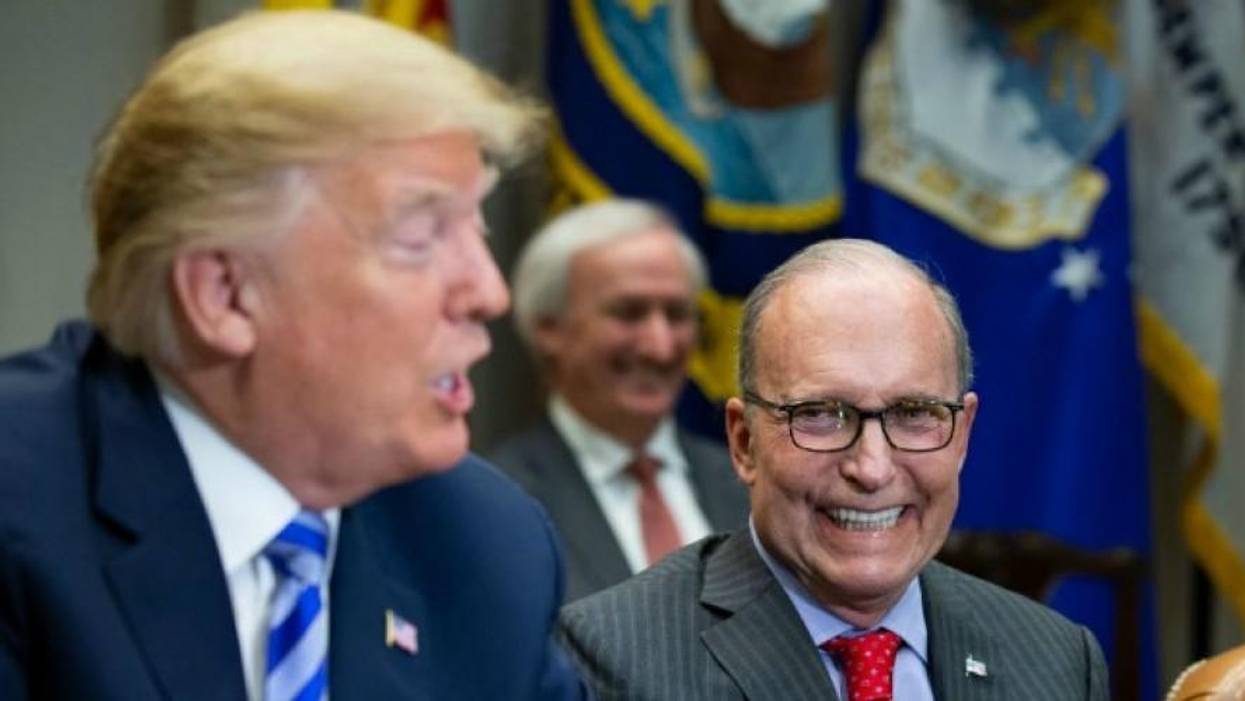
As President Donald Trump and top members of his administration continue their push to deliver another round of tax cuts to rich investors, an analysis published Tuesday by the Institute for Policy Studies and Americans for Tax Fairness showed that U.S. billionaires have seen their collective wealth soar by nearly $800 billion since Covid-19 began spreading rapidly across the country in March.
The new research found that between March 18 and August 20--a five-month period in which the economy tanked and tens of millions of people across the U.S. lost their jobs--the combined wealth of America's more than 600 billionaires jumped by $792 billion, bringing their collective net worth to a staggering $3.7 trillion.
"By demanding even more tax cuts for the rich at this crucial moment, President Trump shows he is as out of touch with our nation's needs as America's billionaires are disconnected from our nation's misery."
--Frank Clemente, Americans for Tax Fairness
"For billionaires, this is a heads we win, tails you lose economy, boosted by Trump policies to funnel wealth to the top," Chuck Collins, director of the IPS Program on Inequality, said in a statement.
Collins said the fact that just 12 U.S. billionaires now own more than a trillion dollars in combined wealth is "an unprecedented and disturbing indicator of the concentrated wealth during a pandemic." According to IPS, Amazon CEO Jeff Bezos--the richest man in the world--has seen his wealth grow by $81.9 billion since mid-March, a bigger jump than any other U.S. billionaire.
The updated wealth figures came just hours before Larry Kudlow, Trump's top economic adviser, boasted about the president's plan to slash the capital gains tax during a speech on the second night of the Republican National Convention Tuesday. The benefits of any cut to the capital gains tax would disproportionately flow to the wealthiest Americans.
"Looking ahead, more tax cuts and regulatory rollback will be in store," said Kudlow. "Payroll tax cuts for higher wages, income tax cuts for the middle class. Capital gains tax cuts for investment, productivity, and jobs. Much more regulatory relief for small businesses."
Earlier this month, Trump himself vowed to slash the capital gains tax if reelected in November.
Frank Clemente, executive director of Americans for Tax Fairness, said in a statement that "by demanding even more tax cuts for the rich at this crucial moment, President Trump shows he is as out of touch with our nation's needs as America's billionaires are disconnected from our nation's misery."
"The pandemic profiteering of America's billionaires shows taxes on the wealthy must go up substantially to narrow the wealth gap and raise revenue vital for our big climb back from disaster," Clemente added.
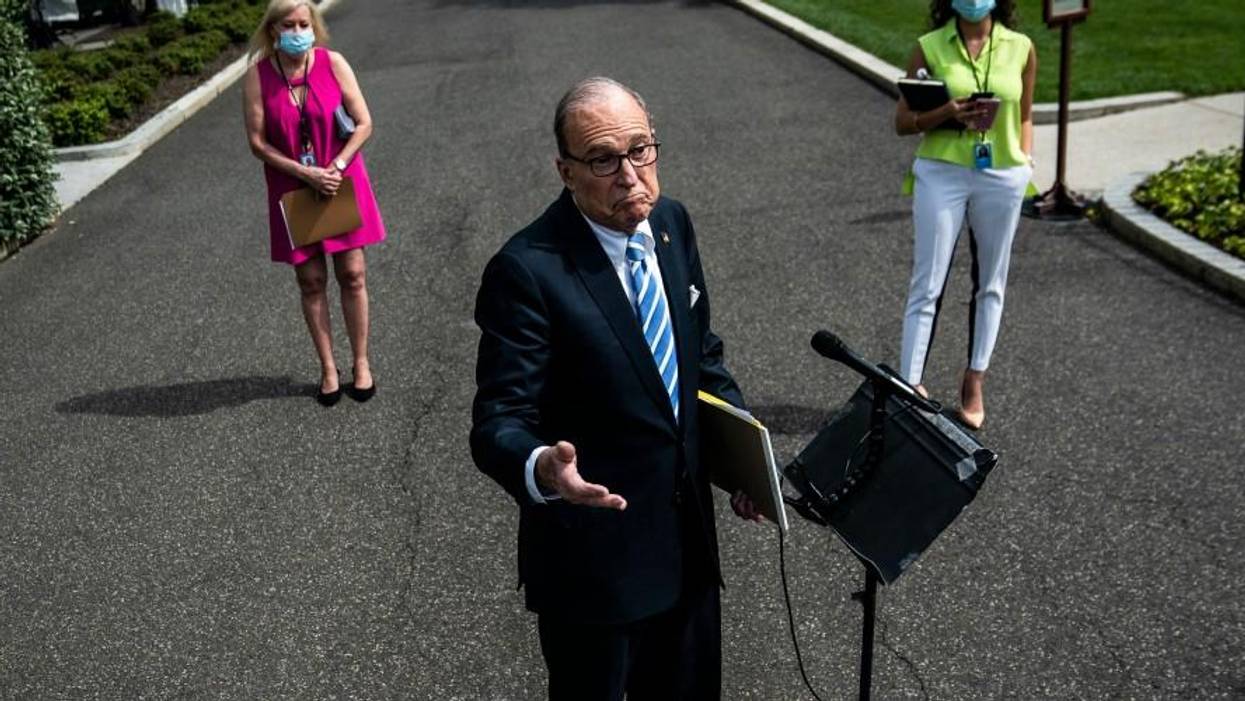
The Trump White House is publicly advocating a massive tax cut for wealthy U.S. investors while simultaneously urging Congress to pare back the expanded unemployment benefits currently serving as a financial lifeline for more than 30 million--and counting--jobless Americans.
"Regarding the 'capital gains holiday,' remember this key stat: 82% of all capital gains tax is paid by the richest 1%. A capital gains tax holiday is a pure giveaway to the rich."
--Michael Linden, Groundwork Collaborative
In an interview on Fox Business Monday, White House economic adviser Larry Kudlow said President Donald Trump wants included in the next Covid-19 stimulus package "a payroll tax holiday"--which critics warn is a stealth attack on Social Security--and a reduction in the capital gains tax.
A levy on profits from the sale of assets, the capital gains tax disproportionately affects the wealthy and most of the benefits of any cut would largely be enjoyed by rich investors.
Slashing the capital gains tax is a longtime goal of congressional Republicans and Trump, who last year considered but ultimately abandoned a legally dubious plan to lower the tax with an executive order.
While stressing that formal talks with Congress on the next stimulus package have not yet begun, Kudlow said the administration is also pushing for "reforms" to the $600-per-week boost in unemployment insurance (UI) payments, which he characterized as excessively generous "disincentives" to work.
The benefits are set to expire at the end of the month without action from Congress.
"So the White House position is that we have to cut the incomes of 30 million people who lost their jobs or who lost hours, while also giving a giant tax cut to the biggest corporations and the richest people in the world," tweeted Michael Linden, executive director of the Groundwork Collaborative, a progressive think tank.
"Regarding the 'capital gains holiday,' remember this key stat: 82% of all capital gains tax is paid by the richest 1%," Linden added. "A capital gains tax holiday is a pure giveaway to the rich."
The Washington Post reported Tuesday that after previously urging complete expiration of the enhanced unemployment benefits, "Trump administration officials have begun opening the door to accepting a narrower version of what Congress previously approved."
"One potential compromise discussed by Republican lawmakers would involve cutting the unemployment benefit from $600 per week to between $200 and $400 per week and making up at least part of the difference by sending another round of $1,200 stimulus payments," the Post reported.
Trump spokesman Judd Deere told the Post that the White House is open to approving a reduction in the current weekly UI payments but remains opposed to extending the full $600-per-week.
"UI reform is a priority for this White House in any phase four package and we are in ongoing discussions with the Hill," said Deere.
Julia Wolfe, state economic analyst with the Economic Policy Institute, warned in a blog post last week that if Congress fails to extend the enhanced unemployment benefits through next year, "it could cost us more than five million jobs and $500 million in personal income."
"We should despair for the millions who have lost their jobs and for their families," Wolfe wrote, "and our top priority as a country should be protecting the health and safety of workers and our broader communities by paying workers to stay home when possible, whether that means working from home some or all of the time, using paid leave, or claiming UI benefits."
With the U.S. jobless rate still at levels not seen since the Great Depression and coronavirus-induced mass layoffs continuing across the nation, millionaire White House economic adviser Larry Kudlow complained Sunday that the $600-per-week increase in unemployment insurance authorized by the CARES Act is too generous and said the benefits should expire at the end of July.
"I mean, we're paying people not to work. It's better than their salaries would get," Kudlow said in an appearance on CNN, echoing the common Republican complaint that many U.S. workers are earning slightly more on the boosted unemployment insurance than they would at their low-wage jobs. Progressive lawmakers and economists have argued that the solution is to raise wages, not slash benefits.
Kudlow predicted that Congress will not extend the enhanced unemployment benefits past the July 31 expiration date and said the Trump administration is "looking at a reform measure that will still provide some kind of bonus for returning to work, but it will not be as large."
Economists have repeatedly warned in recent days that prematurely ending financial relief for laid-off workers could have disastrous consequences for millions of people and hinder the broader economic recovery.
In the face of widespread economic pain and insecurity, the extra unemployment insurance has served as a lifeline for those lucky enough to have actually received the benefits to which they are entitled by law. Former Treasury Department economist Ernie Tedeschi has estimated that ending the enhanced unemployment benefits on July 31 would result in a "pay cut of 50-75% overnight" for millions of people.
Josh Bivens and Heidi Shierholz of the Economic Policy Institute argued in a blog post last month that "for the purpose of generating a rapid macroeconomic recovery from this shock, the more money getting into the pockets of low- and moderate-wage workers, the better."
"Without generous relief, these workers and their families would have had to run down meager savings and go into debt just to survive during the lockdown period," Bivens and Shierholz wrote. "Besides causing avoidable human misery, this would severely hamper spending--and, by extension, the overall economic recovery--when the public health all-clear is eventually sounded."
"The extra $600 is smart and compassionate and policymakers should extend all (or at least most) of this extra boost well past July--at least until unemployment is falling rapidly and at a manageable level," the economists added.
As Common Dreams reported, Trump administration officials and Republican members of Congress took something of a victory lap following the Bureau of Labor Statistics' (BLS) June 5 jobs report showing that the unemployment rate declined slightly between April and May. The BLS found that the jobless rate remains at a staggering 16%--a fact that did not stop Republican lawmakers from using the report to declare that additional coronavirus relief is no longer needed.
Sen. Ron Wyden (D-Ore.), one of the architects of the enhanced unemployment insurance, ripped the Trump administration and the GOP last week for "declaring 'mission accomplished' in response" to the BLS report.
"Even if millions of Americans go back to work, if millions of Americans lose their supercharged benefits and are abruptly unable to pay their bills, the economy will not rebound," Wyden warned during a conference call with workers and activists. "Things will get worse and I fear that families will find themselves in increasingly dire straits. Congress cannot abandon families in the midst of this ongoing economic crisis."
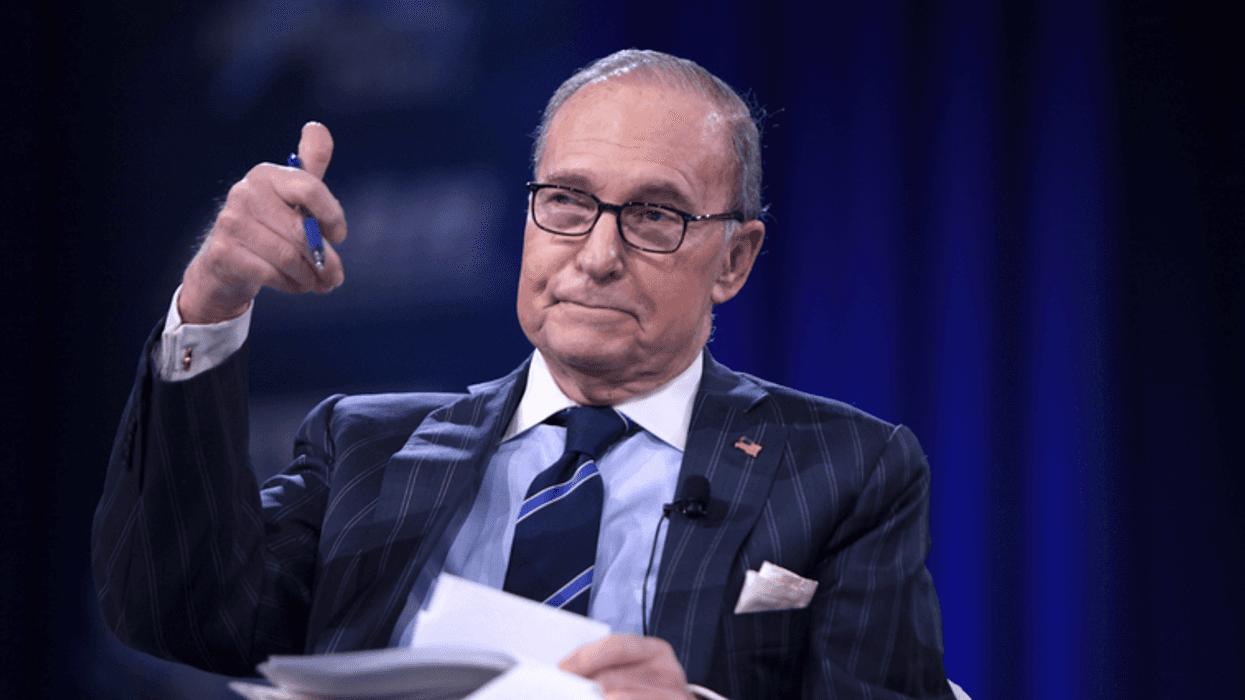
President Donald Trump and Larry Kudlow, the director of Trump's National Economic Council, aren't doctors, but they play them on TV. As the coronavirus epidemic spirals into a pandemic, causing a plunge in the U.S. stock market, Trump and Kudlow, a former CNBC TV host, are cynically spreading disinformation about the contagion.
"We have contained this. I won't say airtight, but it's pretty close to airtight," Larry Kudlow told CNBC Tuesday. Also on Tuesday, Trump tweeted, "Low Ratings Fake News MSDNC (Comcast) & @CNN are doing everything possible to make the Caronavirus (sic) look as bad as possible, including panicking markets ...USA in great shape!"
These statements directly contradicted a dire warning issued earlier that day by Dr. Nancy Messonnier, director of the National Center for Immunization and Respiratory Diseases. She said on a press call: "The global novel coronavirus situation is rapidly evolving and expanding...[meeting] two of the criteria of a pandemic. The world moves closer toward meeting the third criteria: worldwide spread of the new virus."
Referring to an outbreak in the U.S., Dr. Messonnier said, "It's not so much a question of if this will happen anymore but rather ... exactly when this will happen and how many people in this country will have severe illness."
As of Wednesday night, there were more than 82,000 confirmed cases of coronavirus infections globally, and 2,800 deaths, as reported by a team at Johns Hopkins University. Most of these cases were in China, but the virus has been detected on every continent save Antarctica, with deaths also reported in Iran, Italy, France, Japan, the Philippines, Taiwan, Hong Kong and aboard the Diamond Princess cruise ship, quarantined in Yokohama, Japan.
One of the most critical actions a government can take to prevent or to limit a pandemic is to clearly communicate accurate information to as wide a population as possible.
That is probably why Li Wenliang, a 34-year-old ophthalmologist at Wuhan Central Hospital, China, shared his observations on the outbreak as he was treating patients on Dec. 30. The Chinese government censored his posts, and he was ordered to a police station to sign a confession that he had made "untrue statements" on social media. At least seven others were similarly harassed. Days later, Li Wenliang became sick with coronavirus, and was hospitalized. He died on Feb. 6. His death sparked widespread criticism of the Chinese government for suppressing news of the epidemic's severity and for punishing a courageous whistleblower. The 47-year-old director of the Wuhan hospital died of the same viral infection not long after.
China mounted a massive response, building a 1,000-bed hospital in less than a week, and locked down Wuhan and other huge cities, quarantining up to 100 million people.
In the U.S., as the number of confirmed coronavirus cases increases, our preparedness, or lack thereof, is causing concern.
Pulitzer Prize winning science journalist Laurie Garrett recently reported in Foreign Policy, "In 2018, the Trump administration fired the government's entire pandemic response chain of command." Currently, no coherent structure exists in the U.S. to address a rapidly spreading, deadly pandemic. Instead, a hodgepodge of unqualified Trump loyalists are on the front line, with, thankfully, career professionals at the Centers for Disease Control and Prevention and National Institutes of Health trying their best to protect the public despite a dysfunctional White House.
At a Senate hearing Tuesday, Louisiana Republican Sen. John Kennedy seemed incredulous with acting Homeland Security Secretary Chad Wolf's lack of preparation. After grilling Wolf on respirators, infection rates, anticipated number of patients and more, Sen. Kennedy, exasperated, said: "Mr. Secretary, I'm going to stop here. You're supposed to keep us safe. And the American people deserve some straight answers on the coronavirus. And I'm not getting them from you."
At a Wednesday evening news conference, Trump again assured the public that everything was going to be fine, as long as people wash their hands and avoid touching doorknobs
He also announced that Vice President Mike Pence would coordinate the federal response, citing the "Indiana Model" of public health Pence implemented as governor. What experience was Trump touting?
Between 2011 and 2015, first as an Indiana congressmember then as the governor, Pence oversaw the defunding of Planned Parenthood, as well as the shutdown of needle exchange programs. After an outbreak of HIV infections, Pence was forced to back down. His moralistic prescriptions, canceling sensible, public health policies, caused lasting harm. What can we expect from him now?
Here's a message for Trump and his cronies: This is not about the stock market or your reelection; the coronavirus epidemic -- or pandemic -- demands a concerted, professional, fully funded global public health response.
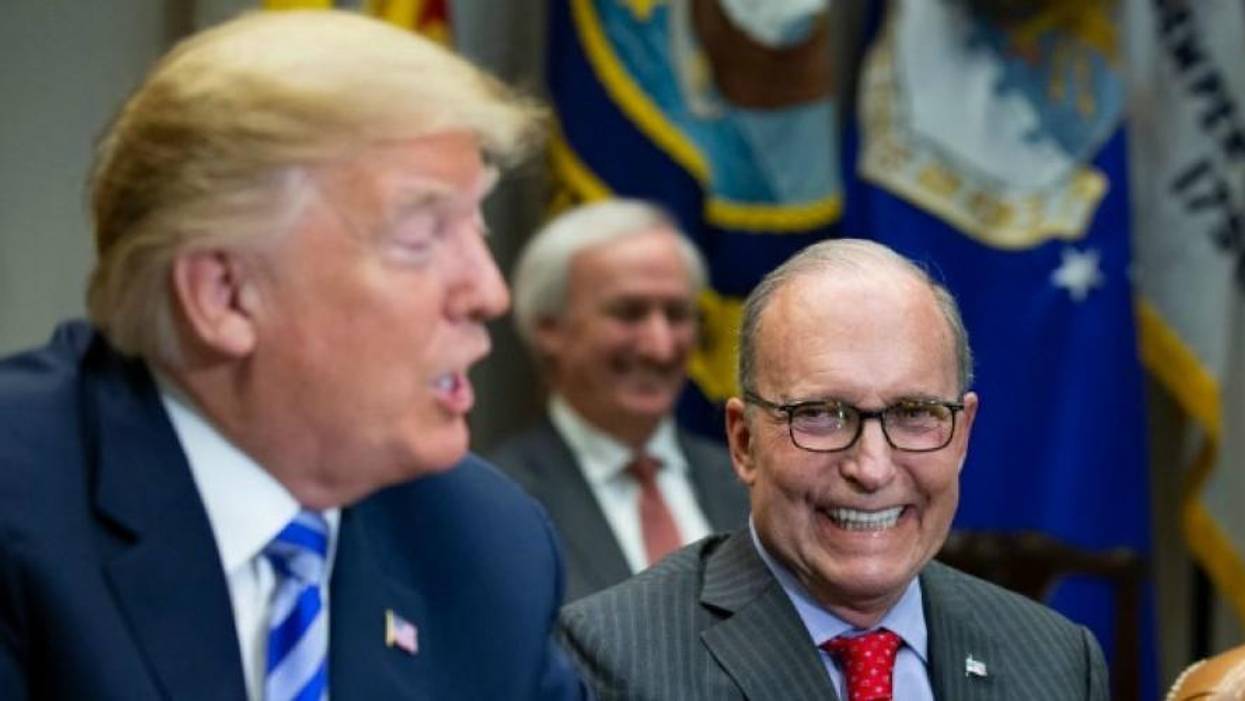
The Tax March movement responded critically on Friday after National Economic Council Director Larry Kudlow revealed that President Donald Trump has instructed him to unveil the second round of what opponents call the GOP "tax scam" ahead of the presidential election in November.
"Announcing an ambiguous set of so-called middle-class tax cuts just ahead of the November election is yet another political ploy."
--Maura Quint, Tax March
"Announcing an ambiguous set of so-called middle-class tax cuts just ahead of the November election is yet another political ploy," Tax March executive director Maura Quint declared in a statement.
"We know the truth: the first punch of the Trump tax scam brought higher taxes on working people to pay for the massive giveaways to billionaires and corporations," she said. "And now, to top it all off, Trump is trying to land a second punch to our pocketbooks. The only promise Trump is fulfilling with this second round of tax cuts is his commitment to enrich the rich at the expense of working people."
When Trump signed the Tax Cuts and Jobs Act (TCJA) into law in December 2017, he told reporters at the White House that "corporations are literally going wild over this, I think even beyond my expectations," shortly after touting the legislation as "a bill for the middle class."
The TCJA slashed the corporate tax rate from 35% to 21% and included various other permanent benefits for companies and wealthy Americans. Although the legislation also included tax cuts for families and individuals, those benefits are set to expire after 2025. "And once the individual tax rates revert to their former levels, a stingier inflation gauge would raise taxes for most households," CBS News noted in 2017.
Fox Business reported Friday that the next round of the administration's tax agenda is "a middle-class tax cut plan," and that Kudlow said the president recently told him to "get it out by September," just two months before Trump will face off with the Democratic Party's presidential nominee.
According to Fox Business:
"It'll come out sometime in September," Kudlow told Fox Business' Maria Bartiromo.
The administration, he said, will likely use the Office of Management and Budget Director Russell Vought's $1.4 trillion budget request to craft the package and make tax cuts permanent.
Kudlow said the administration plans to give the middle class a 10% tax cut in addition to strengthening and making permanent "some of the other tax cuts."
Chye-Ching Huang, senior director of economic policy at the Center on Budget and Policy Priorities, tweeted Friday that reporting on Kudlow's comments was "yet another occasion for a reminder that the 2017 tax law was costly, tilted to the top, and invites tax gaming by the wealthy."
Tax March's Quint said Friday that "if Trump had wanted to help the middle-class, he would have done so already. Instead, he continues to push tax giveaways to the wealthy and major corporations while also proposing massive cuts to services that everyday Americans pay into and depend upon."
As Common Dreams reported Monday, just two days after promising that the White House "will not be touching your Social Security or Medicare," Trump unveiled a budget blueprint for 2021 that calls for doing exactly that. Critics condemend the president's proposal to cut hundreds of billions of dollars from those and other programs as "savage" and "shameful."
In a floor speech this week, Sen. Sherrod Brown (D-Ohio) tied Trump's proposed safety net cuts to the administration's "tax scam" for corporations and the wealthy.
The Trump administration intensified its interference in politically-fractured Venezuela on Monday by announcing the seizure of billions of dollars in assets connected to the nation's state-owned oil company, a move critics decried as part of a "dangerous" U.S. policy to help opposition forces overthrow elected president Nicolas Maduro.
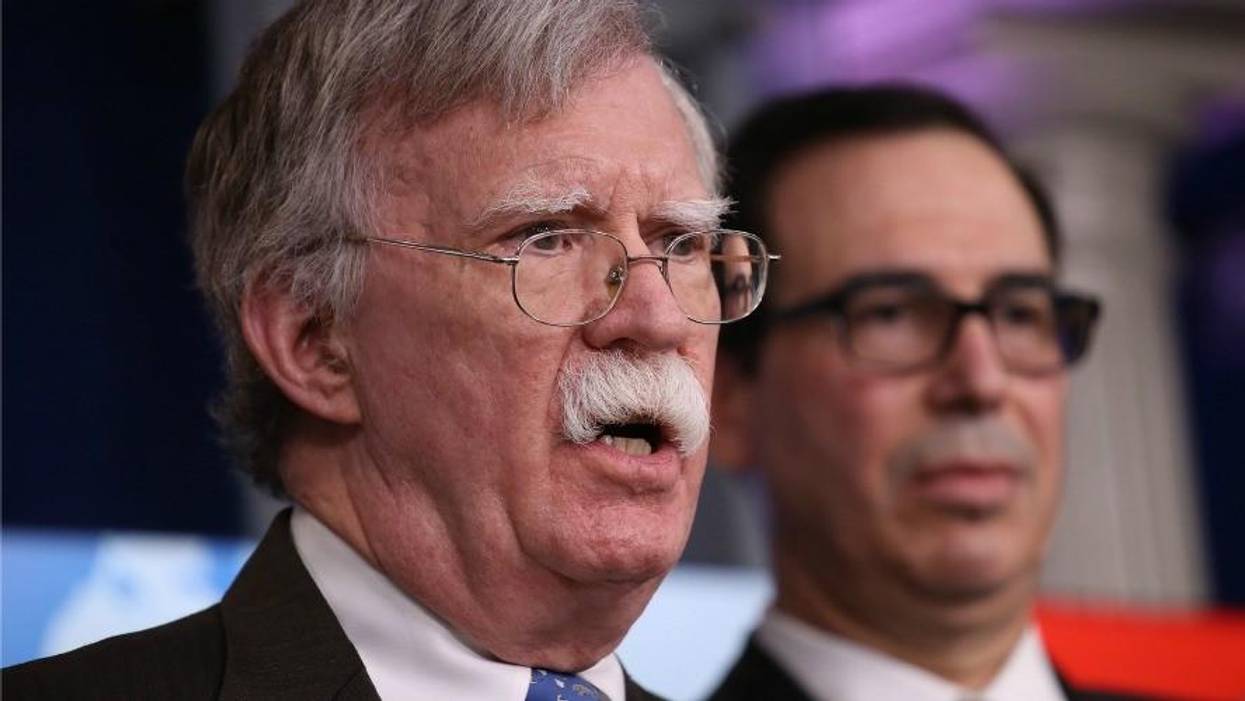
National Security Adviser John Bolton and Treasury Secretary Steven Mnuchin announced the sanctions imposed via executive order against Petroleos de Venezuela, S.A. (PdVSA)--a primary source of income and foreign currency for the country--at a White House press briefing on Monday afternoon. They were joined by Larry Kudlow, director of the National Economic Council.
Mnuchin vowed the United States "will continue to use all of our diplomatic and economic tools" to back Juan Guaido, who has declared himself Venezuela's "interim president." The secretary made clear that "the path to sanctions relief for PdVSA is through the expeditious transfer of control to the interim president or a subsequent, democratically elected government."
As CNBC reported:
Mnuchin said PDVSA has long been a vehicle for embezzlement and corruption by officials and businessmen. The sanctions will prevent the nation's oil wealth from being diverted to Maduro and will only be lifted when his regime hands control of PDVSA to a successor government, he added.
[...]
Under the sanctions, U.S. companies can continue to purchase Venezuelan oil, but the payments must be held in an account that cannot be accessed by the Maduro regime.
"If the people in Venezuela want to continue to sell us oil, as long as that money goes into blocked accounts, we'll continue to take it," Mnuchin said. "Otherwise we will not be buying it."
In addition to tightening economic restrictions on the Maduro government as a way to bolster the position of Guaido, Bolton also issued a fresh threat of military action by telling reporters in the White House briefing room that Trump "has made it clear that all options are on the table" when it comes to next possible steps.
"This is very dangerous," world-renowned economics professor and senior U.N. advisor Jeffrey D. Sachs warned on CNN Monday afternoon. He expressed concern that the administration's actions could cause immense suffering among the Venezuelan people, similar to the consequences endured by citizens of other countries subjected to U.S. interventions.
"The problem here is that these efforts by the United States to change other countries' governments often lead to catastrophe," Sachs noted, "as has happened all through the Middle East in recent years."
"Very often Washington says, 'Somebody must go,'" he continued. "And this is how our foreign policy often works--it's very arrogant [to say] who should rule in another country. By the way, Maduro is not a decent, pleasant man--but on the other hand, for Washington to just announce that a self-declared politician is the president, is kind of an American regime change tradition."
Keeping with that tradition, a Wall Street Journal report published last week revealed that Guaido's coup attempt has been highly coordinated with Trump administration officials and Republican lawmakers. A handful of other nations including Israel and Brazil are also backing Guaido, and in a speech before the U.N. Security Council on Saturday, U.S. Secretary of State Mike Pompeo urged others to follow suit.
Experts and a few progressive members of Congress, meanwhile, have acknowledged the economic and political crises in Venezuela but also demanded that the Trump administration refrain from intervening through military action or sanctions.
"Instead of a U.S.-led regime change, the two sides need to share power temporarily, until new elections, perhaps in 2021. It seems inconceivable, yet history shows this can be done," Sachs charged in a column for CNN on Sunday, citing Poland's transition to democracy in 1989 as an example. As he outlined:
Such a compromise would have Maduro remain as president, the military in effect hold the Ministries of Defense and Interior, and the opposition forces take over the civilian ministries, and the Central Bank of Venezuela. Guaido, or some other leader in the opposition camp, would serve in effect as a prime minister, leading the civilian cabinet, and guiding Venezuela's economic policies. Elections would be agreed upon for 2021 or 2022, perhaps under a semi-parliamentary system by that time.
"The U.S. instead appears to be aiming for regime change and tightening sanctions to bring Maduro to his knees," Sachs concluded. "Such an outcome is perhaps feasible, though it would leave a very bitter legacy. More likely, though, it would occasion further violence and an escalation of the economic crisis, possibly leading to war."
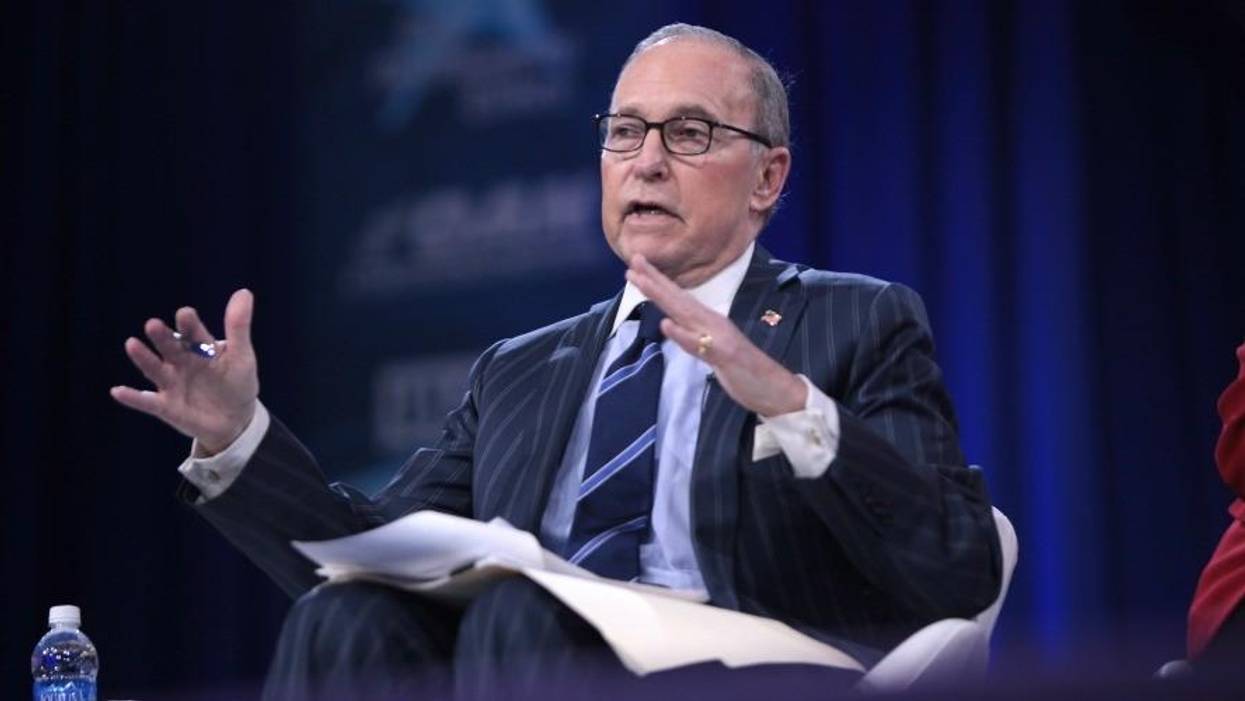
Despite mounting evidence to the contrary, White House economic adviser Larry Kudlow said Thursday that corporate tax cuts are the best way to lift low-income Americans out of poverty--not a federal minimum wage hike, which he denounced as "silly."
Kudlow, who heads the National Economic Council, told a crowd at a live event hosted by the Washington Post that the federal minimum wage overall--which was first introduced in 1938 as a way to alleviate the effects of the Great Depression on American families--is a "terrible idea" which damages small businesses' ability to operate.
"Vote, because this White House wants to abolish the minimum wage." --Working Families PartyThe president's top economic adviser also said that should Democrats win control of the House or Senate in the midterm elections, the White House would fight against any effort to raise the federal minimum wage.
Progressives and Democratic lawmakers immediately seized on the comments as the latest proof that President Donald Trump's policies and proposals endanger working families while propping up corporations and the wealthiest Americans--and urged voters to keep that in mind when they go to the polls on November 6.
" Donald Trump and his advisers believe in huge tax breaks for billionaires, but when it comes to raising wages for workers they actually want to abolish the minimum wage," Sen. Bernie Sanders (I-Vt.) said in a statement following Kudlow's remarks. "Too many Americans today are forced to work two or three jobs to survive. That's wrong. If you work 40 hours a week, you should not live in poverty. We must raise the federal minimum wage to a living wage, $15 an hour."
The federal minimum wage has stood at $7.25 per hour--just over $16,000 per year--for nearly a decade. According to the National Low Income Housing Coalition, an employee earning the minimum wage would be unable to afford to rent a small two-bedroom apartment in any state in the nation.
While Kudlow suggested that corporate tax cuts are the most effective way to help working families, nearly a year after the passage of the Republican tax plan, that theory has been proven to be demonstrably false. According to the Tax Policy Center, 83 percent of the $1.5 trillion plan's benefits went to the wealthy, and only 4.3 percent of American workers were expected to see those benefits down to them in the form of raises or substantial bonuses according to Americans for Tax Fairness.
Kudlow also said that a federal minimum wage did not make sense for a country in which the cost of living varies from state-to-state.
"Idaho is different than New York. Alabama is different than Nebraska. That's why the federal minimum wage doesn't work for me," Kudlow said. The comment drew criticism from advocates for a $15 minimum wage--who believe that cost-of-living disparities mean that that minimum wage in more expensive states should be far higher than those in states with cheaper housing, to allow workers to support themselves and their families.
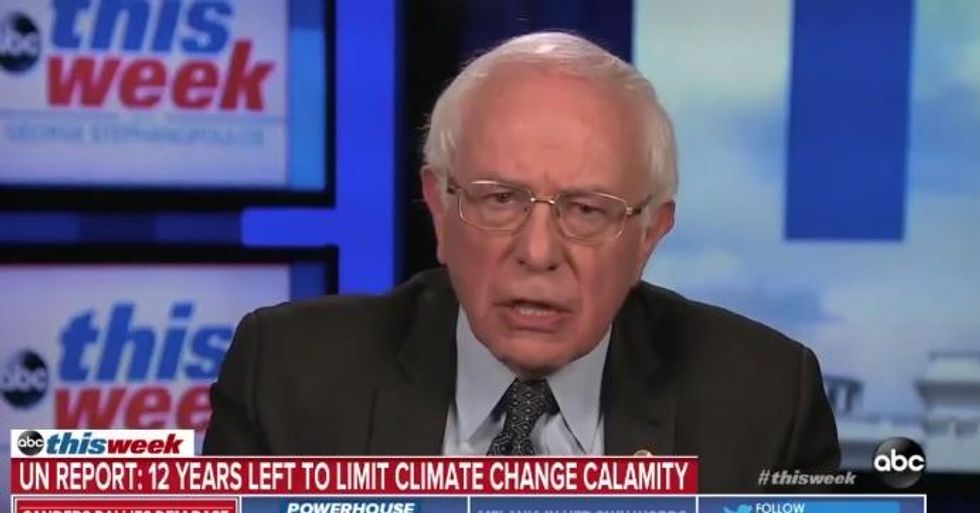
Appearing on ABC's "This Week" on Sunday just moments after President Donald Trump's chief economic adviser and noted Wall Street stooge Larry Kudlow dismissed a new United Nations climate report showing that the world must cut carbon emissions in half by 2030 to avert global catastrophe, Sen. Bernie Sanders (I-Vt.) denounced the White House for its "dangerous" rejection of climate science and slammed Trump for working hand-in-hand with Big Oil to make "a bad situation worse."
"The comments a moment ago that Larry Kudlow made are so irresponsible, so dangerous that it's just hard to believe that a leading government official could make them," Sanders told host George Stephanopoulos after Kudlow--a fervent climate denier--accused the U.N. of overestimating the severity of the climate crisis.
"What the Intergovernmental Panel on Climate Change (IPCC) said is that we have 12 years--12 years to substantially cut the amount of carbon in our atmosphere or this planet, our country, the rest of the world, is going to suffer irreversible damage," the Vermont senator continued. "We are in crisis mode and you have an administration that virtually does not even recognize the reality of climate change and their policies, working with the fossil fuel industry, are making a bad situation worse."
Watch:
Far from taking even the smallest steps toward mitigating carbon emissions and developing a clean energy system that is necessary to avert planetary catastrophe, Trump has worked relentlessly during his first two years in office to free massive oil and gas companies to unleash dangerous pollutants at home while undermining international efforts to confront the climate crisis.
Asked about the IPCC's dire assessment of the next several decades if immediate, ambitious, and systemic action is not taken to drastically reduce carbon emissions, Trump appeared to indicate that he has never heard of the IPCC.
"It was given to me and I want to look at who drew it," Trump told reporters. "You know, which group drew it, because I can give you reports that are fabulous and I can give you reports that aren't so good."
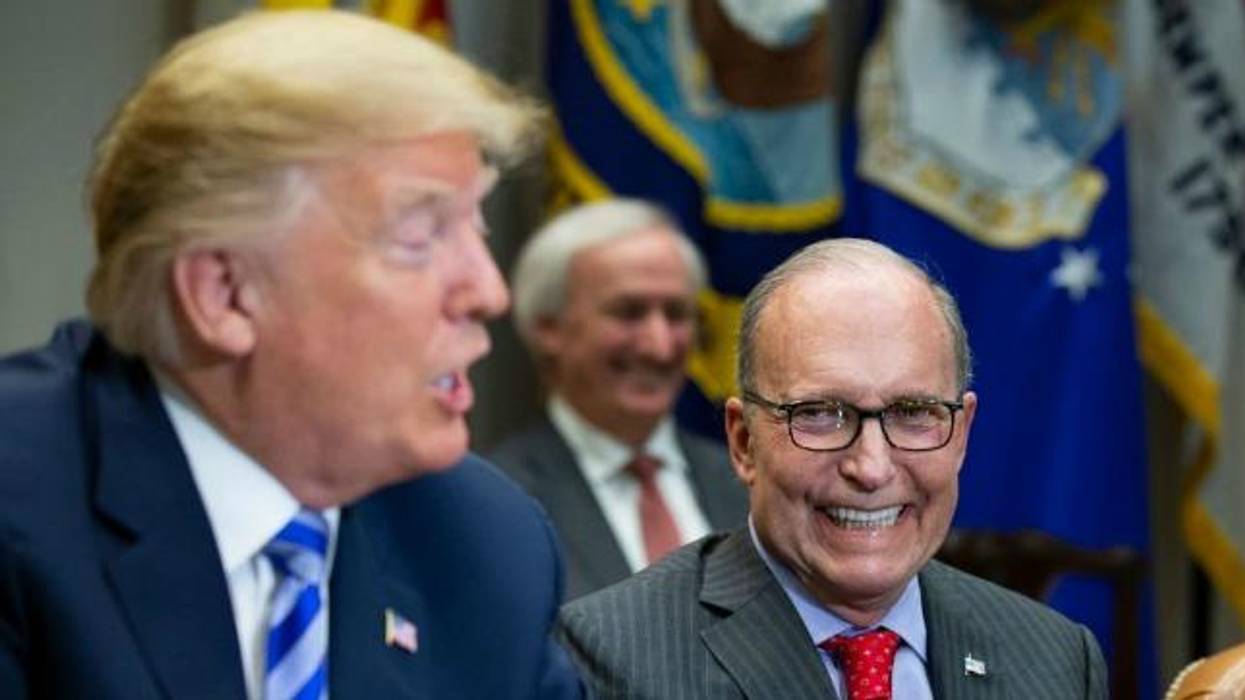
As the GOP plows ahead with another round of budget-exploding tax cuts for the rich just before the crucial 2018 midterms, President Donald Trump's top economic adviser and former television personality Larry Kudlow confirmed on Monday that the White House will push for cuts to life-saving safety net programs like Medicare and Social Security if the GOP retains control of Congress in November.
"Believe them when they say they are coming after Medicare and Social Security. This election is the last chance to stop them."
--Topher Spiro, Center for American Progress"We have to be tougher on spending," Kudlow, the director of the National Economic Council, declared in remarks to the Economic Club of New York.
Asked when Social Security and Medicare will be targeted for "reforms"--which, as one advocacy group noted, is "code for massive cuts"--Kudlow said, "Everyone will look at that--probably next year."
"Believe them when they say they are coming after Medicare and Social Security," Topher Spiro, senior fellow at the Center for American Progress, wrote on Twitter in response to Kudlow's comments. "This election is the last chance to stop them."
In the months since Trump signed into law the GOP's initial $1.5 trillion in tax cuts for the rich, progressives have been warning that the White House and Republicans would attempt to use the resulting deficit explosion as a justification to slash popular programs like Medicare, Medicaid, and Social Security.
Kudlow's comments represent the latest admission that this is precisely the GOP's plan of action if they are able to keep control of Congress in November.
"This is wholly unacceptable: Republicans giving huge tax breaks to the rich and now coming after the vital programs that millions of Americans rely upon," the progressive coalition Tax March declared in a tweet on Monday. "We won't allow it."
Republicans have long placed obliterating the safety net near the top of their party's list of priorities, but their attack on key public programs will likely take on even more intensity if they ram through Tax Scam 2.0, which experts say could cost an additional $3 trillion over ten years.
"For weeks, Republicans have been misleading the American public--the truth is they have been trying to cut Medicare for years," the advocacy group Protect Our Care noted. "Today, Larry Kudlow, Director of the National Economic Council, confirmed that they still have their sights set on Americans' care.
Despite Trump's insistence on the campaign trail that he would not go after Medicare, Medicaid, and Social Security, the president's "morally bankrupt" 2019 budget proposal released earlier this year called for $1.7 trillion in cuts to safety net programs--including hundreds of billions in cuts to the very programs he vowed to shield.