SUBSCRIBE TO OUR FREE NEWSLETTER
Daily news & progressive opinion—funded by the people, not the corporations—delivered straight to your inbox.
5
#000000
#FFFFFF
To donate by check, phone, or other method, see our More Ways to Give page.
Daily news & progressive opinion—funded by the people, not the corporations—delivered straight to your inbox.
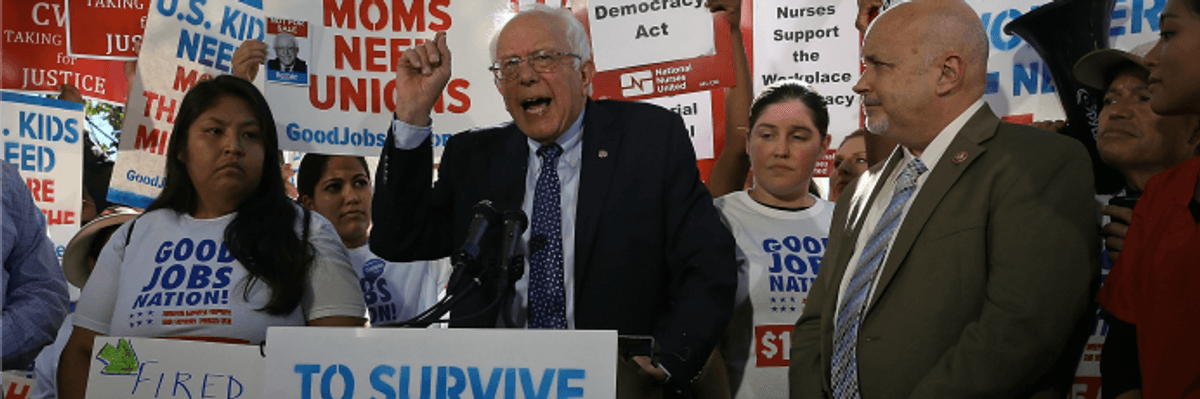
Sen. Bernie Sanders (I-Vt.) speaks during a news conference on better wages for workers, on Capitol Hill in Washington, D.C. (Photo: Mark Wilson/Getty Images)
Just weeks after the progressive duo's pressure campaign against Amazon forced the online retail giant to hike its minimum wage to $15 an hour, Sen. Bernie Sanders (I-Vt.) and Rep. Ro Khanna (D-Calif.) on Thursday will set their sights on America's largest private employer and other massive companies by introducing the "Stop Walmart Act" (pdf), a bill that would ban corporate giants from buying back their own stock if they don't pay workers $15 an hour plus benefits.
"While Walmart claims it cannot afford to pay its workers $15 an hour, it was able to find enough money to pay its CEO more than $22 million last year."
--Sen. Bernie Sanders
In a statement, Sanders declared that the Walton family--the owners of Walmart and the wealthiest family in the United States--"must pay its workers a living wage, and the Stop Walmart Act will do just that."
"Most Walmart retail workers are working for horrendously low wages with minimal benefits," the Vermont senator said. "Amazon did the right thing by raising their minimum wage to $15 an hour. Walmart can and must do the same."
While named after Walmart--which has long been notorious for its low pay and poor working conditions--Sanders and Khanna's legislation takes aim at all companies with over 500 employees, many of which are currently on a record-shattering stock buyback spree thanks to President Donald Trump's $1.5 trillion in tax cuts.
As the Washington Post reports, the Stop Walmart Act "would bar big corporations from buying their own stock--a move that rewards shareholders--unless they pay all employees $15 an hour, provide them seven days of sick leave, and prevent CEO compensation from rising more than 150 times above median employee pay."
Given that the starting wage for Walmart employees is currently just $11 an hour--which translates to $19,000 a year, an income below the federal poverty line for a family of three--Sanders and Khanna's legislation would be enormously beneficial for millions of workers at little cost to the immensely profitable retail giant and its owners.
Speaking to the Post on Wednesday, Ken Jacobs, chair of the University of California at Berkeley Labor Center, estimated that lifting the starting wage of all employees to at least $15 an hour would cost Walmart $3.8 billion--a tiny fraction of the company's nearly $500 billion in annual revenue.
"Overall, the cost to Walmart of doing this would be a tiny, tiny fraction of their revenues, while its impact on workers' lives would be huge."
--Lenore Palladino, Roosevelt Institute
It is also just a fraction of the $20 billion in stock buybacks Walmart announced last year.
"Overall, the cost to Walmart of doing this would be a tiny, tiny fraction of their revenues, while its impact on workers' lives would be huge," Jacobs said.
In a blog post on Wednesday, Lenore Palladino, senior economist and policy counsel at the Roosevelt Institute, applauded the Stop Walmart Act as a necessary step toward curtailing the ever-growing gulf between executive and worker pay.
"Walmart still pays its employees a starting wage of $11 dollars per hour--a wage that company executives think is fair. Never mind that the Walmart family is the wealthiest family in the country, and that the six heirs of the Walton empire own more wealth than 40 percent of Americans," Palladino notes. "They also comprise the majority of the company's shareholders, sit on the board of directors, and, in part, decide how much Walmart spends on its stock buybacks program."
"While Congress should ultimately pass legislation that would end the practice of stock buybacks entirely," Palladino concluded, "bills like the Stop Walmart Act that continue to highlight the link between rewarding shareholders and wages that aren't keeping up are an important and needed step. Reversing decades of rising economic inequality depends on it."
Dear Common Dreams reader, It’s been nearly 30 years since I co-founded Common Dreams with my late wife, Lina Newhouser. We had the radical notion that journalism should serve the public good, not corporate profits. It was clear to us from the outset what it would take to build such a project. No paid advertisements. No corporate sponsors. No millionaire publisher telling us what to think or do. Many people said we wouldn't last a year, but we proved those doubters wrong. Together with a tremendous team of journalists and dedicated staff, we built an independent media outlet free from the constraints of profits and corporate control. Our mission has always been simple: To inform. To inspire. To ignite change for the common good. Building Common Dreams was not easy. Our survival was never guaranteed. When you take on the most powerful forces—Wall Street greed, fossil fuel industry destruction, Big Tech lobbyists, and uber-rich oligarchs who have spent billions upon billions rigging the economy and democracy in their favor—the only bulwark you have is supporters who believe in your work. But here’s the urgent message from me today. It's never been this bad out there. And it's never been this hard to keep us going. At the very moment Common Dreams is most needed, the threats we face are intensifying. We need your support now more than ever. We don't accept corporate advertising and never will. We don't have a paywall because we don't think people should be blocked from critical news based on their ability to pay. Everything we do is funded by the donations of readers like you. When everyone does the little they can afford, we are strong. But if that support retreats or dries up, so do we. Will you donate now to make sure Common Dreams not only survives but thrives? —Craig Brown, Co-founder |
Just weeks after the progressive duo's pressure campaign against Amazon forced the online retail giant to hike its minimum wage to $15 an hour, Sen. Bernie Sanders (I-Vt.) and Rep. Ro Khanna (D-Calif.) on Thursday will set their sights on America's largest private employer and other massive companies by introducing the "Stop Walmart Act" (pdf), a bill that would ban corporate giants from buying back their own stock if they don't pay workers $15 an hour plus benefits.
"While Walmart claims it cannot afford to pay its workers $15 an hour, it was able to find enough money to pay its CEO more than $22 million last year."
--Sen. Bernie Sanders
In a statement, Sanders declared that the Walton family--the owners of Walmart and the wealthiest family in the United States--"must pay its workers a living wage, and the Stop Walmart Act will do just that."
"Most Walmart retail workers are working for horrendously low wages with minimal benefits," the Vermont senator said. "Amazon did the right thing by raising their minimum wage to $15 an hour. Walmart can and must do the same."
While named after Walmart--which has long been notorious for its low pay and poor working conditions--Sanders and Khanna's legislation takes aim at all companies with over 500 employees, many of which are currently on a record-shattering stock buyback spree thanks to President Donald Trump's $1.5 trillion in tax cuts.
As the Washington Post reports, the Stop Walmart Act "would bar big corporations from buying their own stock--a move that rewards shareholders--unless they pay all employees $15 an hour, provide them seven days of sick leave, and prevent CEO compensation from rising more than 150 times above median employee pay."
Given that the starting wage for Walmart employees is currently just $11 an hour--which translates to $19,000 a year, an income below the federal poverty line for a family of three--Sanders and Khanna's legislation would be enormously beneficial for millions of workers at little cost to the immensely profitable retail giant and its owners.
Speaking to the Post on Wednesday, Ken Jacobs, chair of the University of California at Berkeley Labor Center, estimated that lifting the starting wage of all employees to at least $15 an hour would cost Walmart $3.8 billion--a tiny fraction of the company's nearly $500 billion in annual revenue.
"Overall, the cost to Walmart of doing this would be a tiny, tiny fraction of their revenues, while its impact on workers' lives would be huge."
--Lenore Palladino, Roosevelt Institute
It is also just a fraction of the $20 billion in stock buybacks Walmart announced last year.
"Overall, the cost to Walmart of doing this would be a tiny, tiny fraction of their revenues, while its impact on workers' lives would be huge," Jacobs said.
In a blog post on Wednesday, Lenore Palladino, senior economist and policy counsel at the Roosevelt Institute, applauded the Stop Walmart Act as a necessary step toward curtailing the ever-growing gulf between executive and worker pay.
"Walmart still pays its employees a starting wage of $11 dollars per hour--a wage that company executives think is fair. Never mind that the Walmart family is the wealthiest family in the country, and that the six heirs of the Walton empire own more wealth than 40 percent of Americans," Palladino notes. "They also comprise the majority of the company's shareholders, sit on the board of directors, and, in part, decide how much Walmart spends on its stock buybacks program."
"While Congress should ultimately pass legislation that would end the practice of stock buybacks entirely," Palladino concluded, "bills like the Stop Walmart Act that continue to highlight the link between rewarding shareholders and wages that aren't keeping up are an important and needed step. Reversing decades of rising economic inequality depends on it."
Just weeks after the progressive duo's pressure campaign against Amazon forced the online retail giant to hike its minimum wage to $15 an hour, Sen. Bernie Sanders (I-Vt.) and Rep. Ro Khanna (D-Calif.) on Thursday will set their sights on America's largest private employer and other massive companies by introducing the "Stop Walmart Act" (pdf), a bill that would ban corporate giants from buying back their own stock if they don't pay workers $15 an hour plus benefits.
"While Walmart claims it cannot afford to pay its workers $15 an hour, it was able to find enough money to pay its CEO more than $22 million last year."
--Sen. Bernie Sanders
In a statement, Sanders declared that the Walton family--the owners of Walmart and the wealthiest family in the United States--"must pay its workers a living wage, and the Stop Walmart Act will do just that."
"Most Walmart retail workers are working for horrendously low wages with minimal benefits," the Vermont senator said. "Amazon did the right thing by raising their minimum wage to $15 an hour. Walmart can and must do the same."
While named after Walmart--which has long been notorious for its low pay and poor working conditions--Sanders and Khanna's legislation takes aim at all companies with over 500 employees, many of which are currently on a record-shattering stock buyback spree thanks to President Donald Trump's $1.5 trillion in tax cuts.
As the Washington Post reports, the Stop Walmart Act "would bar big corporations from buying their own stock--a move that rewards shareholders--unless they pay all employees $15 an hour, provide them seven days of sick leave, and prevent CEO compensation from rising more than 150 times above median employee pay."
Given that the starting wage for Walmart employees is currently just $11 an hour--which translates to $19,000 a year, an income below the federal poverty line for a family of three--Sanders and Khanna's legislation would be enormously beneficial for millions of workers at little cost to the immensely profitable retail giant and its owners.
Speaking to the Post on Wednesday, Ken Jacobs, chair of the University of California at Berkeley Labor Center, estimated that lifting the starting wage of all employees to at least $15 an hour would cost Walmart $3.8 billion--a tiny fraction of the company's nearly $500 billion in annual revenue.
"Overall, the cost to Walmart of doing this would be a tiny, tiny fraction of their revenues, while its impact on workers' lives would be huge."
--Lenore Palladino, Roosevelt Institute
It is also just a fraction of the $20 billion in stock buybacks Walmart announced last year.
"Overall, the cost to Walmart of doing this would be a tiny, tiny fraction of their revenues, while its impact on workers' lives would be huge," Jacobs said.
In a blog post on Wednesday, Lenore Palladino, senior economist and policy counsel at the Roosevelt Institute, applauded the Stop Walmart Act as a necessary step toward curtailing the ever-growing gulf between executive and worker pay.
"Walmart still pays its employees a starting wage of $11 dollars per hour--a wage that company executives think is fair. Never mind that the Walmart family is the wealthiest family in the country, and that the six heirs of the Walton empire own more wealth than 40 percent of Americans," Palladino notes. "They also comprise the majority of the company's shareholders, sit on the board of directors, and, in part, decide how much Walmart spends on its stock buybacks program."
"While Congress should ultimately pass legislation that would end the practice of stock buybacks entirely," Palladino concluded, "bills like the Stop Walmart Act that continue to highlight the link between rewarding shareholders and wages that aren't keeping up are an important and needed step. Reversing decades of rising economic inequality depends on it."