

SUBSCRIBE TO OUR FREE NEWSLETTER
Daily news & progressive opinion—funded by the people, not the corporations—delivered straight to your inbox.
5
#000000
#FFFFFF
To donate by check, phone, or other method, see our More Ways to Give page.
Daily news & progressive opinion—funded by the people, not the corporations—delivered straight to your inbox.
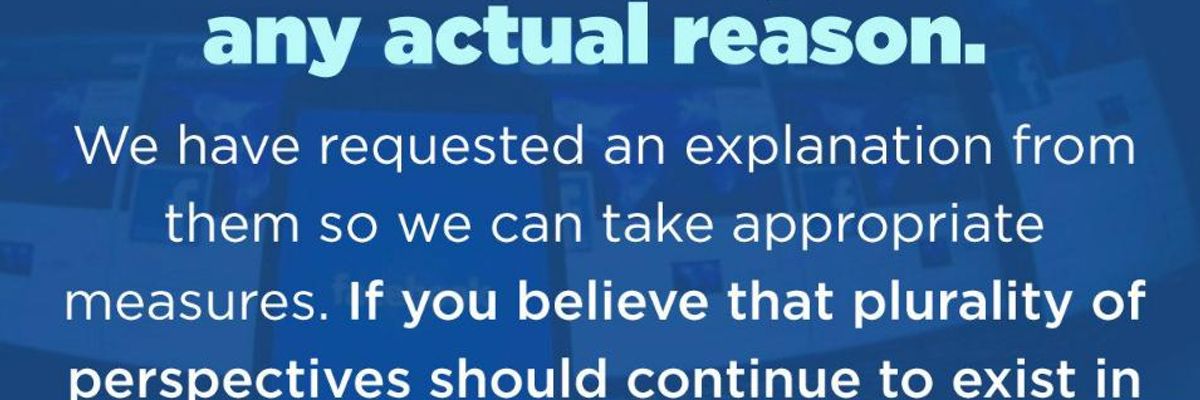
For the second time this year, Facebook removed TeleSUR English's page without an explanation beyond claiming the media network had violated the platform's terms of service. (Photo: TeleSUREnglish/Twitter)
For the second time this year, Facebook has suspended teleSUR English's page, claiming the left-leaning Latin American news network violated the social media platform's terms of service without any further explanation--a move that provoked outrage and concern among journalists, free speech advocates, and Big Tech critics.
In a short article posted on teleSUR's website on Monday, the regional news network--which is based in Venezuela but also has received funding from Argentina, Bolivia, Cuba, Ecuador, and Nicaragua--explained:
teleSUR English's page has been removed from Facebook for the second time this year without any specific reason being provided. It should be noted that the first time this occurred back in January 2018, Facebook did NOT provide any explanation in spite of our best efforts to understand their rationale. This is an alarming development in light of the recent shutting down of pages that don't fit a mainstream narrative.
According to the outlet, "the only communication" teleSUR has received from Facebook is the following message:
Your Page "teleSUR English" has been removed for violating our Terms of Use. A Facebook Page is a distinct presence used solely for business or promotional purposes. Among other things, Pages that are hateful, threatening or obscene are not allowed. We also take down Pages that attack an individual or group, or that are set up by an unauthorized individual. If your Page was removed for any of the above reasons, it will not be reinstated. Continued misuse of Facebook's features could result in the permanent loss of your account.
The network has turned to Twitter to raise awareness about Facebook's move, tweeting with the hashtag #BringBackteleSUREnglish:
Max Blumenthal, editor of The Grayzone Project, called Facebook's decision "deeply disturbing." He also noted that the platform recently banned Venezuelanalysis.com, which like teleSUR offers a leftist perspective on Latin America, and raised alarm about Facebook's work with the Digital Forensic Research Lab, a project of the Atlantic Council, a NATO-backed, D.C.-based think tank:
After Facebook banned Venezuelanalysis.com, Blumenthal shared his concerns on Aaron Mate's podcast for The Real News:
Venezuelanalysis.com, for its part on Tuesday, offered solidarity to teleSUR against Facebook's "repressive actions," tweeting:
Comedian and activist Lee Camp, who hosts a comedy news show on RT America--a Russian government-funded, D.C.-based television news network that has been harshly ridiculed (pdf) by the U.S. intelligence community--praised teleSUR as "one of the best online resources for debunking Western propaganda about Venezuela."
Sameera Khan, a correspondent for RT America, praised teleSUR's coverage of the Pakistani elections, and also raised alarm about Facebook's partnership with the Atlantic Council:
Glenn Greenwald connected the incident to the broader issue of urging social media companies to censor users, pointing to The Intercept's reporting on other instances of platforms silencing leftist voices:
Facebook's decision to suspend teleSUR comes after Facebook, Apple, Google-owned YouTube, and Spotify banned right-wing radio show host and conspiracy theorist Alex Jones. While the bans on Jones were welcomed by many, free speech advocates such as the digital rights group Electronic Frontier Foundation (EFF) urged caution, pointing to the other voices that have been--or could be in the future--silenced by increasingly powerful social media and online platforms.
"We should be extremely careful before rushing to embrace an Internet that is moderated by a few private companies by default, one where the platforms that control so much public discourse routinely remove posts and deactivate accounts because of objections to the content," EFF senior staff attorney David Greene wrote for The Washington Post Monday.
"The power that these platforms have over the online public sphere should worry all of us, no matter whether we agree or disagree with a given content decision," Greene added. "We must demand that they apply their rules consistently and provide clear, accessible avenues for meaningful appeal."
Dear Common Dreams reader, It’s been nearly 30 years since I co-founded Common Dreams with my late wife, Lina Newhouser. We had the radical notion that journalism should serve the public good, not corporate profits. It was clear to us from the outset what it would take to build such a project. No paid advertisements. No corporate sponsors. No millionaire publisher telling us what to think or do. Many people said we wouldn't last a year, but we proved those doubters wrong. Together with a tremendous team of journalists and dedicated staff, we built an independent media outlet free from the constraints of profits and corporate control. Our mission has always been simple: To inform. To inspire. To ignite change for the common good. Building Common Dreams was not easy. Our survival was never guaranteed. When you take on the most powerful forces—Wall Street greed, fossil fuel industry destruction, Big Tech lobbyists, and uber-rich oligarchs who have spent billions upon billions rigging the economy and democracy in their favor—the only bulwark you have is supporters who believe in your work. But here’s the urgent message from me today. It's never been this bad out there. And it's never been this hard to keep us going. At the very moment Common Dreams is most needed, the threats we face are intensifying. We need your support now more than ever. We don't accept corporate advertising and never will. We don't have a paywall because we don't think people should be blocked from critical news based on their ability to pay. Everything we do is funded by the donations of readers like you. When everyone does the little they can afford, we are strong. But if that support retreats or dries up, so do we. Will you donate now to make sure Common Dreams not only survives but thrives? —Craig Brown, Co-founder |
For the second time this year, Facebook has suspended teleSUR English's page, claiming the left-leaning Latin American news network violated the social media platform's terms of service without any further explanation--a move that provoked outrage and concern among journalists, free speech advocates, and Big Tech critics.
In a short article posted on teleSUR's website on Monday, the regional news network--which is based in Venezuela but also has received funding from Argentina, Bolivia, Cuba, Ecuador, and Nicaragua--explained:
teleSUR English's page has been removed from Facebook for the second time this year without any specific reason being provided. It should be noted that the first time this occurred back in January 2018, Facebook did NOT provide any explanation in spite of our best efforts to understand their rationale. This is an alarming development in light of the recent shutting down of pages that don't fit a mainstream narrative.
According to the outlet, "the only communication" teleSUR has received from Facebook is the following message:
Your Page "teleSUR English" has been removed for violating our Terms of Use. A Facebook Page is a distinct presence used solely for business or promotional purposes. Among other things, Pages that are hateful, threatening or obscene are not allowed. We also take down Pages that attack an individual or group, or that are set up by an unauthorized individual. If your Page was removed for any of the above reasons, it will not be reinstated. Continued misuse of Facebook's features could result in the permanent loss of your account.
The network has turned to Twitter to raise awareness about Facebook's move, tweeting with the hashtag #BringBackteleSUREnglish:
Max Blumenthal, editor of The Grayzone Project, called Facebook's decision "deeply disturbing." He also noted that the platform recently banned Venezuelanalysis.com, which like teleSUR offers a leftist perspective on Latin America, and raised alarm about Facebook's work with the Digital Forensic Research Lab, a project of the Atlantic Council, a NATO-backed, D.C.-based think tank:
After Facebook banned Venezuelanalysis.com, Blumenthal shared his concerns on Aaron Mate's podcast for The Real News:
Venezuelanalysis.com, for its part on Tuesday, offered solidarity to teleSUR against Facebook's "repressive actions," tweeting:
Comedian and activist Lee Camp, who hosts a comedy news show on RT America--a Russian government-funded, D.C.-based television news network that has been harshly ridiculed (pdf) by the U.S. intelligence community--praised teleSUR as "one of the best online resources for debunking Western propaganda about Venezuela."
Sameera Khan, a correspondent for RT America, praised teleSUR's coverage of the Pakistani elections, and also raised alarm about Facebook's partnership with the Atlantic Council:
Glenn Greenwald connected the incident to the broader issue of urging social media companies to censor users, pointing to The Intercept's reporting on other instances of platforms silencing leftist voices:
Facebook's decision to suspend teleSUR comes after Facebook, Apple, Google-owned YouTube, and Spotify banned right-wing radio show host and conspiracy theorist Alex Jones. While the bans on Jones were welcomed by many, free speech advocates such as the digital rights group Electronic Frontier Foundation (EFF) urged caution, pointing to the other voices that have been--or could be in the future--silenced by increasingly powerful social media and online platforms.
"We should be extremely careful before rushing to embrace an Internet that is moderated by a few private companies by default, one where the platforms that control so much public discourse routinely remove posts and deactivate accounts because of objections to the content," EFF senior staff attorney David Greene wrote for The Washington Post Monday.
"The power that these platforms have over the online public sphere should worry all of us, no matter whether we agree or disagree with a given content decision," Greene added. "We must demand that they apply their rules consistently and provide clear, accessible avenues for meaningful appeal."
For the second time this year, Facebook has suspended teleSUR English's page, claiming the left-leaning Latin American news network violated the social media platform's terms of service without any further explanation--a move that provoked outrage and concern among journalists, free speech advocates, and Big Tech critics.
In a short article posted on teleSUR's website on Monday, the regional news network--which is based in Venezuela but also has received funding from Argentina, Bolivia, Cuba, Ecuador, and Nicaragua--explained:
teleSUR English's page has been removed from Facebook for the second time this year without any specific reason being provided. It should be noted that the first time this occurred back in January 2018, Facebook did NOT provide any explanation in spite of our best efforts to understand their rationale. This is an alarming development in light of the recent shutting down of pages that don't fit a mainstream narrative.
According to the outlet, "the only communication" teleSUR has received from Facebook is the following message:
Your Page "teleSUR English" has been removed for violating our Terms of Use. A Facebook Page is a distinct presence used solely for business or promotional purposes. Among other things, Pages that are hateful, threatening or obscene are not allowed. We also take down Pages that attack an individual or group, or that are set up by an unauthorized individual. If your Page was removed for any of the above reasons, it will not be reinstated. Continued misuse of Facebook's features could result in the permanent loss of your account.
The network has turned to Twitter to raise awareness about Facebook's move, tweeting with the hashtag #BringBackteleSUREnglish:
Max Blumenthal, editor of The Grayzone Project, called Facebook's decision "deeply disturbing." He also noted that the platform recently banned Venezuelanalysis.com, which like teleSUR offers a leftist perspective on Latin America, and raised alarm about Facebook's work with the Digital Forensic Research Lab, a project of the Atlantic Council, a NATO-backed, D.C.-based think tank:
After Facebook banned Venezuelanalysis.com, Blumenthal shared his concerns on Aaron Mate's podcast for The Real News:
Venezuelanalysis.com, for its part on Tuesday, offered solidarity to teleSUR against Facebook's "repressive actions," tweeting:
Comedian and activist Lee Camp, who hosts a comedy news show on RT America--a Russian government-funded, D.C.-based television news network that has been harshly ridiculed (pdf) by the U.S. intelligence community--praised teleSUR as "one of the best online resources for debunking Western propaganda about Venezuela."
Sameera Khan, a correspondent for RT America, praised teleSUR's coverage of the Pakistani elections, and also raised alarm about Facebook's partnership with the Atlantic Council:
Glenn Greenwald connected the incident to the broader issue of urging social media companies to censor users, pointing to The Intercept's reporting on other instances of platforms silencing leftist voices:
Facebook's decision to suspend teleSUR comes after Facebook, Apple, Google-owned YouTube, and Spotify banned right-wing radio show host and conspiracy theorist Alex Jones. While the bans on Jones were welcomed by many, free speech advocates such as the digital rights group Electronic Frontier Foundation (EFF) urged caution, pointing to the other voices that have been--or could be in the future--silenced by increasingly powerful social media and online platforms.
"We should be extremely careful before rushing to embrace an Internet that is moderated by a few private companies by default, one where the platforms that control so much public discourse routinely remove posts and deactivate accounts because of objections to the content," EFF senior staff attorney David Greene wrote for The Washington Post Monday.
"The power that these platforms have over the online public sphere should worry all of us, no matter whether we agree or disagree with a given content decision," Greene added. "We must demand that they apply their rules consistently and provide clear, accessible avenues for meaningful appeal."

