SUBSCRIBE TO OUR FREE NEWSLETTER
Daily news & progressive opinion—funded by the people, not the corporations—delivered straight to your inbox.
5
#000000
#FFFFFF
To donate by check, phone, or other method, see our More Ways to Give page.
Daily news & progressive opinion—funded by the people, not the corporations—delivered straight to your inbox.
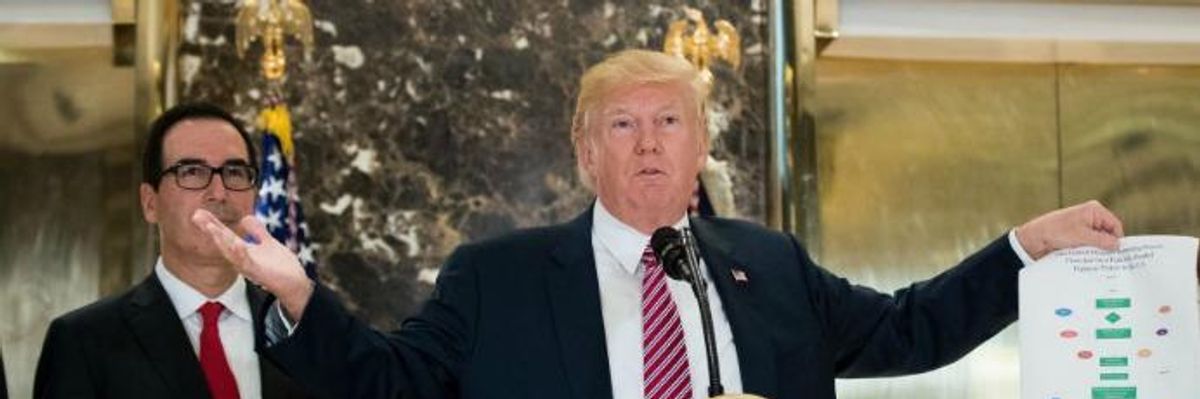
Flanked by (L to R) Treasury Secretary Steve Mnuchin, President Donald Trump holds up a dederal decision permitting-process flowchart for federally funded highway projects in the United States' while speaking following a meeting on infrastructure at Trump Tower, August 15, 2017 in New York City. (Photo: Drew Angerer/Getty Images)
As Wall Street banks continue to enjoy record profits thanks to President Donald Trump's $1.5 trillion tax scam, Trump's Treasury Department--headed by former Goldman Sachs executive Steve Mnuchin--quietly moved to hand big banks yet another major gift on Wednesday by hiding a $2.5 billion tax cut in the fine print of an "esoteric" new rule proposal (pdf).
"It is appalling that Steven Mnuchin claims that banks are not part of the 'financial services' industry and qualify for generous tax cuts. They are betting America's future on the bankers."
--Rep. Ro Khanna
At first glance, the Trump administration's rule appeared to be little more than a mundane set of regulations aimed at providing owners of so-called pass-through businesses everything they "need to comply with the Republican Tax Cuts and Jobs Act," as Reuters put it.
But Capital & Main journalist David Sirota decided to take the radical step of actually reading the proposal in its entirety, and he found that the White House's rule also seeks to exclude banking from the "financial services" category--a move that would allow thousands of large banks to take advantage of the controversial tax cut for pass-through income included in Trump's tax bill.
As they were hashing out the details of their tax bill behind closed doors, Sirota notes, Republican lawmakers included a provision that prohibited businesses in the "financial services" sector from qualifying for the tax cut in an effort to counter "assertions that the bill could enrich big banks."
But, at the direction of bank lobbyists, the Trump administration's new rule asserts that "'financial services' don't include banking," thus allowing "hundreds of banks operating as S corporations--as well as their owners--[to] claim the tax cut," Sirota writes.
In addition to taking the side of bank lobbyists with its new rule, the Trump administration also explicitly "echoed their views" in the fine print of its proposal, Sirota points out.
"Banking industry lobbyists pushed for the interpretation--acknowledging that the bill generally blocked pass-through tax cuts for businesses in financial services, but arguing that 'financial services are, however, clearly something other than banking,'" Sirota writes. "The Trump Treasury Department not only sided with the lobbyists, but in the fine print of its new rule, which is now subject to a public comment period before it goes into force, echoed their views."
According Daniel Hemel, a tax law professor at the University of Chicago, the Trump administration's rule change would reward "roughly 2,000 banks around the country that qualify as S corporations."
"It's a safe bet that most of the S corporation shareholders benefited by today's decision will fall into the upper reaches of the top one percent--not many middle-class folks own a bank," Hemel told Capital & Main. "If you assume a return on assets of around one percent and S corporation bank assets in the range of $400 billion, then the move reduces the total tax liability of S corporation bank shareholders by $300 million per year for 2018 through 2025. We're talking about something like $2.5 billion total."
In response to the Trump White House's latest attempt to reward the wealthy--which comes as wages for most workers are declining--Sen. Bernie Sanders (I-Vt.) wrote, "It's never been more clear who the Trump administration is really working for."
Dear Common Dreams reader, It’s been nearly 30 years since I co-founded Common Dreams with my late wife, Lina Newhouser. We had the radical notion that journalism should serve the public good, not corporate profits. It was clear to us from the outset what it would take to build such a project. No paid advertisements. No corporate sponsors. No millionaire publisher telling us what to think or do. Many people said we wouldn't last a year, but we proved those doubters wrong. Together with a tremendous team of journalists and dedicated staff, we built an independent media outlet free from the constraints of profits and corporate control. Our mission has always been simple: To inform. To inspire. To ignite change for the common good. Building Common Dreams was not easy. Our survival was never guaranteed. When you take on the most powerful forces—Wall Street greed, fossil fuel industry destruction, Big Tech lobbyists, and uber-rich oligarchs who have spent billions upon billions rigging the economy and democracy in their favor—the only bulwark you have is supporters who believe in your work. But here’s the urgent message from me today. It's never been this bad out there. And it's never been this hard to keep us going. At the very moment Common Dreams is most needed, the threats we face are intensifying. We need your support now more than ever. We don't accept corporate advertising and never will. We don't have a paywall because we don't think people should be blocked from critical news based on their ability to pay. Everything we do is funded by the donations of readers like you. When everyone does the little they can afford, we are strong. But if that support retreats or dries up, so do we. Will you donate now to make sure Common Dreams not only survives but thrives? —Craig Brown, Co-founder |
As Wall Street banks continue to enjoy record profits thanks to President Donald Trump's $1.5 trillion tax scam, Trump's Treasury Department--headed by former Goldman Sachs executive Steve Mnuchin--quietly moved to hand big banks yet another major gift on Wednesday by hiding a $2.5 billion tax cut in the fine print of an "esoteric" new rule proposal (pdf).
"It is appalling that Steven Mnuchin claims that banks are not part of the 'financial services' industry and qualify for generous tax cuts. They are betting America's future on the bankers."
--Rep. Ro Khanna
At first glance, the Trump administration's rule appeared to be little more than a mundane set of regulations aimed at providing owners of so-called pass-through businesses everything they "need to comply with the Republican Tax Cuts and Jobs Act," as Reuters put it.
But Capital & Main journalist David Sirota decided to take the radical step of actually reading the proposal in its entirety, and he found that the White House's rule also seeks to exclude banking from the "financial services" category--a move that would allow thousands of large banks to take advantage of the controversial tax cut for pass-through income included in Trump's tax bill.
As they were hashing out the details of their tax bill behind closed doors, Sirota notes, Republican lawmakers included a provision that prohibited businesses in the "financial services" sector from qualifying for the tax cut in an effort to counter "assertions that the bill could enrich big banks."
But, at the direction of bank lobbyists, the Trump administration's new rule asserts that "'financial services' don't include banking," thus allowing "hundreds of banks operating as S corporations--as well as their owners--[to] claim the tax cut," Sirota writes.
In addition to taking the side of bank lobbyists with its new rule, the Trump administration also explicitly "echoed their views" in the fine print of its proposal, Sirota points out.
"Banking industry lobbyists pushed for the interpretation--acknowledging that the bill generally blocked pass-through tax cuts for businesses in financial services, but arguing that 'financial services are, however, clearly something other than banking,'" Sirota writes. "The Trump Treasury Department not only sided with the lobbyists, but in the fine print of its new rule, which is now subject to a public comment period before it goes into force, echoed their views."
According Daniel Hemel, a tax law professor at the University of Chicago, the Trump administration's rule change would reward "roughly 2,000 banks around the country that qualify as S corporations."
"It's a safe bet that most of the S corporation shareholders benefited by today's decision will fall into the upper reaches of the top one percent--not many middle-class folks own a bank," Hemel told Capital & Main. "If you assume a return on assets of around one percent and S corporation bank assets in the range of $400 billion, then the move reduces the total tax liability of S corporation bank shareholders by $300 million per year for 2018 through 2025. We're talking about something like $2.5 billion total."
In response to the Trump White House's latest attempt to reward the wealthy--which comes as wages for most workers are declining--Sen. Bernie Sanders (I-Vt.) wrote, "It's never been more clear who the Trump administration is really working for."
As Wall Street banks continue to enjoy record profits thanks to President Donald Trump's $1.5 trillion tax scam, Trump's Treasury Department--headed by former Goldman Sachs executive Steve Mnuchin--quietly moved to hand big banks yet another major gift on Wednesday by hiding a $2.5 billion tax cut in the fine print of an "esoteric" new rule proposal (pdf).
"It is appalling that Steven Mnuchin claims that banks are not part of the 'financial services' industry and qualify for generous tax cuts. They are betting America's future on the bankers."
--Rep. Ro Khanna
At first glance, the Trump administration's rule appeared to be little more than a mundane set of regulations aimed at providing owners of so-called pass-through businesses everything they "need to comply with the Republican Tax Cuts and Jobs Act," as Reuters put it.
But Capital & Main journalist David Sirota decided to take the radical step of actually reading the proposal in its entirety, and he found that the White House's rule also seeks to exclude banking from the "financial services" category--a move that would allow thousands of large banks to take advantage of the controversial tax cut for pass-through income included in Trump's tax bill.
As they were hashing out the details of their tax bill behind closed doors, Sirota notes, Republican lawmakers included a provision that prohibited businesses in the "financial services" sector from qualifying for the tax cut in an effort to counter "assertions that the bill could enrich big banks."
But, at the direction of bank lobbyists, the Trump administration's new rule asserts that "'financial services' don't include banking," thus allowing "hundreds of banks operating as S corporations--as well as their owners--[to] claim the tax cut," Sirota writes.
In addition to taking the side of bank lobbyists with its new rule, the Trump administration also explicitly "echoed their views" in the fine print of its proposal, Sirota points out.
"Banking industry lobbyists pushed for the interpretation--acknowledging that the bill generally blocked pass-through tax cuts for businesses in financial services, but arguing that 'financial services are, however, clearly something other than banking,'" Sirota writes. "The Trump Treasury Department not only sided with the lobbyists, but in the fine print of its new rule, which is now subject to a public comment period before it goes into force, echoed their views."
According Daniel Hemel, a tax law professor at the University of Chicago, the Trump administration's rule change would reward "roughly 2,000 banks around the country that qualify as S corporations."
"It's a safe bet that most of the S corporation shareholders benefited by today's decision will fall into the upper reaches of the top one percent--not many middle-class folks own a bank," Hemel told Capital & Main. "If you assume a return on assets of around one percent and S corporation bank assets in the range of $400 billion, then the move reduces the total tax liability of S corporation bank shareholders by $300 million per year for 2018 through 2025. We're talking about something like $2.5 billion total."
In response to the Trump White House's latest attempt to reward the wealthy--which comes as wages for most workers are declining--Sen. Bernie Sanders (I-Vt.) wrote, "It's never been more clear who the Trump administration is really working for."