
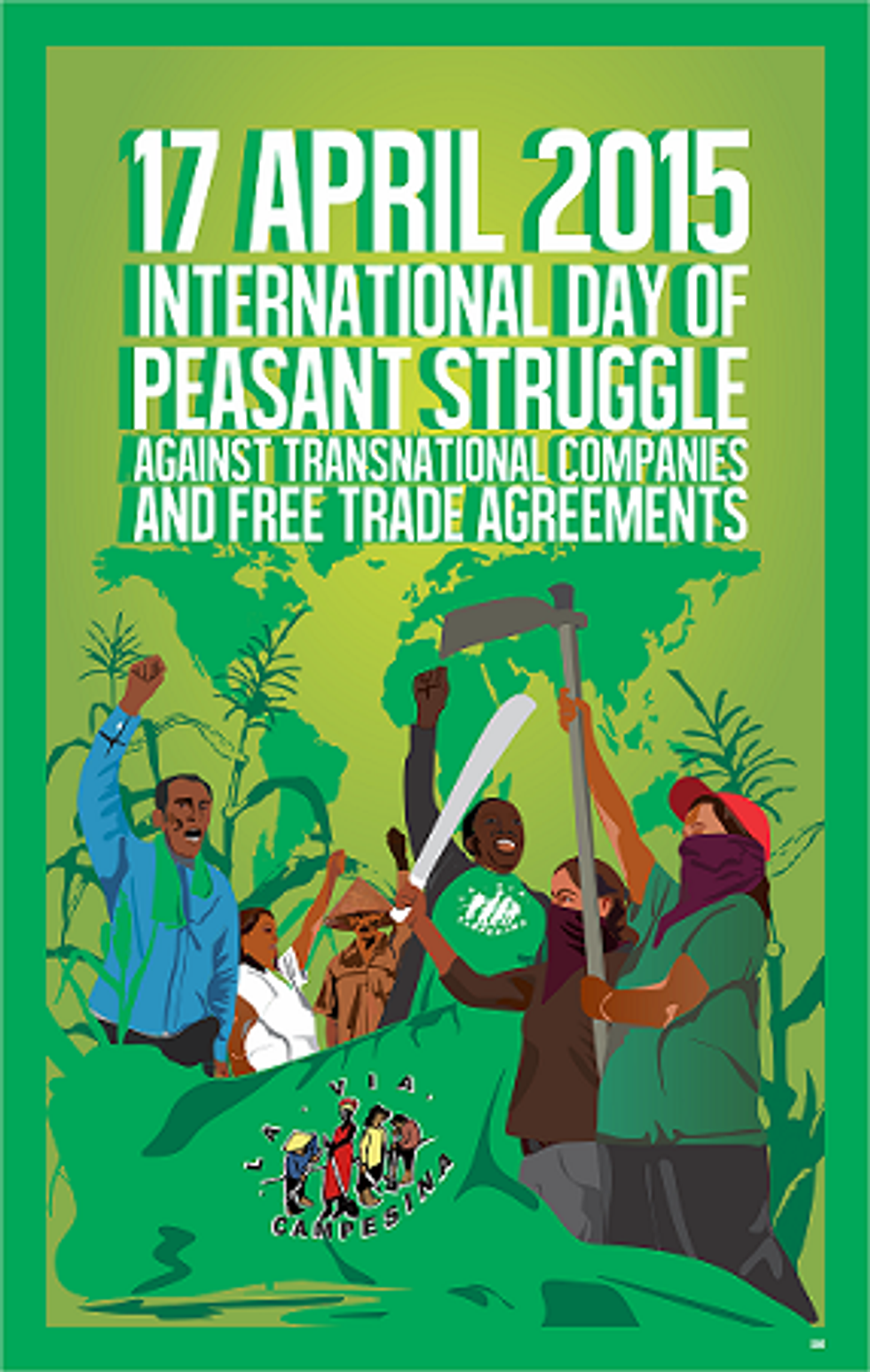
This week activists around the world will take to the streets for two days of action to challenge corporate power. Friday is La Via Campesina's International Day of Peasant Struggle when food producers will gather to resist the global takeover of land, seeds and livelihoods by big business. Then on Saturday, thousands of citizens will demand an end to free trade deals, including the Transatlantic Trade & Investment Partnership (TTIP) currently being hammered out by the EU and US governments.
So why are these days of action back to back? Farmers are some of the hardest hit by free trade deals that hand control of our food systems to corporations. Here are five reasons why TTIP and similar trader deals would be bad news for farmers:
1. Democracy, the Coca Cola way
The US and EU governments have been lambasted for negotiating TTIP behind closed doors. But one group has had plenty of access to decision makers- corporate lobbyists. During TTIP's preparation phase, no sector lobbied the European Commission more than agribusiness sector. In fact, food and agri-trader lobbyists, including those for Unilever, Nestle and Coca cola, had more contact with the commission than those from the pharmaceutical, chemical, financial and car industries put together. Yet small-scale farmers have been left out in the cold. The UK's Land Workers Alliance said, "We believe this process is wholly undemocratic and undermines the integrity of those governments who seek to make an example of their democracy."
2. (T)Tipping the playing field
The US and EU governments currently provide support for their farmer through a series of tariffs on key goods to ensure that their sectors are not undermined by cheap imports or fluctuations in global trade. Yet under TTIP, many of these tariffs could be removed. US and EU small-scale farmers, already playing on an uneven playing field with big business, fear that they would fail to operate under TTIP's reforms. Some have said that they would be forced to adopt more intensive farming methods, forgoing sustainable and traditional practices.
3. Sowing the seeds for Monsanto
Due to the EU's tight restrictions on genetically-modified (GM) plant materials, EU farmers have been largely free from the control of GM seed companies. Yet in the US, where growth of GM food is widespread, farmers have faced rising debts under contracts for GM seeds with companies like Monstanto and Syngenta. Others have been sued after their crops have been contaminated with the companies' patented produce. While EU officials have denied that GM laws will change under TTIP, US negotiators have made clear they will continue to push the EU to reform these policies under the trade deal.
4. This land is.... your land?
One of the biggest barriers in building a better, fairer food system is the price of land. With corporations buying up land for large-scale farms, or simply to speculate on its price, small-scale and young farmers are being priced out. It's no wonder that only 6% of both EU and US farmers are under thirty-five. With TTIP's free market reforms, land prices would rocket even higher. Any hope of land reform (currently being mooted in Scotland) could be challenged through TTIP's proposed Investor State Dispute Settlement that would let corporations take states to court if new policies impede their ability to make profit.
5. Local food? Overruled
Across the US and Europe, local authorities are using their buying power to support local, sustainable food economies. New schemes and polices are seeing local governments ensure that state institutions like schools use public money to buy good food from local growers. Yet both EU and US TTIP negotiators see this a threat to the free trade doctrine, and are calling for such public procurement policies to be overruled..
Find an action near you on Global Trade Day
This week activists around the world will take to the streets for two days of action to challenge corporate power. Friday is La Via Campesina's International Day of Peasant Struggle when food producers will gather to resist the global takeover of land, seeds and livelihoods by big business. Then on Saturday, thousands of citizens will demand an end to free trade deals, including the Transatlantic Trade & Investment Partnership (TTIP) currently being hammered out by the EU and US governments.
So why are these days of action back to back? Farmers are some of the hardest hit by free trade deals that hand control of our food systems to corporations. Here are five reasons why TTIP and similar trader deals would be bad news for farmers:
1. Democracy, the Coca Cola way
The US and EU governments have been lambasted for negotiating TTIP behind closed doors. But one group has had plenty of access to decision makers- corporate lobbyists. During TTIP's preparation phase, no sector lobbied the European Commission more than agribusiness sector. In fact, food and agri-trader lobbyists, including those for Unilever, Nestle and Coca cola, had more contact with the commission than those from the pharmaceutical, chemical, financial and car industries put together. Yet small-scale farmers have been left out in the cold. The UK's Land Workers Alliance said, "We believe this process is wholly undemocratic and undermines the integrity of those governments who seek to make an example of their democracy."
2. (T)Tipping the playing field
The US and EU governments currently provide support for their farmer through a series of tariffs on key goods to ensure that their sectors are not undermined by cheap imports or fluctuations in global trade. Yet under TTIP, many of these tariffs could be removed. US and EU small-scale farmers, already playing on an uneven playing field with big business, fear that they would fail to operate under TTIP's reforms. Some have said that they would be forced to adopt more intensive farming methods, forgoing sustainable and traditional practices.
3. Sowing the seeds for Monsanto
Due to the EU's tight restrictions on genetically-modified (GM) plant materials, EU farmers have been largely free from the control of GM seed companies. Yet in the US, where growth of GM food is widespread, farmers have faced rising debts under contracts for GM seeds with companies like Monstanto and Syngenta. Others have been sued after their crops have been contaminated with the companies' patented produce. While EU officials have denied that GM laws will change under TTIP, US negotiators have made clear they will continue to push the EU to reform these policies under the trade deal.
4. This land is.... your land?
One of the biggest barriers in building a better, fairer food system is the price of land. With corporations buying up land for large-scale farms, or simply to speculate on its price, small-scale and young farmers are being priced out. It's no wonder that only 6% of both EU and US farmers are under thirty-five. With TTIP's free market reforms, land prices would rocket even higher. Any hope of land reform (currently being mooted in Scotland) could be challenged through TTIP's proposed Investor State Dispute Settlement that would let corporations take states to court if new policies impede their ability to make profit.
5. Local food? Overruled
Across the US and Europe, local authorities are using their buying power to support local, sustainable food economies. New schemes and polices are seeing local governments ensure that state institutions like schools use public money to buy good food from local growers. Yet both EU and US TTIP negotiators see this a threat to the free trade doctrine, and are calling for such public procurement policies to be overruled..
Find an action near you on Global Trade Day
This week activists around the world will take to the streets for two days of action to challenge corporate power. Friday is La Via Campesina's International Day of Peasant Struggle when food producers will gather to resist the global takeover of land, seeds and livelihoods by big business. Then on Saturday, thousands of citizens will demand an end to free trade deals, including the Transatlantic Trade & Investment Partnership (TTIP) currently being hammered out by the EU and US governments.
So why are these days of action back to back? Farmers are some of the hardest hit by free trade deals that hand control of our food systems to corporations. Here are five reasons why TTIP and similar trader deals would be bad news for farmers:
1. Democracy, the Coca Cola way
The US and EU governments have been lambasted for negotiating TTIP behind closed doors. But one group has had plenty of access to decision makers- corporate lobbyists. During TTIP's preparation phase, no sector lobbied the European Commission more than agribusiness sector. In fact, food and agri-trader lobbyists, including those for Unilever, Nestle and Coca cola, had more contact with the commission than those from the pharmaceutical, chemical, financial and car industries put together. Yet small-scale farmers have been left out in the cold. The UK's Land Workers Alliance said, "We believe this process is wholly undemocratic and undermines the integrity of those governments who seek to make an example of their democracy."
2. (T)Tipping the playing field
The US and EU governments currently provide support for their farmer through a series of tariffs on key goods to ensure that their sectors are not undermined by cheap imports or fluctuations in global trade. Yet under TTIP, many of these tariffs could be removed. US and EU small-scale farmers, already playing on an uneven playing field with big business, fear that they would fail to operate under TTIP's reforms. Some have said that they would be forced to adopt more intensive farming methods, forgoing sustainable and traditional practices.
3. Sowing the seeds for Monsanto
Due to the EU's tight restrictions on genetically-modified (GM) plant materials, EU farmers have been largely free from the control of GM seed companies. Yet in the US, where growth of GM food is widespread, farmers have faced rising debts under contracts for GM seeds with companies like Monstanto and Syngenta. Others have been sued after their crops have been contaminated with the companies' patented produce. While EU officials have denied that GM laws will change under TTIP, US negotiators have made clear they will continue to push the EU to reform these policies under the trade deal.
4. This land is.... your land?
One of the biggest barriers in building a better, fairer food system is the price of land. With corporations buying up land for large-scale farms, or simply to speculate on its price, small-scale and young farmers are being priced out. It's no wonder that only 6% of both EU and US farmers are under thirty-five. With TTIP's free market reforms, land prices would rocket even higher. Any hope of land reform (currently being mooted in Scotland) could be challenged through TTIP's proposed Investor State Dispute Settlement that would let corporations take states to court if new policies impede their ability to make profit.
5. Local food? Overruled
Across the US and Europe, local authorities are using their buying power to support local, sustainable food economies. New schemes and polices are seeing local governments ensure that state institutions like schools use public money to buy good food from local growers. Yet both EU and US TTIP negotiators see this a threat to the free trade doctrine, and are calling for such public procurement policies to be overruled..
Find an action near you on Global Trade Day