SUBSCRIBE TO OUR FREE NEWSLETTER
Daily news & progressive opinion—funded by the people, not the corporations—delivered straight to your inbox.
5
#000000
#FFFFFF
To donate by check, phone, or other method, see our More Ways to Give page.
This week, Connecticut won the honor of becoming the first state to pass a law requiring genetically engineered foods to be labeled. (The governor has indicated he will sign.) It was really only a matter of time. The disappointing defeat of Prop 37 last fall in California (thanks to a massive industry disinformation campaign) sparked a national movement that has
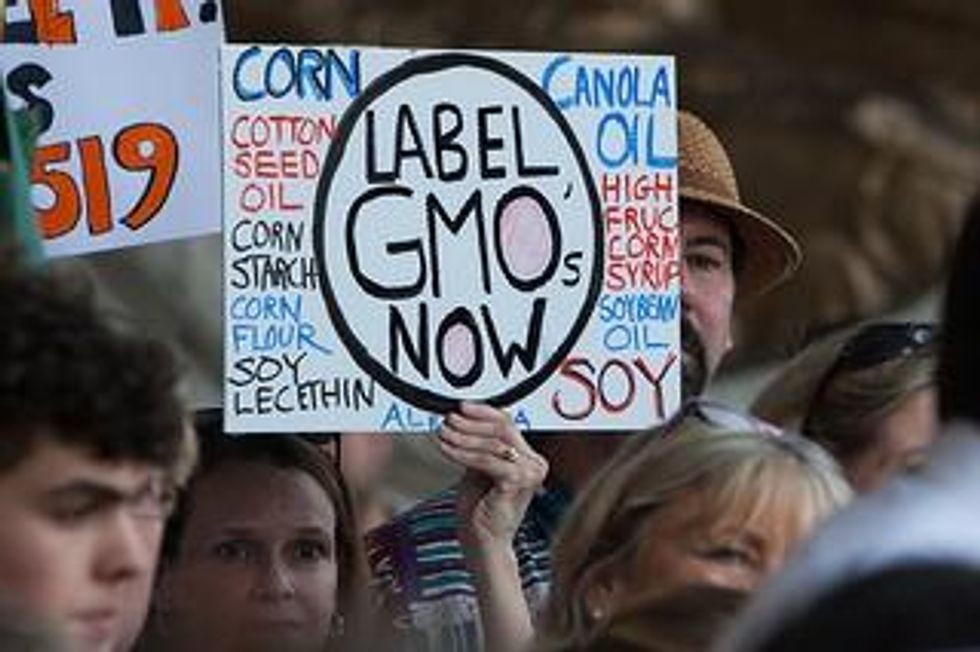
But how did the small state of Connecticut make this happen?
I spoke at length with the leader of the effort, Tara Cook-Littman of GMO Free CT, who worked for the past two years as a volunteer. (See the group's impressive list of coalition partners.)
She said for a long time efforts to pass labeling bills went nowhere, but things started to change two years ago once advocates formally organized themselves. While at first she and others "were dismissed as a bunch of crazy moms and environmentalists," things started to pick up last year "when advocates were able to show themselves to be a serious movement with political power."
What about the opposition? Cook-Littman said it was formidable, and that industry made all the same fear-mongering arguments we heard last year during Prop 37 in California about higher food prices and confusing consumers.
She and others suspect the biotech industry was funneling money through the trade group the Connecticut Food Association, which represents retailers and wholesalers. Also in opposition was the Grocery Manufacturers Association, the national trade group for food makers, which firmly stated its opposition to Prop 37 last year, calling it the organization's "single-highest priority."
In addition, Cook-Littman told me about the front group industry formed to oppose the bill, "Connecticut Farm to Food." (For more about front groups, see my recent report.) This group's home page claims boldly if inexplicably, "Forced labeling will drive business and science out of Connecticut." Listed as sponsors are three groups: The Council for Biotechnology Information (a trade group for the biotech industry; its website is whybiotech.com), the Connecticut Retail Merchants Association, and the previously mentioned Grocery Manufacturers Association. In other words, two of these three groups behind this "Connecticut" organization are based in Washington DC.
The toughest opposition though, Cook-Littman said, came from the Connecticut Farm Bureau, which claimed the bill would hurt farmers, despite the bill not even being about farming, but rather food products. "They claimed that farmers' sales of value-added products would be destroyed if they had to be labeled," she said. But as a strong counterweight, advocates had the support of the state's numerous organic farmers, led by the Connecticut Chapter of the Northeast Organic Farming Association, which Cook-Littman called "our truest partner."
Still, how did this grassroots group fight off such high-powered lobbyists representing at least three major industries - biotech, food retailers, and food manufacturers? She said, "We just got louder."
What exactly was the turning point for the movement? Cook-Littman said face-to-face meetings with politicians were critical. "We spent a lot of time developing relationships with our representatives. Just spending that time with them was invaluable," she said.
Also, the group's social media presence, especially on Facebook, allowed non-paid advocates to engage in less time-consuming ways. "We told our representatives, 'Look at what's happening on Facebook.'"
And simply showing up in massive numbers when it counted: at two critical rallies, one before the legislative session began, another just weeks ago, along with a huge turnout for the hearing.
Cook-Littman credits the national advocacy group Food Democracy Now! for being a vital partner in the effort. "We could not have done it without them. They always believed in us, while others discounted us," she said. "They also helped drive more than 40,000 phone calls to the governor's office and provided strategic advice along the way."
Dave Murphy, founder and executive director of Food Democracy Now!, told me that another turning point was when Jerry Greenfield of Ben and Jerry's Ice Cream came to the capital to testify in support of the bill.
"That gave the issue instant credibility because Ben and Jerry's is a very successful company. There were politicians who had been against the bill standing in line for ice cream and a photo opp with Jerry."
Also, there were several times during the process when they thought the bill was dead. But the advocates didn't give up; another crucial lesson: to hang in there.
Of course, to get any bill difficult bill passed, compromises must be made along the way. While the labeling provisions of the bill are strong, unfortunately, legislators added a "trigger clause," which requires that four other states in the northeast region enact similar bills before the law takes effect in Connecticut.
Cook-Littman told me that the advocates fought to keep this provision out, but at the end of day they were advised to take the compromise or else risk the bill going down to defeat, with an uncertain future. She is quite confident that the clause will actually motivate other states to get bill passed. And as a member of the Right to Know Coalition of States, she is determined to help others in doing so. She also hopes the passage helps the Washington State ballot measure coming up for vote this November.
What advice does Cook-Littman have for advocates in other states facing similar opposition from powerful lobbyists?
"I told my fellow advocates, 'Stand in your power as a constituent and let your representatives hear you.' Too often, we give up our power," she said. "But once you realize that you can make a difference, that's when change happens. Also, stay the course and keep fighting."
Dave Murphy called the Connecticut victory "one giant step for Connecticut and one giant leap for the GMO labeling movement." He continued: "The grassroots have won the day in Connecticut for a key victory over Monsanto and the biotech lobby. It was inspiring to watch Connecticut legislators supporting GMO labeling stand strong in the face of the biotech industry's effort to kill the bill."
Also feeling inspired, Cook-Littman told me, "It truly feels amazing to know that our little state of Connecticut, with its grassroots power, was able to beat back the opposition to get the bill passed. I really do think it is an important step and will encourage other states to do the same."
I couldn't agree more. These victories don't come very often. Let's savor this one.
This week, Connecticut won the honor of becoming the first state to pass a law requiring genetically engineered foods to be labeled. (The governor has indicated he will sign.) It was really only a matter of time. The disappointing defeat of Prop 37 last fall in California (thanks to a massive industry disinformation campaign) sparked a national movement that has
But how did the small state of Connecticut make this happen?
I spoke at length with the leader of the effort, Tara Cook-Littman of GMO Free CT, who worked for the past two years as a volunteer. (See the group's impressive list of coalition partners.)
She said for a long time efforts to pass labeling bills went nowhere, but things started to change two years ago once advocates formally organized themselves. While at first she and others "were dismissed as a bunch of crazy moms and environmentalists," things started to pick up last year "when advocates were able to show themselves to be a serious movement with political power."
What about the opposition? Cook-Littman said it was formidable, and that industry made all the same fear-mongering arguments we heard last year during Prop 37 in California about higher food prices and confusing consumers.
She and others suspect the biotech industry was funneling money through the trade group the Connecticut Food Association, which represents retailers and wholesalers. Also in opposition was the Grocery Manufacturers Association, the national trade group for food makers, which firmly stated its opposition to Prop 37 last year, calling it the organization's "single-highest priority."
In addition, Cook-Littman told me about the front group industry formed to oppose the bill, "Connecticut Farm to Food." (For more about front groups, see my recent report.) This group's home page claims boldly if inexplicably, "Forced labeling will drive business and science out of Connecticut." Listed as sponsors are three groups: The Council for Biotechnology Information (a trade group for the biotech industry; its website is whybiotech.com), the Connecticut Retail Merchants Association, and the previously mentioned Grocery Manufacturers Association. In other words, two of these three groups behind this "Connecticut" organization are based in Washington DC.
The toughest opposition though, Cook-Littman said, came from the Connecticut Farm Bureau, which claimed the bill would hurt farmers, despite the bill not even being about farming, but rather food products. "They claimed that farmers' sales of value-added products would be destroyed if they had to be labeled," she said. But as a strong counterweight, advocates had the support of the state's numerous organic farmers, led by the Connecticut Chapter of the Northeast Organic Farming Association, which Cook-Littman called "our truest partner."
Still, how did this grassroots group fight off such high-powered lobbyists representing at least three major industries - biotech, food retailers, and food manufacturers? She said, "We just got louder."
What exactly was the turning point for the movement? Cook-Littman said face-to-face meetings with politicians were critical. "We spent a lot of time developing relationships with our representatives. Just spending that time with them was invaluable," she said.
Also, the group's social media presence, especially on Facebook, allowed non-paid advocates to engage in less time-consuming ways. "We told our representatives, 'Look at what's happening on Facebook.'"
And simply showing up in massive numbers when it counted: at two critical rallies, one before the legislative session began, another just weeks ago, along with a huge turnout for the hearing.
Cook-Littman credits the national advocacy group Food Democracy Now! for being a vital partner in the effort. "We could not have done it without them. They always believed in us, while others discounted us," she said. "They also helped drive more than 40,000 phone calls to the governor's office and provided strategic advice along the way."
Dave Murphy, founder and executive director of Food Democracy Now!, told me that another turning point was when Jerry Greenfield of Ben and Jerry's Ice Cream came to the capital to testify in support of the bill.
"That gave the issue instant credibility because Ben and Jerry's is a very successful company. There were politicians who had been against the bill standing in line for ice cream and a photo opp with Jerry."
Also, there were several times during the process when they thought the bill was dead. But the advocates didn't give up; another crucial lesson: to hang in there.
Of course, to get any bill difficult bill passed, compromises must be made along the way. While the labeling provisions of the bill are strong, unfortunately, legislators added a "trigger clause," which requires that four other states in the northeast region enact similar bills before the law takes effect in Connecticut.
Cook-Littman told me that the advocates fought to keep this provision out, but at the end of day they were advised to take the compromise or else risk the bill going down to defeat, with an uncertain future. She is quite confident that the clause will actually motivate other states to get bill passed. And as a member of the Right to Know Coalition of States, she is determined to help others in doing so. She also hopes the passage helps the Washington State ballot measure coming up for vote this November.
What advice does Cook-Littman have for advocates in other states facing similar opposition from powerful lobbyists?
"I told my fellow advocates, 'Stand in your power as a constituent and let your representatives hear you.' Too often, we give up our power," she said. "But once you realize that you can make a difference, that's when change happens. Also, stay the course and keep fighting."
Dave Murphy called the Connecticut victory "one giant step for Connecticut and one giant leap for the GMO labeling movement." He continued: "The grassroots have won the day in Connecticut for a key victory over Monsanto and the biotech lobby. It was inspiring to watch Connecticut legislators supporting GMO labeling stand strong in the face of the biotech industry's effort to kill the bill."
Also feeling inspired, Cook-Littman told me, "It truly feels amazing to know that our little state of Connecticut, with its grassroots power, was able to beat back the opposition to get the bill passed. I really do think it is an important step and will encourage other states to do the same."
I couldn't agree more. These victories don't come very often. Let's savor this one.
This week, Connecticut won the honor of becoming the first state to pass a law requiring genetically engineered foods to be labeled. (The governor has indicated he will sign.) It was really only a matter of time. The disappointing defeat of Prop 37 last fall in California (thanks to a massive industry disinformation campaign) sparked a national movement that has
But how did the small state of Connecticut make this happen?
I spoke at length with the leader of the effort, Tara Cook-Littman of GMO Free CT, who worked for the past two years as a volunteer. (See the group's impressive list of coalition partners.)
She said for a long time efforts to pass labeling bills went nowhere, but things started to change two years ago once advocates formally organized themselves. While at first she and others "were dismissed as a bunch of crazy moms and environmentalists," things started to pick up last year "when advocates were able to show themselves to be a serious movement with political power."
What about the opposition? Cook-Littman said it was formidable, and that industry made all the same fear-mongering arguments we heard last year during Prop 37 in California about higher food prices and confusing consumers.
She and others suspect the biotech industry was funneling money through the trade group the Connecticut Food Association, which represents retailers and wholesalers. Also in opposition was the Grocery Manufacturers Association, the national trade group for food makers, which firmly stated its opposition to Prop 37 last year, calling it the organization's "single-highest priority."
In addition, Cook-Littman told me about the front group industry formed to oppose the bill, "Connecticut Farm to Food." (For more about front groups, see my recent report.) This group's home page claims boldly if inexplicably, "Forced labeling will drive business and science out of Connecticut." Listed as sponsors are three groups: The Council for Biotechnology Information (a trade group for the biotech industry; its website is whybiotech.com), the Connecticut Retail Merchants Association, and the previously mentioned Grocery Manufacturers Association. In other words, two of these three groups behind this "Connecticut" organization are based in Washington DC.
The toughest opposition though, Cook-Littman said, came from the Connecticut Farm Bureau, which claimed the bill would hurt farmers, despite the bill not even being about farming, but rather food products. "They claimed that farmers' sales of value-added products would be destroyed if they had to be labeled," she said. But as a strong counterweight, advocates had the support of the state's numerous organic farmers, led by the Connecticut Chapter of the Northeast Organic Farming Association, which Cook-Littman called "our truest partner."
Still, how did this grassroots group fight off such high-powered lobbyists representing at least three major industries - biotech, food retailers, and food manufacturers? She said, "We just got louder."
What exactly was the turning point for the movement? Cook-Littman said face-to-face meetings with politicians were critical. "We spent a lot of time developing relationships with our representatives. Just spending that time with them was invaluable," she said.
Also, the group's social media presence, especially on Facebook, allowed non-paid advocates to engage in less time-consuming ways. "We told our representatives, 'Look at what's happening on Facebook.'"
And simply showing up in massive numbers when it counted: at two critical rallies, one before the legislative session began, another just weeks ago, along with a huge turnout for the hearing.
Cook-Littman credits the national advocacy group Food Democracy Now! for being a vital partner in the effort. "We could not have done it without them. They always believed in us, while others discounted us," she said. "They also helped drive more than 40,000 phone calls to the governor's office and provided strategic advice along the way."
Dave Murphy, founder and executive director of Food Democracy Now!, told me that another turning point was when Jerry Greenfield of Ben and Jerry's Ice Cream came to the capital to testify in support of the bill.
"That gave the issue instant credibility because Ben and Jerry's is a very successful company. There were politicians who had been against the bill standing in line for ice cream and a photo opp with Jerry."
Also, there were several times during the process when they thought the bill was dead. But the advocates didn't give up; another crucial lesson: to hang in there.
Of course, to get any bill difficult bill passed, compromises must be made along the way. While the labeling provisions of the bill are strong, unfortunately, legislators added a "trigger clause," which requires that four other states in the northeast region enact similar bills before the law takes effect in Connecticut.
Cook-Littman told me that the advocates fought to keep this provision out, but at the end of day they were advised to take the compromise or else risk the bill going down to defeat, with an uncertain future. She is quite confident that the clause will actually motivate other states to get bill passed. And as a member of the Right to Know Coalition of States, she is determined to help others in doing so. She also hopes the passage helps the Washington State ballot measure coming up for vote this November.
What advice does Cook-Littman have for advocates in other states facing similar opposition from powerful lobbyists?
"I told my fellow advocates, 'Stand in your power as a constituent and let your representatives hear you.' Too often, we give up our power," she said. "But once you realize that you can make a difference, that's when change happens. Also, stay the course and keep fighting."
Dave Murphy called the Connecticut victory "one giant step for Connecticut and one giant leap for the GMO labeling movement." He continued: "The grassroots have won the day in Connecticut for a key victory over Monsanto and the biotech lobby. It was inspiring to watch Connecticut legislators supporting GMO labeling stand strong in the face of the biotech industry's effort to kill the bill."
Also feeling inspired, Cook-Littman told me, "It truly feels amazing to know that our little state of Connecticut, with its grassroots power, was able to beat back the opposition to get the bill passed. I really do think it is an important step and will encourage other states to do the same."
I couldn't agree more. These victories don't come very often. Let's savor this one.