

SUBSCRIBE TO OUR FREE NEWSLETTER
Daily news & progressive opinion—funded by the people, not the corporations—delivered straight to your inbox.
5
#000000
#FFFFFF
To donate by check, phone, or other method, see our More Ways to Give page.
Daily news & progressive opinion—funded by the people, not the corporations—delivered straight to your inbox.
press@occupywallst.org
Jonathan Smucker, OWS, 717-209-0445, jms@beyondthechoir.org
Today, across the United States, Americans are standing up to keep families in their homes. Occupy Wall Street and the burgeoning 99% movement is standing up to the big banks.
This action is part of a national kick-off for a new frontier for the occupy movement: the liberation of vacant bank-owned homes for those in need, and the defense of families under threat of foreclosure and eviction. Actions will take place in more than 20 cities across the country today.
The Brooklyn action will convene at 1:00pm. We are gathering at Pennsylvania and Livonia in East New York, Brooklyn (3 train to Pennsylvania or L train to Livonia) at 1:00pm to march through a neighborhood on the front lines of the economic crisis.
Wall Street and the big banks are making record profits while most Americans are struggling to stay in their homes. Banks break the law with impunity, but millions of us get served with eviction. Banks make trillions and get bailouts, while we face record unemployment and record debt.
No more! Our system has been serving Wall Street, big banks, and the one percent.
We are the 99%. We are reclaiming our democracy. And we are reclaiming our homes.
https://occupyourhomes.org/
Available for Interviews
These and other spokespeople are available for interviews upon request.
Robert and Debbie Henry | Southgate, Michigan
Contact: Shannon McEvilly, 734.748.5413
Robert and Debbie Henry, with the support of friends, family, and community, are resisting the foreclosure of their Southgate, Michigan home. After years of struggling with mortgage companies, including Bank of America, to modify their loan, the Henrys face foreclosure and eviction. The family has decided that as an act of civil disobedience, they will stay in their home, in protest of how bailed-out banks are treating homeowners all across the country.
Bobby Hull | Minneapolis, Minnesota
Contact: Anthony Newby 612-327-9453
Occupy Minneapolis, NOC, community groups, neighbors, homeowner Bobby Hull, and his extended family. Bobby and his family have been in their home since 1968. He's also a former Marine and a Vietnam War veteran. Some recent health problems have caused him to fall behind in his payments. Meanwhile Bank of America has offered and then refused to modify his loan. If we do nothing he and his family are facing a February eviction, in the dead of winter, with nowhere to go. Come hear directly from Bobby on the need for banks to change the way they do business with hard working families.
https://occupyourhomes.org/stories/2011/dec/5/bobbys-story-facing-foreclosure-fighting-back/
Monique White | Minneapolis, Minnesota
Contact: Anthony Newby 612-327-9453
Monique White bought her house in North Minneapolis in 2003, and was the first person in her family to own a home. Now she is facing foreclosure and though she has been trying for years to work with U.S. Bank to save her home, they have been unwilling to help her up to this point. She is working with Occupy Minneapolis to save her home.
https://occupyourhomes.org/stories/2011/nov/8/help-monique-white-save-her-home/
Catherine Lennon | Rochester, New York
Contact: Ryan Acuff, 585-455-0961
After Catherine's husband died of brain and lung cancer 3 years ago Countrywide/Bank of America refused to renegotiate the mortgage and foreclosed on Cathy, her three daughters, and eight small grandchildren. With the support of Take Back the Land Rochester Cathy's nonviolent eviction blockade of her house successfully stopped the eviction for weeks. On March 28 she was evicted in a SWAT-like operation by 20 Rochester police with seven eviction defenders arrested including a neighbor in her pajamas. On Mother's Day of this year she reclaimed her home and has been living there ever since.
https://www.huffingtonpost.com/van-jones/this-is-not-america-swat-_b_843708.html
Maria and Harold Steidel | Rochester, New York
Contact: Ryan Acuff, 585-455-0961
Maria and Harold Steidel with support of Take Back the Land Rochester and Occupy Rochester are resisting the foreclosure and eviction of their longtime Rochester home. Maria is the pastor of her local church. Despite being willing and able to pay the mortgage for years, Wells Fargo has refused to work with family because a temporary reduction of income due to a job loss in 2008. On November 14, 2011 the family publicly announced they would let not leave their house and their pledge would be defended by Take Back the Land and Occupy Rochester. Two days later Wells Fargo and Freddie Mac called off the eviction to renegotiate a permanent settlement. The family is still in their home.
Senator Vincent Fort | Atlanta, Georgia
Contact: Tim Franzen, 404-414-5521
Vincent D. Fort is serving his eighth term in the state senate in the 39th district. He represents parts of the city of Atlanta and East Point in Fulton county. Senator Fort began his efforts to fight predatory abusive lending in 2000. He introduced the predatory lending legislation in 2001. Senator Fort's legislation was the basis for the strongest predatory lending law in the country when it passed in 2002. He has negotiated dozens of settlements for homeowners with most of the major banks in the United States. Sen. Fort has appeared on numerous local national and international media outlets including CNN, Fox News, and MSNBC.
Ana Wison | Los Angeles, California
Contact: Peter Kuhns 213-272-1141
Ana Wison, a court interpreter and disability advocate with cerebral palsy, has announced that she and her family are refusing to leave their home after Wells Fargo foreclosed on them despite three stable incomes and the ability to pay the mortgage.
Carolyn Gage | San Francisco, California
Contact: Grace Martinez, 415-377-6872
On Nov 1st Carolyn Gage moved back in to the home she had been evicted from early in the year. The property was still sitting vacant, and owned by the bank. Carolyn's father built the house and the family had been living there for 50 years. Carolyn was a Deputy Sheriff for 17 years until she was injured on the job in 1996.
Tasha Glasgow | Brooklyn, New York
Contacts: Sean Barry, 646-373-3344
Karanja Gacuca, 646-675-9324
Tej Nagaraja, 646-752-6451
Tasha is a single mom raising a 9 year-old daughter with autism and a 5 year-old son. She grew up in Brooklyn, but has spent most of the past decade in and out of the shelter system through NYC. After being awarded a Section 8 voucher in spring 2011 that would allow her move out of the shelter system, it was withdrawn right before she moved into a new apartment due to budget cuts by Mayor Bloomberg. On Tuesday Occupy Wall Street joins with community organizations to reclaim a home for Tasha and her family.
For interviews with anti-foreclosure actions across the country:
Jeff Ordower, 314-267-4664
Andy McDonald, 202-256-5990, andy@berlinrosen.com
on-site at Brooklyn, NY action:
Sean Barry, 646-373-3344
Karanja Gacuca, 646-675-9324
Tej Nagaraja, 646-752-6451
Occupy Wall Street is a people-powered movement that began on September 17, 2011 in Liberty Square in Manhattan's Financial District, and has spread to more than 100 cities in the United States and actions in over 1,500 cities globally. For more visit https://occupywallst.org
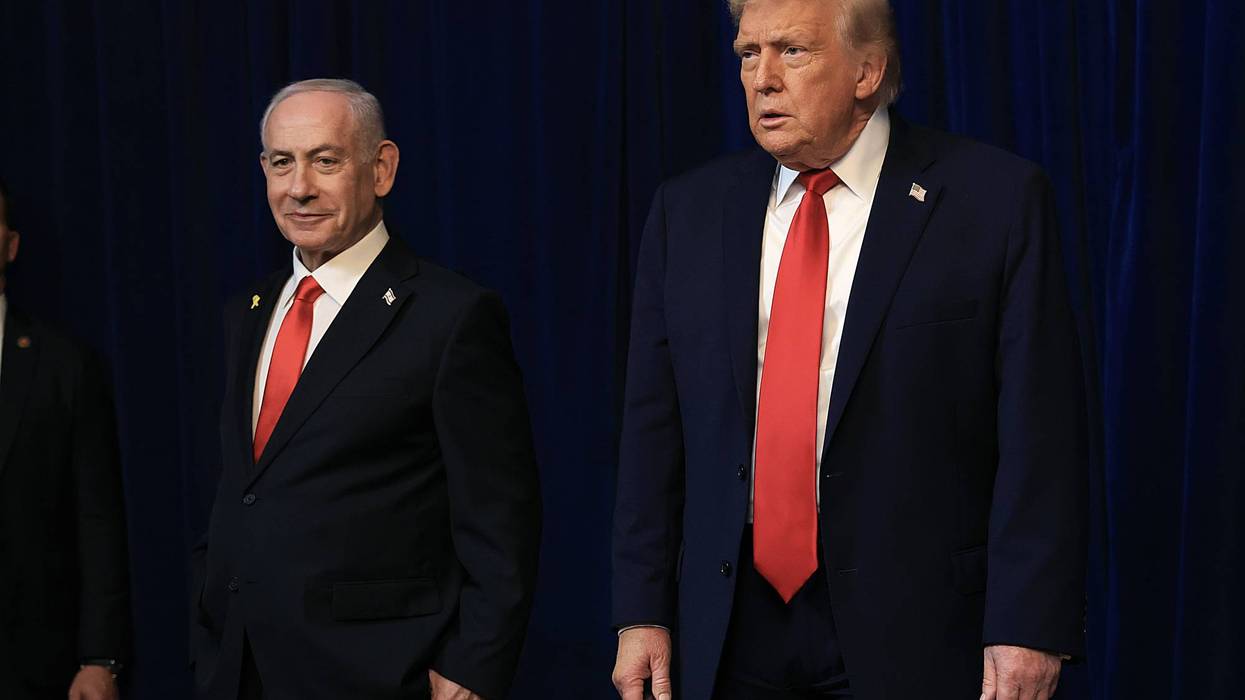
"Trump again says the quiet part out loud—America entered the Iran war to support a genocidal ethno-state and brutal absolute autocracies, all of whom are his political and commercial financiers."
During his campaign for reelection, one of President Donald Trump's central pitches was that the US needed to stay out of foreign wars in order to prioritize "America first."
But his decision to join Israel and launch a massive war with Iran, which has caused turmoil across the American economy, has left many voters rather skeptical of these motivations, believing the war benefits other nations—particularly Israel—more than the US.
That perception has not been assuaged by statements from officials like Secretary of State Marco Rubio, who acknowledged in the early days of the war that a so-called "imminent threat" to the US only existed because Israel had planned to attack, or by the president's recent comment that he doesn't "think about Americans' financial situation" regarding the war.
In an interview with Sean Hannity on Fox News on Thursday, Trump appeared to further affirm that the Iran invasion's impact on his own country is far from top-of-mind.
Trump was asked by Hannity about his weekslong effort to reopen the Strait of Hormuz, which Iran closed in response to the war's launch, causing a spike in global oil prices that has hit the US. Reopening the strait has become one of Trump's main demands as he pushes for a deal with Iran, even though it was open before the war began.
But Trump said on Thursday that other countries "need the strait more than we need it open." He cited his administration's aggressive expansion of oil drilling, which he has claimed would make the US more resilient to the oil shock, although it hasn't been enough to stop gas prices from soaring above $4.50/gallon on average.
"We don't need it at all," Trump said, to which Hannity responded incredulously, "We don't need it at all?"
"We don't need it at all," Trump reiterated. “I mean, you could make the case, you know, like why are we even, we’re doing it to help Israel, and to help Saudi Arabia, and to help Qatar and [the United Arab Emirates] and, you know, Kuwait and other countries, Bahrain—”
Hannity interjected: "It also helps China."
Speaking of his summit this week with Chinese leaders, including President Xi Jinping, Trump said: "Actually, I told him today, I said, 'You know, we're helping you, and we're helping you in another way,' because I don't think they want, I don't think China wants Iran to have a nuclear weapon either.'"
Trump's director of national intelligence, Tulsi Gabbard, testified in a written statement to Congress in March that Iran had not tried to rebuild its nuclear enrichment capability after earlier US and Israeli attacks last June, which undercut one of the administration's primary rationales for war.
Trump's former National Counterterrorism Center director, Joe Kent, said last week that the US intelligence community agreed in the days leading up to the war that "Iran wasn’t developing a nuclear weapon,” but said that these assessments were undermined by persuasion from "a foreign government—Israel," which "won the argument and forced us into this war."
Many of the US's Persian Gulf allies have publicly tried to distance themselves from the war, especially in the face of retaliation from Iran. But The Associated Press has reported that countries like the UAE, Saudi Arabia, Kuwait, and Bahrain have pushed Trump behind the scenes to continue escalating the war in an effort to weaken Iran militarily and force more permanent changes to the regime.
Some have noted the Trump family’s close personal ties to the Gulf regimes—from his family’s cryptocurrency venture which is buoyed by a $500 million investment from a powerful member of Abu Dhabi’s ruling family; to his son in law Jared Kushner’s private equity firm, which has received $2 billion from Saudi Arabia’s public investment fund; to his real estate empire which has lucrative Trump-branded properties popping up across the region.
Independent journalist Borzou Daragahi said that with his latest comments, "Trump again says the quiet part out loud—America entered the Iran war to support a genocidal ethno-state and brutal absolute autocracies, all of whom are his political and commercial financiers."
Democratic Rep. Pramila Jayapal called for an immediate end to the US blockade, warning that "we are contributing to immense suffering in Cuba and a worsening humanitarian crisis."
The director of the US Central Intelligence Agency met with Cuban officials in Havana on Thursday after the island nation's government said it had completely run out of fuel due to the Trump administration's oil blockade.
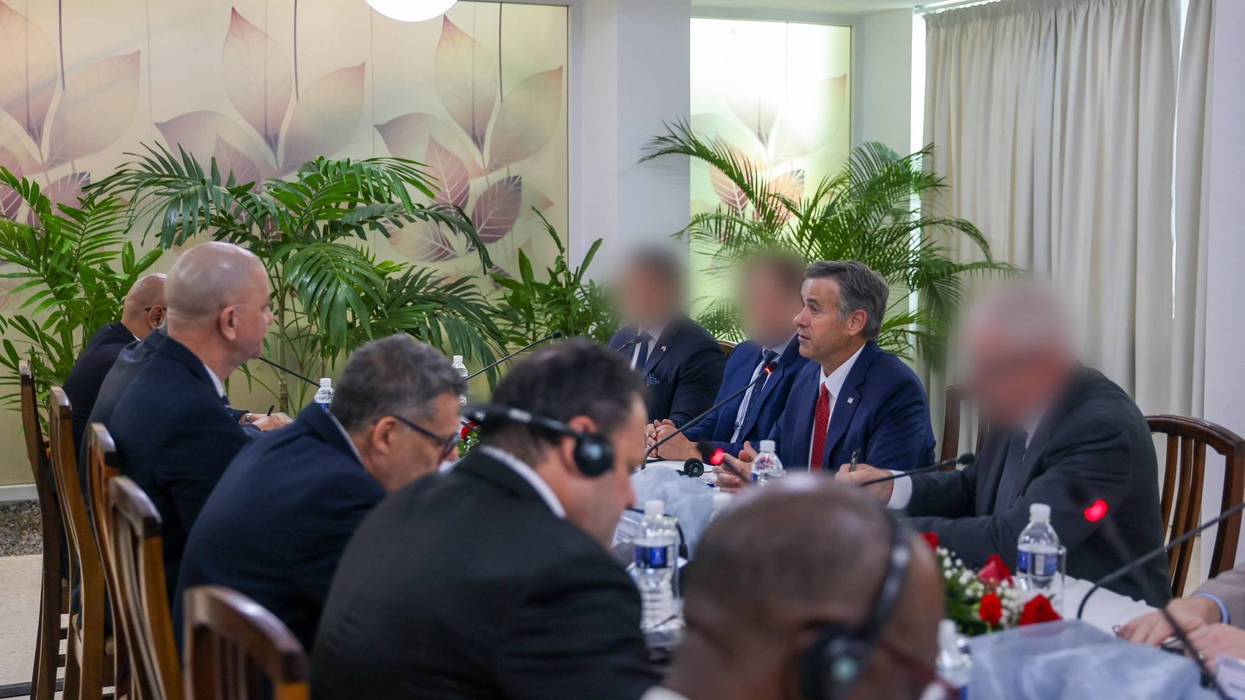
The CIA's X account posted photos of some of Director John Ratcliffe's meetings, blurring the faces of US intelligence officials who accompanied the agency chief. In a statement, the CIA said it met with Raúl Rodríguez Castro, the grandson of former Cuban President Raúl Castro; Interior Minister Lázaro Álvarez Casas; and the head of Cuba's intelligence services.
Havana, Cuba pic.twitter.com/7S7TtJPyf5
— CIA (@CIA) May 14, 2026
"This is one of the most sinister and ominous social media posts I've ever seen," legal scholar Maryam Jamshidi wrote in response to the CIA photos.
Ratcliffe, the highest-ranking Trump administration official to visit Cuba, decided to visit "to personally deliver President Donald Trump's message that the United States is prepared to seriously engage on economic and security issues, but only if Cuba makes fundamental changes," the CIA said.
A CIA official told NewsNation that "while the director emphasized that President Trump prefers dialogue, the Cubans should have no illusions that the President will not enforce red lines."
Trump has repeatedly threatened to seize Cuba by force, describing the island country as his next military target after Venezuela and Iran. Fears of an imminent military attack have grown in recent weeks amid Trump's belligerent rhetoric and surging US surveillance flights off Cuba's coast.
"I think I can do anything I want with [Cuba], if you want to know the truth," Trump told reporters in the Oval Office in March. "A very weakened nation."
"This failed policy needs to end immediately. Every day, we are contributing to immense suffering in Cuba and a worsening humanitarian crisis."
The spy chief's trip came a day after Cuba's energy minister announced that months after Trump imposed an oil blockade on the island, "we have absolutely no fuel oil, absolutely no diesel."
The same day, the US State Department dangled "$100 million in direct humanitarian assistance to the Cuban people." Cuban Foreign Minister Bruno Rodríguez Parrilla said Cuba's leadership is "willing to hear the details of the offer and the manner in which it would be implemented."
"We hope it is free of political maneuvers and attempts to exploit the shortages and suffering of a people under siege," he added. "The best aid that the US government could provide to the noble Cuban people at this or any time is to de-escalate the measures of the energy, economic, commercial, and financial blockade, intensified as never before in recent months, which severely affects all sectors of the Cuban economy and society."
Cuban President Miguel Díaz-Canel echoed that sentiment, writing in a Thursday social media post that "the damage could be alleviated in a much easier and more expeditious way by lifting or easing the blockade, as it is well known that the humanitarian situation is coldly calculated and induced."
Progressive lawmakers in the US are imploring the Trump administration to end US economic warfare against Cuba, engage diplomatically with the country, and drop any plans for a military assault.
Rep. Pramila Jayapal (D-Wash.), who has come under attack from Republican lawmakers for visiting Cuba in April, said Thursday that "Cuba has run out of diesel and fuel oil and is enduring some of the worst blackouts in decades because of the US’ cruel oil blockade."
"This failed policy needs to end immediately," said Jayapal. "Every day, we are contributing to immense suffering in Cuba and a worsening humanitarian crisis."
“You can only decrease consumption so much, and when inventories run out, they are going to run out,” said one energy industry expert.
The global energy crisis caused by President Donald Trump's illegal war with Iran is set to worsen in the coming months, as The Wall Street Journal reported on Friday that the world is "burning through its oil safety net."
Even though oil prices surged at the start of the war, which led Iran to close the Strait of Hormuz to commercial ships, that increase was temporarily mitigated by crude surpluses that allowed countries to add more petroleum to the market.
However, the Journal reported that those reserve stocks are being depleted at an unprecedented pace, with inventories declining by nearly 250 million barrels in just the first two months of the conflict.
This rapid drawdown has led oil executives and analysts to warn that "a harsh reckoning is set to upend the relative calm in energy markets" as "acute shortages of key fuels and soaring prices could emerge within weeks if the Strait of Hormuz remains shut," according to the Journal.
The Journal cited a report from consulting firm Eurasia Group estimating that, at the current rate of depletion, US diesel reserves are set to fall below 100 million barrels for the first time in 23 years by the end of this month.
Ellen Wald, senior fellow at the Atlantic Council’s Global Energy Center, told the Journal that while the increased price of oil would be partially offset by a decrease in consumption, the sheer scale of the coming supply crunch is so big that prices will continue to spiral upward.
“You can only decrease consumption so much, and when inventories run out, they are going to run out,” Wald explained. “At some point the market is going to collide and prices are going to shoot up.”
This problem could be exacerbated further if Trump decides to renew attacks on Iran, which could lead to devastating Iranian counterstrikes on oil production facilities throughout the region.
Zeteo reported on Thursday that "preparations for an imminent new phase of Trump’s Iran war have accelerated," as the president "has grown increasingly frustrated by the state of peace talks."
According to Zeteo's sources, the US military campaign is set to ramp up shortly after Trump returns from his visit to China, with options that include "a potential massive new bombing campaign against the Iranians."
The US military bombed Iranian military targets and civilian infrastructure throughout the early weeks of the conflict, but the country has still refused to reopen the Strait of Hormuz.
With peace talks stalled and the prospect of renewed hostilities on the table, the price of Brent crude futures surged on Friday, topping more than $108 per barrel.
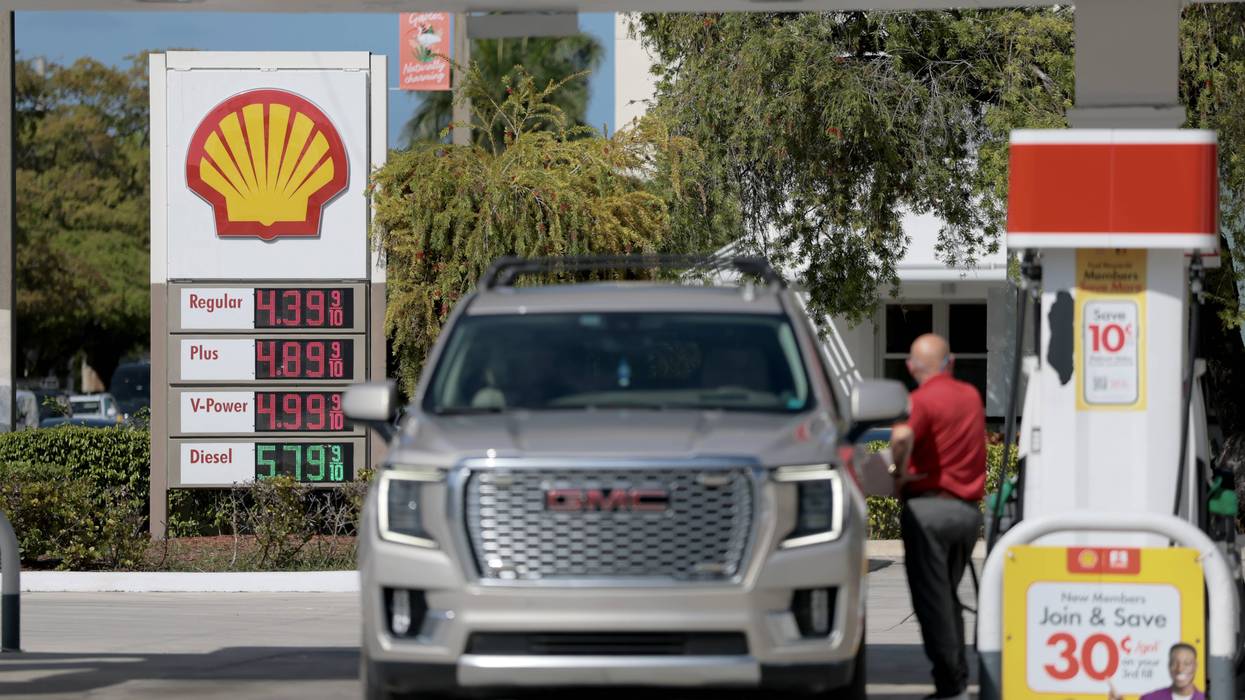
Average gas prices in the US remained above $4.50 on Friday, and petroleum industry analyst Patrick De Haan estimated on Thursday that prices could soon jump to over $5 per gallon if the Strait of Hormuz isn't opened soon.