SUBSCRIBE TO OUR FREE NEWSLETTER
Daily news & progressive opinion—funded by the people, not the corporations—delivered straight to your inbox.
5
#000000
#FFFFFF
To donate by check, phone, or other method, see our More Ways to Give page.
Daily news & progressive opinion—funded by the people, not the corporations—delivered straight to your inbox.
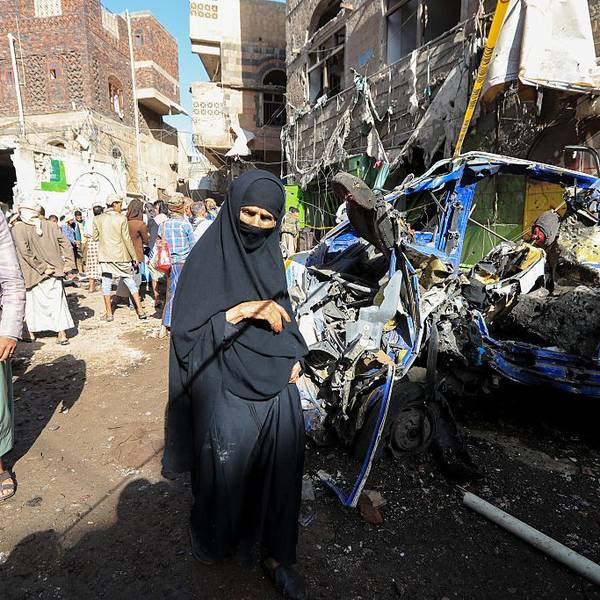
An explosion tore through a residential neighborhood in Yemen's capital on Monday, as Saudi coalition air strikes continue to pound the city amid a mounting nation-wide humanitarian crisis worsened by dangerously low supplies of food, medicine, and water.
The coalition bombing on Monday unleashed an eruption through a civilian area in the Faj Attan area of Sana. Buildings were flattened, windows were broken, and according to witnesses, the event felt like an earthquake. Media outlets say the eruption may have been caused when an air strike hit a munitions cache.
Hospitals were reportedly inundated with the dead and wounded, and efforts to retrieve survivors from the rubble are ongoing, in an area that has suffered repeated bombings since the coalition bombings began March 26.
People in Yemen turned to social media to document the aftermath.
Since March 26, the Saudi-led bombing campaign has struck markets, schools, medical facilities, power plants, and refugee camps.
The international aid organization Oxfam said that, on Sunday, the coalition bombed a warehouse containing "vital humanitarian aid" in the northern governate of Saada.
"This is an absolute outrage particularly when one considers that we have shared detailed information with the Coalition on the locations of our offices and storage facilities," declared Grace Ommer, Oxfam's country director in Yemen, in a press statement released Monday. "The contents of the warehouse had no military value. It only contained humanitarian supplies associated with our previous work in Saada, bringing clean water to thousands of households."
The war, which is led by Saudi Arabia and now includes the United States, Kuwait, Qatar, the United Arab Emirates, Bahrain, Jordan, Egypt, Sudan, and Morocco, is being waged against one of the poorest countries in the world.
So far, 18 of Yemen's 22 governates have been affected by air strikes, according to the United Nations Office for the Coordination of Humanitarian Affairs. Meanwhile, fighting continues to intensify in the south, with the port city of Aden especially hard hit.
The World Health Organization reports that at least 767 people have been killed and 2,906 wounded in the conflict since March 19, in what are believed to be dramatic under-counts of the actual toll. The UN Office for the Coordination of Humanitarian Affairs says at least 150,000 people have been displaced.
Aid organizations warn that coalition partners, including the U.S., may be guilty of war crimes, and Houthi combatants have also been accused of killing civilians.
Meanwhile, from within Yemen and around the world, people are calling for an end to the fighting.
Last week, U.S. and U.K. Yemen scholars published an open letter condemning the Saudi-led campaign:
This military campaign is illegal under international law: None of these states has a case for self-defense. The targets of the campaign include schools, homes, refugee camps, water systems, grain stores and food industries. This has the potential for appalling harm to ordinary Yemenis as almost no food or medicine can enter.
Yemen is the poorest country of the Arab world in per capita income, yet rich in cultural plurality and democratic tradition. Rather than contributing to the destruction of the country, the US and UK should support a UN Security Council resolution demanding an immediate, unconditional ceasefire and use their diplomatic influence to strengthen the sovereignty and self-government of Yemen. As specialists we are more than aware of internal divisions within Yemeni society, but we consider that it is for the Yemenis themselves to be allowed to negotiate a political settlement.
Dear Common Dreams reader, It’s been nearly 30 years since I co-founded Common Dreams with my late wife, Lina Newhouser. We had the radical notion that journalism should serve the public good, not corporate profits. It was clear to us from the outset what it would take to build such a project. No paid advertisements. No corporate sponsors. No millionaire publisher telling us what to think or do. Many people said we wouldn't last a year, but we proved those doubters wrong. Together with a tremendous team of journalists and dedicated staff, we built an independent media outlet free from the constraints of profits and corporate control. Our mission has always been simple: To inform. To inspire. To ignite change for the common good. Building Common Dreams was not easy. Our survival was never guaranteed. When you take on the most powerful forces—Wall Street greed, fossil fuel industry destruction, Big Tech lobbyists, and uber-rich oligarchs who have spent billions upon billions rigging the economy and democracy in their favor—the only bulwark you have is supporters who believe in your work. But here’s the urgent message from me today. It's never been this bad out there. And it's never been this hard to keep us going. At the very moment Common Dreams is most needed, the threats we face are intensifying. We need your support now more than ever. We don't accept corporate advertising and never will. We don't have a paywall because we don't think people should be blocked from critical news based on their ability to pay. Everything we do is funded by the donations of readers like you. When everyone does the little they can afford, we are strong. But if that support retreats or dries up, so do we. Will you donate now to make sure Common Dreams not only survives but thrives? —Craig Brown, Co-founder |
An explosion tore through a residential neighborhood in Yemen's capital on Monday, as Saudi coalition air strikes continue to pound the city amid a mounting nation-wide humanitarian crisis worsened by dangerously low supplies of food, medicine, and water.
The coalition bombing on Monday unleashed an eruption through a civilian area in the Faj Attan area of Sana. Buildings were flattened, windows were broken, and according to witnesses, the event felt like an earthquake. Media outlets say the eruption may have been caused when an air strike hit a munitions cache.
Hospitals were reportedly inundated with the dead and wounded, and efforts to retrieve survivors from the rubble are ongoing, in an area that has suffered repeated bombings since the coalition bombings began March 26.
People in Yemen turned to social media to document the aftermath.
Since March 26, the Saudi-led bombing campaign has struck markets, schools, medical facilities, power plants, and refugee camps.
The international aid organization Oxfam said that, on Sunday, the coalition bombed a warehouse containing "vital humanitarian aid" in the northern governate of Saada.
"This is an absolute outrage particularly when one considers that we have shared detailed information with the Coalition on the locations of our offices and storage facilities," declared Grace Ommer, Oxfam's country director in Yemen, in a press statement released Monday. "The contents of the warehouse had no military value. It only contained humanitarian supplies associated with our previous work in Saada, bringing clean water to thousands of households."
The war, which is led by Saudi Arabia and now includes the United States, Kuwait, Qatar, the United Arab Emirates, Bahrain, Jordan, Egypt, Sudan, and Morocco, is being waged against one of the poorest countries in the world.
So far, 18 of Yemen's 22 governates have been affected by air strikes, according to the United Nations Office for the Coordination of Humanitarian Affairs. Meanwhile, fighting continues to intensify in the south, with the port city of Aden especially hard hit.
The World Health Organization reports that at least 767 people have been killed and 2,906 wounded in the conflict since March 19, in what are believed to be dramatic under-counts of the actual toll. The UN Office for the Coordination of Humanitarian Affairs says at least 150,000 people have been displaced.
Aid organizations warn that coalition partners, including the U.S., may be guilty of war crimes, and Houthi combatants have also been accused of killing civilians.
Meanwhile, from within Yemen and around the world, people are calling for an end to the fighting.
Last week, U.S. and U.K. Yemen scholars published an open letter condemning the Saudi-led campaign:
This military campaign is illegal under international law: None of these states has a case for self-defense. The targets of the campaign include schools, homes, refugee camps, water systems, grain stores and food industries. This has the potential for appalling harm to ordinary Yemenis as almost no food or medicine can enter.
Yemen is the poorest country of the Arab world in per capita income, yet rich in cultural plurality and democratic tradition. Rather than contributing to the destruction of the country, the US and UK should support a UN Security Council resolution demanding an immediate, unconditional ceasefire and use their diplomatic influence to strengthen the sovereignty and self-government of Yemen. As specialists we are more than aware of internal divisions within Yemeni society, but we consider that it is for the Yemenis themselves to be allowed to negotiate a political settlement.
An explosion tore through a residential neighborhood in Yemen's capital on Monday, as Saudi coalition air strikes continue to pound the city amid a mounting nation-wide humanitarian crisis worsened by dangerously low supplies of food, medicine, and water.
The coalition bombing on Monday unleashed an eruption through a civilian area in the Faj Attan area of Sana. Buildings were flattened, windows were broken, and according to witnesses, the event felt like an earthquake. Media outlets say the eruption may have been caused when an air strike hit a munitions cache.
Hospitals were reportedly inundated with the dead and wounded, and efforts to retrieve survivors from the rubble are ongoing, in an area that has suffered repeated bombings since the coalition bombings began March 26.
People in Yemen turned to social media to document the aftermath.
Since March 26, the Saudi-led bombing campaign has struck markets, schools, medical facilities, power plants, and refugee camps.
The international aid organization Oxfam said that, on Sunday, the coalition bombed a warehouse containing "vital humanitarian aid" in the northern governate of Saada.
"This is an absolute outrage particularly when one considers that we have shared detailed information with the Coalition on the locations of our offices and storage facilities," declared Grace Ommer, Oxfam's country director in Yemen, in a press statement released Monday. "The contents of the warehouse had no military value. It only contained humanitarian supplies associated with our previous work in Saada, bringing clean water to thousands of households."
The war, which is led by Saudi Arabia and now includes the United States, Kuwait, Qatar, the United Arab Emirates, Bahrain, Jordan, Egypt, Sudan, and Morocco, is being waged against one of the poorest countries in the world.
So far, 18 of Yemen's 22 governates have been affected by air strikes, according to the United Nations Office for the Coordination of Humanitarian Affairs. Meanwhile, fighting continues to intensify in the south, with the port city of Aden especially hard hit.
The World Health Organization reports that at least 767 people have been killed and 2,906 wounded in the conflict since March 19, in what are believed to be dramatic under-counts of the actual toll. The UN Office for the Coordination of Humanitarian Affairs says at least 150,000 people have been displaced.
Aid organizations warn that coalition partners, including the U.S., may be guilty of war crimes, and Houthi combatants have also been accused of killing civilians.
Meanwhile, from within Yemen and around the world, people are calling for an end to the fighting.
Last week, U.S. and U.K. Yemen scholars published an open letter condemning the Saudi-led campaign:
This military campaign is illegal under international law: None of these states has a case for self-defense. The targets of the campaign include schools, homes, refugee camps, water systems, grain stores and food industries. This has the potential for appalling harm to ordinary Yemenis as almost no food or medicine can enter.
Yemen is the poorest country of the Arab world in per capita income, yet rich in cultural plurality and democratic tradition. Rather than contributing to the destruction of the country, the US and UK should support a UN Security Council resolution demanding an immediate, unconditional ceasefire and use their diplomatic influence to strengthen the sovereignty and self-government of Yemen. As specialists we are more than aware of internal divisions within Yemeni society, but we consider that it is for the Yemenis themselves to be allowed to negotiate a political settlement.