
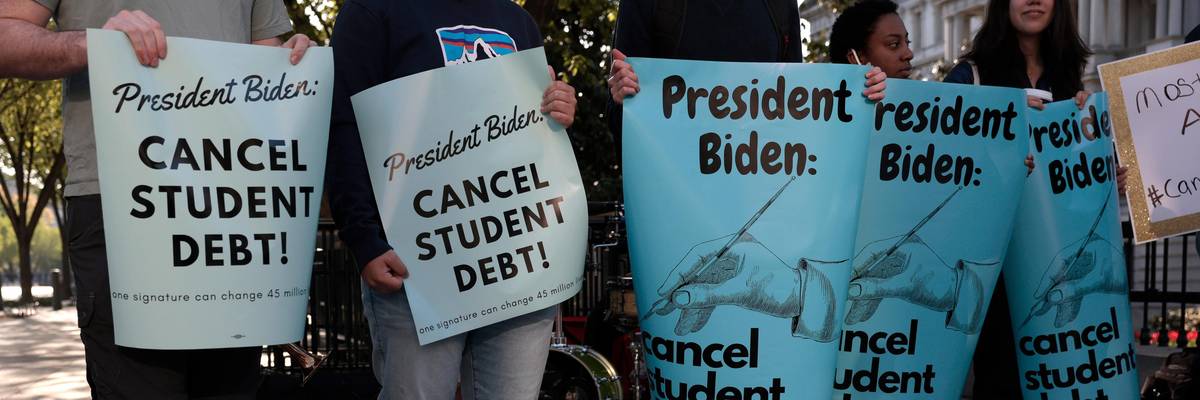
Activists hold signs as they attend a Student Loan Forgiveness rally on Pennsylvania Avenue and 17th street near the White House on April 27, 2022 in Washington, DC. Student loan activists including college students held the rally to celebrate U.S. President Joe Biden's extension of the pause on student loans and also urge him to sign an executive order that would fully cancel all student debt. (Photo: Anna Moneymaker/Getty Images)
'Debt Shaming' Has Dampened Democracy
The single and most simple thing President Biden can do to help save the Democratic majority this midterm, while stimulating the economy, is cancel student debt; and he should do it without delay.
When I ran for mayor of Buffalo, New York, last year, my past-due parking tickets became a major reason for reduced favorability among voters. When Stacy Abrams ran for governor of Georgia in 2018, there was a lot of talk in the mainstream media about how much debt she was in. I share these examples because in general, the working poor do not willfully withhold payment for debts. We are faced with the very real decision between paying often illegitimate debts (like parking tickets and student loans) and feeding our children or paying for life-saving medical treatment for our loved ones.
The hardships imposed on working people have become even more harsh and inhumane in recent years, while vast wealth has been funneled into the pockets of a very few.
New York State's recently passed $220 billion budget has me thinking about the broad acceptance of the idea that the wealthy are best equipped to make the decisions that are supposed to benefit the public at large. The state decided that it was a wise decision to give $650 million to the billionaire owners of the Buffalo Bills while turning a blind eye to the crumbling infrastructure, lack of decent housing, and struggling education system in cities like Buffalo. We have now reached the stage of capitalism where corporate-dominated governments are more willing to invest public dollars into entertainment than in the public good.
Last month I attended a "debtors assembly" in Washington, D.C., hosted by The Debt Collective. It was the first time I publicly acknowledged how much student debt I carry--along with millions of other people. I am not alone and I have no reason to be ashamed. Not only was it liberating, but it got me thinking: what would municipal, state, and even federal budgets look like if we elect people who have had to decide between medication and student loan payments? Furthermore, what kind of talented and compassionate people would run for office if not forced into the shadows under the stigma and shame of medical, consumer, or student debt?
As we look to 2022 midterm elections, voters are questioning the failure of a Democratic majority in Congress to deliver voting rights, the Build Back Better bill, and cancellation of student debt. The single and most simple thing President Biden can do to help save the Democratic majority this midterm, while stimulating the economy, is cancel student debt; and he should do it without delay. In sharp contrast to other highly industrialized countries where higher education is inexpensive or free, approximately 45 million people in our country owe a total of $1.7 trillion in student debt.
We now have the crucial challenge of changing the narrative about who carries the burden of debt, who deserves personal agency, and who deserves decision-making capacity. That is why I am excited to continue to participate in vital coalition work as a member of the RootsAction team. (For more information on our #withoutstudentdebt campaign, visit withoutstudentdebt.us.)
The hardships imposed on working people have become even more harsh and inhumane in recent years, while vast wealth has been funneled into the pockets of a very few. As crucial steps to reduce income inequality, we need to reject "debt shaming" and insist on cancelation of student debt.
An Urgent Message From Our Co-Founder
Dear Common Dreams reader, It’s been nearly 30 years since I co-founded Common Dreams with my late wife, Lina Newhouser. We had the radical notion that journalism should serve the public good, not corporate profits. It was clear to us from the outset what it would take to build such a project. No paid advertisements. No corporate sponsors. No millionaire publisher telling us what to think or do. Many people said we wouldn't last a year, but we proved those doubters wrong. Together with a tremendous team of journalists and dedicated staff, we built an independent media outlet free from the constraints of profits and corporate control. Our mission has always been simple: To inform. To inspire. To ignite change for the common good. Building Common Dreams was not easy. Our survival was never guaranteed. When you take on the most powerful forces—Wall Street greed, fossil fuel industry destruction, Big Tech lobbyists, and uber-rich oligarchs who have spent billions upon billions rigging the economy and democracy in their favor—the only bulwark you have is supporters who believe in your work. But here’s the urgent message from me today. It's never been this bad out there. And it's never been this hard to keep us going. At the very moment Common Dreams is most needed, the threats we face are intensifying. We need your support now more than ever. We don't accept corporate advertising and never will. We don't have a paywall because we don't think people should be blocked from critical news based on their ability to pay. Everything we do is funded by the donations of readers like you. When everyone does the little they can afford, we are strong. But if that support retreats or dries up, so do we. Will you donate now to make sure Common Dreams not only survives but thrives? —Craig Brown, Co-founder |
When I ran for mayor of Buffalo, New York, last year, my past-due parking tickets became a major reason for reduced favorability among voters. When Stacy Abrams ran for governor of Georgia in 2018, there was a lot of talk in the mainstream media about how much debt she was in. I share these examples because in general, the working poor do not willfully withhold payment for debts. We are faced with the very real decision between paying often illegitimate debts (like parking tickets and student loans) and feeding our children or paying for life-saving medical treatment for our loved ones.
The hardships imposed on working people have become even more harsh and inhumane in recent years, while vast wealth has been funneled into the pockets of a very few.
New York State's recently passed $220 billion budget has me thinking about the broad acceptance of the idea that the wealthy are best equipped to make the decisions that are supposed to benefit the public at large. The state decided that it was a wise decision to give $650 million to the billionaire owners of the Buffalo Bills while turning a blind eye to the crumbling infrastructure, lack of decent housing, and struggling education system in cities like Buffalo. We have now reached the stage of capitalism where corporate-dominated governments are more willing to invest public dollars into entertainment than in the public good.
Last month I attended a "debtors assembly" in Washington, D.C., hosted by The Debt Collective. It was the first time I publicly acknowledged how much student debt I carry--along with millions of other people. I am not alone and I have no reason to be ashamed. Not only was it liberating, but it got me thinking: what would municipal, state, and even federal budgets look like if we elect people who have had to decide between medication and student loan payments? Furthermore, what kind of talented and compassionate people would run for office if not forced into the shadows under the stigma and shame of medical, consumer, or student debt?
As we look to 2022 midterm elections, voters are questioning the failure of a Democratic majority in Congress to deliver voting rights, the Build Back Better bill, and cancellation of student debt. The single and most simple thing President Biden can do to help save the Democratic majority this midterm, while stimulating the economy, is cancel student debt; and he should do it without delay. In sharp contrast to other highly industrialized countries where higher education is inexpensive or free, approximately 45 million people in our country owe a total of $1.7 trillion in student debt.
We now have the crucial challenge of changing the narrative about who carries the burden of debt, who deserves personal agency, and who deserves decision-making capacity. That is why I am excited to continue to participate in vital coalition work as a member of the RootsAction team. (For more information on our #withoutstudentdebt campaign, visit withoutstudentdebt.us.)
The hardships imposed on working people have become even more harsh and inhumane in recent years, while vast wealth has been funneled into the pockets of a very few. As crucial steps to reduce income inequality, we need to reject "debt shaming" and insist on cancelation of student debt.
When I ran for mayor of Buffalo, New York, last year, my past-due parking tickets became a major reason for reduced favorability among voters. When Stacy Abrams ran for governor of Georgia in 2018, there was a lot of talk in the mainstream media about how much debt she was in. I share these examples because in general, the working poor do not willfully withhold payment for debts. We are faced with the very real decision between paying often illegitimate debts (like parking tickets and student loans) and feeding our children or paying for life-saving medical treatment for our loved ones.
The hardships imposed on working people have become even more harsh and inhumane in recent years, while vast wealth has been funneled into the pockets of a very few.
New York State's recently passed $220 billion budget has me thinking about the broad acceptance of the idea that the wealthy are best equipped to make the decisions that are supposed to benefit the public at large. The state decided that it was a wise decision to give $650 million to the billionaire owners of the Buffalo Bills while turning a blind eye to the crumbling infrastructure, lack of decent housing, and struggling education system in cities like Buffalo. We have now reached the stage of capitalism where corporate-dominated governments are more willing to invest public dollars into entertainment than in the public good.
Last month I attended a "debtors assembly" in Washington, D.C., hosted by The Debt Collective. It was the first time I publicly acknowledged how much student debt I carry--along with millions of other people. I am not alone and I have no reason to be ashamed. Not only was it liberating, but it got me thinking: what would municipal, state, and even federal budgets look like if we elect people who have had to decide between medication and student loan payments? Furthermore, what kind of talented and compassionate people would run for office if not forced into the shadows under the stigma and shame of medical, consumer, or student debt?
As we look to 2022 midterm elections, voters are questioning the failure of a Democratic majority in Congress to deliver voting rights, the Build Back Better bill, and cancellation of student debt. The single and most simple thing President Biden can do to help save the Democratic majority this midterm, while stimulating the economy, is cancel student debt; and he should do it without delay. In sharp contrast to other highly industrialized countries where higher education is inexpensive or free, approximately 45 million people in our country owe a total of $1.7 trillion in student debt.
We now have the crucial challenge of changing the narrative about who carries the burden of debt, who deserves personal agency, and who deserves decision-making capacity. That is why I am excited to continue to participate in vital coalition work as a member of the RootsAction team. (For more information on our #withoutstudentdebt campaign, visit withoutstudentdebt.us.)
The hardships imposed on working people have become even more harsh and inhumane in recent years, while vast wealth has been funneled into the pockets of a very few. As crucial steps to reduce income inequality, we need to reject "debt shaming" and insist on cancelation of student debt.