SUBSCRIBE TO OUR FREE NEWSLETTER
Daily news & progressive opinion—funded by the people, not the corporations—delivered straight to your inbox.
5
#000000
#FFFFFF
To donate by check, phone, or other method, see our More Ways to Give page.
Daily news & progressive opinion—funded by the people, not the corporations—delivered straight to your inbox.
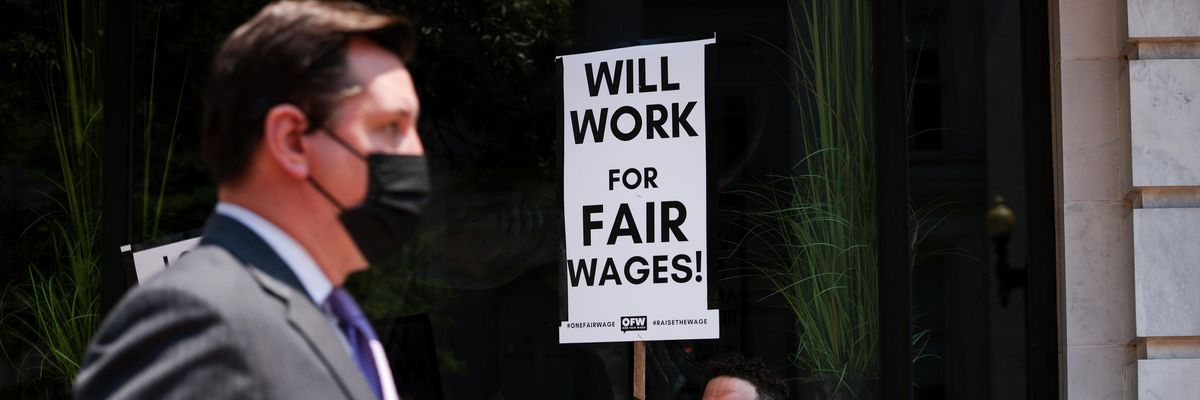
Activists with One Fair Wage participate in a "Wage Strike" demonstration outside of the Old Ebbitt Grill restaurant on May 26th, 2021 in Washington, DC. (Photo: Anna Moneymaker/Getty Images)
The one-year anniversary of the attack on the Capitol has come and gone, and a lot has been said about the need to fight back against existential threats to our democracy. Not enough is being said, however, about what's being fought for and won in workplaces across the country.
Make no mistake, that fight is about democracy too.
"This historic rise in worker power wouldn't be possible if not for programs that gave workers cash, and thus the breathing room needed to finally have a choice."
It's no accident that workers across the country are choosing this moment to demand better. The global pandemic dramatically shifted people's priorities--and who has leverage in a tight labor market. Tens of thousands of Americans across industries have demanded wage increases, more humane schedules, and an end to dangerous work. And they're winning, because employers facing labor shortages are finding it harder to force people to accept poor working conditions and pay.
Understanding how we got here is critical to building upon this progress.
This historic rise in worker power wouldn't be possible if not for programs that gave workers cash, and thus the breathing room needed to finally have a choice. Part of the federal government's pandemic response has been a short-term strengthening of the social safety net. The American Rescue Plan provided $850 billion for stimulus checks, increased unemployment insurance, and an expanded Child Tax Credit that provided a guaranteed income floor for nearly every family with kids under 18.
That government support saved lives, saved jobs, and kept millions of people out of poverty. But it also gave workers options in the wake of a national disaster that had left many re-evaluating their priorities. Having a little cushion empowered millions to demand higher wages, or simply leave for better-paying jobs.
This "Great Resignation" is a welcome course correction after a decades-long trend toward increased corporate power. Since World War II, workers in other countries have used their leverage to force the government to provide a social safety net that included health care, retirement, and sick leave provisions. While American unions were forced to spend the intervening decades bargaining for those same rights, meaning they were intrinsically tied to having a job, unions in other countries were freed up to fight for everything from higher wages to better working conditions.
Americans fell behind because the compromises made here were anchored in achieving labor peace instead of pursuing democracy. And those compromises go back further than the 1940s and 1950s.
The grand project of building a healthy, multiracial democracy in America has been in the works for over 150 years. During Reconstruction, we ratified the 13th Amendment to the Constitution to abolish slavery and all forms of forced labor. We passed the 14th Amendment to guarantee citizenship to those born in the United States, and the 15th Amendment to give the right to vote to Black men. These are all monumental attempts to build a true democracy for America.
Reconstruction was left incomplete, of course, stopped in its tracks by those who wanted to reclaim control for a select few--people who wanted to put Black, Indigenous, and immigrant communities back in our place, if not on a plantation then as exploitable wage laborers.
"Workers across the country are putting their lives and their livelihoods on the line because they are serious about forcing change."
Even the protections eventually won for wage labor often exempted roles traditionally filled by women and people of color, such as farm and domestic workers, and continue to exclude immigrants and people who are incarcerated or disabled. Meanwhile, corporations have established subcategories of work with limited rights, such as the modern-day gig worker, or the misclassified independent contractor.
Democracy isn't just a system of political practices. It must be applied to participation and decision-making in all aspects of our economic lives as well. When wages are stagnating at the same time that big business is accumulating a staggering amount of wealth, it is an indictment of our democracy.
The last year has demonstrated the challenges and opportunities to change this status quo. Hourly wages have increased 5.1 percent over the last year--and that's benefited many of the lowest-paid workers--but rising prices are outpacing those gains, and the pandemic is still surging.
We've learned from the example of pandemic relief that a permanent, federal guaranteed income would provide security to the workers who need it most, and shift the power balance enough to help us win long-overdue structural change.
And we can buttress that by finally compelling corporations to do their part by paying fair wages, recognizing unions, and contributing their fair share in taxes.
Today, workers across the country are putting their lives and their livelihoods on the line because they are serious about forcing change. They're out to prove this isn't an isolated moment or an aberration in our history. Our task is to ensure that we seize this opportunity to unite against white supremacy and corporate control, so we can finally complete the 150-year project of building a thriving multiracial democracy.
Dear Common Dreams reader, It’s been nearly 30 years since I co-founded Common Dreams with my late wife, Lina Newhouser. We had the radical notion that journalism should serve the public good, not corporate profits. It was clear to us from the outset what it would take to build such a project. No paid advertisements. No corporate sponsors. No millionaire publisher telling us what to think or do. Many people said we wouldn't last a year, but we proved those doubters wrong. Together with a tremendous team of journalists and dedicated staff, we built an independent media outlet free from the constraints of profits and corporate control. Our mission has always been simple: To inform. To inspire. To ignite change for the common good. Building Common Dreams was not easy. Our survival was never guaranteed. When you take on the most powerful forces—Wall Street greed, fossil fuel industry destruction, Big Tech lobbyists, and uber-rich oligarchs who have spent billions upon billions rigging the economy and democracy in their favor—the only bulwark you have is supporters who believe in your work. But here’s the urgent message from me today. It's never been this bad out there. And it's never been this hard to keep us going. At the very moment Common Dreams is most needed, the threats we face are intensifying. We need your support now more than ever. We don't accept corporate advertising and never will. We don't have a paywall because we don't think people should be blocked from critical news based on their ability to pay. Everything we do is funded by the donations of readers like you. When everyone does the little they can afford, we are strong. But if that support retreats or dries up, so do we. Will you donate now to make sure Common Dreams not only survives but thrives? —Craig Brown, Co-founder |
The one-year anniversary of the attack on the Capitol has come and gone, and a lot has been said about the need to fight back against existential threats to our democracy. Not enough is being said, however, about what's being fought for and won in workplaces across the country.
Make no mistake, that fight is about democracy too.
"This historic rise in worker power wouldn't be possible if not for programs that gave workers cash, and thus the breathing room needed to finally have a choice."
It's no accident that workers across the country are choosing this moment to demand better. The global pandemic dramatically shifted people's priorities--and who has leverage in a tight labor market. Tens of thousands of Americans across industries have demanded wage increases, more humane schedules, and an end to dangerous work. And they're winning, because employers facing labor shortages are finding it harder to force people to accept poor working conditions and pay.
Understanding how we got here is critical to building upon this progress.
This historic rise in worker power wouldn't be possible if not for programs that gave workers cash, and thus the breathing room needed to finally have a choice. Part of the federal government's pandemic response has been a short-term strengthening of the social safety net. The American Rescue Plan provided $850 billion for stimulus checks, increased unemployment insurance, and an expanded Child Tax Credit that provided a guaranteed income floor for nearly every family with kids under 18.
That government support saved lives, saved jobs, and kept millions of people out of poverty. But it also gave workers options in the wake of a national disaster that had left many re-evaluating their priorities. Having a little cushion empowered millions to demand higher wages, or simply leave for better-paying jobs.
This "Great Resignation" is a welcome course correction after a decades-long trend toward increased corporate power. Since World War II, workers in other countries have used their leverage to force the government to provide a social safety net that included health care, retirement, and sick leave provisions. While American unions were forced to spend the intervening decades bargaining for those same rights, meaning they were intrinsically tied to having a job, unions in other countries were freed up to fight for everything from higher wages to better working conditions.
Americans fell behind because the compromises made here were anchored in achieving labor peace instead of pursuing democracy. And those compromises go back further than the 1940s and 1950s.
The grand project of building a healthy, multiracial democracy in America has been in the works for over 150 years. During Reconstruction, we ratified the 13th Amendment to the Constitution to abolish slavery and all forms of forced labor. We passed the 14th Amendment to guarantee citizenship to those born in the United States, and the 15th Amendment to give the right to vote to Black men. These are all monumental attempts to build a true democracy for America.
Reconstruction was left incomplete, of course, stopped in its tracks by those who wanted to reclaim control for a select few--people who wanted to put Black, Indigenous, and immigrant communities back in our place, if not on a plantation then as exploitable wage laborers.
"Workers across the country are putting their lives and their livelihoods on the line because they are serious about forcing change."
Even the protections eventually won for wage labor often exempted roles traditionally filled by women and people of color, such as farm and domestic workers, and continue to exclude immigrants and people who are incarcerated or disabled. Meanwhile, corporations have established subcategories of work with limited rights, such as the modern-day gig worker, or the misclassified independent contractor.
Democracy isn't just a system of political practices. It must be applied to participation and decision-making in all aspects of our economic lives as well. When wages are stagnating at the same time that big business is accumulating a staggering amount of wealth, it is an indictment of our democracy.
The last year has demonstrated the challenges and opportunities to change this status quo. Hourly wages have increased 5.1 percent over the last year--and that's benefited many of the lowest-paid workers--but rising prices are outpacing those gains, and the pandemic is still surging.
We've learned from the example of pandemic relief that a permanent, federal guaranteed income would provide security to the workers who need it most, and shift the power balance enough to help us win long-overdue structural change.
And we can buttress that by finally compelling corporations to do their part by paying fair wages, recognizing unions, and contributing their fair share in taxes.
Today, workers across the country are putting their lives and their livelihoods on the line because they are serious about forcing change. They're out to prove this isn't an isolated moment or an aberration in our history. Our task is to ensure that we seize this opportunity to unite against white supremacy and corporate control, so we can finally complete the 150-year project of building a thriving multiracial democracy.
The one-year anniversary of the attack on the Capitol has come and gone, and a lot has been said about the need to fight back against existential threats to our democracy. Not enough is being said, however, about what's being fought for and won in workplaces across the country.
Make no mistake, that fight is about democracy too.
"This historic rise in worker power wouldn't be possible if not for programs that gave workers cash, and thus the breathing room needed to finally have a choice."
It's no accident that workers across the country are choosing this moment to demand better. The global pandemic dramatically shifted people's priorities--and who has leverage in a tight labor market. Tens of thousands of Americans across industries have demanded wage increases, more humane schedules, and an end to dangerous work. And they're winning, because employers facing labor shortages are finding it harder to force people to accept poor working conditions and pay.
Understanding how we got here is critical to building upon this progress.
This historic rise in worker power wouldn't be possible if not for programs that gave workers cash, and thus the breathing room needed to finally have a choice. Part of the federal government's pandemic response has been a short-term strengthening of the social safety net. The American Rescue Plan provided $850 billion for stimulus checks, increased unemployment insurance, and an expanded Child Tax Credit that provided a guaranteed income floor for nearly every family with kids under 18.
That government support saved lives, saved jobs, and kept millions of people out of poverty. But it also gave workers options in the wake of a national disaster that had left many re-evaluating their priorities. Having a little cushion empowered millions to demand higher wages, or simply leave for better-paying jobs.
This "Great Resignation" is a welcome course correction after a decades-long trend toward increased corporate power. Since World War II, workers in other countries have used their leverage to force the government to provide a social safety net that included health care, retirement, and sick leave provisions. While American unions were forced to spend the intervening decades bargaining for those same rights, meaning they were intrinsically tied to having a job, unions in other countries were freed up to fight for everything from higher wages to better working conditions.
Americans fell behind because the compromises made here were anchored in achieving labor peace instead of pursuing democracy. And those compromises go back further than the 1940s and 1950s.
The grand project of building a healthy, multiracial democracy in America has been in the works for over 150 years. During Reconstruction, we ratified the 13th Amendment to the Constitution to abolish slavery and all forms of forced labor. We passed the 14th Amendment to guarantee citizenship to those born in the United States, and the 15th Amendment to give the right to vote to Black men. These are all monumental attempts to build a true democracy for America.
Reconstruction was left incomplete, of course, stopped in its tracks by those who wanted to reclaim control for a select few--people who wanted to put Black, Indigenous, and immigrant communities back in our place, if not on a plantation then as exploitable wage laborers.
"Workers across the country are putting their lives and their livelihoods on the line because they are serious about forcing change."
Even the protections eventually won for wage labor often exempted roles traditionally filled by women and people of color, such as farm and domestic workers, and continue to exclude immigrants and people who are incarcerated or disabled. Meanwhile, corporations have established subcategories of work with limited rights, such as the modern-day gig worker, or the misclassified independent contractor.
Democracy isn't just a system of political practices. It must be applied to participation and decision-making in all aspects of our economic lives as well. When wages are stagnating at the same time that big business is accumulating a staggering amount of wealth, it is an indictment of our democracy.
The last year has demonstrated the challenges and opportunities to change this status quo. Hourly wages have increased 5.1 percent over the last year--and that's benefited many of the lowest-paid workers--but rising prices are outpacing those gains, and the pandemic is still surging.
We've learned from the example of pandemic relief that a permanent, federal guaranteed income would provide security to the workers who need it most, and shift the power balance enough to help us win long-overdue structural change.
And we can buttress that by finally compelling corporations to do their part by paying fair wages, recognizing unions, and contributing their fair share in taxes.
Today, workers across the country are putting their lives and their livelihoods on the line because they are serious about forcing change. They're out to prove this isn't an isolated moment or an aberration in our history. Our task is to ensure that we seize this opportunity to unite against white supremacy and corporate control, so we can finally complete the 150-year project of building a thriving multiracial democracy.