SUBSCRIBE TO OUR FREE NEWSLETTER
Daily news & progressive opinion—funded by the people, not the corporations—delivered straight to your inbox.
5
#000000
#FFFFFF
To donate by check, phone, or other method, see our More Ways to Give page.
Daily news & progressive opinion—funded by the people, not the corporations—delivered straight to your inbox.
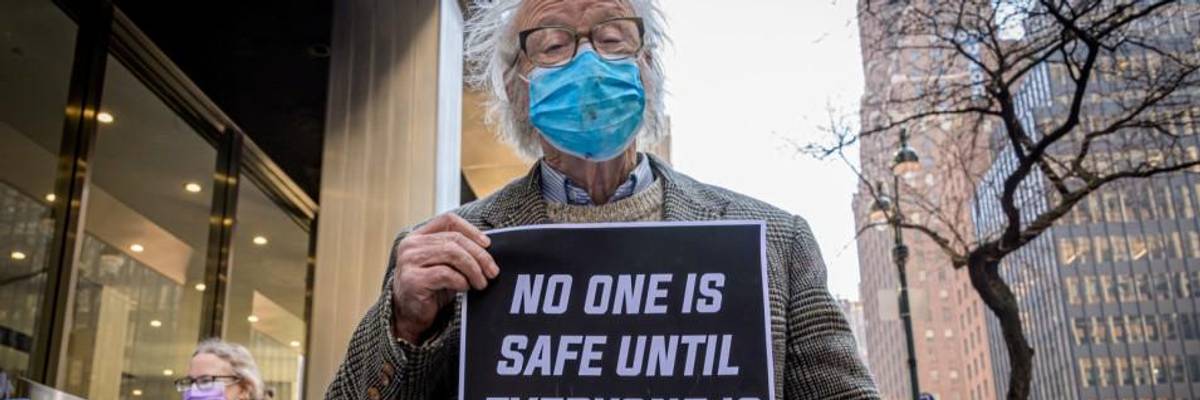
A coalition of health justice advocates gathered outside Pfizer's headquarters in Manhattan on March 11, 2021. (Photo: Erik McGregor/LightRocket via Getty Images)
India is now ground zero for COVID-19.
On Saturday, it suffered a record of more than 335,000 new infections and more than 4,000 deaths in one day. Hospitals are running out of oxygen and beds. Morgues and crematoria are overwhelmed.
In total, a staggering 22.6 million people in India have been infected, with 246,116 deaths.
With 1.3 billion people, India is the second most populous country in the world. From across the country and across the world, there are increasing demands that Prime Minister Narendra Modi order a lockdown of the country to help staunch the spread of the virus.
If we are to address common global threats such as contagions or climate change or nuclear war, we must develop a global perspective.
This may be imperative, but one can understand the reluctance to do it. When Modi enforced a 21-day lockdown last year, it helped squelch the spread of the disease but caused a 24% economic contraction in the first quarter of 2020 and widespread desperation among India's large numbers of migrant workers.
More recently, at the same time Modi put off another lockdown, he displayed Trumpian irresponsibility by holding a mass political rally with thousands of largely maskless people crowded together and refusing to halt the huge Hindu pilgrimage of millions to bathe in the Ganges River. To some extent, as The Lancet, a medical journal, noted, this is a "self-inflicted catastrophe."
With India in distress and much of the world desperate for access to vaccine supplies, supplier nations have been slow to respond. China is by far the largest supplier of vaccines, having shipped more than 240 million doses to countries across the world, more than the rest of the world combined. China promises to ship 500 million more.
China, fierce rival of India, immediately stepped in to promise to supply countries that India was forced to cut off to fight its own outbreak. China's vaccine is not as effective as those developed by Pfizer and Moderna, but it surely is better than nothing.
Last week, the Biden administration finally challenged the U.S. drug industry, announcing that the White House would support an international waiver of intellectual property protections on COVID-19 vaccines during the pandemic. This is a long overdue measure, but if the industry continues to resist, the negotiations are likely to take months that the world can ill afford. Though the companies benefited greatly from government subsidies and guaranteed purchases--and have seen their profits and stocks soar--they have a large stake in controlling production to ensure continued profits over time.
The Biden administration decision--if aggressively enforced--will put public health over private profit.
As the pandemic rages in India and Brazil, it poses a continued threat to the world. If it isn't brought under control everywhere, new variants will develop and most likely spread, even to countries that have succeeded in inoculating their populations. The pandemic is truly a global threat that requires a global mobilization.
At the national level, global cooperation has been slow to develop. Instead, the surge to supply countries in need is propelled less from a unified global effort and more from a competitive national "vaccine diplomacy," with India, China, Russia and now the U.S. vying to win hearts and minds through vaccine supplies.
Fighting the pandemic isn't just the responsibility of governments. This is a global, human tragedy. The pandemic spreads through the air, so no people are safe unless all are safe. We need at outpouring of citizen action -- telethons by stars and musicians, increased donations from foundations, mobilization of volunteers, ramping up of production of supplies -- to ensure that vaccines are available and citizens are mobilized to receive them. We need increased global efforts to get the vaccine into rural areas and into the poorest ghettos and barrios of the poorest nations.
Joe Biden announced that he would rely on science for advice, but we can't rely on science or on government alone. Popular mobilization is essential.
If we are to address common global threats such as contagions or climate change or nuclear war, we must develop a global perspective. Now it becomes ever more apparent that, as Dr. Martin Luther King taught long ago, "all life is interrelated. We are caught in an inescapable network of mutuality; tied in a single garment of destiny. Whatever affects one directly, affects all indirectly. ... As long as diseases are rampant ... no man can be totally healthy, even if he just got a clean bill of health from the finest clinic in America."
In the global struggle to meet the threat of Covid-19, this basic truth is more important than ever.
Dear Common Dreams reader, It’s been nearly 30 years since I co-founded Common Dreams with my late wife, Lina Newhouser. We had the radical notion that journalism should serve the public good, not corporate profits. It was clear to us from the outset what it would take to build such a project. No paid advertisements. No corporate sponsors. No millionaire publisher telling us what to think or do. Many people said we wouldn't last a year, but we proved those doubters wrong. Together with a tremendous team of journalists and dedicated staff, we built an independent media outlet free from the constraints of profits and corporate control. Our mission has always been simple: To inform. To inspire. To ignite change for the common good. Building Common Dreams was not easy. Our survival was never guaranteed. When you take on the most powerful forces—Wall Street greed, fossil fuel industry destruction, Big Tech lobbyists, and uber-rich oligarchs who have spent billions upon billions rigging the economy and democracy in their favor—the only bulwark you have is supporters who believe in your work. But here’s the urgent message from me today. It's never been this bad out there. And it's never been this hard to keep us going. At the very moment Common Dreams is most needed, the threats we face are intensifying. We need your support now more than ever. We don't accept corporate advertising and never will. We don't have a paywall because we don't think people should be blocked from critical news based on their ability to pay. Everything we do is funded by the donations of readers like you. When everyone does the little they can afford, we are strong. But if that support retreats or dries up, so do we. Will you donate now to make sure Common Dreams not only survives but thrives? —Craig Brown, Co-founder |
India is now ground zero for COVID-19.
On Saturday, it suffered a record of more than 335,000 new infections and more than 4,000 deaths in one day. Hospitals are running out of oxygen and beds. Morgues and crematoria are overwhelmed.
In total, a staggering 22.6 million people in India have been infected, with 246,116 deaths.
With 1.3 billion people, India is the second most populous country in the world. From across the country and across the world, there are increasing demands that Prime Minister Narendra Modi order a lockdown of the country to help staunch the spread of the virus.
If we are to address common global threats such as contagions or climate change or nuclear war, we must develop a global perspective.
This may be imperative, but one can understand the reluctance to do it. When Modi enforced a 21-day lockdown last year, it helped squelch the spread of the disease but caused a 24% economic contraction in the first quarter of 2020 and widespread desperation among India's large numbers of migrant workers.
More recently, at the same time Modi put off another lockdown, he displayed Trumpian irresponsibility by holding a mass political rally with thousands of largely maskless people crowded together and refusing to halt the huge Hindu pilgrimage of millions to bathe in the Ganges River. To some extent, as The Lancet, a medical journal, noted, this is a "self-inflicted catastrophe."
With India in distress and much of the world desperate for access to vaccine supplies, supplier nations have been slow to respond. China is by far the largest supplier of vaccines, having shipped more than 240 million doses to countries across the world, more than the rest of the world combined. China promises to ship 500 million more.
China, fierce rival of India, immediately stepped in to promise to supply countries that India was forced to cut off to fight its own outbreak. China's vaccine is not as effective as those developed by Pfizer and Moderna, but it surely is better than nothing.
Last week, the Biden administration finally challenged the U.S. drug industry, announcing that the White House would support an international waiver of intellectual property protections on COVID-19 vaccines during the pandemic. This is a long overdue measure, but if the industry continues to resist, the negotiations are likely to take months that the world can ill afford. Though the companies benefited greatly from government subsidies and guaranteed purchases--and have seen their profits and stocks soar--they have a large stake in controlling production to ensure continued profits over time.
The Biden administration decision--if aggressively enforced--will put public health over private profit.
As the pandemic rages in India and Brazil, it poses a continued threat to the world. If it isn't brought under control everywhere, new variants will develop and most likely spread, even to countries that have succeeded in inoculating their populations. The pandemic is truly a global threat that requires a global mobilization.
At the national level, global cooperation has been slow to develop. Instead, the surge to supply countries in need is propelled less from a unified global effort and more from a competitive national "vaccine diplomacy," with India, China, Russia and now the U.S. vying to win hearts and minds through vaccine supplies.
Fighting the pandemic isn't just the responsibility of governments. This is a global, human tragedy. The pandemic spreads through the air, so no people are safe unless all are safe. We need at outpouring of citizen action -- telethons by stars and musicians, increased donations from foundations, mobilization of volunteers, ramping up of production of supplies -- to ensure that vaccines are available and citizens are mobilized to receive them. We need increased global efforts to get the vaccine into rural areas and into the poorest ghettos and barrios of the poorest nations.
Joe Biden announced that he would rely on science for advice, but we can't rely on science or on government alone. Popular mobilization is essential.
If we are to address common global threats such as contagions or climate change or nuclear war, we must develop a global perspective. Now it becomes ever more apparent that, as Dr. Martin Luther King taught long ago, "all life is interrelated. We are caught in an inescapable network of mutuality; tied in a single garment of destiny. Whatever affects one directly, affects all indirectly. ... As long as diseases are rampant ... no man can be totally healthy, even if he just got a clean bill of health from the finest clinic in America."
In the global struggle to meet the threat of Covid-19, this basic truth is more important than ever.
India is now ground zero for COVID-19.
On Saturday, it suffered a record of more than 335,000 new infections and more than 4,000 deaths in one day. Hospitals are running out of oxygen and beds. Morgues and crematoria are overwhelmed.
In total, a staggering 22.6 million people in India have been infected, with 246,116 deaths.
With 1.3 billion people, India is the second most populous country in the world. From across the country and across the world, there are increasing demands that Prime Minister Narendra Modi order a lockdown of the country to help staunch the spread of the virus.
If we are to address common global threats such as contagions or climate change or nuclear war, we must develop a global perspective.
This may be imperative, but one can understand the reluctance to do it. When Modi enforced a 21-day lockdown last year, it helped squelch the spread of the disease but caused a 24% economic contraction in the first quarter of 2020 and widespread desperation among India's large numbers of migrant workers.
More recently, at the same time Modi put off another lockdown, he displayed Trumpian irresponsibility by holding a mass political rally with thousands of largely maskless people crowded together and refusing to halt the huge Hindu pilgrimage of millions to bathe in the Ganges River. To some extent, as The Lancet, a medical journal, noted, this is a "self-inflicted catastrophe."
With India in distress and much of the world desperate for access to vaccine supplies, supplier nations have been slow to respond. China is by far the largest supplier of vaccines, having shipped more than 240 million doses to countries across the world, more than the rest of the world combined. China promises to ship 500 million more.
China, fierce rival of India, immediately stepped in to promise to supply countries that India was forced to cut off to fight its own outbreak. China's vaccine is not as effective as those developed by Pfizer and Moderna, but it surely is better than nothing.
Last week, the Biden administration finally challenged the U.S. drug industry, announcing that the White House would support an international waiver of intellectual property protections on COVID-19 vaccines during the pandemic. This is a long overdue measure, but if the industry continues to resist, the negotiations are likely to take months that the world can ill afford. Though the companies benefited greatly from government subsidies and guaranteed purchases--and have seen their profits and stocks soar--they have a large stake in controlling production to ensure continued profits over time.
The Biden administration decision--if aggressively enforced--will put public health over private profit.
As the pandemic rages in India and Brazil, it poses a continued threat to the world. If it isn't brought under control everywhere, new variants will develop and most likely spread, even to countries that have succeeded in inoculating their populations. The pandemic is truly a global threat that requires a global mobilization.
At the national level, global cooperation has been slow to develop. Instead, the surge to supply countries in need is propelled less from a unified global effort and more from a competitive national "vaccine diplomacy," with India, China, Russia and now the U.S. vying to win hearts and minds through vaccine supplies.
Fighting the pandemic isn't just the responsibility of governments. This is a global, human tragedy. The pandemic spreads through the air, so no people are safe unless all are safe. We need at outpouring of citizen action -- telethons by stars and musicians, increased donations from foundations, mobilization of volunteers, ramping up of production of supplies -- to ensure that vaccines are available and citizens are mobilized to receive them. We need increased global efforts to get the vaccine into rural areas and into the poorest ghettos and barrios of the poorest nations.
Joe Biden announced that he would rely on science for advice, but we can't rely on science or on government alone. Popular mobilization is essential.
If we are to address common global threats such as contagions or climate change or nuclear war, we must develop a global perspective. Now it becomes ever more apparent that, as Dr. Martin Luther King taught long ago, "all life is interrelated. We are caught in an inescapable network of mutuality; tied in a single garment of destiny. Whatever affects one directly, affects all indirectly. ... As long as diseases are rampant ... no man can be totally healthy, even if he just got a clean bill of health from the finest clinic in America."
In the global struggle to meet the threat of Covid-19, this basic truth is more important than ever.