SUBSCRIBE TO OUR FREE NEWSLETTER
Daily news & progressive opinion—funded by the people, not the corporations—delivered straight to your inbox.
5
#000000
#FFFFFF
To donate by check, phone, or other method, see our More Ways to Give page.
Daily news & progressive opinion—funded by the people, not the corporations—delivered straight to your inbox.
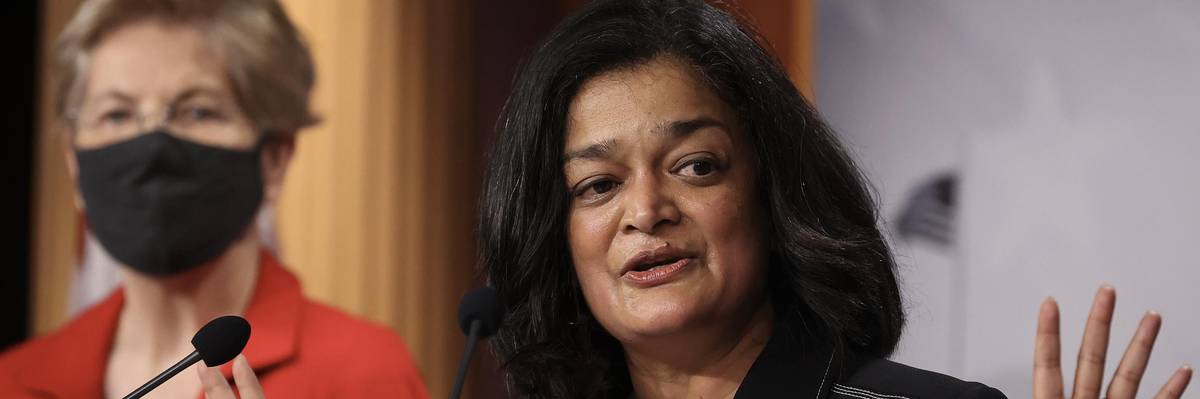
Rep. Pramila Jayapal (D-Wash.) speaks during a news conference with Sen. Elizabeth Warren (D-Mass.) to announce legislation that would tax the net worth of America's wealthiest individuals at the U.S. Capitol on March 01, 2021 in Washington, DC. (Photo:Chip Somodevilla/Getty Images)
It's the job of progressive advocates and activists to tell inconvenient truths, without sugarcoating or cheerleading. To effectively confront the enormous problems facing our country and world, progressives need to soberly assess everything--good, bad and mixed.
Yet last week, the chair of the Congressional Progressive Caucus, Pramila Jayapal, made headlines when she graded President Biden's job performance. "I give him an 'A' so far," Jayapal said in an otherwise well-grounded interview with the Washington Post. She conferred the top grade on Biden even though, as she noted, "that doesn't mean that I agree with him on every single thing."
"In school, an "A" grade commonly means "excellent performance" or "outstanding achievement." Rendering such a verdict on Biden's presidency so far promotes a huge misconception and lowers the progressive bar."
Overall, the policies of the Biden administration have not come close to being consistently outstanding. Awarding an "A" to Biden is flatly unwarranted.
It's also strategically wrongheaded. If we're going to get maximum reforms in this crucial period, President Biden needs focused pressure--not the highest rating--from progressives.
In school, an "A" grade commonly means "excellent performance" or "outstanding achievement." Rendering such a verdict on Biden's presidency so far promotes a huge misconception and lowers the progressive bar.
Biden does deserve credit for some strong high-level appointments (Deb Haaland as Interior Secretary jumps to mind), a number of important executive orders (many simply undoing four years of horrific Trumpism), and one crucial legislative achievement--the American Rescue Act. The proposed American Jobs Act (a small step toward a Green New Deal) and American Families Act (education/anti-poverty) are also quite progressive.
But Biden has made several major appointments that overtly kowtowed to corporate America--for example, "Mr. Monsanto" Tom Vilsack as Secretary of Agriculture and former venture capitalist Gina Raimondo as Commerce Secretary. To mark Biden's first 100 days, the Revolving Door Project issued an overall grade of B- in its report card on how Biden had done in preventing "corporate capture" of the executive branch by industries such as fossil fuels, Big Pharma and Big Tech.
In an improvement over the Obama era, the Biden administration earned a B/B+ in keeping Wall Streeters from dominating its economic and financial teams. On the other hand, as graded by the Revolving Door Project, Biden got a D- on limiting the power of the military-industrial complex over U.S. foreign policy: "We are particularly alarmed by Biden's hiring of several alumni of the Center for a New American Security, a hawkish think tank funded by weapons manufacturers like Lockheed Martin and Northrop Grumman."
Much as "personnel is policy" in the executive branch, the federal budget indicates actual priorities. Biden's budget reflects his continuing embrace of the military-industrial complex, a tight grip that squeezes many billions needed for vital social, economic and environmental programs. The administration recently disclosed its plan to increase the basic military budget to $753 billion, a $13 billion boost above the last bloated Trump budget. (All told, the annual total of U.S. military-related spending has been way above $1 trillion for years.) And Biden continues to ramp up spending for nuclear weapons, including ICBMs--which former Defense Secretary William Perry aptly says are "some of the most dangerous weapons in the world."
Meanwhile, Biden is heightening the dangers of an unimaginably catastrophic war with Russia or China. In sharp contrast to his assertion on Feb. 4 that "diplomacy is back at the center of our foreign policy," Biden proceeded to undermine diplomacy with reckless rhetoric toward Russia and a confrontational approach to China. The effects have included blocking diplomatic channels and signaling military brinkmanship.
Biden won praise when he announced plans for a not-quite-total U.S. troop withdrawal from Afghanistan, but he has not committed to ending the U.S. air war there--and some forms of on-the-ground military involvement are open-ended.
Unfortunately, little attention has gone to the alarming realities of Biden's foreign policy and inflated budget for militarism. Domestic matters are in the spotlight, where--contrary to overblown praise--the overall picture is very mixed.
While Biden has issued some executive orders improving social and regulatory policies, he has refused to issue many much-needed executive orders. Give him an "I" for incomplete, including on the issue of $1.7 trillion in student loan debt that undermines the economy and burdens 45 million debtors, especially people of color. Biden has not budged, even after non-progressive Democrats like Senate Majority Leader Chuck Schumer have pressed him to use his executive authority under existing legislation to excuse up to $50,000 in college debt per person.
On the subject of healthcare reform, Biden has long been held back by his allegiance to corporate power--as Rep. Jayapal knows well, since she has tenaciously led the Medicare for All battle in the House. Biden has never disavowed his appalling comment in March 2020 that he might veto Medicare for All if it somehow passed both houses of Congress. During the traumatic 14 months of the pandemic since then, while millions have lost coverage because insurance is tied to employment, Biden's stance hardly improved. Candidate Biden had promised to lower the age of Medicare eligibility from 65 to 60, but even that meager promise has disappeared.
With wealth and income having gushed to the top in recent decades, and especially during COVID, Biden is proposing some tax increases on corporations and the very wealthy--quite popular with voters--to pay for infrastructure and social programs. For example, Biden proposes returning the top marginal tax bracket on the richest individuals from 37 percent to merely 39.6 percent, where it was in 2017 before Trump lowered it. Presidential candidate Bernie Sanders campaigned on raising the top tax bracket to 52 percent, while AOC called for raising it to 70 percent, a popular approach according to polls. To put this all in perspective: When the U.S. economy and middle class boomed during the 1950s, the top tax bracket was over 90 percent under Republican President Eisenhower.
We have no quarrel with those who seek to inspire optimism among progressives by pointing out that their activism has already achieved some great things. But activism should be grounded in candor and realism about where we are now--and how far we still need to go.
Dear Common Dreams reader, It’s been nearly 30 years since I co-founded Common Dreams with my late wife, Lina Newhouser. We had the radical notion that journalism should serve the public good, not corporate profits. It was clear to us from the outset what it would take to build such a project. No paid advertisements. No corporate sponsors. No millionaire publisher telling us what to think or do. Many people said we wouldn't last a year, but we proved those doubters wrong. Together with a tremendous team of journalists and dedicated staff, we built an independent media outlet free from the constraints of profits and corporate control. Our mission has always been simple: To inform. To inspire. To ignite change for the common good. Building Common Dreams was not easy. Our survival was never guaranteed. When you take on the most powerful forces—Wall Street greed, fossil fuel industry destruction, Big Tech lobbyists, and uber-rich oligarchs who have spent billions upon billions rigging the economy and democracy in their favor—the only bulwark you have is supporters who believe in your work. But here’s the urgent message from me today. It's never been this bad out there. And it's never been this hard to keep us going. At the very moment Common Dreams is most needed, the threats we face are intensifying. We need your support now more than ever. We don't accept corporate advertising and never will. We don't have a paywall because we don't think people should be blocked from critical news based on their ability to pay. Everything we do is funded by the donations of readers like you. When everyone does the little they can afford, we are strong. But if that support retreats or dries up, so do we. Will you donate now to make sure Common Dreams not only survives but thrives? —Craig Brown, Co-founder |
Norman Solomon is the national director of RootsAction.org and executive director of the Institute for Public Accuracy. The paperback edition of his latest book, War Made Invisible: How America Hides the Human Toll of Its Military Machine, includes an afterword about the Gaza war.
It's the job of progressive advocates and activists to tell inconvenient truths, without sugarcoating or cheerleading. To effectively confront the enormous problems facing our country and world, progressives need to soberly assess everything--good, bad and mixed.
Yet last week, the chair of the Congressional Progressive Caucus, Pramila Jayapal, made headlines when she graded President Biden's job performance. "I give him an 'A' so far," Jayapal said in an otherwise well-grounded interview with the Washington Post. She conferred the top grade on Biden even though, as she noted, "that doesn't mean that I agree with him on every single thing."
"In school, an "A" grade commonly means "excellent performance" or "outstanding achievement." Rendering such a verdict on Biden's presidency so far promotes a huge misconception and lowers the progressive bar."
Overall, the policies of the Biden administration have not come close to being consistently outstanding. Awarding an "A" to Biden is flatly unwarranted.
It's also strategically wrongheaded. If we're going to get maximum reforms in this crucial period, President Biden needs focused pressure--not the highest rating--from progressives.
In school, an "A" grade commonly means "excellent performance" or "outstanding achievement." Rendering such a verdict on Biden's presidency so far promotes a huge misconception and lowers the progressive bar.
Biden does deserve credit for some strong high-level appointments (Deb Haaland as Interior Secretary jumps to mind), a number of important executive orders (many simply undoing four years of horrific Trumpism), and one crucial legislative achievement--the American Rescue Act. The proposed American Jobs Act (a small step toward a Green New Deal) and American Families Act (education/anti-poverty) are also quite progressive.
But Biden has made several major appointments that overtly kowtowed to corporate America--for example, "Mr. Monsanto" Tom Vilsack as Secretary of Agriculture and former venture capitalist Gina Raimondo as Commerce Secretary. To mark Biden's first 100 days, the Revolving Door Project issued an overall grade of B- in its report card on how Biden had done in preventing "corporate capture" of the executive branch by industries such as fossil fuels, Big Pharma and Big Tech.
In an improvement over the Obama era, the Biden administration earned a B/B+ in keeping Wall Streeters from dominating its economic and financial teams. On the other hand, as graded by the Revolving Door Project, Biden got a D- on limiting the power of the military-industrial complex over U.S. foreign policy: "We are particularly alarmed by Biden's hiring of several alumni of the Center for a New American Security, a hawkish think tank funded by weapons manufacturers like Lockheed Martin and Northrop Grumman."
Much as "personnel is policy" in the executive branch, the federal budget indicates actual priorities. Biden's budget reflects his continuing embrace of the military-industrial complex, a tight grip that squeezes many billions needed for vital social, economic and environmental programs. The administration recently disclosed its plan to increase the basic military budget to $753 billion, a $13 billion boost above the last bloated Trump budget. (All told, the annual total of U.S. military-related spending has been way above $1 trillion for years.) And Biden continues to ramp up spending for nuclear weapons, including ICBMs--which former Defense Secretary William Perry aptly says are "some of the most dangerous weapons in the world."
Meanwhile, Biden is heightening the dangers of an unimaginably catastrophic war with Russia or China. In sharp contrast to his assertion on Feb. 4 that "diplomacy is back at the center of our foreign policy," Biden proceeded to undermine diplomacy with reckless rhetoric toward Russia and a confrontational approach to China. The effects have included blocking diplomatic channels and signaling military brinkmanship.
Biden won praise when he announced plans for a not-quite-total U.S. troop withdrawal from Afghanistan, but he has not committed to ending the U.S. air war there--and some forms of on-the-ground military involvement are open-ended.
Unfortunately, little attention has gone to the alarming realities of Biden's foreign policy and inflated budget for militarism. Domestic matters are in the spotlight, where--contrary to overblown praise--the overall picture is very mixed.
While Biden has issued some executive orders improving social and regulatory policies, he has refused to issue many much-needed executive orders. Give him an "I" for incomplete, including on the issue of $1.7 trillion in student loan debt that undermines the economy and burdens 45 million debtors, especially people of color. Biden has not budged, even after non-progressive Democrats like Senate Majority Leader Chuck Schumer have pressed him to use his executive authority under existing legislation to excuse up to $50,000 in college debt per person.
On the subject of healthcare reform, Biden has long been held back by his allegiance to corporate power--as Rep. Jayapal knows well, since she has tenaciously led the Medicare for All battle in the House. Biden has never disavowed his appalling comment in March 2020 that he might veto Medicare for All if it somehow passed both houses of Congress. During the traumatic 14 months of the pandemic since then, while millions have lost coverage because insurance is tied to employment, Biden's stance hardly improved. Candidate Biden had promised to lower the age of Medicare eligibility from 65 to 60, but even that meager promise has disappeared.
With wealth and income having gushed to the top in recent decades, and especially during COVID, Biden is proposing some tax increases on corporations and the very wealthy--quite popular with voters--to pay for infrastructure and social programs. For example, Biden proposes returning the top marginal tax bracket on the richest individuals from 37 percent to merely 39.6 percent, where it was in 2017 before Trump lowered it. Presidential candidate Bernie Sanders campaigned on raising the top tax bracket to 52 percent, while AOC called for raising it to 70 percent, a popular approach according to polls. To put this all in perspective: When the U.S. economy and middle class boomed during the 1950s, the top tax bracket was over 90 percent under Republican President Eisenhower.
We have no quarrel with those who seek to inspire optimism among progressives by pointing out that their activism has already achieved some great things. But activism should be grounded in candor and realism about where we are now--and how far we still need to go.
Norman Solomon is the national director of RootsAction.org and executive director of the Institute for Public Accuracy. The paperback edition of his latest book, War Made Invisible: How America Hides the Human Toll of Its Military Machine, includes an afterword about the Gaza war.
It's the job of progressive advocates and activists to tell inconvenient truths, without sugarcoating or cheerleading. To effectively confront the enormous problems facing our country and world, progressives need to soberly assess everything--good, bad and mixed.
Yet last week, the chair of the Congressional Progressive Caucus, Pramila Jayapal, made headlines when she graded President Biden's job performance. "I give him an 'A' so far," Jayapal said in an otherwise well-grounded interview with the Washington Post. She conferred the top grade on Biden even though, as she noted, "that doesn't mean that I agree with him on every single thing."
"In school, an "A" grade commonly means "excellent performance" or "outstanding achievement." Rendering such a verdict on Biden's presidency so far promotes a huge misconception and lowers the progressive bar."
Overall, the policies of the Biden administration have not come close to being consistently outstanding. Awarding an "A" to Biden is flatly unwarranted.
It's also strategically wrongheaded. If we're going to get maximum reforms in this crucial period, President Biden needs focused pressure--not the highest rating--from progressives.
In school, an "A" grade commonly means "excellent performance" or "outstanding achievement." Rendering such a verdict on Biden's presidency so far promotes a huge misconception and lowers the progressive bar.
Biden does deserve credit for some strong high-level appointments (Deb Haaland as Interior Secretary jumps to mind), a number of important executive orders (many simply undoing four years of horrific Trumpism), and one crucial legislative achievement--the American Rescue Act. The proposed American Jobs Act (a small step toward a Green New Deal) and American Families Act (education/anti-poverty) are also quite progressive.
But Biden has made several major appointments that overtly kowtowed to corporate America--for example, "Mr. Monsanto" Tom Vilsack as Secretary of Agriculture and former venture capitalist Gina Raimondo as Commerce Secretary. To mark Biden's first 100 days, the Revolving Door Project issued an overall grade of B- in its report card on how Biden had done in preventing "corporate capture" of the executive branch by industries such as fossil fuels, Big Pharma and Big Tech.
In an improvement over the Obama era, the Biden administration earned a B/B+ in keeping Wall Streeters from dominating its economic and financial teams. On the other hand, as graded by the Revolving Door Project, Biden got a D- on limiting the power of the military-industrial complex over U.S. foreign policy: "We are particularly alarmed by Biden's hiring of several alumni of the Center for a New American Security, a hawkish think tank funded by weapons manufacturers like Lockheed Martin and Northrop Grumman."
Much as "personnel is policy" in the executive branch, the federal budget indicates actual priorities. Biden's budget reflects his continuing embrace of the military-industrial complex, a tight grip that squeezes many billions needed for vital social, economic and environmental programs. The administration recently disclosed its plan to increase the basic military budget to $753 billion, a $13 billion boost above the last bloated Trump budget. (All told, the annual total of U.S. military-related spending has been way above $1 trillion for years.) And Biden continues to ramp up spending for nuclear weapons, including ICBMs--which former Defense Secretary William Perry aptly says are "some of the most dangerous weapons in the world."
Meanwhile, Biden is heightening the dangers of an unimaginably catastrophic war with Russia or China. In sharp contrast to his assertion on Feb. 4 that "diplomacy is back at the center of our foreign policy," Biden proceeded to undermine diplomacy with reckless rhetoric toward Russia and a confrontational approach to China. The effects have included blocking diplomatic channels and signaling military brinkmanship.
Biden won praise when he announced plans for a not-quite-total U.S. troop withdrawal from Afghanistan, but he has not committed to ending the U.S. air war there--and some forms of on-the-ground military involvement are open-ended.
Unfortunately, little attention has gone to the alarming realities of Biden's foreign policy and inflated budget for militarism. Domestic matters are in the spotlight, where--contrary to overblown praise--the overall picture is very mixed.
While Biden has issued some executive orders improving social and regulatory policies, he has refused to issue many much-needed executive orders. Give him an "I" for incomplete, including on the issue of $1.7 trillion in student loan debt that undermines the economy and burdens 45 million debtors, especially people of color. Biden has not budged, even after non-progressive Democrats like Senate Majority Leader Chuck Schumer have pressed him to use his executive authority under existing legislation to excuse up to $50,000 in college debt per person.
On the subject of healthcare reform, Biden has long been held back by his allegiance to corporate power--as Rep. Jayapal knows well, since she has tenaciously led the Medicare for All battle in the House. Biden has never disavowed his appalling comment in March 2020 that he might veto Medicare for All if it somehow passed both houses of Congress. During the traumatic 14 months of the pandemic since then, while millions have lost coverage because insurance is tied to employment, Biden's stance hardly improved. Candidate Biden had promised to lower the age of Medicare eligibility from 65 to 60, but even that meager promise has disappeared.
With wealth and income having gushed to the top in recent decades, and especially during COVID, Biden is proposing some tax increases on corporations and the very wealthy--quite popular with voters--to pay for infrastructure and social programs. For example, Biden proposes returning the top marginal tax bracket on the richest individuals from 37 percent to merely 39.6 percent, where it was in 2017 before Trump lowered it. Presidential candidate Bernie Sanders campaigned on raising the top tax bracket to 52 percent, while AOC called for raising it to 70 percent, a popular approach according to polls. To put this all in perspective: When the U.S. economy and middle class boomed during the 1950s, the top tax bracket was over 90 percent under Republican President Eisenhower.
We have no quarrel with those who seek to inspire optimism among progressives by pointing out that their activism has already achieved some great things. But activism should be grounded in candor and realism about where we are now--and how far we still need to go.